


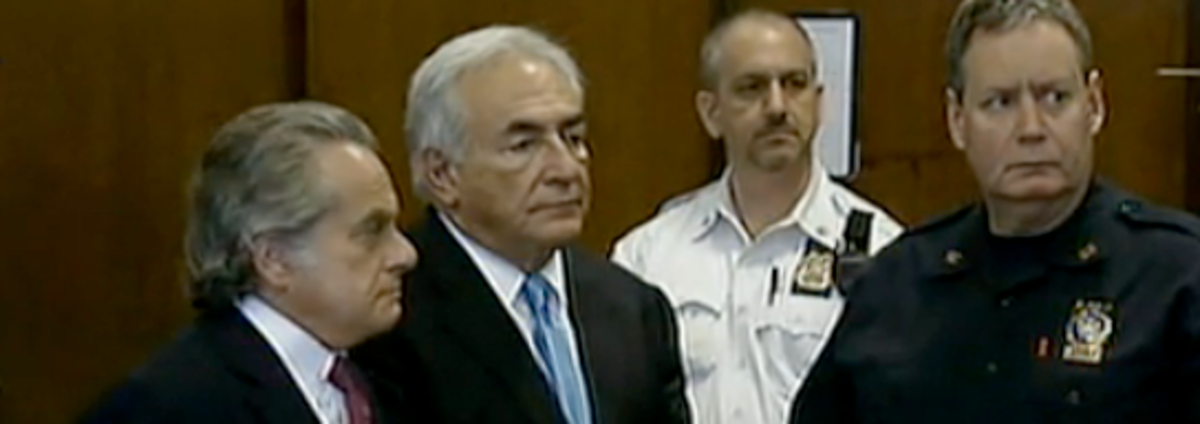
Former IMF chief Dominique Strauss-Kahn, arrested in New York on May 14th for the attempted rape and sexual assault of a Manhattan hotel chambermaid, was granted release from house arrest and freed of his electronic tag Friday after New York prosecutors admitted doubts over the credibility of his alleged victim.
In a hurriedly convened hearing at Manhattan State Supreme Court, Strauss-Kahn was also given back his six million-dollar cash bail and bond. The seven charges leveled against Strauss-Kahn remain, and there was no move to downgrade them. Importantly, DNA evidence has established that he had a sexual encounter with the chambermaid. His passport stays confiscated, although he is free to move as he pleases within the US. His next due in court on July 18th.
However, prosecutors with Manhattan district attorney, Cyrus R. Vance Jr. have disclosed that the 32 year-old chambermaid, Nafissatou Diallo, has lied over certain details of the alleged attack and her background, as well making false tax refund claims and has been linked to people involved in drug dealing and money laundering. They disclosed the information to Strauss-Kahn's legal defence team on Thursday in a letter that was also sent to Justice Michael Obus who presided the court hearing on Friday.
Prosecutors said that the maid had not revealed, after leaving Strauss-Kahn's 28th-floor suite at the Sofitel hotel, that she cleaned another room before returning to Strauss-Kahn's suite again to clean that too, and only then alerted a supervisor to the alleged sexual assault. She had initially claimed that she hid in an outside hallway until Strauss-Kahn left the room and entered an elevator. She had testified to that first version before a Grand Jury.
"I understand that the circumstances of this case have changed substantially and I agree the risk that he would not be here has receded quite a bit," Obus told the court. "I release Mr Strauss-Kahn at his own recognisance," he added, meaning that his promise to return to court later in July was sufficient. "In the meantime there will be no rush to judgment on this case," Obus said.
A report published late Thursday by The New York Times, which first revealed the developments, summarised law enforcement officials as saying "the accuser has repeatedly lied" since the alleged events May 14th.
"According to the two officials, the woman had a phone conversation with an incarcerated man within a day of her encounter with Mr. Strauss-Kahn in which she discussed the possible benefits of pursuing the charges against him", the paper reported. "The conversation was recorded." The prisoner, the report said, was arrested in possession of 400 pounds of marijuana.
The officials also told the Times that over the past two years he and several other individuals had made cash deposits "totaling around $100,000" into Diallo's bank account.
According to the prosecutors' letter (see below), addressed to Strauss-Kahn's lawyers and Obus, during her 2004 asylum application Diallo, who arrived in the US from Guinea, West Africa, admitted giving a false statement about suffering victimisation in her native country. During the Strauss-Kahn investigation, she also twice falsely claimed to have been the victim of a gang rape in Guinea. "During both of these interviews, the victim cried and appeared to be markedly distraught when recounting the incident," they wrote. "In subsequent interviews she admitted that the gang rape had never occurred."
They also found that Diallo had falsified her declared earnings in documents concerning her home rental and had falsely declared an extra child to benefit from tax refunds two years running.
"Finally, during the course of this investigation, the complainant was untruthful with assistant district attorneys about a variety of additional topics concerning her history, background, present circumstances and personal relationships," ended the letter, signed by Assistant District Attorneys Joan Illuzzi-Orbon and John McConnell.
A copy of the letter from Assistant District Attorneys Illuzzi-Orbon and McConnell:
'She's still a rape victim'
After Friday's hearing, lawyers for both parties separately addressed reporters outside the court building. "I want to remind all of you that at each appearance in the last six weeks, we asked you and asked the world not to rush to judgement - now I think you can understand why," said Strauss-Kahn's attorney William Taylor.
Diallo's principal lawyer, Kenneth P. Thompson, said his client would soon speak publicly about the alleged attack and attacked the decsiion to free Strauss-Kahn from house arrest. "From Day One she has described a violent sexual assault that Dominique Strauss-Kahn committed against her," he said. "She has described that sexual assault many times, to prosecutors and to me, and she has never once changed a single thing about that encounter."
"They agreed to let Dominique Strauss-Kahn freely roam the streets of New York city, or any other city of the United States [...] knowing very well that they have a picture of a bruised vagina, knowing very to this very day that she suffered a tear to her [shoulder] ligament, when he threw her down to the ground, and knowing very well to this day that they have a pair of stockings that were ripped by Dominique Strauss-Kahn," he continued, adding that DNA evidence included semen she had spat out on the wall of the hotel suite. "Now, it is a fact that the victim here made some mistakes, but that doesn't mean that she isn't a rape victim," he said.
Until his arrest in May, Strauss-Kahn, aka DSK, appeared the likely Socialist Party contender in the French presidential elections due next year, which he was until then widely forecast to win. The arrest led to his resignation as IMF Director General and wrecked his likely bid for the French presidency. Friday's events were the second dramatic turnaround in Strauss-Kahn's situation in as many months and once again threw the French political scene into turmoil, with some even envisaging his return to politics.
"We need him, we need his talent, we need his competence, we need his stature," said Jack Lang, a veteran socialist figure, Friday.
Strauss-Kahn, a former finance minister and Socialist Party heavyweight, who consistently led opinion polls earlier this year as the most popular potential candidate for the French presidency, had until July 13th to declare he was running in the party primaries. Former party leader and declared candidate François Hollande said Friday that, with regard to events in New York, he had "no reserves about the idea of postponing the date for the registering of candidatures" to allow Strauss-Kahn to run. He added that if charges were dropped against the former IMF chief by his next court appearance due July 18th, he would "have every freedom to take a decision."
Martine Aubry, who stood down as Socialist Party leader this week after she declared she was also a candidate in the primaries, said shortly before the Friday hearing in New York: "I hope with all my heart that the American justice system will today establish all the truth and remove Dominique from this nightmare." She then referred to the initial report in The New York Times revealing the prosecution doubts over the credibility of his alleged victim. "It is the friend of Dominique Strauss-Kahn who is talking this morning. I want to say that the news that has reached us overnight from the American press gives me an immense joy as [it does also] to all those close to Dominique."
Speaking on French rolling news channel i>Télé, veteran Socialist Party MP Claude Bartelone spoke of the discomfort he imagined among Strauss-Kahn opponents on the right. "There's one thing that pleases me, beyond the hope that reappears in the life of Dominique Strauss-Kahn," he said. "It's the face that Nicolas Sarkozy must be wearing today along with all those on the right who wanted to eliminate the Socialist Party on a question of morals with this affair."
French Prime Minister François Fillon, speaking during a trip to Indonesia, said: "We must wait serenely for the American justice system to do its job. That is the only way of approaching this matter."
Bernard Debré, MP with Fillon's ruling conservative right UMP party and who described Strauss-Kahn shortly after his arrest as "sexually obsessed" and who had "dirtied France" said Friday that "I completely recognise that I went too fast".
"I over-reacted because I found, knowing a part of the Banon affair and a certain number of things, that it was the straw that broke the camel's back," he told news channel BFMTV.
"I draw two lessons," French agriculture minister Bruno Le Maire told Europe 1 radio station. "The first is that people always talk too much and too quickly. And the same who, yesterday, railed against Dominique Strauss-Kahn will rail against the American justice system or the prosecutor. Me, I'll stick to the line I've followed since the beginning of this affair, which is to wait for the American justice system to shed all the light on this case."
Please go to page 3 for an update on this story.
Disagreement over handling of the case
Story developments July 2nd:
The extent of prosecution doubts over the credibility of the alleged victim were further revealed this weekend by The New York Times, the media organisation that has led recent revelations on the turnaround in the Strauss-Kahn case. It has been privy to information from unnamed prosecuting sources it describes as "law enforcement officials", and added further detail about the call Diallo made to a prisoner, just 28 hours after Strauss-Kahn's arrest, this time citing an interview with one of the un-named officials.
"Investigators with the Manhattan district attorney's office learned the call had been recorded and had it translated from a "unique dialect of Fulani," a language from the woman's native country, Guinea, according to a well-placed law enforcement official", the Times reported.
"When the conversation was translated - a job completed only this Wednesday - investigators were alarmed: "She says words to the effect of, ‘Don't worry, this guy has a lot of money. I know what I'm doing,' " the official said."
The latest developments in the case have now raised many questions, in the US and France, over the speed of the indictment of Strauss-Kahn. According to the late Friday report from the New York Times "early on, there appeared to be disagreement in the office over how to proceed - whether to agree to a bail package for Mr. Strauss-Kahn and take more time to investigate before seeking his indictment, or whether to try to keep him locked up and quickly take the case to the grand jury for an indictment, according to three people involved in the case."
A report published in the paper Saturday threw light on the role of Manhattan district attorney Cyrus R. Vance Jr. in the management of the Strauss-Kahn case. "After Mr. Strauss-Kahn's arrest, the district attorney's office faced the question of whether to ask a judge to keep him in custody", said the report. "To do so, the official had to obtain an indictment within five days. The alternative was to agree to a bail package so that prosecutors could take their time investigating the case before deciding whether to indict, according to four people briefed on the matter."
"In the end, Mr. Vance chose a quick indictment, drawing criticism that he had moved before he knew of the accuser's background. Early on, Mr. Vance took the case away from the sex crimes unit and gave it to two other experienced assistant district attorneys."
"Some people in the office said that decision hurt the office's handling of the case because those prosecutors were not as familiar with the types of problems that sex crimes prosecutors routinely face: a victim with a troubled background; a he-said, she-said story."
Reaction in France appeared moderated this weekend by the understanding, not immediately apparent Friday, that the case would continue at least until July 18th, when Strauss-Kahn is next due in court.
Socialist Party figures continued to offer diverging opinions on the question of delaying the party's July 13th deadline for the declaration of candidatures for the primary elections in order to accommodate Strauss-Kahn's now perceived possible return to politics.
Former socialist leader and Prime Minister Lionel Jospin said that if Strauss-Kahn was definitively cleared of the charges against him "it will be first down to him to decide [...] and then it will be down to the socialists to decide."
Ségolène Royal, a declared socialist candidate for the primaries and a rival for the former IMF chief, who was the party's last presidential candidate in elections she lost to Nicolas Sarkozy in 2007, said Saturday that a postponement of the date "poses no problem" as long as Strauss-Kahn "asks for it himself".
However, the party's interim leader, Harlem Désir, appointed after former first secretary Martine Aubry announced her own candidature for the primaries, dismissed a postponement of the candidature. "There is no reason to question the calendar," he said.
Meanwhile, far-right National Front party leader, and candidate for the 2012 presidential elections, Marine Le Pen, said she "reiterates that Monsieur Strauss-Kahn is someone who has a problematic relation towards women." Interviewed by French daily France-Soir, she said she did not believe he could now return to the political scene.
An opinion poll for the Sunday edition of French daily Le Parisien/Aujourd'hui en France reported that 49% of those polled wanted Strauss-Kahn to return to a political career, discarding whether he is innocent or guilty of the sex charges leveled against him. Another 45% were against.