


A wide-ranging sociological study published in October last year, carried out in two volatile, socially deprived suburbs near Paris where riots erupted in 2005, found that many local youngsters hate their school careers advisor far more than they say they dislike the police.
It was an astonishing observation, but the study confirmed a reality which has until now been given little attention: that when it comes to choosing which baccalaureate programme (1) to follow, school students from families of non-French or White French ethnic origins often complain that they do not receive equal treatment from their schools.
"There is a feeling of being discriminated against among certain pupils who find it deeply unjust to be oriented in a direction they have often not chosen, said Séverine Chauvel, a sociologist specialising in career orientation at CMH, a leading French social science research institute.
François Dubet, sociology professor at Bordeaux University who is currently studying the issue of discrimination in schools, said he had heard disturbing stories from pupils. "I’m thinking of a young woman of African origin doing a professional baccalaureate as a cleaning operative, who told me her class was entirely made up of black girls," he said.
Studies have been few and far between, but one dating from 2005 by two CMH researchers, Yaël Brinbaum and Annick Kieffer, showed that schools tend to more frequently refuse the career choices made by pupils from immigrant families. Children of French origin’s choices accounted for 26% of refusals, whereas for children of Portuguese origin the refusal rate was 33%. This rate rose to 39% for children of North African origin.
Fabrice Dhume, a sociologist based at ISCRA, a social sciences research institute in the southern city of Montpellier, believes the lack of investigation into discrimination in education is no coincidence. "The public powers-that-be have not ceased to deny or avoid this question,” he said. “In 1999, for the first time, the Jospin government (2) committed the public sector to working on the question of racial discrimination. It took the school system 10 years to issue a circular on the matter."
Dhume, who has been working on the subject for a decade, now hopes an unusual study he is coordinating in the French Alpine town of Grenoble will give the issue legitimacy "from the bottom up".
The study, which has been running for three years now, involves teachers, special needs assistants and careers advisors in five schools that have volunteered to put their day-to-day practice under the microscope in an effort to identify the origins and workings of discrimination.
It was initiated by the education authority and city hall of Grenoble, in south-east France, together with ACSE, the French state agency for social cohesion and equal opportunities. Four middle schools, called collèges in the French education system, and one lycée, which prepares pupils aged 15 to 18 for baccalaureate examinations, are taking part.
The study is unusual in that it aims to do more than just bring objective observations to a complex debate. It also seeks to help teachers and careers advisors with a problem they often encounter but feel ill-equipped to deal with, those participating told Mediapart.
Almost from the start it was conceived as a grass-roots project. "Even if the impetus in the first place came from on high, from the education authority and the city, we very soon wanted people to take ownership of the process because they know better than we do in what ways their practices may make them wonder about the issue of discrimination," said Sophie Ebermeyer, advisor on education and anti-discrimination policy for Grenoble city hall.
-------------------------
1: The baccalaureate is the French school-leavers’ qualification usually obtained at age 18. It may be an academic baccalaureate, required for university study, a "technical" baccalaureate which can lead to university or to a job in a particular industry, or a "professional" baccalaureate which involves vocational training for specific jobs.
2: The last socialist government led by Prime Minister Lionel Jospin from 1997 to 2002.
Heated debates
For Dhume, discrimination is made up of "an accumulation of micro-processes". These become tangible at critical points in the French education system, either over decisions at the end of each school year on whether a pupil has the required level to go into the next class or must repeat a year, or over advice given to orient pupils towards the type of baccalaureate they should take.
At the end of each term French schools hold "conseils de classe", meetings for each class involving teachers of all subjects as well as pupils’ and parents’ delegates, to discuss each pupil’s marks and performance. The final meeting of the year, usually in late May or early June, takes decisions for the following year.
"For example, taking pupils with equal marks, not everyone is asked to repeat a year. Why? Our job is to bring in data and analyse cases," Dhume commented.
Careers advice kicks in during the last year in middle school, when pupils choose whether to take an academic, technical or professional baccalaureate, and again at the end of their first year of lycée.
At this point pupils who have opted for an academic baccalaureate choose whether they want to study science, social science or literature, and some may be told to take a technical baccalaureate instead. Such decisions are made not by the careers advisor but by the conseils de classe.
And this kind of decision may be unwitting racism despite a desire to help. Dubet, the professor at Bordeaux, gives the example of a teacher holding back from suggesting a professional baccalaureate in hairdressing to a black girl in case she were to suffer the racism of white women who might not want a black hairdresser.
Danièle Mingone, careers advisor at the Lycée Mounier in Grenoble, was eager to take part in the study as soon as she heard about it. "From our side, it began with an uneasy feeling at the end of some end-year conseils de classe. Things were said there that caused embarrassed silences," she said.
"Let's just say we don’t have the same appreciation of a pupil of European origin who comes from a middle class family and does music as of a child from an immigrant family living in La Villeneuve [Editor's note: a large housing estate in Grenoble]," Mingone said.
"And there is a belief that with equivalent results, they won't have the same ability to succeed. People anticipate that they won't manage to complete their courses, particularly in "S" [the science option for the baccalaureate known as Bac S], which is perhaps the most academic option," she added.
Given this context, Dhume and the volunteers paid a lot of attention to how they went about identifying discrimination.
Enlargement : Illustration 2
"We built a method together. Some people wanted to look at report cards, the marks and the register of language used. Others wanted to look at [decisions to] repeat a year," Dhume said.
The reluctance to categorise pupils was palpable. At the lycée that figures in the study, Lycée Mounier, a working group examined every decision on what type of baccalaureate was recommended to every pupil in each of the seven pre-baccalaureate classes in relation to the wishes pupils and their families had expressed. Coefficients were attributed to the most important subjects.
Pupils were also divided into "majority" and "minority" categories based on factors such as their parents’ origins, where they lived and their gender. Debates to establish these categories were apparently heated.
Discrimination can come from all quarters
There was an entirely different approach at Collège Aimé-Césaire. The working group there, made up of the careers advisor, a special needs assistant and several teachers, did not want to put pupils into categories at all. "I think we were afraid to do so," said the school’s careers advisor, Jean-Pierre Strapazzon.
"In any case, we didn't want to designate 'ethnic-racial' categories. It's not our role. Other research in other contexts can do so but not in the school system," added a young history and geography teacher who declined to be named.
Their concern, these teachers said, is not to present statistics on discrimination but to instigate reflection on the subject and increase sensitivity to the issue. The fact of doing so has already begun to change their practice, they say.
"Previously we would circulate a photograph so we could identify the pupil in question. We no longer do so. Do we need to see the face of a pupil to decide whether we are going to sanction him or her?" Strapazzon asked.
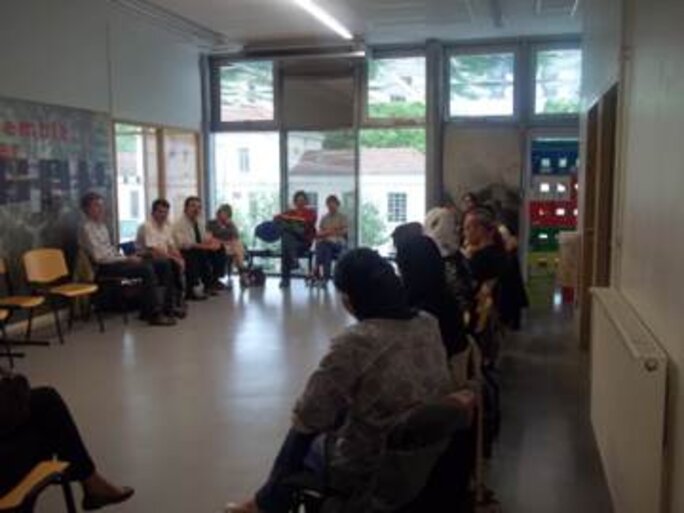
At this stage the teams working on the study are starting to collate the results they have obtained. But this may turn out to be the hardest part. A recent meeting at the lycée to present the study had to be cancelled, as only four teachers out of the 60 people who work at the school actually turned up.
And the refusal to admit that discrimination might exist in schools still seems to be firmly entrenched. One of the participants reported talking to a teacher who said she did not feel the question of discrimination concerned her at all, saying flatly, "This doesn’t exist in the education system."
Mingone, the school’s careers advisor, recounts how colleagues tell her they simply do not want to go into the subject. "Things are difficult in education, so asking people to think about this as well… colleagues say to me, 'It's hard enough as it is, don't make it worse'," she commented.
Now there is concern among the educational professionals involved about how to follow up on the study's findings. They see a danger that each category of person claiming to suffer discrimination will fight on his or her own turf. "How can we progress to a collective way of combating it?" asked a teacher during one such discussion.
To avoid the issue being rejected outright, it is important not to treat discrimination in a moralising way, and also to address the matter collectively, those involved conclude.
"One can be profoundly anti-racist and yet discriminate every day," said Dhume. "That is why we do not situate this work as being a question of values, or in a moral register, but being to do with practices that give these professionals the ability to rethink their work situations."
The team’s next step was to try and get people in the city’s disadvantaged districts involved through holding public meetings in the Mistral area. The first was with an equal opportunities lawyer, Gwenaëlle Calvès, on June 6th. The following meeting is to be about sex discrimination, which is largely ignored in the school system.
-------------------------
English version: Sue Landau
(Editing by Graham Tearse)