


The French press is experiencing a historic crisis as, one after the other, every newspaper that was once independent is bought up by billionaires whose very least concerns are those of press freedom and the public’s right to know.
Yet many of these same billionaire press proprietors claim that they are the target of undue criticism, advancing the key argument that, without their intervention, the titles in question would have been forced to close.
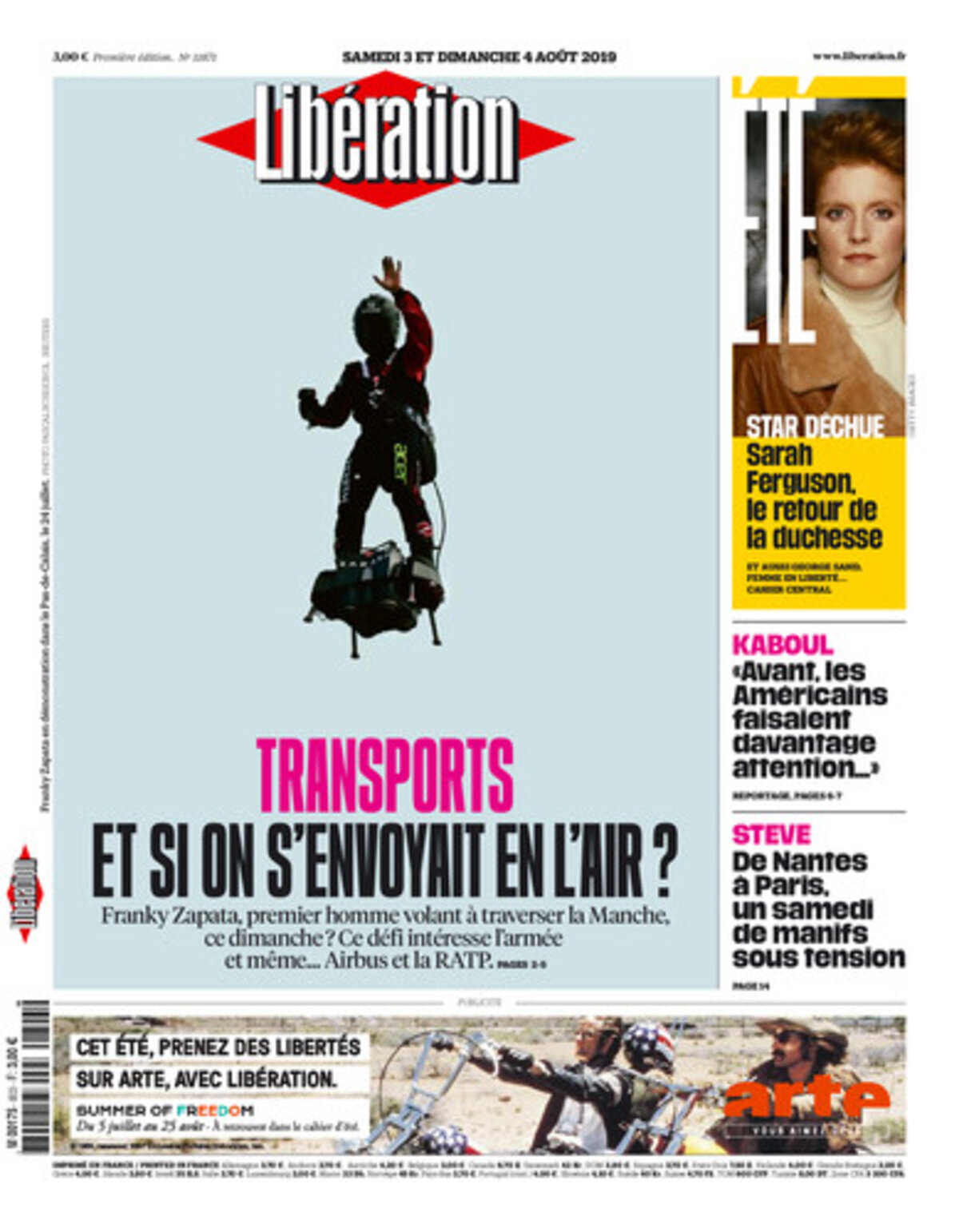
But the 2018 financial accounts of French daily Libération, which were published this week by financial news website WanSquare, reveal a surprising financial manoeuvre. Libération is owned by Swiss-domiciled Franco-Israeli multi-billionaire businessman Patrick Drahi via SFR Presse, a subsidiary of his group Altice. Last year, SFR Presse billed the struggling French daily 1.8 million euros for diverse “services” which included the newspaper’s “restructuring”.
While Libération is losing money to the point of financial agony, Patrick Drahi, who took control of the daily at the same time as he acquired the French weekly L’Express, TV channels BFM Business and BFM TV and broadcaster RMC, is deepening its already significant losses. Far from being the benefactor at the service of media pluralism that he purports to be, the businessman is applying the same predatory strategies that are unfortunately present in numerous industrial sectors, and he appears to be little concerned with re-establishing economic health to the venerable daily.
Alain Weill, chairman and CEO of SFR Presse, has insisted that “all the invoicing is perfectly justified”, and underlined that “there would be no sense in worsening losses that the group must otherwise make up for”.
The accounts of the newspaper indicate that Drahi’s group had injected a total of 37.7 million euros. But the proprietor’s invoicing of “services” in part enrich Patrick Drahi, the owner of the group, and further degrade the financial results of Libération. Below are its 2018 results (in French) as filed with the Paris commercial court:
These confirm the desperate financial situation of the daily, created in 1973 by journalist Serge July and the late French philosopher Jean-Paul Sartre (1905-1980), now owned by a figure who represents their exact ideological opposite. As shown by the tables (below, left) from the annual accounts, Libération is in a state of virtual bankruptcy, surviving on cash injections from its owner.
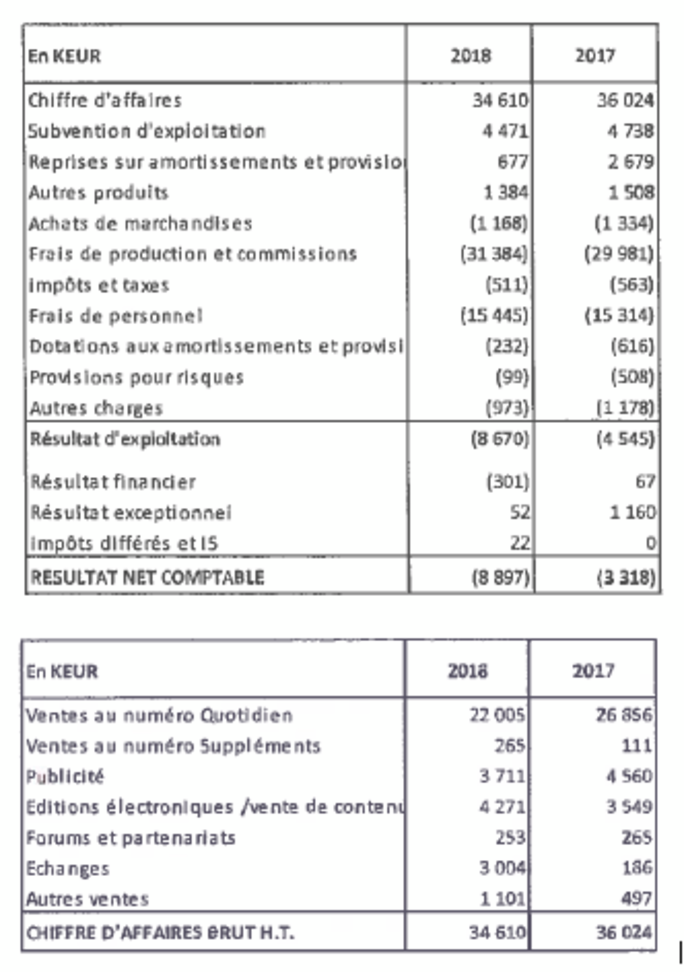
For the year 2018, “net income” shows in fact a loss of 8.8 million euros, which follows a loss of 3.3 million euros in 2017. This year-on-year leap in losses is all the more spectacular given that public subsidies received by the newspaper in 2018 amounted to 4.4 million euros. Which means that without this funding by the taxpayer, Libération’s deficit would have reached 13.2 million euros.
The daily is weathering the same crisis that affects the whole of the printed press: falling sales exacerbated by the collapse of the distribution network and the withering number of street press kiosks, together with a fall in advertising revenue. Libération’s turnover has shrunk, from 36 million euros in 2017 to 34 million euros in 2018, due above all to losses in the numbers of its paying readership.
Its paid circulation in France fell year-on-year by 10.68% in 2018 to a daily 67,238, according to the French newspaper industry’s circulation audit office, the ACPM. Sales at newsstands tumbled even more dramatically, down 24% to around 14,000 copies per day. As a result, income from newsstand sales fell year-on-year from 26 million euros to 22 million euros, which explains the collapse of Libération’s turnover.
Sales this year, however, have seen an upturn, reaching an average 72,128 copies per day over the first half of 2019, a year-on-year progression of 7.9%. For SFR Presse CEO Alain Weill, Libération “is in the process of turning around thanks to digital [activities], and should break even in 2020”. The forecast for losses this year is estimated at 5 million euros.
But the newspaper’s 2018 accounts contain other alarming figures. On December 31st 2018, the negative equity was 29,553,890.68 euros, with total debts amounting to more than 64 million euros – of which 37.7 million euros are debts owed to its proprietor. Operating losses last year represented 28% of its turnover, which is huge.
At first glance, one might conclude from this that if the newspaper has lost its independence, at least it has been been saved by Drahi from certain liquidation. But in reality, the 2018 accounts show that, far from having ensured the survival of Libération, the billionaire has succeeded in extracting money from it, further degrading its already preoccupying financial situation.
The accounts filed with the Paris commercial court reveal that an Ordinary General Meeting of the Libération company structure was held on June 4th 2019, when several resolutions were voted and approved. The third of these, as listed, was the ratification of several agreements, including one between Libération and SFR Presse which was described as “management fees”. This was presented as follows: “Nature and aim: An agreement on provision of central services was signed on April 28th 2018. This agreement takes effect retro-actively from the date of November 10th 2016 through to December 31st 2017. It is subsequently renewed by tacit agreement from one year to the next and can be terminated on the date of December 31st of each year, on the initiative of one of the two parties, conditional to respecting an advance notice of three months. Under this agreement, SFR Presse supplies services in the following domains: - administrative, legal and financial; - advisory, assistance and strategic development; - restructuring of the group. Financial conditions: the sums invoiced under this agreement for the financial year that closed on December 31st 2018 amount to 1,885,043.53 euros.”
The reasons given by SFR Presse for receiving payment from Libération must be judged at their real value, including the surprising service of “restructuring of the group”. This, in sum, means that the bulimic proprietor introduces cost-cutting plans for the newspaper and transfers to himself part of the savings made in the process.
Contacted by Mediapart, SFR Presse said that the amount it was paid by the newspaper for its services last year was finally marked down, at 1.359 million euros. It said a third of that sum was made up of “the wages of the support teams working for Libération and salaried staff in other Altice subsidiaries, Libération not having its own legal and HR services”. It said another third of the total sum was down to “third-party fees such as those of lawyers, auditors etc., invoiced to SFR Presse on behalf of Libération”. The remaining third was “the amortisations of the headquarters of the group at Balard [its HQ site in Paris] chargeable to Libération on a pro rata basis of the square metres occupied [by it].”
An eloquent fact in this financial juggling is that last year Libération received 4.4 million euros in state subsidies, of which almost 4% went into the pocket of SFR Presse – ultimately, that of Patrick Drahi. Despite the state of the newspaper’s accounts, his group does not appear in a hurry to recapitalize it in order to allow it a fresh start, but instead gives it current account advances. The group claims that this in fact makes no difference to the situation for the daily, all the more so because the negative rates mean that the funds leant to Libération cost it nothing (for the time being). But that is forgetting that its dire financial situation weighs on the newspaper’s functioning, and can serve as an argument to put pressure upon its staff.
It is simply twaddle to argue that the billionaires eating up the French press are benefactors with no ulterior motives, as demonstrated by the example of Libération.
-------------------------
Laurent Mauduit is a co-founder of Mediapart.
- The French version of this article can be found here.
English version by Graham Tearse