


The first socialist prime minister under France's Fifth Republic, Pierre Mauroy, has died at the age of 84. He was operated on for lung cancer a year ago and died on Friday of complications related to the disease.
Mauroy, who was born in northern France and was mayor of the northern city of Lille from 1973 to 2001, was a major figure in the Socialist Party (PS) for many years and when he became prime minister under President François Mitterrand in 1981 it was he who was in charge of overseeing the many radical reforms that took place in the early years of that presidency. It was Mauroy who implemented the cut in the retirement age from 65 to 60, nationalised banks and parts of industry, cut the working week from 40 to 39 hours, increased the minimum wage by 25%, put up basic pensions by 38%, strengthened workers' rights and who boosted spending on the arts. He also oversaw the abolition of the death penalty.
However, the prime minister resigned in the face of growing economic problems caused by a spiralling public spending deficit and a failure to implement a major reform of private schools in 1984 that had provoked widespread public protests.
It was his successor as prime minister in 1984, Laurent Fabius, the current minister for foreign affairs, who led the chorus of tributes for Mauroy on Friday. Speaking from Japan where he is on a visit with President François Hollande, Fabius said: “A pillar of socialism has passed away.”
President Hollande himself hailed a man whom he said had “served France during some exceptional times”. The president declared: “Pierre Mauroy was a socialist, he wanted social justice to inspire everything he did. Pierre Mauroy did not deceive, he didn't lie, he followed his convictions to the end taking account of whatever the reality was. He was a man of loyalty, loyal to his working class origins, to his region, to a cause, to socialism and to the unity of the Left.”
His successor as mayor of Lille Martine Aubry who, like Mauroy, is a former first secretary of the PS, said she was “profoundly moved” by the news of the death of a political “giant” who had been “an exceptional mayor for 28 years”. Aubry added: “He was an extraordinary political figure whose actions have so marked the history of our Republic; from [the prime minister’s official residence] Matignon he modernised France and society in committing the country to a new era of social progress.”
Aubry's father Jacques Delors, who was economics and finance minister under Mauroy from 1981 to 1984 and later president of the European Commission, said he felt an “enormous and great sadness” at the death of his friend. He praised Mauroy as a “great prime minister, which is not easy in the Fifth Republic”. Edith Cresson, herself a former socialist prime minister, said she had “a really extraordinary memory” of Mauroy. “He was a calm man, with a great deal of simplicity but at the same time a real vision.”
With the death of Mauroy French socialists have lost both their guilty conscience and one of the guardians of the socialist flame. Pierre Mauroy, who was born at Cartignies in the Nord département of northern France on 5 July 1928, was, like his father, a teacher by profession though his family came from a long line of lumberjacks and miners. Those working class roots and the learned lesson of the importance of collective action were to stay with him throughout his political career.
Skilful and organised
Mauroy had a particular idea of politics and the Socialist Party (PS); that while there were no struggles that did not end in compromise, equally there could be no compromise without a fight. Pierre Mauroy was a fighter and not a political heir to others or someone searching for political legacies.
His form of socialism sought to achieve conciliation as a result of a hard struggle. He embodied the association between confrontation and agreement. He seems to have been the last politician who was capable of rallying behind him both a Jean-Luc Mélonchon of the hard left and someone from the social-democratic wing of the PS such as current finance minister Pierre Moscovici.
As national secretary of the Socialist Youth ( Jeunesses socialistes) from 1955 to 1959 Mauroy tried to save the honour of the French Section of the Workers' International (SFIO) – the forerunner to today's Socialist Party – which was then bogged down under its leader Guy Mollet in the face of the Algerian War while at the same time staying true to his own political upbringing.
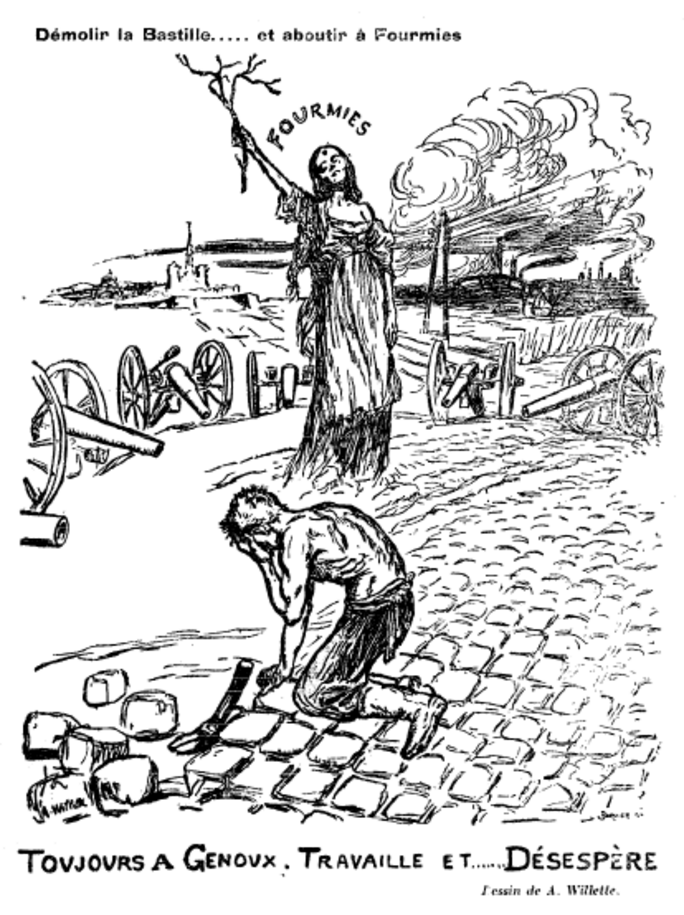
From 1963 Mauroy became one of the regional power-brokers or 'barons' of the movement when he took over as first secretary of the powerful socialist federation of the Nord département. This son of Cartignies worked miracles. Heavily built and skilful, good-natured and organised, from 1971 to 1981 he made himself a link between the socialist traditions epitomised by Fourmies – the town in the Nord where on May 1st 1891 troops fired on the first French and international celebration of International Workers' Day, killing nine strikers (see image on previous page) – and the swarm of experts who surrounded François Mitterrand, who included Laurent Fabius and economic adviser Jacques Attali.
In 1973 he became mayor of Lille, succeeding the former pit worker and member of the Resistance during the Second World War Augustin Laurent. From this socialist stronghold Mauroy became the man whom Mitterrand needed in order to show people he was following in the socialist footsteps of major historical figures on the Left such as Jean Jaurès and Léon Blum. Their relationship was based on mutual respect though they shared no similarities and nor was it an equal relationship – Mitterrand held court while Mauroy slogged away. It was, nonetheless, an ingenious partnership that allowed the presidency to be anchored on the Left as long as was necessary; until the faithful factotum Mauroy was replaced at Matignon by the anointed heir Laurent Fabius in the summer of 1984.
It is interesting to note that this game of political musical chairs that took place over the position of prime minister was repeated later with the PS. Pierre Mauroy became first secretary of the party in 1988, before stepping aside in 1992 for Laurent Fabius the man who, from Japan, first revealed Mauroy's death on Friday.
Pierre Mauroy knew how to let go of power more quickly and better than so many other senior figures, leaving the mayor's office in Lille to Martine Aubry before he was 73, whereas Gaston Defferre, for example, had died aged 75 in 1986 without ever letting go of his fiefdom in Marseille.
He remained a senator for the Nord from 1992 to 2011 where, as the video link on the previous page highlights, he remained true to his values and in particular to a retirement age of 60 until the end. Mauroy also kept the presidency of the Jean Jaurès Foundation, gave advice and granted interviews. But, in his wisdom, he was careful about overplaying his role as a symbol of a certain idea of socialism.
The socialism he represented was not 'real socialism' - the so-called realistic socialism that dates from the Brezhnev era - nor the spruced-up socialism of the majority of his comrades. He refused to make do with the fake or with the illusory. Instead Mauroy's socialism was exemplary, effective and based on tradition; a kind of post-modern Holy Grail. In other words, an appropriate kind of socialism that remains, it seems, undefinable right up to the current day...
---------------------------------
English version by Michael Streeter
