


Many political parties in France have faced difficulties in financing their campaigns for this month’s European Parliament elections because of the increasing reticence of banks to offer them loans. But the far-right Rassemblement National (previously called the Front National), has found a way around the problem by calling on its supporters to lend money for its campaign, offering an attractive 5% return on their investment which ultimately will be paid back by the public purse.
Election campaigns in France are subsidised by the state, with a ceiling amount on what they may be refunded conditional on them gaining a minimum 3% proportion of votes cast, and that their campaign spending accounts are validated by a watchdog commission. In a fast-changing political landscape, which has seen major upsets for both the Left and the Right, many parties represent an uncertain prospect for lenders. There was also notably the rejection by the watchdog commission of Nicolas Sarkozy’s presidential campaign spending accounts submitted for his failed 2012 re-election bid.
The list of candidates for the European Parliament elections fielded by the Rassemblement National (RN) is currently tipped by opinion surveys to be leading voting intentions in France, with an estimated share of around 22%, just in front of President Emmanuel Macron’s LREM party list.
The RN has planned for a campaign budget of around 4.3 million euros, which represents the ceiling amount that the state would refund if the party garners more than 3% of votes cast.
Initially, the party, unable to obtain a loan, has had to pay its campaign expenses upfront from its own funds. “I sent recorded delivery letters to every bank, around 30 in France, and also banks in Europe,” RN campaign treasurer Jean-Michel Dubois told Mediapart. “They lend to practically no party except that of Macron’s.” The RN said it had also tried, in vain, to enlist the help of the official mediator, a post created last August, for parties and individual candidates in their negotiations for loans from banks.
The founder of the Front National party, Jean-Marie Le Pen, who was banished from the party now renamed and led by his daughter Marine le Pen, said in February that his personal micro-party, Cotelec, was unable to lend funds to the RN because the latter was “for the moment” unable to pay back money it already owes.
Enlargement : Illustration 1
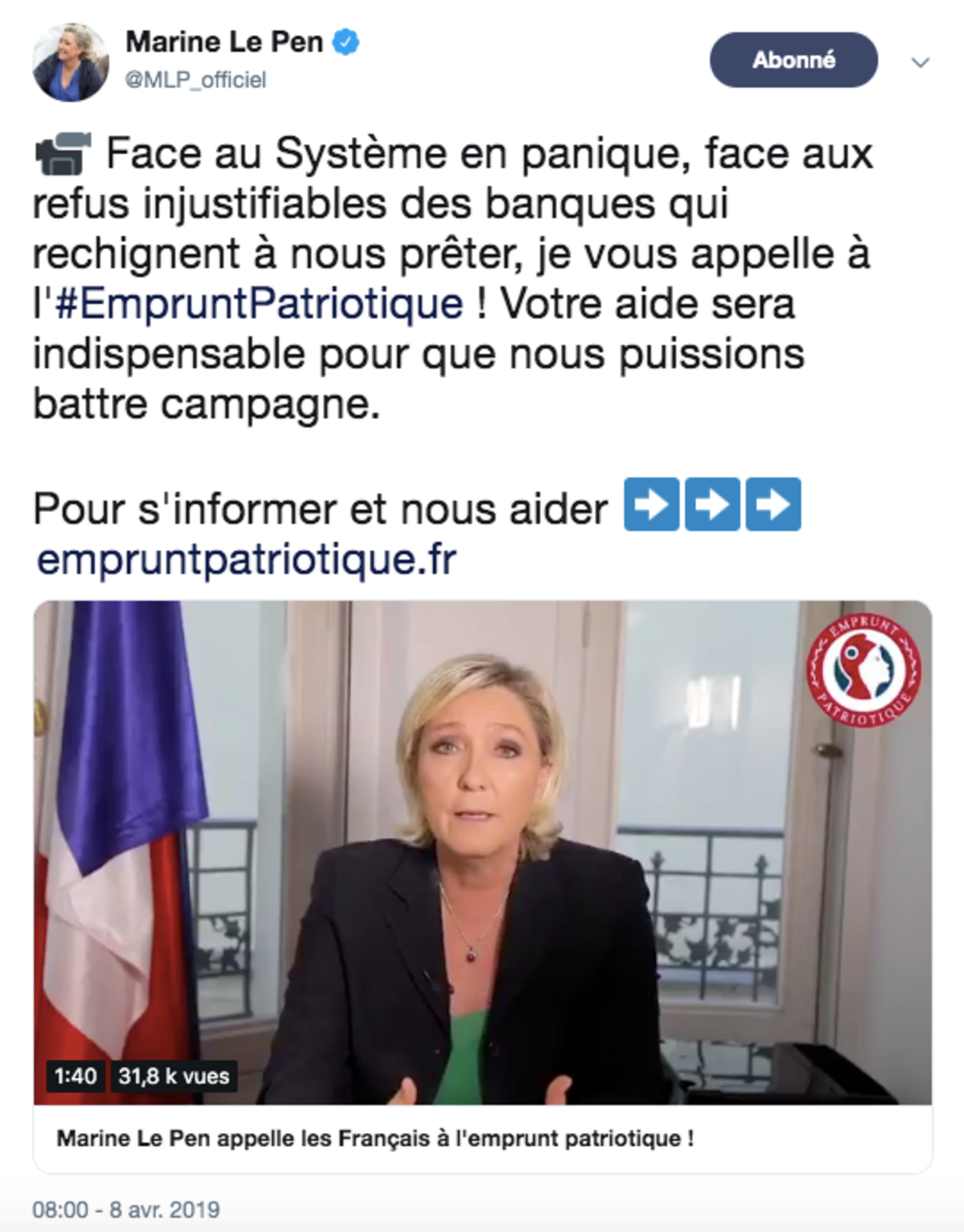
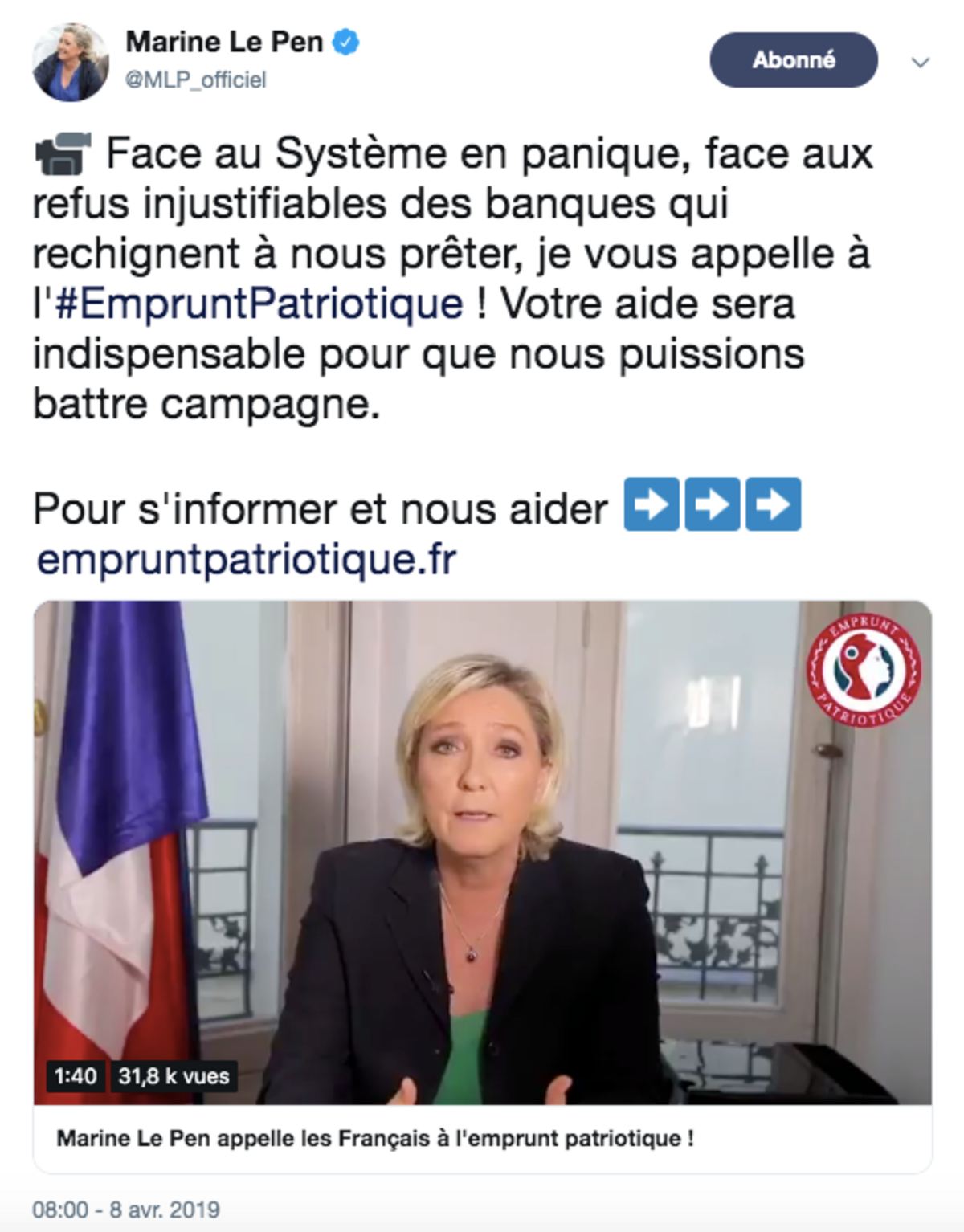
But at the beginning of April the RN launched its campaign for a so-called “patriotic loan”, offering its supporters who make a minimum donation of 1,000 euros each to receive reimbursement of the sum, plus 5% in interest, in February 2020, after the party has received the state refund of its campaign spending. A similar proposal has been made by the marginal hard-right Debout la France party, but which offers an interest rate of up to 3.4%, which is the current normal legal ceiling rate on loan interest payments.
The RN appears to have been the only party to have unearthed a legal exception, made in a decree dated July 2018, which allows paying interest above the allowed 3.4% if a loan is refunded within 18 months.
“The other parties perhaps didn’t see it,” said Jean-Michel Dubois. “We could even have gone beyond an interest rate of 15%, 16% or 17%, it’s legal […] In one week, we received practically what we were looking for, in the realm of 4 million euros.”
“Our members consider that it’s not normal that banks aren’t doing anything,” he added. “They have confidence in the Rassemblement National and make the decision to lend us money. But there is always a little risk. If I do something foolish with the accounts it could have serious consequences, and even lead to no refund. So 99% of people who lend do so as militants, through the desire to defend the movement and not out of financial interest. It’s and act of militancy that we pay back at the same rate we would have had at the level of a bank.”
But in fact the “act of militancy” will not be paid back by the party, but instead by the state, because the RN intends including the 5% interest payments in its “financial expenses” that will be included in its campaign costs that it can expect to be refunded out of public funds.
According to the watchdog commission for political campaign spending, the Commission nationale des comptes de campagne (CNCCFP) – which validates or invalidates spending accounts and decides the amounts to be refunded – the tactic is legal “if the interest was paid at the time when the campaign accounts have been submitted”. According to the CNCCPF guide to regulations concerning this month’s European Parliament elections “the interests paid before the date of the submission of the accounts are open to an all-inclusive refund by the state” if they have been paid back to the lender before the last day of the month when the campaign spending accounts are filed.
All of which means that around 200,000 euros in interest will be paid by the public purse to the party’s supporters who made the loans (together with the 4 million euros in total that they leant).
“Given that we have the right to do it, it is also a part of our refundable campaign costs,” said RN campaign treasurer Jean-Michel Dubois. “If we had obtained a bank loan, the interest would also have been refundable. Objectively, the person who makes the loan will not gain enormously […] the person who will lend 10,000 euros, for example, will gain 200 euros, it’s not enormous, all the same.” In fact, at an interest rate on 5%, the return on 10,000 euros would be 500 euros.
Speaking to Mediapart, one candidate on the RN list for the elections (who spoke on condition his name was withheld) disagreed with the principle. “It’s perfectly legal, but it’s staggering that the interest be paid by the state,” he said. “We can’t continue like that, even if it’s abnormal that banks refuse to grant us a loan.”
RN party leader Marine Le Pen and its chief treasurer Wallerand de Saint-Just declined Mediapart’s request for their comments on the issue.
The party has unsuccessfully attempted to employ a similar strategy in the past. During her presidential election campaigns in 2012 and 2017, Marine Le Pen included large sums of interest payments on funding loans in the campaign costs submitted for reimbursement (as previously did her father, Jean-Marie Le Pen, when he was the Front National candidate). Had it been accepted, the practice would have allowed lenders of the campaign funding – notably the Front National party itself and the Le Pen family’s micro-parties (Cotelec and Jeanne) to pocket handsome returns.
In 2012, Cotelec and Jeanne leant, respectively, 4.5 million euros and 450,000 euros to Marine Le Pen’s campaign at an exceptional interest rate of 7%, which equated to returns of 319,453 euros and 19,000 euros. For her presidential campaign in 2017, the Front National party and Cotelec made loans subject to interest payments of 6% and 6.5%, representing returns of, respectively, 242,017 euros and 585,000 euros.
However, for both the 2012 and 2017 elections the CNCCFP refused to allow a refund of the interest claim in Le Pen’s accounts, on the grounds that the law does not allow for political parties and movements to receive a refund of interest on loans if they have not provided the funds through loans they themselves have contracted, known as “mirror loans”. In the case of Marine Le Pen’s campaigns, the funds were provided directly from the finances of the Front National and the Le Pen micro-parties.
But in the case of this month’s European elections, the loans are provided by individuals who, the law allows, can be refunded for the sums of interest as part of campaign costs. “It will be one of the paths that will be followed in the future,” said a senior RN party official, who asked for his name to be withheld. “It’s a good means, it allows us to [financially] self-suffice thanks to our own circles of members and sympathisers.” Campaign treasurer Jean-Michel Dubois added: "It functioned well, I don’t see why we wouldn’t keep it, above all when you have banks that close their doors to you.”
-------------------------
- The French version of this article can be found here.
English version by Graham Tearse