


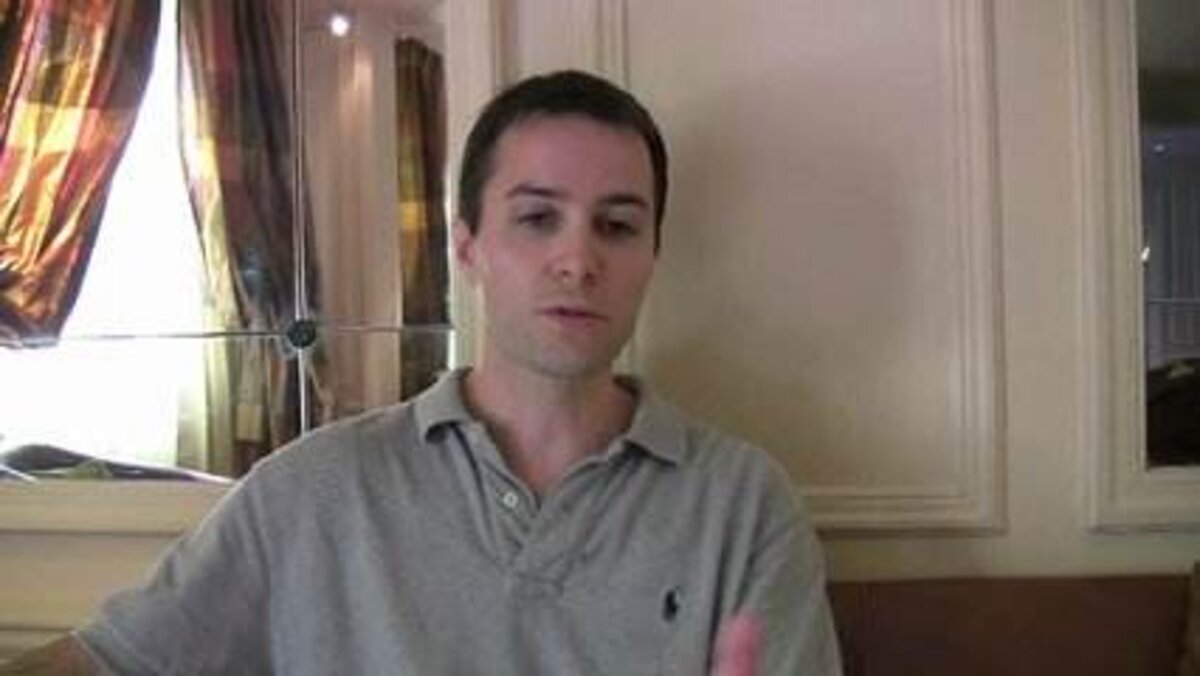
The dark history of the Vichy administration's collaboration with the Nazi occupation continues to fascinate even the younger generation of French historians. In a book just published in France, Laurent Joly, 34, details how the country's public servants formed a monstruaous machine for the persecution and deportation of French Jews.He talks here to Antoine Perraud.
-------------------------
Laurent Joly, 34, is too young to have grown up with the speeches, the problematic and the obsessions that in France were the legacy of the Nazi occupation. A representative of the new generation in historical research, his newly-published book studying the innermost workings of the Vichy regime employs great rigor in its treatment of archives and eye-witness accounts.
He makes no attempt in his work to meter out justice in the emotive field of the role France played in the persecution, and later the destruction, of Jews trapped on its territory.
For his Master's degree, Joly dug up a disused archive of material in Lyon, which he drew on to later write a biography of Xavier Vallat, Commissioner-General for Jewish Questions in the Vichy administration. He followed this with a book (1) on Vallat's successor, Louis Darquier de Pellepoix.
Contrary to typically French received wisdom, according to which there must always be an aggressor and a saviour as with Pétain and De Gaulle, Joly shows that in this case there was no "good guy" (Vallat) and "bad guy" (Darquier) but two bureaucratic criminals shaping a policy which in turn shaped them.
Joly then did his doctoral thesis (2) on the workings of the Vichy administration's Commissariat Général aux Questions Juives (General Commission on Jewish Questions, or CGQJ), a state organ Berlin could only have dreamed of. Pétain created it in 1941.
The CGQJ enacted various aspects of the anti-Semitic rantings then current on both sides of the Rhine in outbursts of legal and police frenzy and economic harassment, with the confiscation, liquidation and Aryanisation of Jewish assets. Joly's conclusion would rile some of the older generation: "Vichy France was certainly the satellite country that played, of its own volition, the most criminal role in the Nazi policy of genocide after Romania."
The task of delving into this sinister institution was helped by an anomaly. Unlike other documents from the time, like records of the paramilitary youth group Les Chantiers de la Jeunesse Française, for example, career records were conserved.
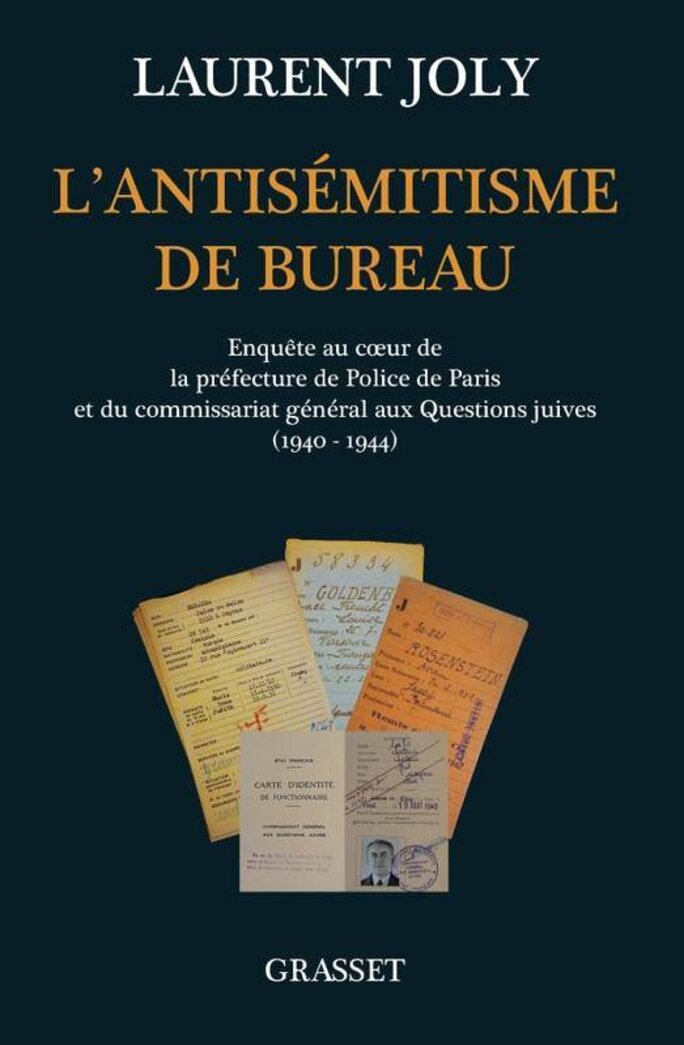
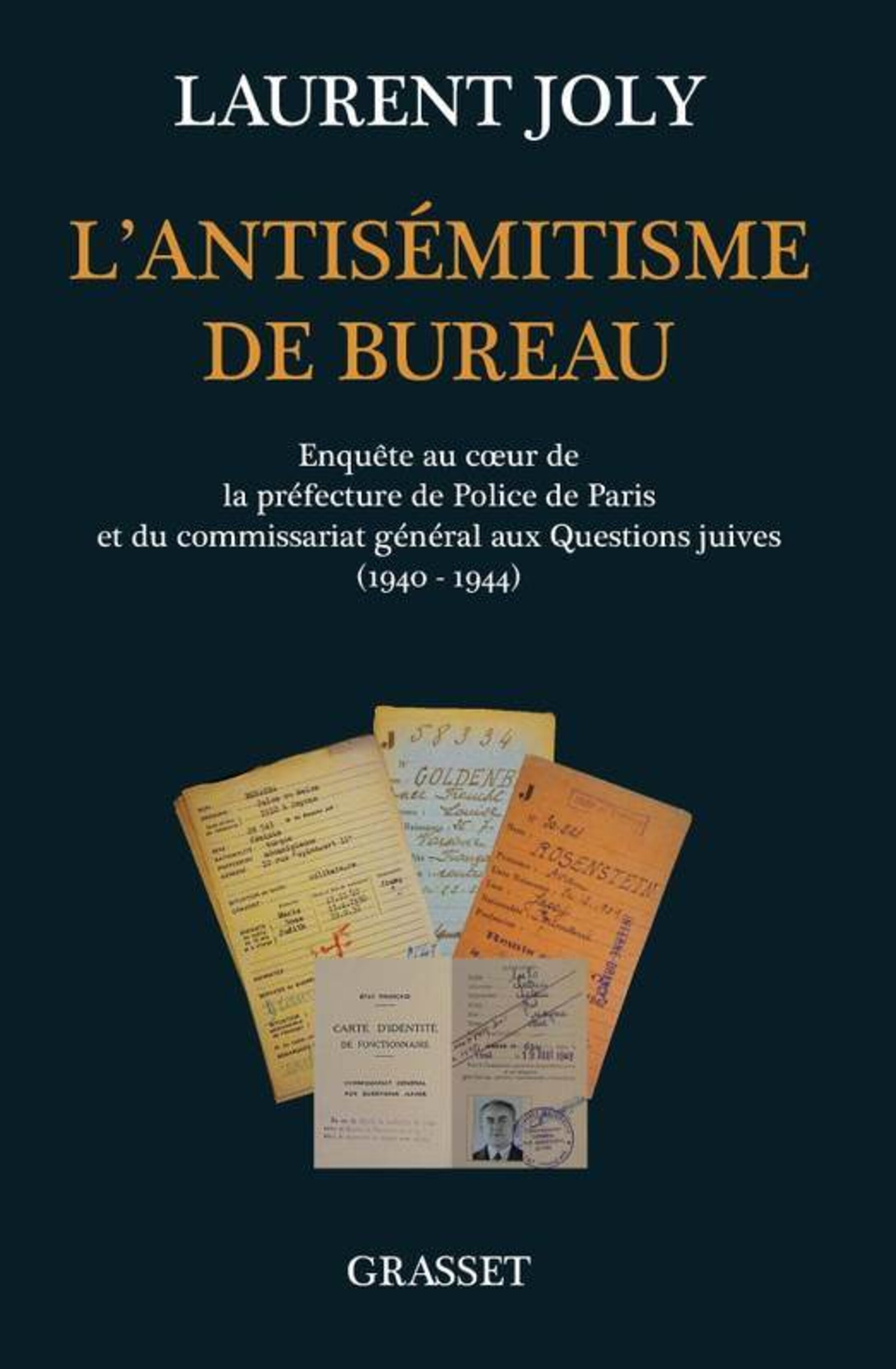
Joly's latest book, L'Antisémitisme de Bureau (roughly ‘Bureaucratic Anti-Semitism'), published in France by Grasset, compares the two departments which operated as the vice used by the Vichy administration to crush Jews living in France.
They were: the CGQJ, which operated out of the former headquarters of the Léopold Louis-Dreyfus Bank, near the Paris Bourse, with up to a thousand employees; and the Sous-Direction des Affaires Juives (Sub-Section for Jewish Affairs), known as the "Jewish department" of the Paris police prefecture, which operated with some 150 specially designated officers.
Joly began his research after a law passed in 2008 on consultation of archives lifted a number of restrictions that had been introduced in 1979. One of the the new measures introduced was to allow documents to be photographed, meaning researchers no longer had to dip summarily into records during opening hours. He determined to take advantage of this mass of information to compare the two organisations.
His method is unconventional. His approach is both at individual level, through meeting the remaining witnesses as did Alain Decaux and André Castellot in Histoire de la France et des Français au Jour le Jour (A Day-by-Day History of France and the French), as well as examining a multitude of documents in detail in the tradition of the quantitative historian Pierre Chaunu.
Joly said the idea was to look at how the individuals who make up a traditional administration and are familiar with the usual ways foreigners are dealt with by a government body would react to the new, excessive demands Vichy made upon them.
"That type of administration, in this case the department of the Prefecture de Police de Paris responsible for foreigners, would be given an extraordinary mission," he told Mediapart. "They would no longer simply control a category of the population, foreigners - in this case Jews - but would also contribute to their persecution by stigmatising them - a stamp identifying them as Jews on their identity papers, the yellow star, round-ups."
"So, how did those public servants, who are the same ones as before, [...] how did they react and how did they adapt to this new situation?"
-------------------------
1: Xavier Vallat, 1891-1972: du nationalisme chrétien à l'antisémitisme d'État (‘Xavier Vallat, 1891-1972, from Christian Nationalism to State Anti-Semitism', Grasset, 2001); Darquier de Pellepoix et l'antisémitisme français (‘Darquier de Pellepoix and French Anti-Semitism', Berg International, 2002).
2: Vichy dans la «Solution finale». Histoire du Commissariat Général aux Questions Juives 1941-1944 (Vichy's Role in the Final Solution: a History of the General Commission on Jewish Questions, Grasset, 2006).
Evil and banal
Enlargement : Illustration 2
Joly analyses the way Vichy's persecution apparatchiks applied bureaucratic imperatives and political logic in both of these centres charged with administering an anti-Semitic public service, French style. He shows how public officials became slaves to pen-pushing in their quest to extract freedom of action from the Germans, at the expense of the Jews.
They did this by establishing a truly French legal framework, making these regulations of native origin a gauge of ‘sovereignty'. This opened the way for all the escalation that such an administrative competition implies, such as targeting children.
Sometimes, Joly says, "anti-Semitic sentiments" would be expressed by these pen-pushers intoxicated by having the power of life and death over the thousands of human beings they insulted, who were made to file by on the third floor - they were forbidden from taking the lift - in police headquarters near Notre Dame cathedral.
Yet the bureaucratic criminals were not militants, and this is the remarkable contribution of the typology Joly develops.
They negotiated policy twists and turns in the name of continuity. The Third Republic had pursued certain foreigners, Vichy persecutes Jews, it appears logical. Their administrative task, their "institutional patriotism", provided guidance in routine, compartmentalised activities during which no one had to look beyond the walls of their own cubicle.
Of course, some took this to extremes, particularly when it came to the so-called cas douteux, an office investigating ‘doubtful cases' where it was not clear if a person was Jewish or not, which operated from Room 91 at police headquarters.
"There, a real bureaucratic way of working would be created which would take on a sort of autonomy with its own methods and its own rules," Joly said. "There were about a dozen officers, sometimes more, who would receive doubtful cases [...] What becomes important is not the person you have before you but applying the law and perhaps making your colleagues laugh. And above all, they got used to working in such a way that what counted were the office rules - for example, can you prove you are baptised, what kind of name you go by."
Room 91 was run by Pierre Vayssettes, an assistant office manager who managed to get promoted to the CGQJ. "It is true that in the rather harsh way the office was run, the role, the direction given by the direct manager [...] Pierre Vayssettes, is important, and he trained his staff in a particular way and told them to apply the law, and he applied it in a very severe way," Joly said.
He cited the case of Georges Wellers, a camp survivor, who decided to declare himself as being a Jew but did not declare his wife as Jewish. "They summoned Georges Wellers' wife [...] she managed to get away with it, to make the case drag on as much as possible and supply falsified documents, but others did not," Joly said.
If someone was found to be Jewish and to have hidden the fact, they were to be charged with an offense. "What do you do as a public servant? Do you decide to take them to court? [...] Here you see clearly that the office manager, Pierre Vayssettes, gave instructions to take them to court systematically," Joly said.
"But the problem is you are in the logic of the deportation, and Jews who were identified in this way were not summoned to appear in court but were taken directly to Drancy. After a while you have to be totally blind not to see that."
Vayssettes was succeeded by André Broc, an averred anti-Semite whose thesis for his doctorate in law was entitled La Qualification Juive (‘The Attribute of Jewishness'). He was even promoted to the job on the basis that this thesis made him an expert on Jewish questions, Joly said.
"We can say that several dozen Jews were deported because from the time he took the manager's job [...] in 1943 until the liberation in August 1944, he continued to handle cases in a merciless manner," he said.
Even though current legislation on citing archives allows the civil servants and officers of the state involved in anti-Jewish policy from 1940 to 1944 to be named, Joly uses only the initial of their surnames to preserve their anonymity. He identifies them fully only above the grade of assistant department managers in the civil service and head of section or department in the CGQJ.
"This is my own jurisprudence, a clear rule for which the only exceptions were names that have already appeared in the press," he said.
The most symbolic case is that of André Tulard (1899-1967), who came to work at the prefecture in 1921 and became head of the Administration of Foreigners and Jewish Affairs. In this capacity he supervised keeping the files which allowed the authorities to organise the infamous round-up of Jews in Paris in July 1942 known as the Rafle du Vel d'Hiv.
His is a serious case. His file from the ‘Epuration Légale', the wave of trials that followed the liberation of France, has disappeared. His son, historian Jean Tulard, a specialist in cinema and the First French Empire, defended his father when Nazi hunter Serge Klarsfeld discovered the Jewish files in 1991, using arguments that do not stand up to the critical analysis normally used in historical studies.
Joly documents the matter with an objectivity tinted with disgust. He did not try and contact Tulard although he met a number of children of these anti-Semitic bureaucrats.
"His essay 'Que sais-je?' (What do I know?) on the history of the French administration in 1984 says it all," Joly commented.
"We read there that 'the personal dramas of public servants under Vichy, their uncertainties, anxieties, are more the concern of psychological history than institutional history.' I wanted to remain free and not repeat this systematic victimisation erected as a defence."
-------------------------
L'Antisémitisme de Bureau, Enquête au cœur de la préfecture de police de Paris et du commissariat général aux questions juives (1940-1944)", is published by Grasset, currently available in French only, priced 23 euros.
English version: Sue Landau
(Editing by Graham Tearse)
