


On September 18th, French education minister Jean-Michel Blanquer and his government colleague Geneviève Darrieussecq, state secretary for the armed forces ministry, were in Clermont-Ferrand in central France to present the programme of commemorations for the centenary next month of the WW1 Armistice, which will culminate in a grand ceremony in Paris on November 11th with 120 foreign dignitaries in attendance, including US President Donald Trump and his Russian counterpart Vladimir Putin.
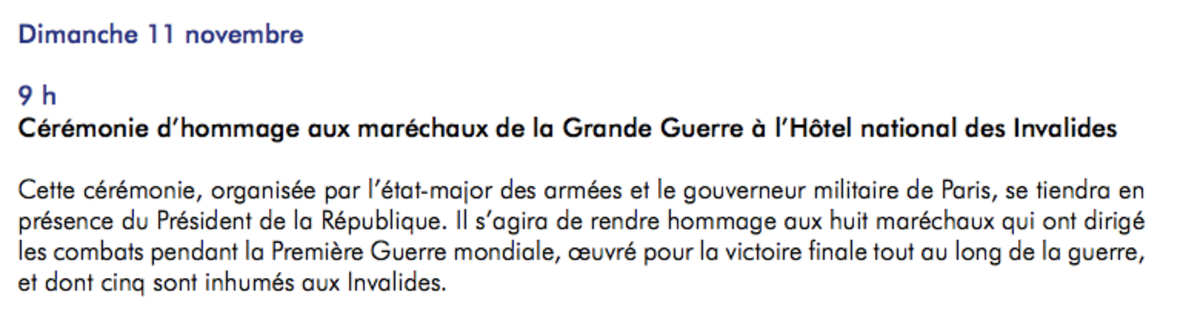
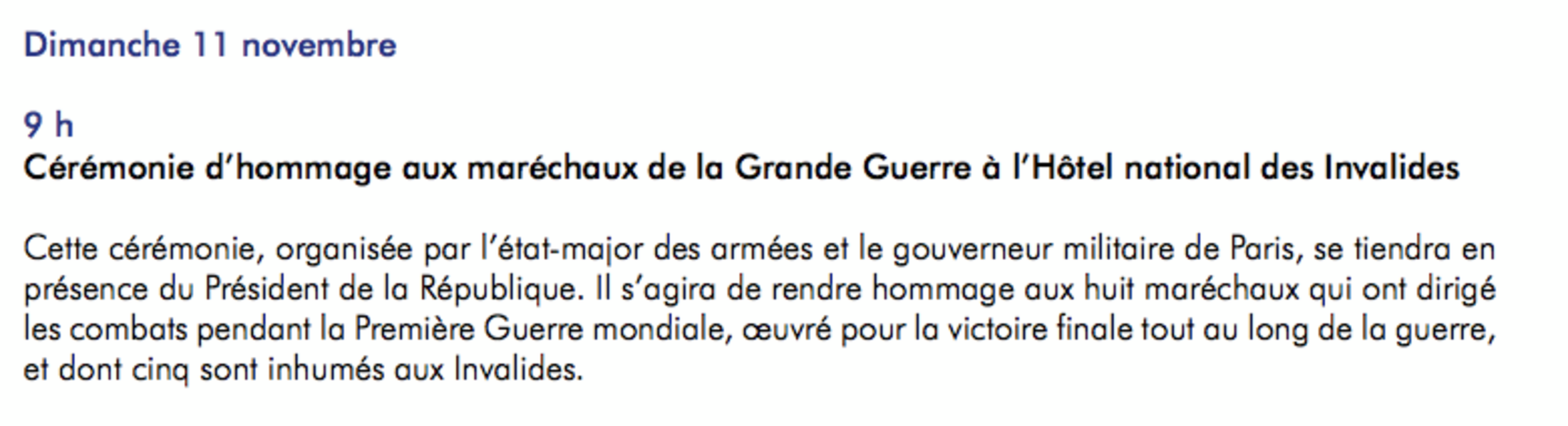
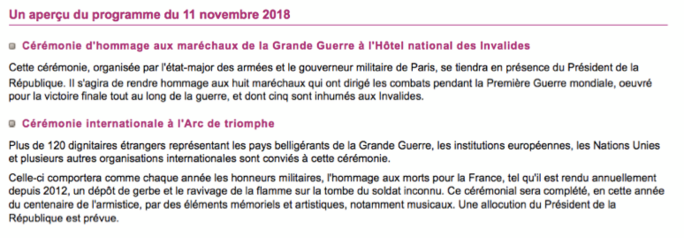
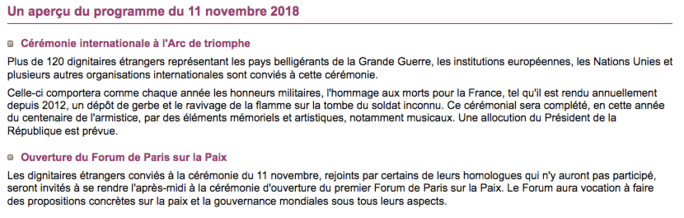
The programme was drawn up by a dedicated inter-ministerial body called the ‘1914-18 centenary mission’. In its original press releases (see the full programme, in French, by clicking the 'More' tab top of page), the committee announced that the French chiefs of staff of the military and the Military Governor of Paris planned to begin the November 11th ceremonies in Paris with a tribute (see below), in presence of French President Emmanuel Macron, to the eight titular French Marshals who took part in WW1; Joseph Joffre, Ferdinand Foch, Joseph Gallieni, Marie Emile Fayolle, Louis Franchet d'Espérey, Hubert Lyautey, Michel-Joseph Maunoury –and Philippe Pétain.
The title of Marshal in France, where it was first used in the 12th century, is a military distiction awarded to generals on the grounds of their exceptional services.
Pétain, whose role during the WW1 battle of Verdun in eastern France earned him the nickname ‘The Lion of Verdun’, headed the collaborationist Vichy regime set up in 1940 by Nazi Germany during its four-year occupation of France. The Pétain-led regime was responsible for mass deportations to German death camps of Jews and political prisoners, notably Communists, while also providing industrial support for the Nazi regime. Its political paramilitary militia, the Milice française, acting alongside the Gestapo, was notably responsible for hunting down Jews and members of the Resistance, and also those who attempted to escape from a programme of forced labour in Germany, under which several hundred thousand people were deported during the Vichy regime to help the Nazi war effort.
After the fall of the Nazis and his arrest in 1945, Pétain was tried in France and sentenced to death for high treason, which was commuted to life imprisonment on the grounds of his age. He died in detention in 1951 on the Ile d’Yeux, aged 95.
Enlargement : Illustration 1
Jean-Dominique Merchet, a journalist with French online and print daily L'Opinion, recounts on his blog how a number of historians, after discovering the planned event, “sounded the alarm” over the idea of honouring Pétain. Contacted by Mediapart, an official with the French presidential office, the Élysée Palace, said it was incomprehensible that such a ceremony could "end up” on the list of events, “when it was not on [the Élysée] programme”, and that the president’s "least step” and every detail of the ceremonies had been the subject of “extremely fine-tuned” decisions.
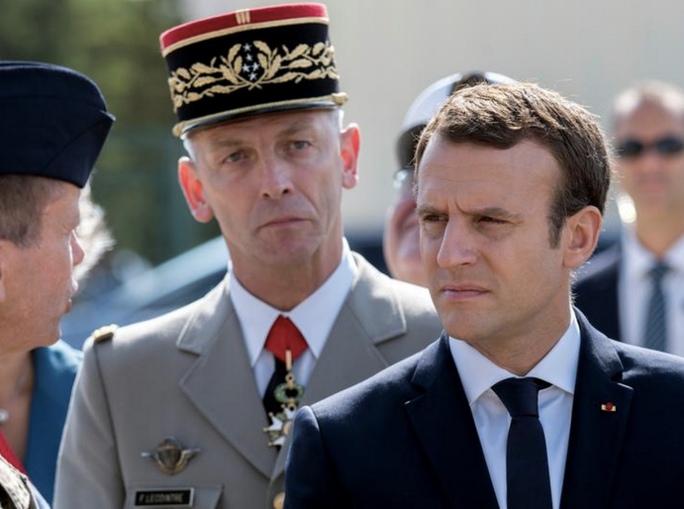
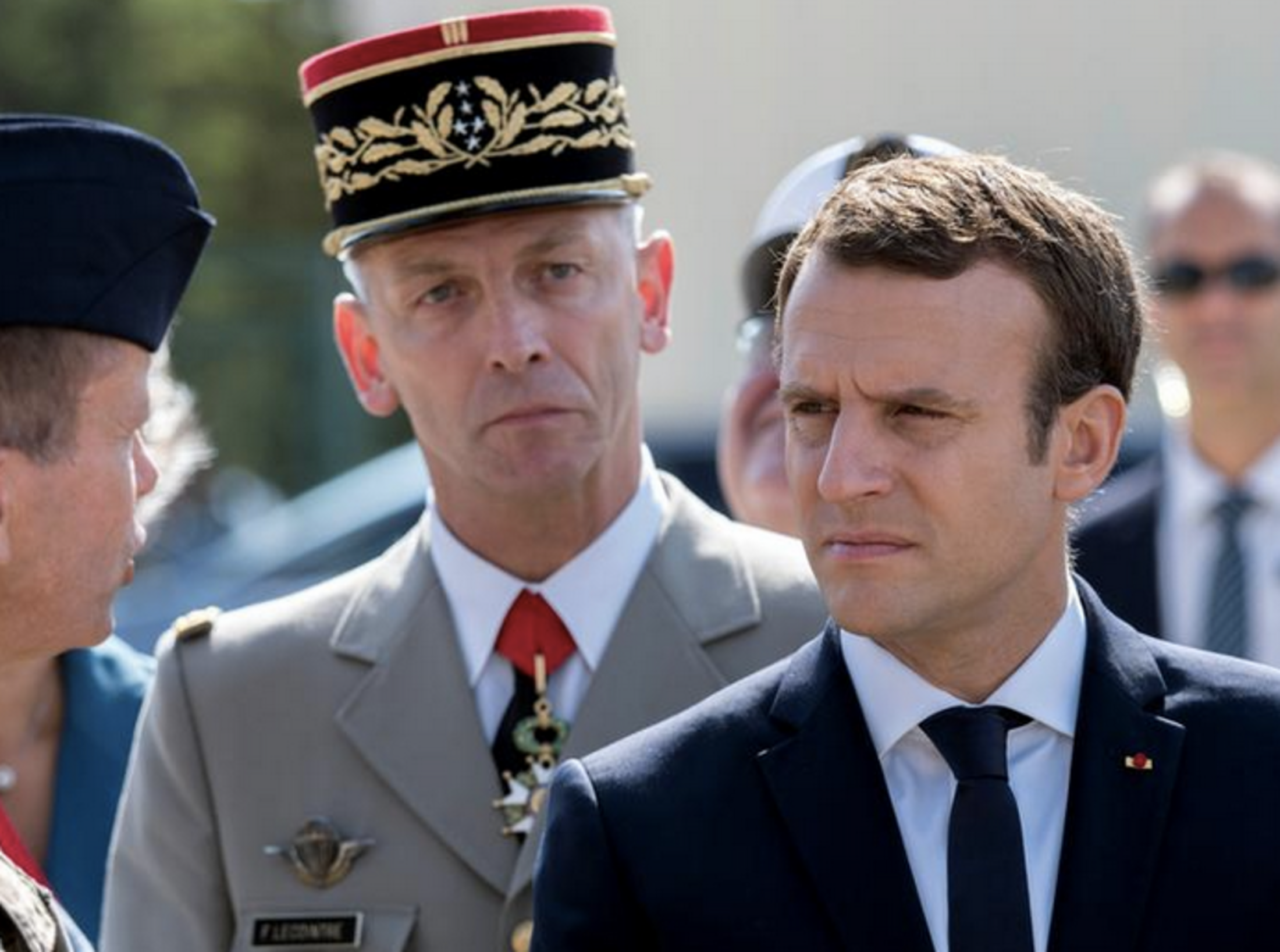
Contrary to what was announced in the press kit, Emmanuel Macron will not be attending the ceremony planned for 9am on November 11th at Les Invalides, the historic military complex in Paris. "The tribute to the Marshals is a quite recurrent request from military circles, in the largest sense," commented an Élysée advisor. “It’s almost become part of the classic WW1 commemoration line-up, but there is reason to question the significance of it.”
Enlargement : Illustration 2
One reason, he said, was the "the presence of Marshal Pétain in this gallery [of Marshals], which has naturally always been a problem, including in the presidential memory". Another is that the centenary was mainly intended to commemorate the people's army, the French soldiers in the trenches who were popularly nicknamed the Poilus. "The vision is to get as close as possible to the way the French experienced the war, as close as possible to the front, to the harshest reality," said the advisor. “A tribute to the Marshals doesn’t fit in with the overall approach to this period of commemoration.”
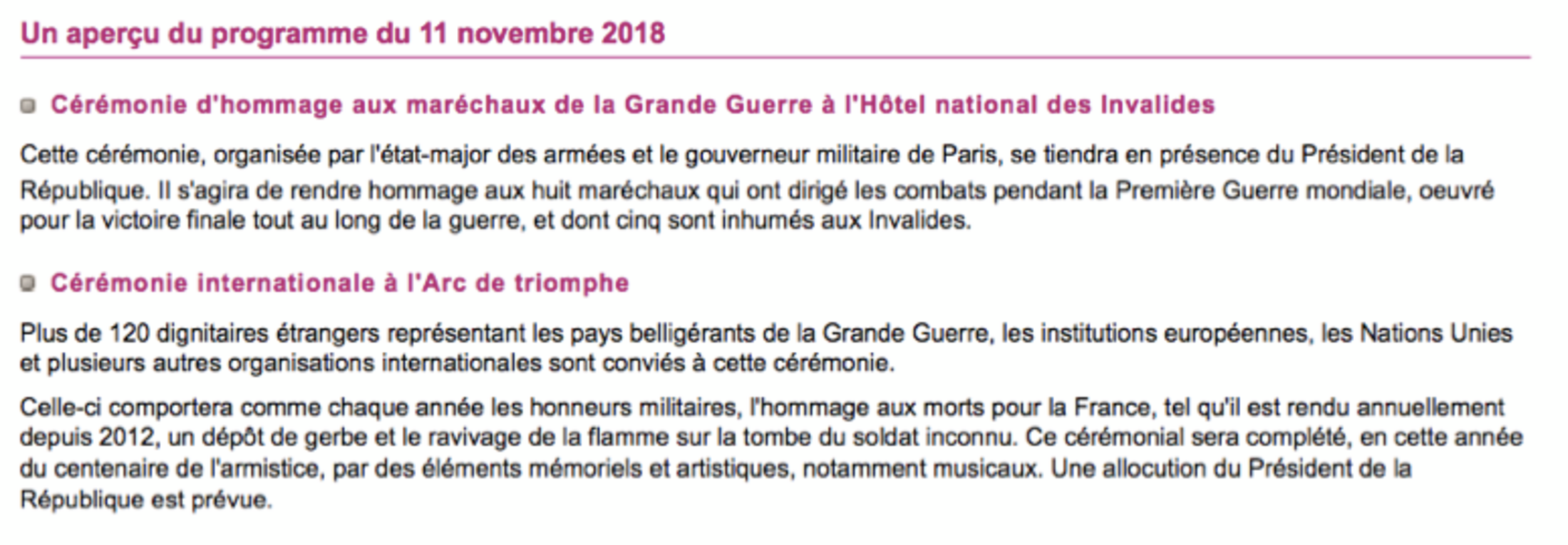
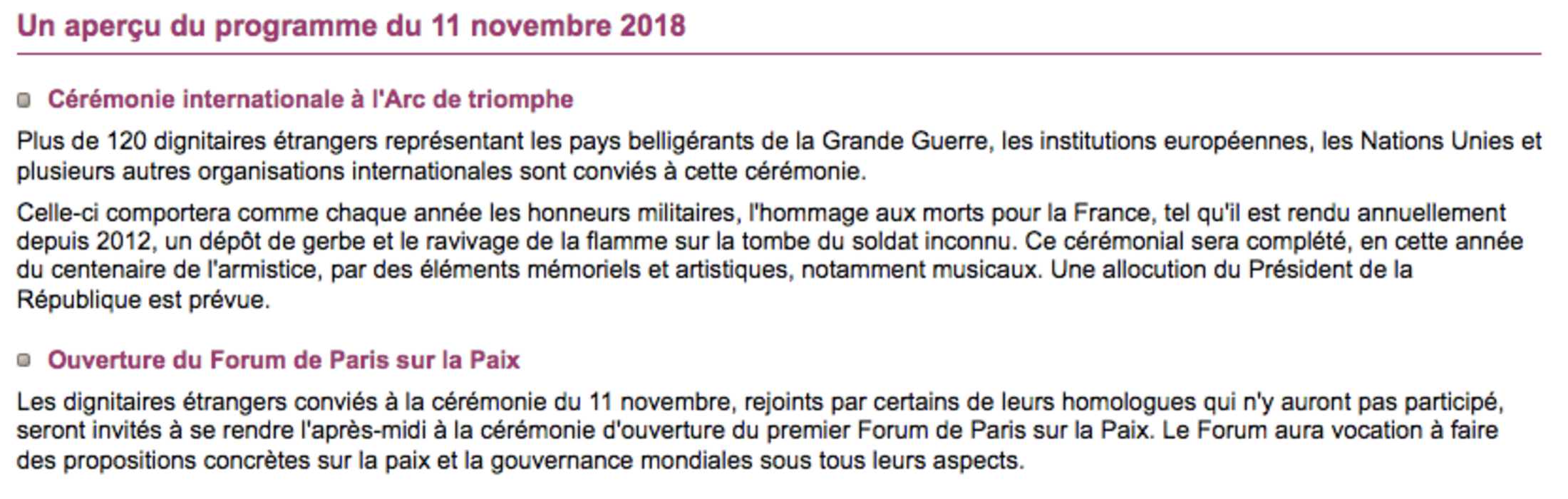
The Élysée insists that the tribute was slipped into the official centenary programme without Macron and his cabinet's approval. But as shown in the screenshots below, it was still included in the press kit posted just several days ago on the websites of the organizing committees and the ministry of education, before suddenly disappearing. But it still features on the portal of the regional education authority in Clermont-Ferrand.
Enlargement : Illustration 3
Enlargement : Illustration 4
Contacted by Mediapart, Joseph Zimet, the head of the 'Centenary mission' coordinating the Armistice commemorations, said he did not wish to comment on the matter, which he insisted was handled directly by the presidential office. None of the several people close to the organisation of the programme who were contacted earlier this week were able to say whether the military joint chiefs of staff were still planning to commemorate the WWI Marshals, albeit in another form and without Macron attending. Meanwhile, the Marshals will receive tributes at a day-long symposium, ‘The Marshals of the Great War’, to be held at Les Invalides next Tuesday, when France’s armed forces chief of staff General François Lecointre will be among the many historians and military representatives speaking at the event.
-------------------------
- The French version of this article can be found here.
English version by Eric Rosencrantz