


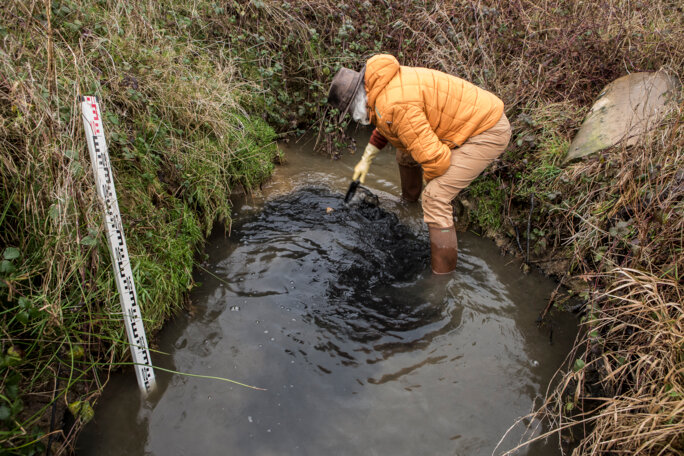
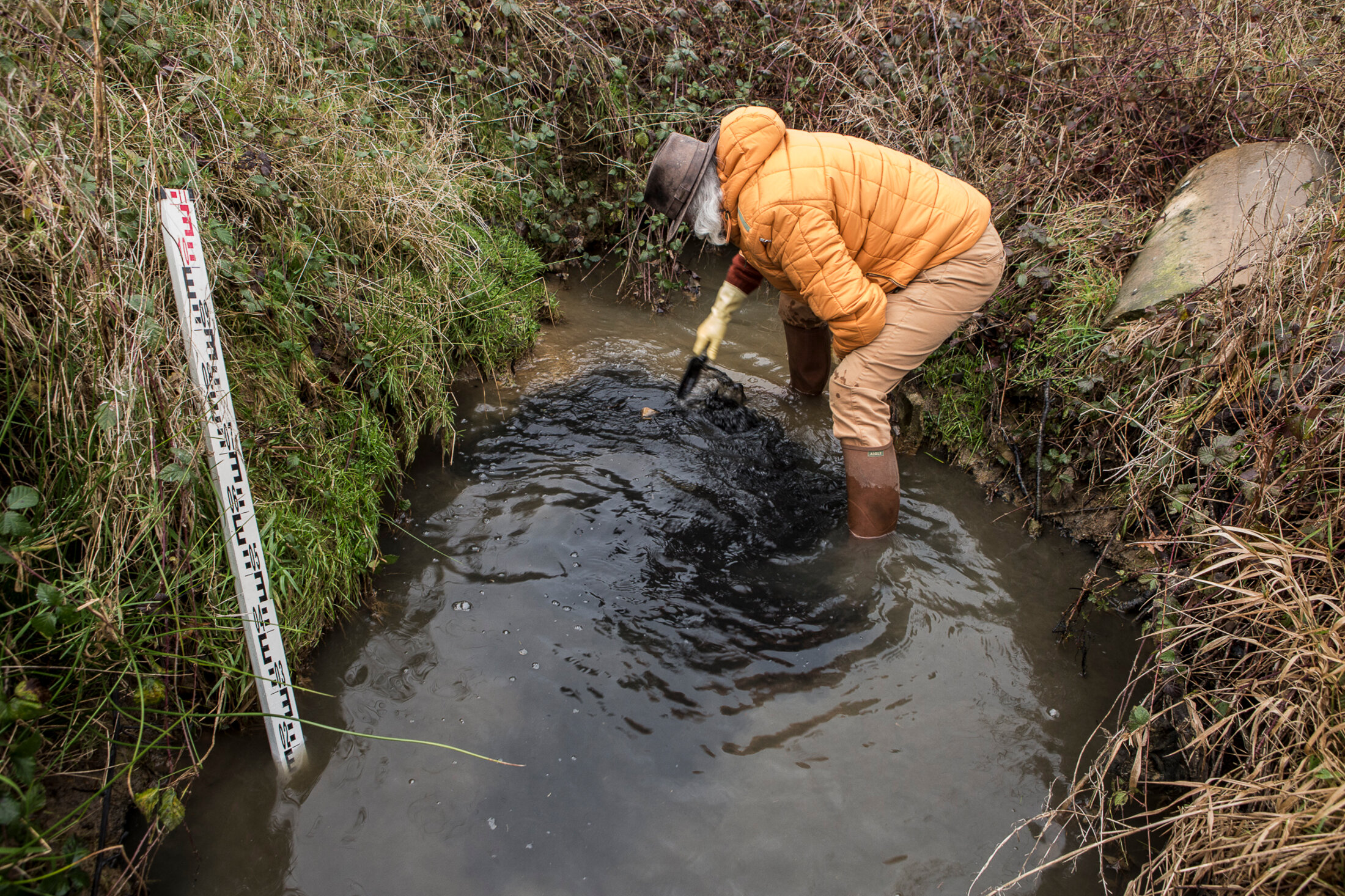
Armed with just a shovel and a water measuring stick, the fisherman walks across the field until he reaches the Roglain, a small stream which feeds into the River Sarthe in northern France. Once in the middle of the stream he agitates the mud with his boots and then waits. Within a few seconds the water has taken on a blackish hue.
“You see, it's like ink. It's a real open sewer,” says Jean-Paul Doron, who is president of the fishing federation in the département or county of Orne in the Normandy region. “There are no fish because animal life can't develop here, there's no more natural oxygenation. Yet it's a stream where there should be salmonids [editor's note, a family of fish including salmon and trout],” says the fisherman and ecological activist as he collects a layer of black organic sediment from the stream bed.
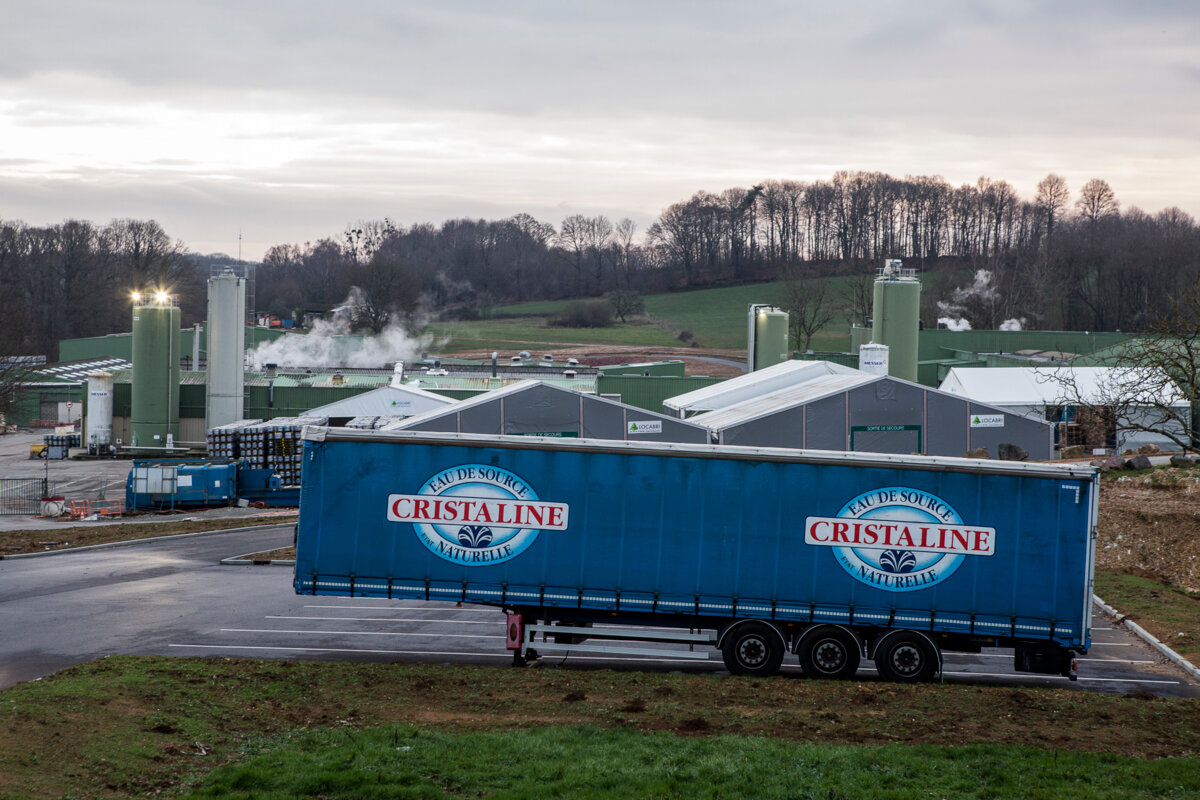
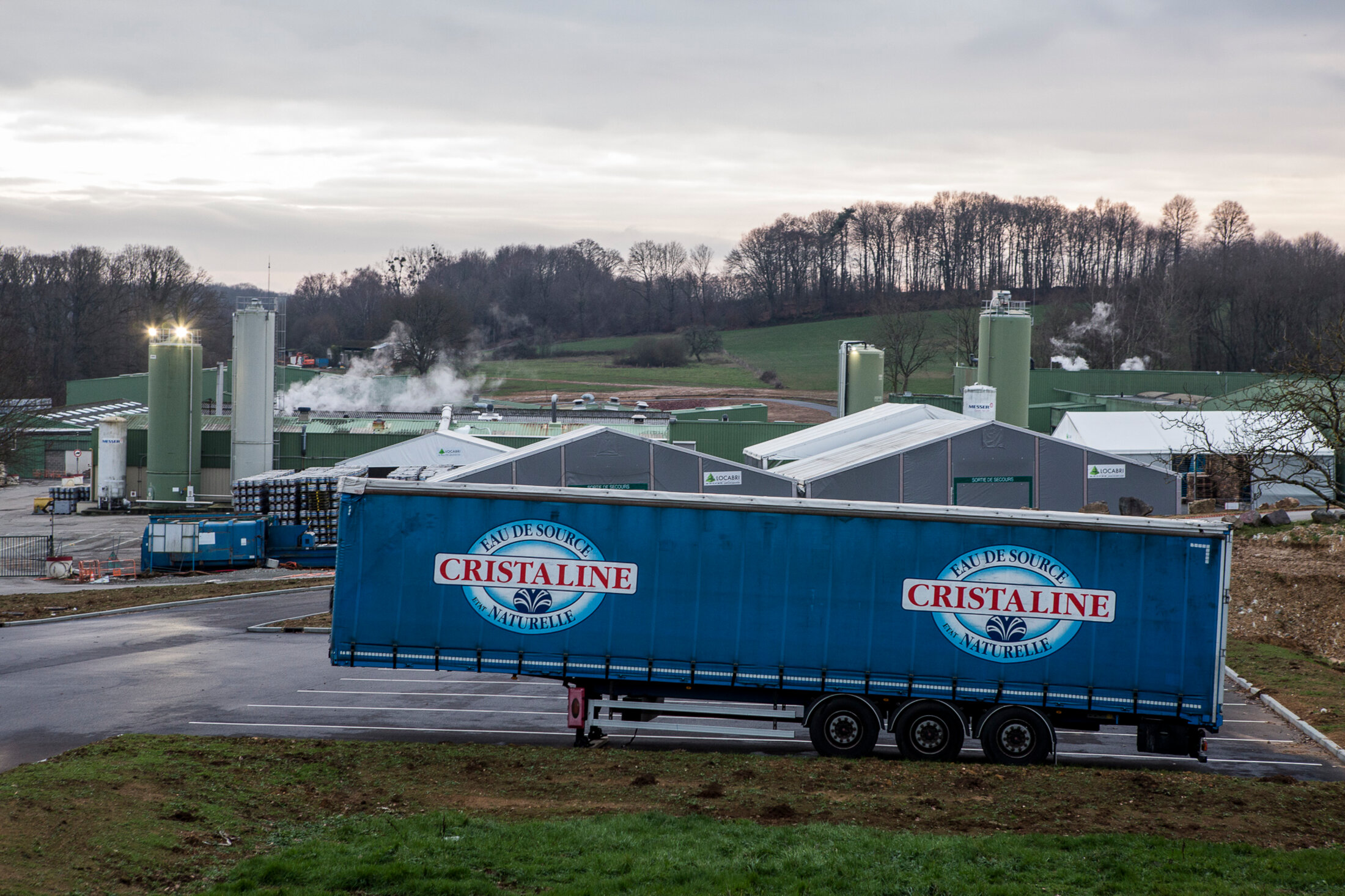
The fisherman is gazing upstream of the Roglain towards a building which he blames for the situation. Fewer than 500 metres away as the crow flies are the green roofs of an industrial plant owned by the Roxane group in the small Normandy village of La Ferrière-Bochard. This French company owns the Cristaline brand, the most widely-consumed bottled water in France.
For close to twenty years fishermen, local residents and environmental inspectors have been observing and warning about the organic pollution - largely in vain - that comes from this site into the stream.
Mediapart has learnt that in 2017, fifteen years after the first concerns were reported, a criminal investigation was opened by the prosecution authorities in the nearby town of Alençon. And more recently, in November 2020, officials from the body which polices the environment in France, the Office Français de la Biodiversité (OFB), recorded yet another pollution incident at the site.
The object of residents' and officials' concern is the constant failures of the water treatment plant at the factory – where iced teas and fizzy drinks are bottled – which discharges its waste water into the Roglain stream. “No fish mortality was recorded, but, given the ecological state of the stream, that's not surprising. Organic pollution was recorded and will be the object of a report to the legal authorities,” the head of the local OFB office wrote in an email on November 24th 2020, which Mediapart has seen.
Enlargement : Illustration 1
Roxane's European subsidiary, Alma, did not respond in detail to Mediapart's questions about the pollution at the Normandy site. But it insisted that it took environmental issues “very seriously”, as “protecting water sources and respecting the environment are essential for our activity”.
The company said that the site at La Ferrière-Bochard, which is looking to expand so it can start to bottle Cristaline water by 2022, is being given “major investment towards a complete modernisation of its infrastructure, including its water treatment plant” and that “in agreement with the authorities the work is under way and will be finished by the summer of 2021”.
The factory at La Ferrière-Bochard is not just a standard bottling plant for Roxane, which is the number three French bottling group behind Nestlé and Danone and which had a turnover of 1.4 billion euros in 2019. It has also been the group's headquarters since 1954 when Lucien Lobjoit, a wine and spirits merchant from Alençon, decided to start up in business bottling non-alcoholic drinks and founded Roxane in the village of La Ferrière-Bochard, whose population today is just 700.
A few years later a man called Pierre Papillaud joined the company and went on to become Lobjoit's successor. The new boss transformed the small Normandy company into a group with an international presence, boasting a portfolio of around thirty brands including bottled water labels Cristaline, Vichy, Vals, Saint-Yorre and Crystal Geyser, and which has opened factories in the United States, United Kingdom and Italy. Papillaud, who died in 2017, was a high-profile often controversial boss best known for his appearance in an advert for Rozana sparkling water that became something of a cult hit.
In 2016 Pierre Papillaud's name was cited in the 'Panama Papers' offshore financing investigation for having set up several companies in tax havens, from the British Virgin Islands to Luxembourg. This triggered an investigation by the financial crimes prosecution unit the Parquet National Financier (PNF) for laundering the proceeds of tax fraud. Meanwhile Pierre Papillaud kept the group's operating centre at La Ferrière-Bochard through his subsidiary Alma. Over time it became a major company in the region - and seemingly impervious to criticism.
For our investigation shows that from at least 2003 until the end of 2020 a series of environmental inspectors raised the alarm about pollution from the La Ferrière-Bochard factory. Yet at no point did the group take adequate measures to prevent harm to the environment and to aquatic wildlife.
The first alert came from the Conseil Supérieur de la Pêche (CSP), one of the OFB's predecessors. In December 2003 an inspector wrote a report under the provisions of legislation aimed at protecting water sources, flagging contraventions at the “Roxane stream” where a flow of substances had a “damaging effect on the health of or caused damage to flora or fauna”. The CSP inspector observed that the water treatment plant at Roxane was spreading its waste mud towards a stream next to the factory, which feeds into the Roglain.
Seven years later, the CSP had been replaced by the Office National de l’Eau et des Milieux Aquatiques (ONEMA). The officials had changed and the assessment had become even more severe. In one report by ONEMA, dated February 19th 2010, officials describe pollution in the Roglain over a “total stretch of 3.5 kilometres of streams up to where it joins the river Sarthe”. The environment inspectors observed “severe deterioration in the ecological quality of the streams”, due to “very high levels of regular pollution with [organic pollution] matter” which “without any possible doubt [came from] the Roxane industrial plant”.
'You can definitely call it chronic pollution'
The environmental inspectors pointed out that an impact study had been carried out when the local prefecture granted an operating licence to Roxane. This study said that the bottling company had to collect and treat its waste water full of sugars – which came from the washing of the production tanks – in the water treatment plant before it was discharged into the River Sarthe. The study said that only rainwater and “clear” water should be discharged into the Roglain. This was the water left over from making the fizzy drinks which was then filtered and had any iron content removed.
This means that in 2010 the ONEMA inspectors were aware of an offence that had been committed under France's environment code. But as they knew that changes were being made to the operating licence at Roxane at the time, they decided not to prosecute the offence but instead to produce a report drawing attention to the pollution. In other words, it was simply a warning with no further consequences for the company. “The discharge had been going on for many years. There was no official complaint because at that time there wasn't the same culture about taking legal action. We didn't have the same prerogatives then as we do today with the OFB,” said one inspector from the OFB, who knows the case well and who asked to stay anonymous.
But Mediapart has learnt that in 2017 proceedings were launched against Roxane. The Agence Française de la Biodiversité (AFB) – which had by now replaced ONEMA – had observed fresh pollution between May 29th and June 1st of that year. Prosecutors at Alençon then opened an investigation.
“The Roglain was no longer a stream. There were no dead fish because there were simply none left … this stream no longer functions, it can't be rebuilt even though it should be a trout stream,” one OFB inspector told Mediapart. “This is discharge of organic matter, of putrid sludge. Tubifex worms, bloodworms [editor's note, often associated with sewage waste] are flourishing there. You can definitely call it chronic pollution.”
Yet despite the legal investigation and Roxane's promises to carry out a 600,000-euro modernisation of the factory, more pollution incidents were observed the following year. In October 2018, following yet another report about a failure of the water treatment plant, the prefecture in the local Orne département issued a notice giving Roxane three months to comply with the terms of its operating licence.
Less than a year later, in May 2019, the prefecture issued another decree in which it acknowledged the “work that has already been carried out” but which also stated that the “malfunctions linked to the network of waste water and rainwater have not been completed resolved”. There was no follow-up. When contacted by Mediapart both the prefecture in the Orne and the local branch of the environment and planning agency, the Direction Régionale de l’Environnement, de l’Eménagement et du logement (DREAL), declined to comment.
Local residents are infuriated by the authorities' cautious approach. Sébastien Boulay lives just a few dozen yards from the bottling plant at La Ferrière-Bochard and the stream that leads from the factory runs alongside his land. He is fed up with the constant pollution and gave a statement to the gendarmes in Alençon at the end of 2018. “It's getting worse and worse. When we came here eight years ago we cleaned the section of the stream that goes past the land with a depth of 50 centimetres. A fortnight later and it was already black,” he told Mediapart, as he puffed on a cigarette behind the front gate of his house.
Sébastien Boulay showed Mediapart a stretch of water at the bottom of his garden. “In my pond there were 3,000 fish larvae, little fish. They're nearly all dead. There were around 15 carp, and there must only be one or two left,” he said, showing photos of the dead fish.
Enlargement : Illustration 2
In another case, La Montagne newspaper reported on December 11th 2020 that searches had been carried out by detectives at Saint-Yorre and Châteldon, two major Roxane plants which bottle sparkling water in the Auvergne region of central France.
The prosecutors' office at Cusset in the Auvergne told Mediapart that it did “not yet want to comment on the case”. But the fact that the investigation is being carried out by the Office Central de Lutte contre les Atteintes à l’Environnement et à la Santé Publique (OCLAESP) - the gendarme unit which handles pollution and environmental cases - gives a clear indication of the nature of the probe.
When contacted Roxane's subsidiary company Alma said that it was “cooperating fully with the authorities” but did not want to comment on an ongoing investigation “other than to reassure consumers, as the food safety of the products is not at stake, the products can be consumed in complete safety”.
In California, meanwhile, where Roxane bottles the water brand Crystal Geyser, the group has also faced legal proceedings over recent pollution incidents. In January 2020 its American subsidiary CG Roxane LLC pleaded guilty to breaching environmental laws and agreed to pay a criminal fine of 5 million dollars. This was over the discharge of arsenic-contaminated waste water into a man-made pond – known as “the Arsenic Pond” – at its plant at Olancha in California for around fifteen years, the United States Attorney’s Office for the Central District of California said in a statement.
A few weeks earlier, on November 28th 2019, the United States Environmental Protection Agency (EPA), issued a suspension notice in relation to Roxane's American subsidiary, which barred it from signing contracts with the United States government.
-------------------------
If you have information of public interest you would like to pass on to Mediapart for investigation you can contact us at this email address: enquete@mediapart.fr. If you wish to send us documents for our scrutiny via our highly secure platform please go to https://www.frenchleaks.fr/ which is presented in both English and French.
-------------------------
- The original French version of this article can be found here.
English version by Michael Streeter