


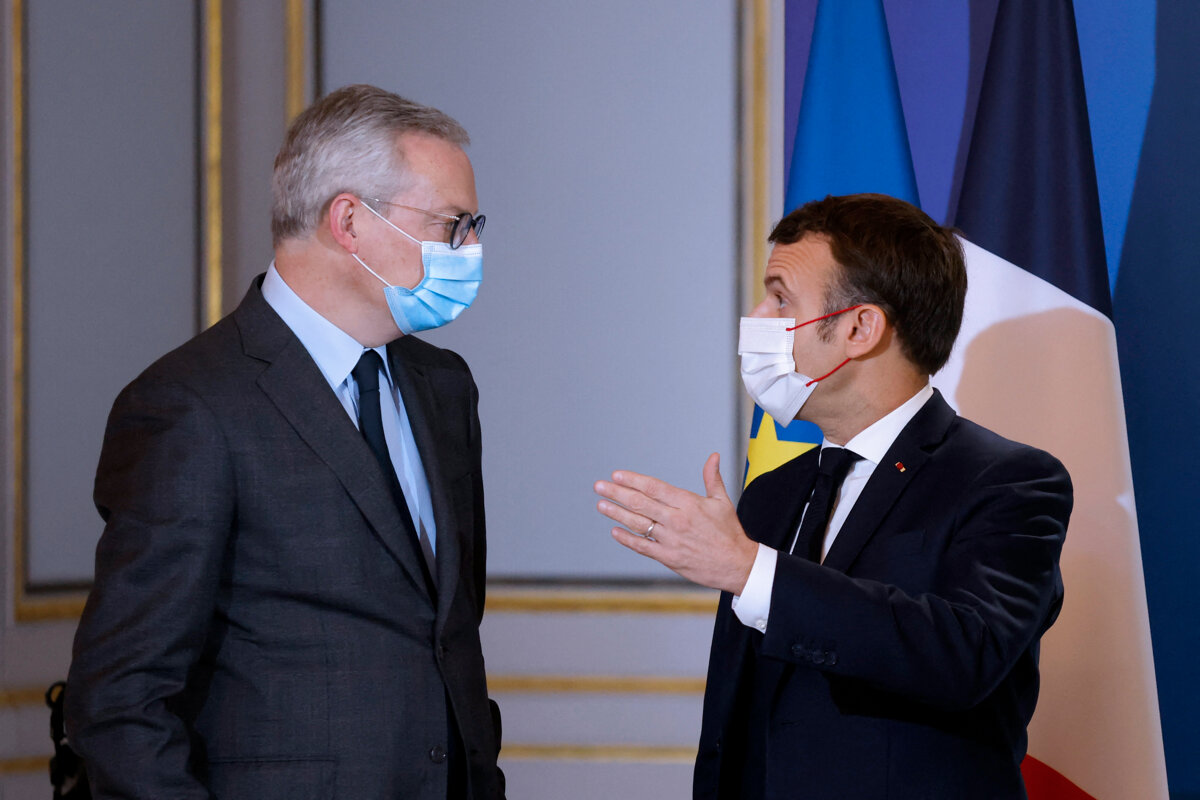
The “gamble” over health restrictions taken by President Emmanuel Macron, who has sought to avoid a third national lockdown in France despite a rise in the number of Covid cases since January, appears to have failed. Already much of the country, including the Paris region, is now under a form of lockdown even if the president himself has been careful to avoid using the term. There is also talk of further restrictions being announced later this week.
But the head of state has taken another “gamble” too; this one economic. The French government's aim was to control the epidemic, or at least contain it at a certain level - a plateau of 20,000 daily new cases was mentioned - and leave much of the economy open.
Enlargement : Illustration 1
This strategy allowed ministers to construct an important economic narrative for public consumption: this was that the French economy was withstanding the epidemic “better than forecast”. The message was that everything was going just fine: the epidemic was adapting to a certain level of economic activity and the economy in turn was adapting to the epidemic. It was not hard to work out the aim of this operation: as the economy is first and foremost about 'confidence', and thus about what story you choose to tell those involved, this upbeat approach was designed to ensure a swift recovery in activity.
For this ploy to work, however, there was one essential condition: the schools had to stay open. This allows parents, and thus a large part of the country's workforce, to carry on working, either remotely or in their normal workplace. That was the major difference between the first lockdown, from March 17th to May 11th 2020, and the measures announced for the second lockdown on October 28th 2020. During the first lockdown the closure of the schools led to constraints on working. It made the large-scale production of goods and services impossible.
But the schools have stayed open since the autumn of 2020 and those constraints have been absent. So the reduction in economic activity has been limited to a few particular areas: many retail outlets for a period and, most of all, the culture and hospitality industries, which have been shut down for five months. The situation for these two sectors is critical, even if the macro-economic impact is in fact less so.
This gave rise to ministers' narrative about France's economic 'resistance'. One of the mistakes made in the projections for the new 'lockdowns' – from the autumn of 2020 onwards - was that they used the first lockdown in the spring of 2020 as a reference point. Under the later restrictions when the schools were open, many employees or freelance workers were able to work normally, either at home or their place of work. It was obviously a very different situation from the first lockdown and the figures reflect this. In the second quarter of 2020 France's gross domestic product plummeted by 18.6% compared with the same period in the previous year. But for the fourth quarter of 2020 – the period affected by the second lockdown – the fall was a much less dramatic 4.6%.
These new figures were compared with the earlier ones – even though as we have seen the circumstances were different – and as a result economic forecasts were revised upwards. But we need to be wary about what is known as the 'base effect', where one set of outlier figures can distort the overall picture. In this case the massive fall in GDP in the second quarter of 2020 ensured that 2020 as a whole would be a poor one – and that 2021 will almost certainly be one of relative growth in comparison as the economy rebounds. That was why economy minister Bruno Le Maire was able to brag to French Members of Parliament about a likely growth rate of 5.5% for 2021. This was essentially just a rhetorical exercise. For while France has not seen such a growth rate for a long time, this projected growth owes much – if not everything – to the 8.2% fall in GDP for the whole of 2020.
In reality, then, France's economic “resistance” is strictly relative. It owes everything to a certain reading of the figures which can easily and quickly be turned upside down. The various 'forecasts' that have been made are not an exact science. The fact is that the French economy, like most European economies, basically depends on the progress of the epidemic and the decisions which are taken to control it. One can try to paint a picture of autonomy in economic management in this regard, but that autonomy only exists in as far as the epidemic allows it.
Since March 2020 the French economy has in effect been nothing more than a sub-branch of epidemiology. If you let people produce and consume, they duly produce and consume and so you can claim that there has been a recovery. If you stop them, they do not do so and there is an uproar about economic collapse. It is as simple as that.
There are several basic conclusions to be drawn from this. The first is that, obviously, the less you close down activities the greater the economic 'resistance' there will be. You can claim this was the result of tax reforms, or a recovery plan or of support measures. But the bottom line is that you simply allowed people to work and consume. When, at the end of November 2020, the French government reopened retail stores even though the previously-announced targets for daily infection levels were far from having been attained, that created all the “strong resistance” that exists in the economy.
And when you bring in a system of Covid measures based on a curfew that still allows a high-level of Covid infections, as was done between December and February in France, you are prioritising production and thus GDP. This is because the principle of this curfew is to 'lockdown' once the working day is over.
These successes are therefore simply Pyrrhic victories. This is because – and this is the second conclusion – if you want your economy to prosper, or at least get through the crisis without too much damage, then you need to do things in the right order. If the economy depends on the epidemic then you first have to defeat the epidemic. To put it another way, you need to break the dependence and allow the economy to regain a measure of autonomy, and after that it is possible to take independent economic measures. But developing an economic plan that tries to weave in and out of the path of the epidemic is a contest that is doomed from the start.
Economic performance that flatters to deceive
This is indeed what has happened in France since November 2020. If we ignore the “projections” and the “expectations” but instead look at the facts, what do we see? We note that since November French GDP has been chronically low, some 5% beneath the level it was a year before. The economic summaries released by the French statistical agency INSEE have confirmed this pattern since January 2021. This level of activity corresponds to the closure of a large number of the services - culture and the restaurant trade, for example - already mentioned. In February 2021 output in services, which is by some way the most important sector in the French economy, was thus 5.3% down on its February 2020 level. In ordinary times it would be astonishing to see this level of performance held up as a form of economic 'resistance'.
However, the argument usually concerns how French industry is resisting the economic problems. In January 2021 the manufacturing sector grew by 3.3%, month on month. But here again we have to be careful about the 'base effect'. In the eleven months following February 2020 manufacturing production fell by 2.6%. Over a full twelve month period that fall is 3.2% if you use quarterly figures. This may be less of a drop than has been seen in services but there is little comfort to be taken from that, especially as the main rises in manufacturing production were, unsurprisingly, in the pharmaceutical and electrical generation sectors, up by 3.6%. These were boosted by the epidemic and lockdowns.
It is true that INSEE's report on the “business climate” has shown a marked improvement for March in both manufacturing and services. But in each case the sectors still remain below the long-term average and are still well below pre-crisis levels. In the industrial sector as well as with services the picture is one of relative improvement in a bad situation, as the prospects become a little less bleak than they were. But the overall performance is down and the story is one of an economic situation that has got worse. Should one be happy about the fact that it has got a bit less bad? Yes, unless this drags on for months and is, as we will discuss, merely the prelude to a new economic crisis.
This chronic underperformance, one should note, leads to an accumulation of losses for companies or at least insufficient profits. This is contrary to the need within capitalism for a steady build-up of profits over time. Once the government's support measures are removed there will have to be a period of adjustment to this accumulation of losses. Even if, as the Bank of France has stated, the country's GDP will regain its 2019 levels by mid-2022, the losses will be considerable.
If we compare the current economic shock with the one witnessed during the financial crisis in 2008 we can say that it is certainly shorter but more intense. So we will not get over this crisis simply because the GDP returns to its 2019 levels by the third quarter of 2022. This is because in the meantime the losses will have mounted up. And these losses are not just calculated in relation to the “normal” levels of 2019, but in relation to the growth that companies had a right to expect in normal times in 2020, 2021 and 2022, the growth they have missed out on. Once this is taken into account the financial hole for companies becomes a large one.
There is therefore no economic “resistance” to be seen in a GDP that stabilises at 95% of the level it was at before the health crisis struck. Furthermore, we can clearly see what the impact of this “resistance” is on the jobs market. In the fourth quarter of 2020 some 320,200 jobs had disappeared in the private sector in France compared with a year before. There were those who celebrated this figure, because some bodies had predicted job losses of up to 500,000. But that is small consolation, even if the state pays nearly all of the wages of employees in those sectors that have had to close down during the epidemic. The reality is that the employment situation is already very bleak and could get more so later as companies try to improve their margins.
In summary, the idea that the economy is “resisting” well to the crisis does not really stand up to scrutiny. The government's strategy to drive economic production whatever the cost is made even more debatable by the fact that this approach also risks making the economy permanently weak in the face of the virus. Let us not forget that the strong economic performance in the third quarter of 2020, when output rose by 17.9% compared with the previous three months, then resulted in the new restrictions taken in November to control the epidemic; the second lockdown. By reacting late to ensure the tourism season was not affected the government allowed the epidemic to take off again, and it then had to bring in tighter restrictions. That is a little like what is happening now: to save the French economy's ability to “resist” the virus, the schools are being kept open. This may then lead to them having to be closed and for a tougher lockdown to be imposed.
This is why household confidence remains low; and the government's handling of the crisis further undermines this confidence. On top of that, the government's talk of the need to reduce the country's debt and for structural reforms simply adds anxiety to the existing nervousness among consumers. This makes the future even more uncertain.
It is thus quite unlikely that such a strategy is more effective than an early suspension of activity to squash the curve of the epidemic. With this current method you get an accumulation of weak economic activity between episodes of tightening the screw rather than periods of total suspension of the economy. This is indeed where the major problem lies in the government's strategy: it thinks it can “protect” activity by longer-term restrictions rather than through periods of real lockdown. But as it is always the virus that leads the way, including on the economy, the battle is always lost from the start. In the end you have to lockdown anyway, and for longer.
In fact, the French government's strategy is one of the most unsuccesful that has been tried. Households suffer the constraints of curfews and are therefore reduced simply to being agents of production, subject to the permanent threat of tougher measures, facing deep uncertainty over an epidemic that continues and which we do not know how to manage, and confronted by the fear of unemployment. This is the other, hidden, side of the economic smugness displayed by leaders and some economists about the French economy's 'resistance' and the claims about how economic activity has been protected during the epidemic. If we add the talk about the need to reduce debt and to carry out more economic reforms, then we have a cocktail of ingredients capable of transforming this disastrous epidemic into a lasting economic disaster. The government's illusions are going to prove very costly for the French people.
--------------------------------------------------------
- The original French version of this article can be found here.
English version by Michael Streeter