After serving 21 days behind bars, former French president Nicolas Sarkozy has been freed from custody. The ex-head of state was released from La Santé prison in Paris where he had been starting a five-year sentence after being convicted in September of criminal conspiracy in the Libyan election funding scandal. It came after a successful appeal against incarceration was made to the court of appeal. However, Sarkozy, who is also appealing his conviction, is subject to a court order that bars him from meeting political ally and current justice minister Gérald Darmanin, who had controversially visited him in prison.
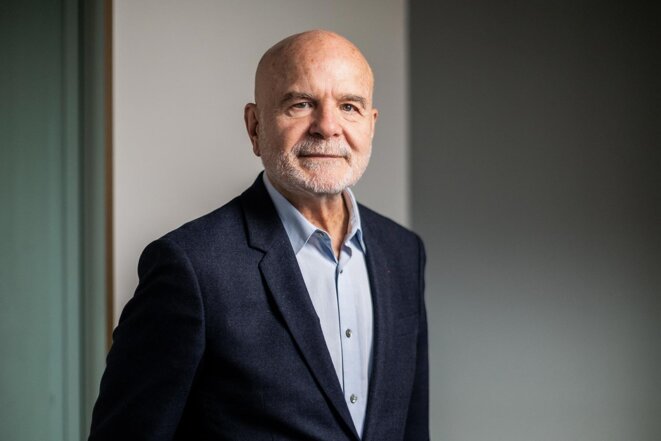
Mediapart and Liberation newspaper last week published videos showing how gendarmes policed a protest at a controversial irrigation reservoir at Sainte-Soline in western France in 2023. Footage from officers' body cameras shows banned and dangerous instructions being given by superiors and a disturbing satisfaction over wounding the “enemy”. Michel Forst, a French citizen who is United Nations Special Rapporteur on Environmental Defenders, says the videos show that the police violence was “not simply a matter of ‘individual misconduct’”, and in an interview with Mediapart he calls for “judicial proceedings” against those responsible.
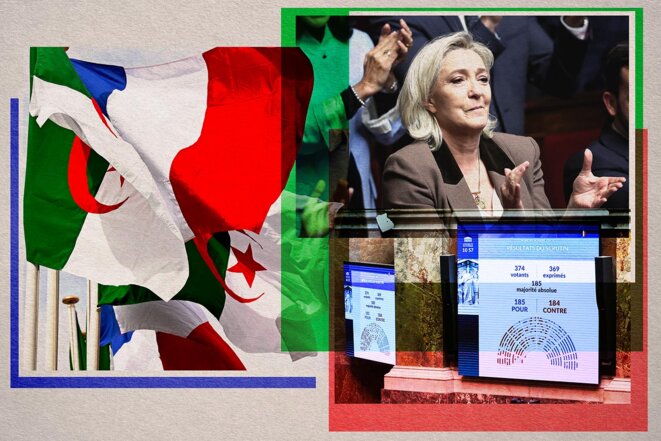
Achieved on the back of a breakdown in Franco-Algerian relations, Rassemblement National's first parliamentary victory late last month underlines the extent to which the far-right's rise to power is driven by the resurgence of a colonial issue that France has still not resolved. As Mediapart's co-founder and former publishing editor Edwy Plenel writes, a desire for revenge over Algerian independence goes well beyond the ranks of the far-right party itself.
Mediapart and Libération have published worrying evidence about the policing of a protest at the site of a controversial crop irrigation reservoir at Sainte-Soline in western France in 2023 which led to brutal clashes. In particular, footage from the gendarmes’ own body cameras shows banned and dangerous instructions being given by superiors, the use of bellicose language, and a disturbing satisfaction in wounding the “enemy”. Faced with these revelations, interior minister Laurent Nuñez has ordered an administrative inquiry into the behaviour of the gendarmes, two and a half years after the events. Camille Polloni, Laura Wojcik and Sarah Benhaïda report.
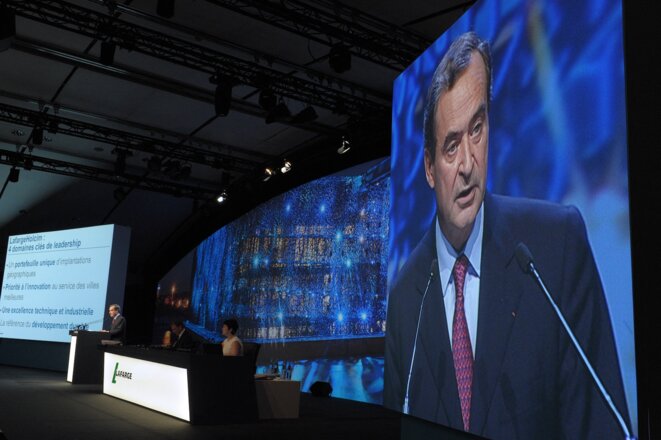
The multinational cement manufacturer Lafarge went on trial in Paris on November 4th, accused of knowingly financing terrorist groups in Syria between 2012 and 2014, in a case set to last until mid-December. Several former executives, including ex-CEO Bruno Lafont, are also in the dock in what is effectively a legal process where corporate greed is on trial.
Large artificial reservoirs, built for farmers and filled from underground water sources in winter to irrigate crops during the summer, are bitterly opposed by environmentalists and have been a source of fierce debate and sometimes violent conflict in France. The company behind the most controversial reservoir, at Sainte-Soline in west France, has been hit by recent court rulings. But in any case, as a Mediapart investigation here shows, the entire economic model of these vast 'mega-basin' crop-watering systems is now looking increasingly unviable.
On October 27th 2005 teenagers Zyed Benna and Bouna Traoré were electrocuted while hiding from the police in an electrical substation in a northern suburb of Paris. Their deaths led to three weeks of protests and urban unrest across France. As part of a wider series on the events that took place 20 years ago and what has changed since, Mediapart here examines how the doctrine of “situational prevention” now influences urban planning in the country's deprived neighbourhoods in a bid to help the policing of future riots and unrest. In particular, this police-led approach dictates which architectural features are permitted - or banned - in new housing schemes.
On October 30th October MPs in the National Assembly voted for a non-binding motion criticising the 1968 accord between France and its former colony Algeria. It was thanks to its active allies on the Right, and its silent ones in the centre, that the far-right succeeded with this vengeful resolution, one oozing in resentment. The French president's own laissez-faire attitude has clearly had a part to play in France's inabilty to acknowledge its colonial past, writes Mediapart’s publishing editor in this op-ed article.
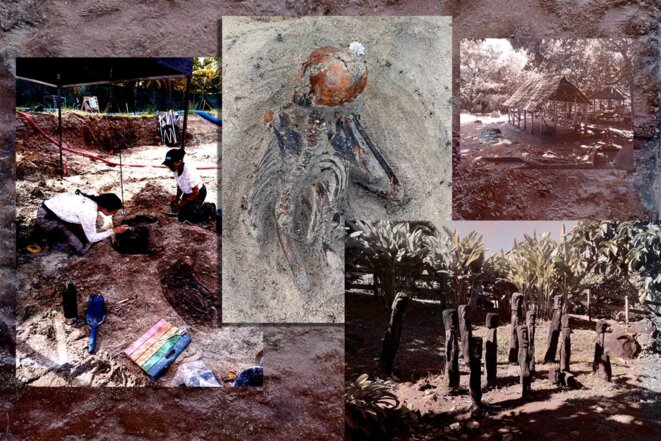
The extraordinary discovery of a large, 1,500-year-old Amerindian site on France’s Caribbean island of Martinique has delighted archaeologists and further fuelled arguments that the rich and ancient history of the region has been obscured by that, comparatively recent, of its colonisation by Europeans. Amandine Ascensio reports from Martinique.
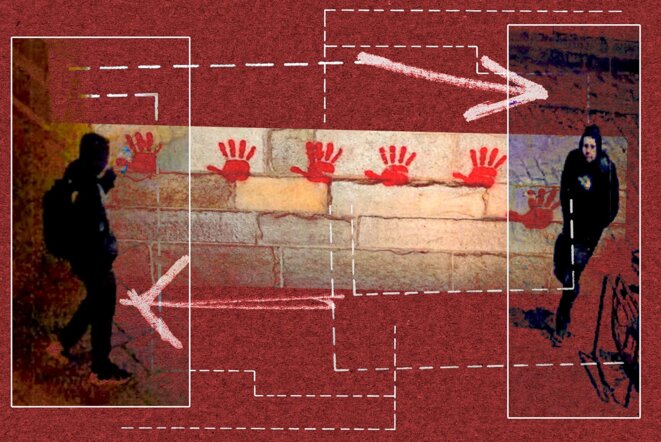
In May 2024 red hand symbols were daubed on the Holocaust memorial in Paris, vandalism that was quickly blamed on Russia. On October 29th four Bulgarian nationals will face trial – one in abstentia – at a Paris court in connection with this defacement of a memorial. The defendants admit carrying out the act but say it was done to promote “peace” and deny it was part of an anti-Semitic operation orchestrated by the Kremlin.