


French billionaire businessmen François-Henri Pinault and Martin Bouygues are among what might be called the ‘chopper set’, whose preferred means of transport for frequent hops from Paris to their respective country homes in Brittany, their separate vineyards in Burgundy and the Bordeaux region, and for visits to countries neighbouring France, is by private helicopter. For longer flights, each has a private jet.
Pinault, 61, is the chairman and CEO of luxury goods group Kering (whose brands include Gucci, Yves Saint Laurent and Balenciaga), and chairman of Groupe Artemis, the holding company of the Pinault family. Martin Bouygues, 71, is chairman of the Bouygues group, whose activities include construction and engineering and telecoms.
The two men share ownership, for their separate use, of a high-end Agusta AW-139 helicopter which, with a crew of up to two pilots, can carry up to ten passengers in luxurious surrounds. While their very different businesses boast of contributing to efforts for tackling climate change, their use of the Agusta private chopper does anything but. Mediapart and Mémoire vive, a collective association that investigates environmental and social issues using information from open sources, have tracked the flights of their Agusta as recorded in publicly available data. This shows that since September 2022 the helicopter has completed 235 flights, covering a total distance of 62,500 kilometres – equivalent to circling the Earth 1.6 times.

Enlargement : Illustration 1

While the Agusta AW-139’s emissions are roughly a third less than the average private jet, they are nevertheless highly polluting. Since September last year, the total CO2 emissions of the 235 flights of their shared helicopter amount to 317 tonnes. By comparison, that equals the estimated average carbon emissions of a French citizen over a period of 32 years (while around 20% of the French population has never travelled by plane).
Furthermore, most of the Agusta’s flights over the past year were brief hops – the average distance covered for each is 267 kilometres – which were journeys that could have often been completed by train.
Mediapart and Mémoire vive found that the chopper had been used for 46 round-trips to London, nearly all from Paris. The train journey from Paris to London takes just two hours and 20 minutes and, according to data from Eurostar, French railways operator SNCF, and AgustaWestland, emits between 400 and 600 times less CO2 than the Agusta AW-139 does on the same journey.
The frequency of the flights to London is most likely explained by the fact that Pinault, since 2014, spends most of the year in the British capital. As a result, he pays taxes in Britain, and over several years asked the French authorities to grant a reduction in the amount of taxes he also pays in France. But his legal move failed in April this year, when a Paris administrative tribunal ruled he was also liable to income tax in France.
Among the other favoured destinations of the billionaires’ Agusta are Venice, Lausanne and the vineyards of southern Burgundy and the Bordeaux region, where both the Pinault family and Bouygues own vineyards, including the prestigious Le Clos de Tart and Château Latour (Pinault) and Château Montrose (Bouygues).
Other recorded flights were to or from Dinard, in Brittany, where the Pinault family own the imposing and seafront Villa Greystones, and to nearby Saint-Coulomb, where Bouygues owns a property and where the helicopter drops him off on the lawn of the holiday home.
In 2006, Pinault and Bouygues created an air transport company called Scar, jointly owned in equal stakes by Artemis, the Pinault family’s holding company, and Actiby, a subsidiary of the Bouygues group, by which they own the helicopter. Given the statutes of the company, Mediapart understands that the two billionaires may benefit from an exoneration of fuel tax for their domestic flights, which would not be the case if the aircraft was owned by either of them personally.
It was in 2019, after selling off a more modest aircraft, that the company bought the Agusta AW-139 for an estimated cost of around 10 million euros. “The AW139, market leader in its class, embodies the hallmarks of elegance, style and sophistication and surpasses all other intermediate helicopters in capability, speed and ride quality,” claims the online presentation by the constructor, adding that “its large and unobstructed cabin is capable of comfortably carrying up to 10 passengers”.
Contacted by Mediapart for comment, neither the Kering group nor the Bouygues group replied before this report was published.
Beginning on September 1st, Mediapart and Mémoire vive will, on this page, publish regularly updated information about the flights of the billionaires’ helicopter over the next three months, including distances travelled and carbon emissions.
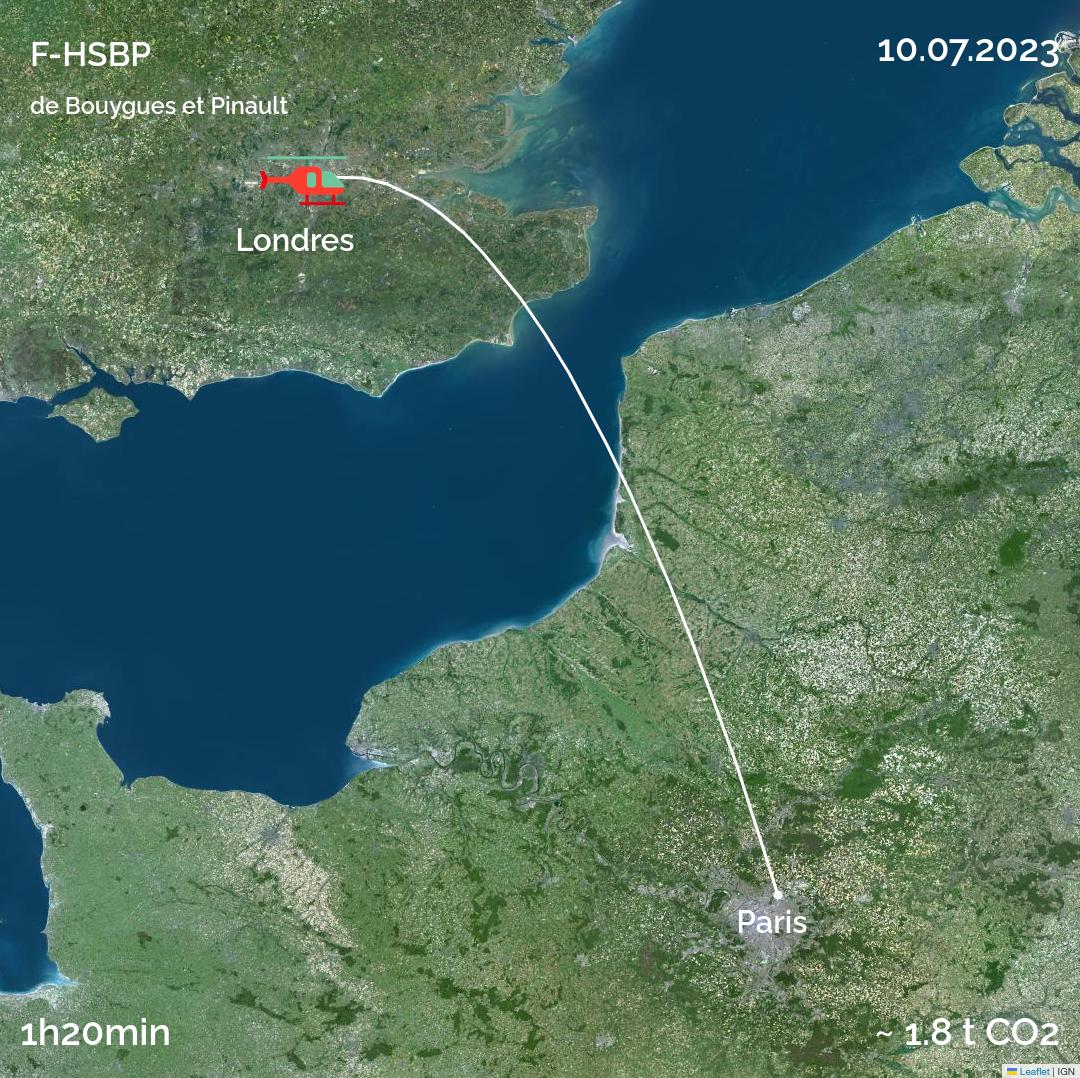
While climate change is accelerating, and this July was globally the hottest month ever recorded, the use of the helicopter is in total contradiction with the green credentials claimed by the groups run by Pinault and Bouygues.
Fêted by some French media as a group that is concerned by climate change, Kering describes itself as “a pioneer in ecological transition among the luxury sector”. In 2019, Pinault, at the request of French President Emmanuel Macron, launched the Fashion Pact, an international project to encourage the various actors of the fashion industry to make their activities compliant with “stopping global warming, restoring biodiversity and protecting the oceans”.
For its part, Kering announced in March that it aimed to reduce its carbon footprint by 40% between now and 2035. In 2021, the group teamed up with the NGO Conservation International to launch a “regenerative fund for nature”, which leant its support to a project for the planting of 200 hectares of nitrogen-stocking legumes in south-west France “in face of global warming”.
Meanwhile, in a press release about its “climate strategy”, Bouygues Construction, the building and engineering arm of the Bouygues group, announced that its vehicle fleet will be almost entirely “green” by 2030, and that it is also aiming to reduce by 80% the number of domestic flights used by its staff on professional missions.
-------------------------
- The original French version of this report can be found here.
English version by Graham Tearse