


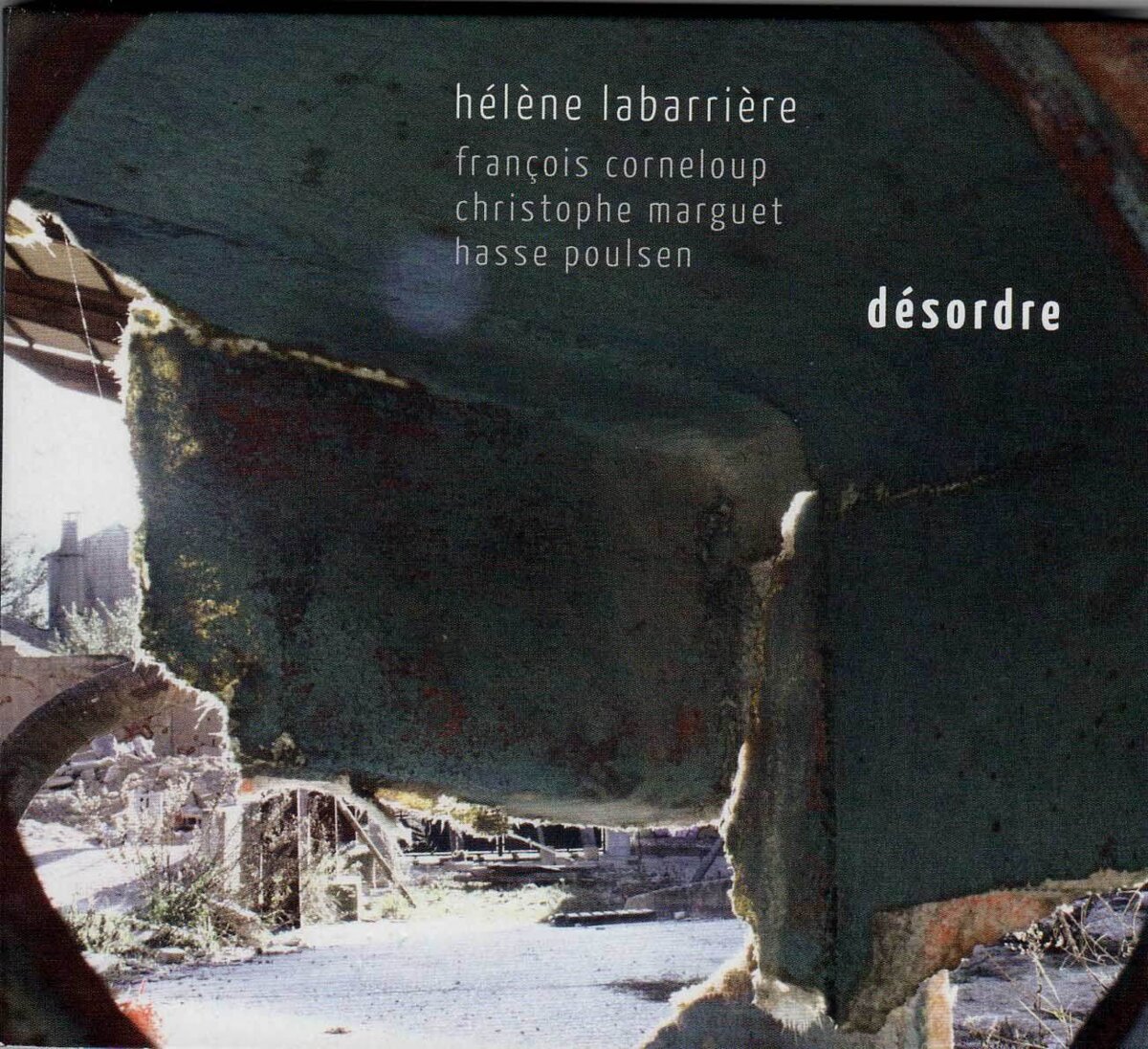
French double-bassist Hélène Labarrière, a composer of jazz and free improvisation music, has carved herself a singular place on the French music scene. Using influences that range from Breton folk songs to West African rhythms, her music is an indefinable, eclectic mix that has evolved from her initial groundings in jazz when, in her early 20s, her first recording was made with the celebrated American alto saxophonist Lee Konitz.
Last month she took to the stage with her quartet at the Sons d’hiver (Winter sounds) music festival in the Paris suburb of Saint-Mandé to present their latest work, Désordre, where photographer Patrick Artinian, a regular contributor to Mediapart, filmed their performance and interviewed Labarrière.
Désordre is only the second album the quartet has produced in ten years and has met with critical acclaim since it was released on February 4th. Bruno Pfeiffer, jazz blogger for French daily Libération, described it as “emanating an incredible sentiment of original beauty” and “the sound of a rich conversation”, while Jazz News Magazine praised its “heady melodies and haunting rhythms” born from Labarrière's long collaboration with saxophonist François Corneloup, guitarist Hasse Poulsen and drummer Christophe Marguet.
“On stage, the disorder, or rather the non-order, is that when the music happens, all the improvised sessions and so on, everything can come about, everything can happen,” Labarrière, 49, explains to Artinian in the video below. “That means that someone can become the leader, for example, in the sense that one can assimilate that to a certain taking power, but this position is co-opted by the others. “
“When you make music, all roads are possible," she adds. "There is not necessarily a chief and followers. There is not necessarily someone who is automatically the accompanist. All of that is always moving, and it can always change. It’s not because I’m a double bassist that I’m going to always support the others. I can be in front and take the stand like a saxophonist. I think that is what is important in our music. It’s that, in the way of making it, we can show that one can socially live differently. It’s in that sense that there is for me, if you like, something political.”
The final section of the video shows the group playing one of Labarrière’s compositions for the album, Mali Montreuil, described as “audacious” and “lively” by magazine Le Disque.
“I completely immersed myself in this [African] music and, having always adored music that’s very groovy, obviously I loved that music and which is what gave me the idea of writing this number,” she tells Artinian. “Which is a sort of strange piece, which is at the same time atonal and asymmetric. So it has nothing to do with Malian music, but within it we regularly come back to a sort of loop that is not particularly Malian but which sounds a bit African. I called it Montreuil Mali like Paris Texas.”
-------------------------
- Patrick Artinian is a Paris-based freelance photographer and a regular contributor to Mediapart, as well as French daily Le Monde, weekly magazine VSD and sports daily L’Equipe. He has previously covered major international events, including the 1989 Armenian earthquake disaster, the 1991 famine disaster in Sudan and the civil war in the former Yugoslavia, in 1993. A member of the Paris photo agency Contact Press Images since 1995, he is currently involved in an extensive photo documentary of contemporary US society.
-------------------------
English version: Graham Tearse
