


The QR code barcode system was born in 1994, invented by Japanese software engineer Masahiro Hara. The code, with its distinctive black and white squares inspired by the Chinese board game Go, quickly made a name for itself in Japan and across the world. Then, just as quickly, it largely disappeared, apart from in Asia.
I still have a few worries concerning the security of the QR codes.
France was no exception and the QR code soon lost popularity here, with people no longer having to get out their smart phone to scan the little squares as they once had. Then, at the end of 2019 a pandemic that began in China quickly spread to the rest of the world, and once again Masahiro Hara's invention became widely used as it was adapted to various online passes. In December 2020 the Japanese inventor told Le Figaro he was pleased that it was being used to help people but added: “I still have a few worries concerning the security of the QR codes which is why I'd still like to improve the system's reliability in the years to come.”
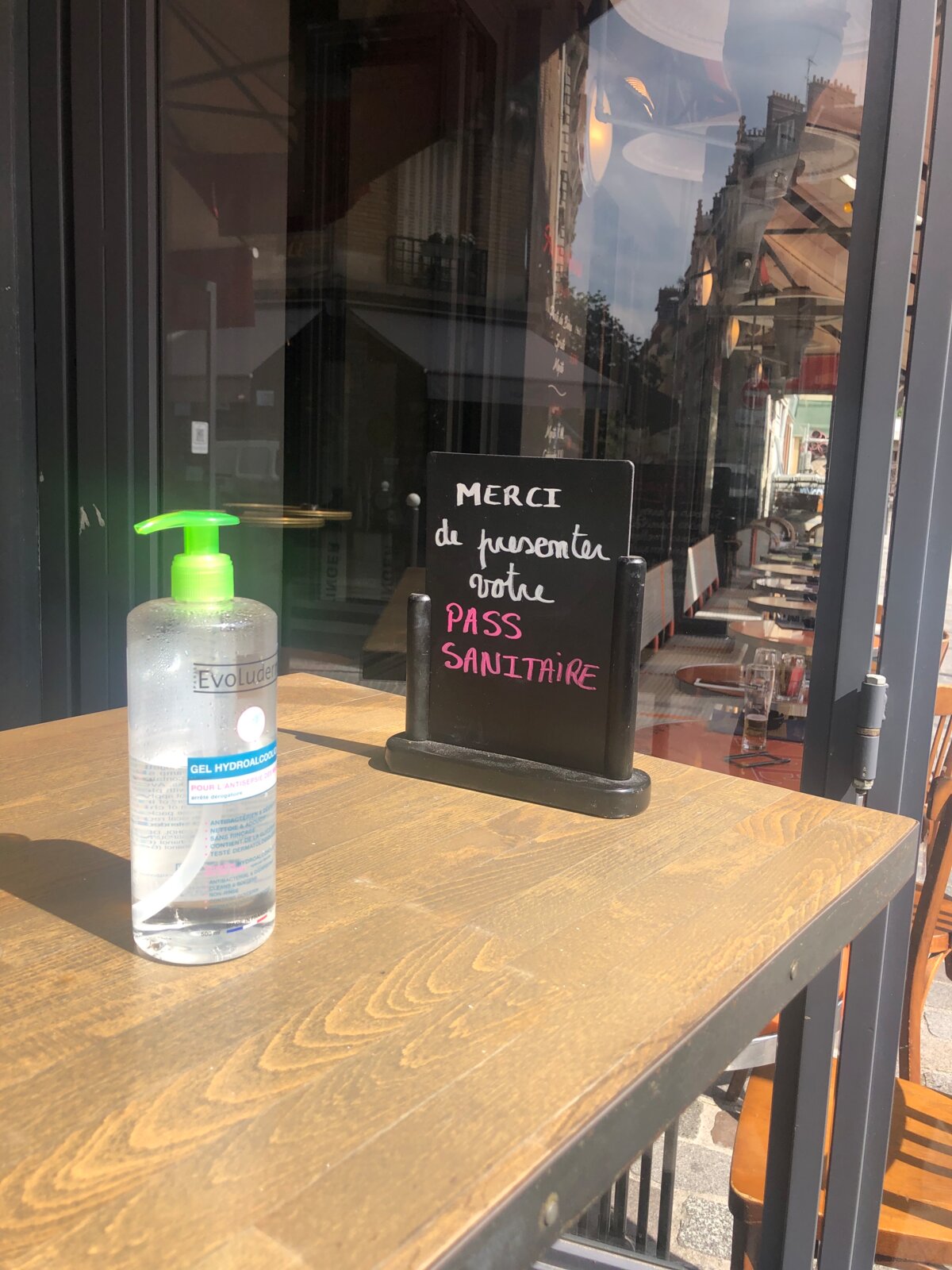
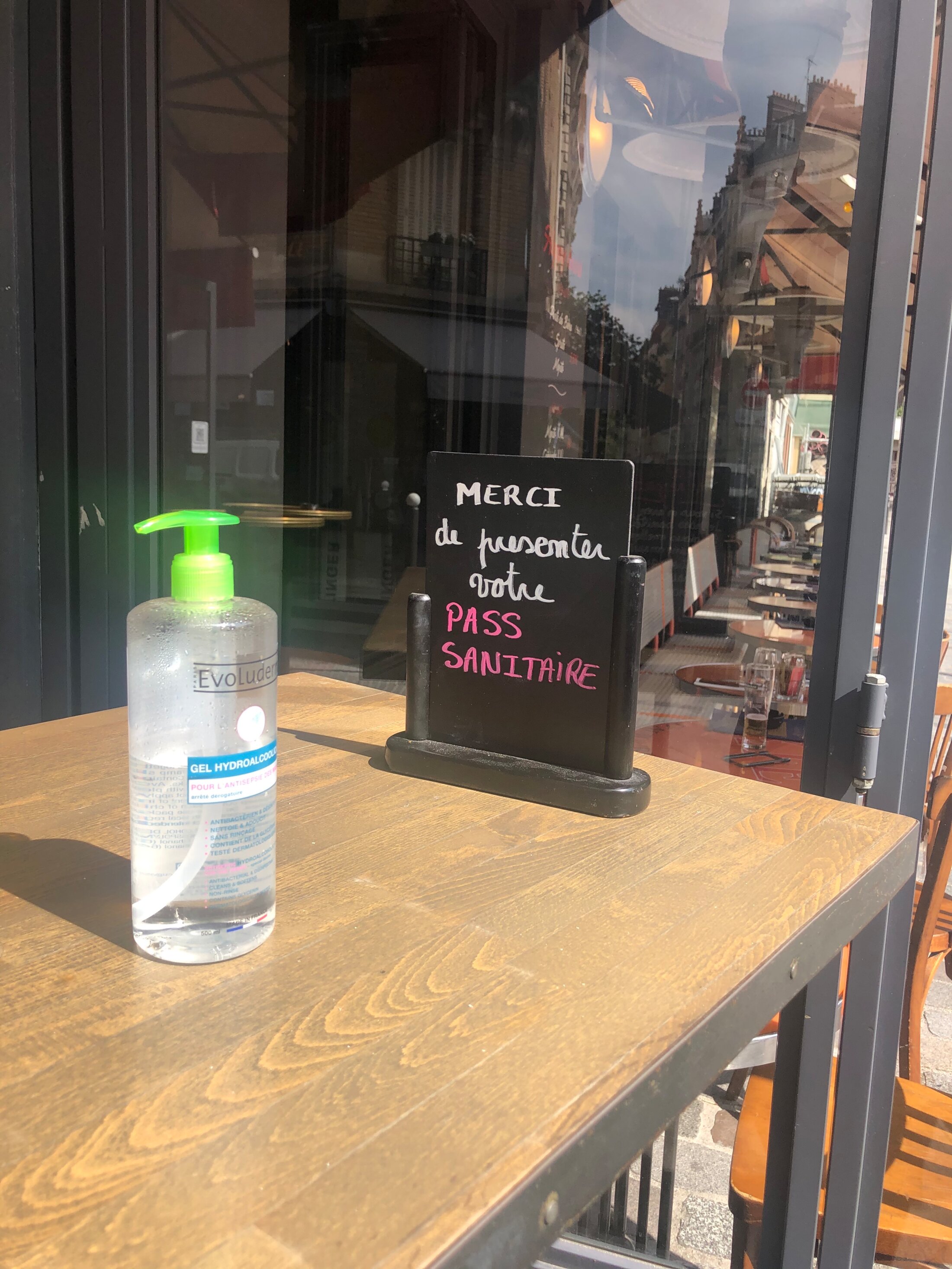
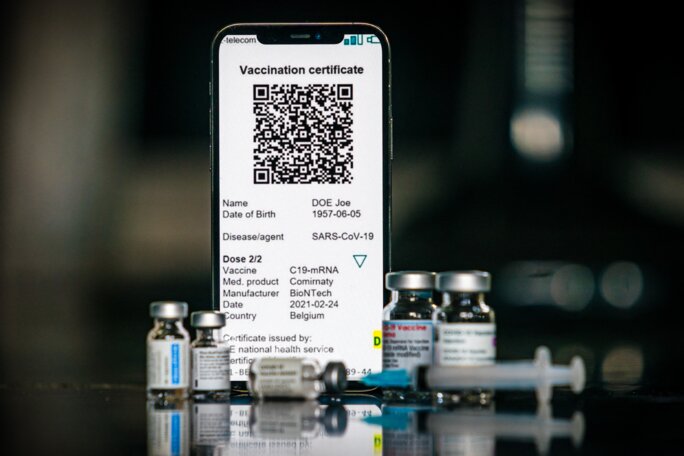
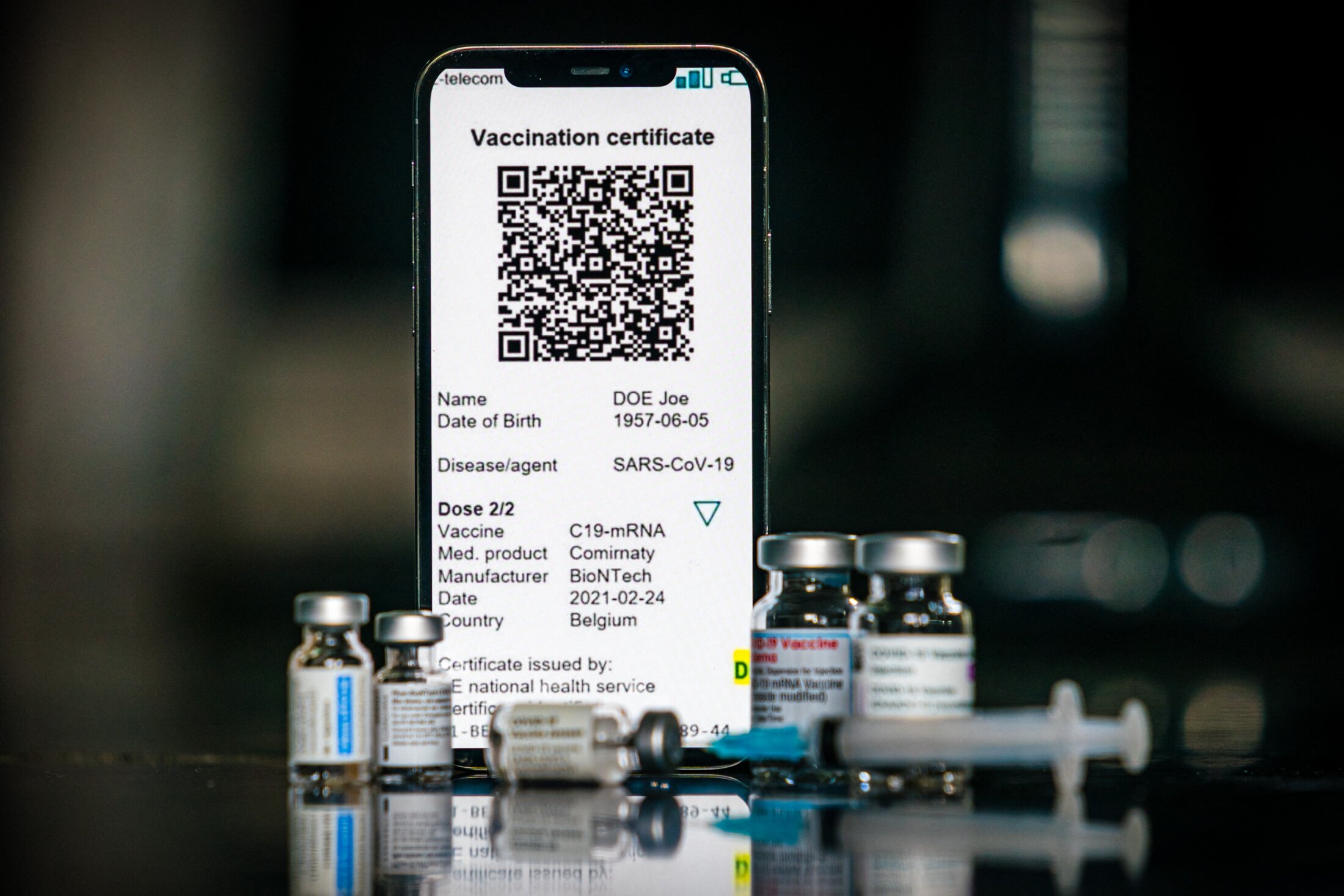
Since Monday August 9th 2021 a 'health pass' has been deployed across France in order to help prevent the spread of Covid-19, a move that has been strongly opposed by some. The pass can be obtained in several ways: with a vaccination certificate, a certificate showing you have tested negative for Covid within the past 72 hours or a certificate showing that you have tested positive for Covid antibodies within the last six months, as proof that you have recovered from the illness. These are then transformed into a QR code which people have to show in order to get access to various forms of establishments and services: hospitals “except for emergencies or to get a Covid-19 test”, cinemas, casinos, libraries, cafes and restaurants, high-speed TGV trains and, from August 16th, some 126 shopping centres with a surface areas of more than 20,000m2.
Enlargement : Illustration 1
So now the QR code, once consigned to the dustbin of French internet use, is firmly back in use. And thousands of men and women are facing a daily battle to get the magic black and white pass so they can continue to live 'normal' lives.
One such person is Brigitte, in her sixties, who struggled for a week to get the pass that she needs to be able to work. She is an actress and director, and someone who has perfected the art of telling stories. Hers resembles that of Sisyphus. Brigitte tested positive for Covid-19 on March 23rd 2021 and quickly recovered. Indeed, the most tiring part was subsequently trying to obtain the health pass to show that she had recovered from the virus and had antibodies: she went to her local testing laboratory every day for a week, and contacted the Ministry of Health, the official rights ombudsman the Defender of Rights, officials at the state social security system and also the IT platform SI-DEP (Système d’Informations de DEPistage) which generates the health pass for those who have recovered from Covid-19.
Brigitte and the saga of the QR code
Brigitte likes to plan ahead. Just under a week before the health pass was due to come into widespread use in France she went to the local laboratory where she had tested positive in March. Once there, the 22-year-old secretary, who was rather overwhelmed by the numbers of patients, duly carried out the necessary procedure on the online SI-DEP platform so that Brigitte would get her health pass. The actress then awaited a confirmatory message from the online platform but none came. The following day she returned to the laboratory and the secretary repeated the procedure. Still nothing.
That same day Brigitte, who describes herself as “peaceful but determined”, called the platform 'TousAntiCovid', the app in which the QR code is downloaded. They told her that she was following the correct steps and should try again. This was Wednesday August 4th and in the afternoon the actress returned once again to the laboratory, with the same fruitless result.
“The secretary was very nice. I was very annoyed that I had to bother them but I didn't know what to do. I wasn't doing all this so that I could go on holiday or have fun, it was to work. If I don't have my QR code I can't rehearse in a theatre. And my show is opening soon,” said the actress, who is directing an adaptation of the play 'Les choses qu'on casse' by Édith Delarue. “My two actors are vaccinated, it's just me who isn't.”
Enlargement : Illustration 2
An irritated Brigitte again called TousAntiCovid and this time the operator at the other end advised her to pass the phone to the secretary at the laboratory so that the latter could call the direct SI-DEP line that is reserved for health professionals.
“The secretary at the laboratory then called the number in front of me,” said Brigitte. “We waited a long time, the laboratory closed and she keep me there for a bit. In all we spent an hour waiting, listening to extremely annoying music. They didn't respond and she told me to come back the next day.” So the actress duly returned to the laboratory on Thursday August 5th. The secretary, as helpful as ever, again called the SI-DEP line reserved for use by health professionals. After an hour of being on hold, the SI-DEP hung up. Both Brigitte and the secretary were annoyed “especially as the secretary told me I certainly wasn't the only in this position”.
Desperate situations call for desperate measures. So now Brigitte decided to call Olivier Véran, the minister of health himself, after finding his number in a Google search. The Ministry of Health officials she got through to advised her to go back to the laboratory and ask the secretary there to call the SI-DEP phone line reserved for use by health professionals...
On the Friday Brigitte went for broke and returned to the same laboratory to get retested for antibodies. “It came back positive, I had some high levels of antibodies. The secretary redid the procedures [editor's note, via the online platform] and there was still nothing. The weekend went by and on the Monday the same secretary called me and explained that the laboratory management had taken up the case and sent an email to SI-DEP the previous Friday. She told me that they'd received a communication that same morning from SI-DEP, who announced that they had updated the system,” said Brigitte. She hurried to the laboratory, got the online procedure redone yet again and within a few seconds she received an email and a text message with her QR code. She left the busy laboratory with the precious QR code on her phone and only returned later to take some chocolates to the secretary.
Enlargement : Illustration 3
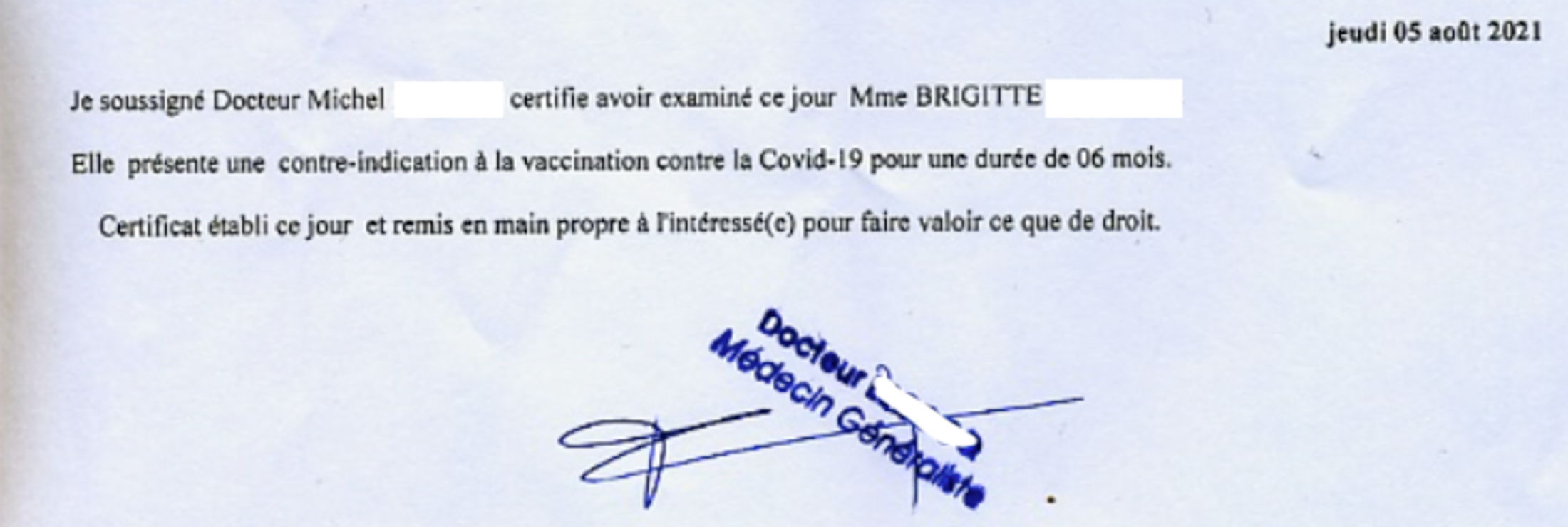
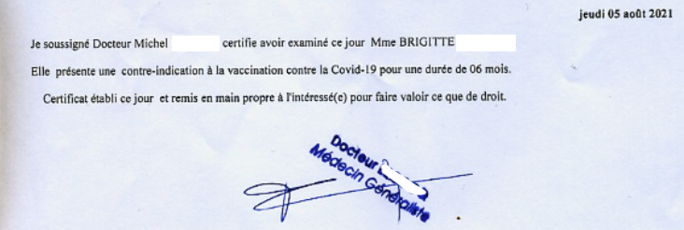
The story could have had its funny side were it not for the fact that Brigitte had not chosen to be unvaccinated. The actress started to cry as she said: “I'm not an anti-vaxxer, I'm not a conspiracy theorist, but in my case this vaccine is really dangerous. I have an allergy to one of its components, I have a contraindication to the vaccination and the government hasn't planned at all for people in my situation. For the time being I at last have this QR code which shows I recovered, but what about afterwards? What will I do when the six months [editor's note, of the validity of her certificate showing she recovered from Covid] have passed and it's no longer valid? I'll have to hope I catch Covid again...” she said.
On August 8th the government published a press dossier on the health pass. It stated that “if you cannot get vaccinated for medical reasons you can get a provisional certificate of contraindication from a doctor so that you are not penalised over the health pass. The contraindication to the vaccination will have to be duly confirmed, in line with the decree in force.”
This waiter is wonderful, I know him well but it's not his fault, he has to respect the instructions he's given.
So Brigitte, still as “peaceful but determined” as ever, decided to put this government assurance to the test. She went to the café below her flat in Paris's XVIIIth arrondissement. She usually goes there early in the morning while her husband is still asleep, and always has the same, café crème. On this occasion she took out her medical certificate without a QR code, and the waiter simply refused to serve her. “This waiter is wonderful, I know him well but it's not his fault, he has to respect the instructions he's given,” she said. The actress then showed him the QR code that she had worked so hard to get and which showed that she had recovered from the illness. That did the trick. “This means that the contraindication certificate is not useable in real life. They're making everything complicated,” she said, irritated.
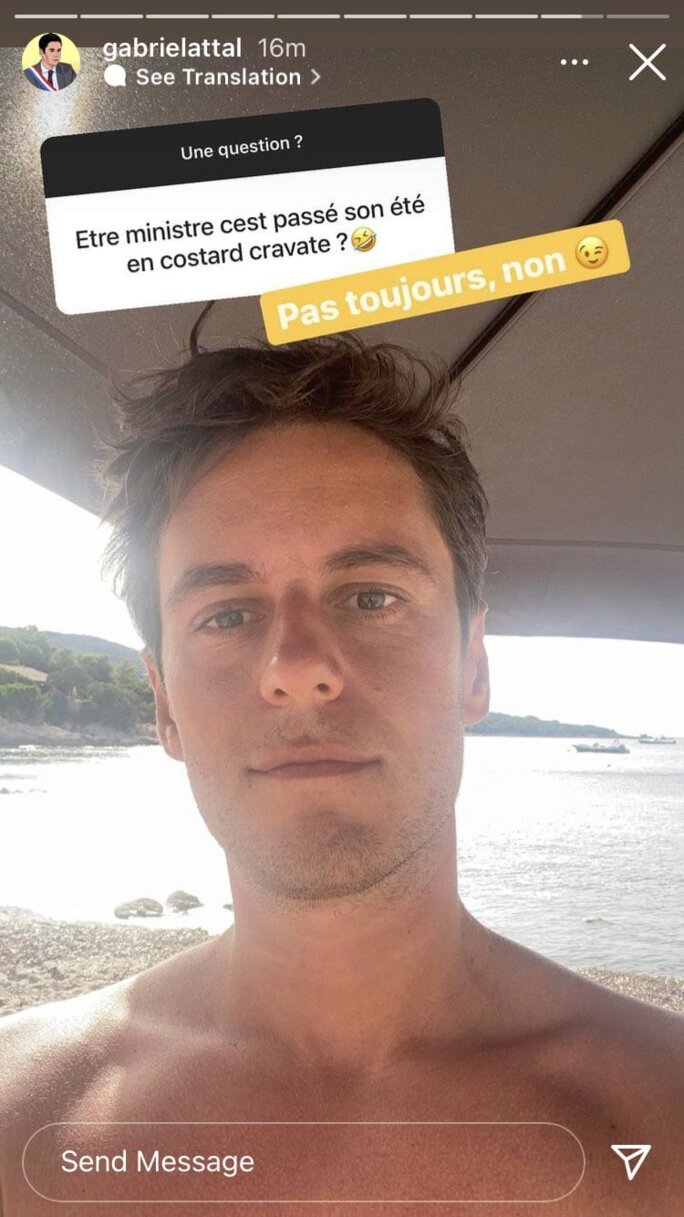
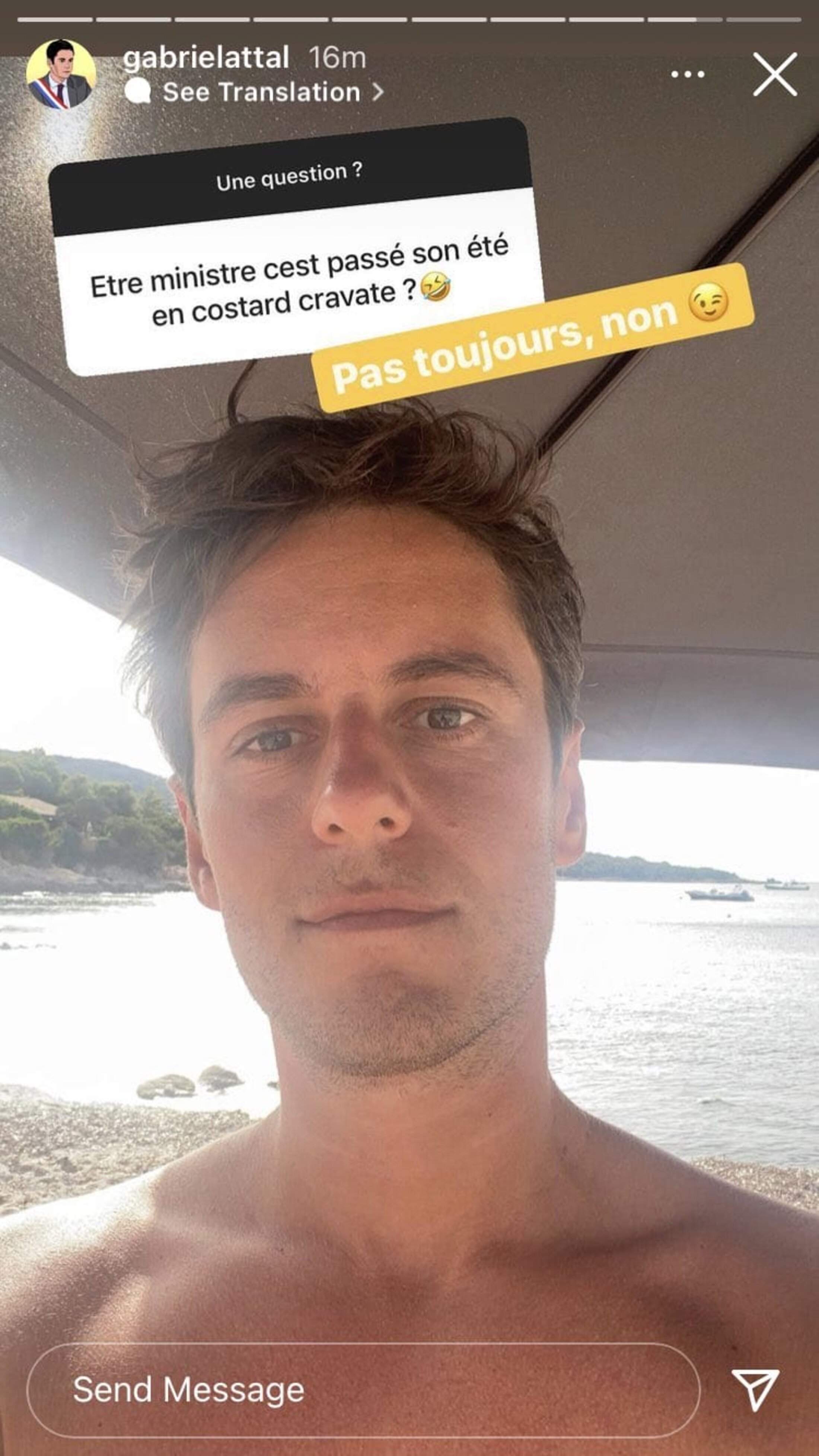
Once her health pass expires Brigitte is planing to get tested every two days so that she can continue to go to work. This is a practice that the government strongly condemns even though it has itself created this situation. The official government spokesperson, Gabriel Attal, said on BFMTV news channel: “Repeated tests are not a substitute for vaccination.” Brigitte noted: “I really won't have a choice, I can't get vaccinated.”
Brigitte is far from the only person to have found themselves in caught up in health pass bureaucracy. Andrew, Marjorie and teenage son Paul have all struggled with the SI-DEP online platform. The family caught Covid in March 2021. Andrew, the father, recalls three endless weeks in which “we were really laid low and on top of that we felt like we were plague carriers”. When their quarantine was over Andrew downloaded his SI-DEP certificate and that of his son Paul, too.
Then on July 12th the president, Emmanuel Macron, announced the timetable for the health pass to come into force. “A summer of mobilisation to get vaccinated, that's what we must aim for. To vaccinate a maximum of people, everywhere, all the time,” the head of state said.
So the family set about using the certificates showing they had had Covid to get a health pass. Andrew downloaded the TousAntiCovid app and tried put in the QR code that he had received. But it did not work. They all went back to the laboratory they had previously used and got their certificates re-issued. But they ended up getting the old certificate format again, which was still not compatible with the app.
Andrew then called the TousAntiCovid and SI-DEP centres, waiting for hours on the phone and getting no clear response. On July 13th he then wrote to TousAntiCovid and they replied three days later in an email that Mediapart has seen. The site told him that “the certificates currently sent by SI-DEP are not recovery certificates that can be integrated in the app's logs.... you will soon be informed about how to add your Covid-19 test to the application. In the meantime we ask you to be patient.” More than a month has gone by and Andrew and Marjorie are still waiting. They will soon have had all their vaccinations but in the meantime for much of the summer they have been unfairly deprived of being able to go to restaurants, cafés and cinemas – to the great dismay of their 15-year-old son in particular.
Questioned about these cases and software issues on the SI-DEP online platform, the Ministry of Health brushed aside any criticism. “The SI-DEP platform, like all IT systems, needs updating and changes that can temporarily disrupt connections to the citizens' portal or the portal for professionals. We are putting in place numerous communication methods for citizens and health professionals (in particular free-phone numbers and email addresses) ...” In its response to Mediapart the ministry also said that in every case a person needed to go back to a laboratory or a medical professional to get their certificate of recovery re-issued.
Meanwhile on Saturday August 14th the Ministry of Health said that the system for obtaining QR codes in laboratories was “back to normal” after two online disruptions had stopped many people from obtaining the codes between Friday afternoon and Saturday lunchtime.
#SIDEP 1er jour de l’obligation du PASS SANITAIRE et pas de QRCODE pic.twitter.com/mytlpgX2Cn
— De Cuerbòne Julià (@d83200julie) August 9, 2021
Software glitches, lack of understanding, annoying music while on hold and then the phone cutting off after an hour …. this all has a real impact on the lives not just of the public but also health professionals on the ground. They are the ones who are closest to the public and who often have to bear the brunt of people's frustrations, threats and even assaults.
On August 9th a female pharmacist was assaulted by a patient at Villeneuve-la-Garenne in the northern suburbs of Paris. At around 11am a couple had come to the counter. The woman was there to get a QR code following a positive test for Covid back in March 2021. In a formal statement of complaint reported to the police station at Villeneuve-la-Garenne, which Mediapart has seen, the pharmacist described what happened next. “I tried to explain to the couple that the data was stored in the database for 90 days and that I could not supply a QR code from a PCR test dating from March because their file had been closed,” she said. “The woman's partner ended up losing his patience and insulting me … he then got hold of the perspex screen separating us and threw it, and it fell on the top of my head, the computer screen was also thrown onto my knees … then the individual leaned over the counter and hit me, I then pushed him back.”
Lionel Barrand, president of the Syndicat National des Jeunes Biologistes Médicaux (SJBM), which represents laboratory technicians and medical staff, said the situation was becoming harder and harder to deal with. “The patient always comes back to the laboratory even though we don't control the issuing of the QR codes. All we can do is to verify the data and ask for a re-issue but we don't have access to the platform itself,” he said. “Often we check everything and everything is fine at our end but the problem comes when the patients go back to the social security system, the health authority or the SI-DEP who all repeat that it's a problem at the laboratory.... and that creates a lot of tensions. In short, we are being let down left, right and centre. Each time the government changes the rules it's always we who have to deal with the teething problems. We're exhausted.”
Enlargement : Illustration 6
If, despite not having a health pass, you still want to take the train and go on holiday it is possible – but again, you have to be patient. Consider the example of someone living in Pantin in the northern suburbs of Paris who wants to go on holiday to Collioure, a charming seaside resort on the Mediterranean coast not far from Perpignan ...
Going on holiday without a health pass – a traveller's guide
To start your journey you hop on the metro train at 6.39am, on line 7 heading for Villejuif. There is no need for a health pass here. You change underground trains at Pyramides station and take line 14, arriving at Bercy railway station at 7.12am. That gives you just enough time to get an overpriced takeaway coffee at the station; you can't sit down and have one because you don't have the magic pass.
You then jump on the 7.34am train to Lyon in eastern France which arrives at 12.51pm. This is a regional TER train so you don't need a health pass; those are only required for high-speed TGV or Ouigo trains or trains on the Intercité network. Once at Lyon you take another TER train, this one to Valence to the south, which leaves at 1.20pm. At Valence you catch the 3.31pm service to Avignon, which arrives at 4.57pm. From here you can take yet another TER to Perpignan via Narbonne. This train gets in to Perpignan at 9.50pm and all that then remains is to climb aboard one final TER train to Collioure, which leaves at 10.09 pm and arrives 20 minutes later. This marathon effort will have taken 15 hours and 48 minutes and cost 162 euros ... but at least it can be done without a health pass.
SNCF staff find it hard to respond to passengers when faced with the absurdity of the situation, while transport minister Jean-Baptiste Djebbari simply keeps referring to the health regulations that are in force. But he is also promising that there will be widespread checks carried out on those trains where a health pass is required.

Enlargement : Illustration 7

Meanwhile those who have the health pass are able to travel freely by any train. In some cinemas, museums and leisure centres pass holders are even allowed to remove their masks. As far as ministers are concerned, the world of leisure and something approaching normal life is reserved for those who have been vaccinated.
“Where there is a health pass [in operation] people can remove their mask because it means that we are sure that all the people who enter are completely vaccinated or had a very recent negative test,” the Ministry of Health said in a statement on July 20th 2021. Yet being vaccinated against Covid does not mean you do not get infected by the disease or are not infectious, as Mediapart has reported here.
Holiday camps reserved for the vaccinated
“I'd planned to go sailing, do paintballing, play laser tag, various open air activities. I was expecting to make new friends, it was going to be my first time,” said Mahel, aged 15. Around 30 young people had arrived at the holiday camp at Yssingeaux in central southern France by train in the afternoon of August 1st. They rushed to their bedrooms, unpacked and finally took off the masks that they have to wear in the corridors and communal rooms. “After three days three children had early symptoms of Covid. They had tests which came back positive - the head of the centre called me and left a voice message to inform me,” said Marine, Mahel's mother. Then every child was tested and the next day, though the results were negative, all of them were sent home except for those few who had already been vaccinated.
We didn't understand why we were being sent home even though we were negative.
“We weren't happy,” said Mahel, who said that most of the support staff were very nice about it. “We asked them for an explanation. We didn't understand why we were being sent home even though we were negative.” When asked for an explanation the holiday camp did not respond to Mediapart's detailed questions but instead simply stated that “all the decisions taken over this situation were done so in full association with the regional health authority and the services of the DDCS [editor's note, the Direction Départementale de la Cohésion Sociale, a state body which oversees social, urban and youth policies in a local area], we didn't really have a choice over certain decisions.”
------------------------------------------------------------------------
- The original French version of this article can be found here.
English version by Michael Streeter