


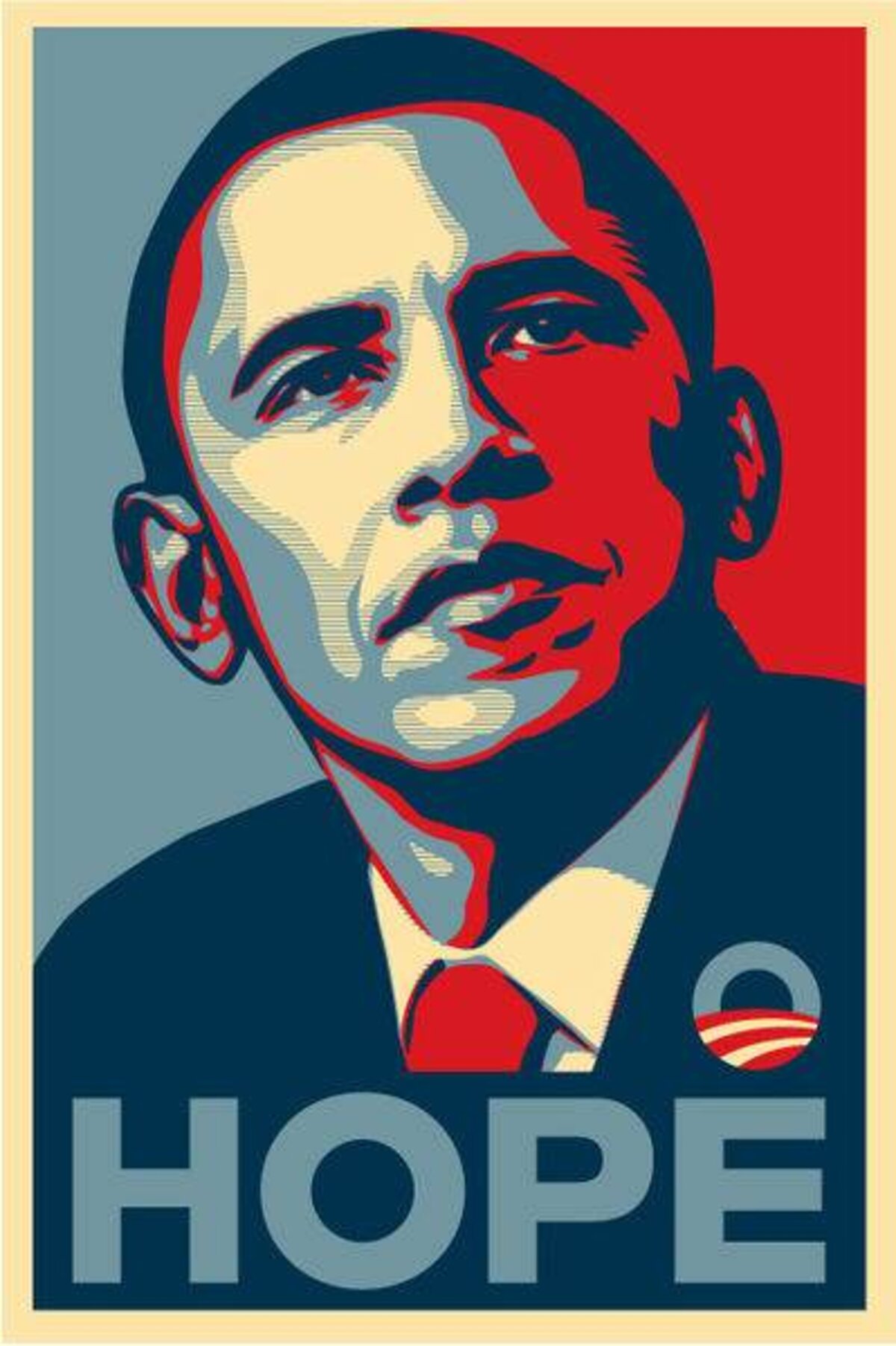
When Mediapart met US street artist Shepard Fairey at his Los Angeles base in February 2011, he was on bail. Ever since he began his first illegal urban graphics in 1989, 42 year-old Fairey, who became widely-known with his ‘Hope’ poster for Barack Obama’s 2008 election campaign, has spent a lot of time either holed up in police custody or inside museums – sometimes even both.
When, in August 2009, the Boston Institute of Contemporary Art mounted a retrospective exhibition of 20 years' of Fairey’s work, the incorrigible son of the punk-rock and skateboarding scene spent the night of the inauguration in a cell, after he was arrested en route to the event, caught red-handed mounting one of his XXL-sized illustrations in the street.
During a recent trip to Paris, however, he managed to stay out of trouble with the men in blue, (although he could not resist sticking a few posters on streets and in the metro). Mediapart followed him (see video below) on his June trip around the French capital, where he came with his wife, two children and three long-serving staff to ‘bomb’ a vast and drab wall in the city’s southern 13th arrondissement, and to present his customized patching of the Levi’s denim bomber jacket (in collaboration with French graffiti artist André Saraiva, AKA M. André) at the company’s new flagship store on the Avenues des Champs-Elysée.
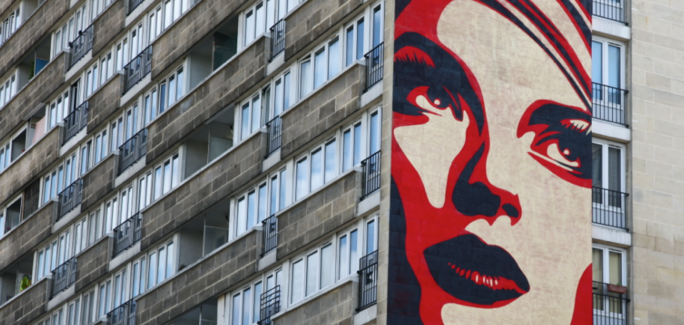
The 13th arrondissement of Paris is becoming something of an open air art gallery, thanks to the street art campaigns of the Itinerrance gallery and a helping hand from Butterfly. Over the past few months artists (off varying talents) have been transforming the buildings of the district with giant murals, and now joined by the esteemed Fairey.
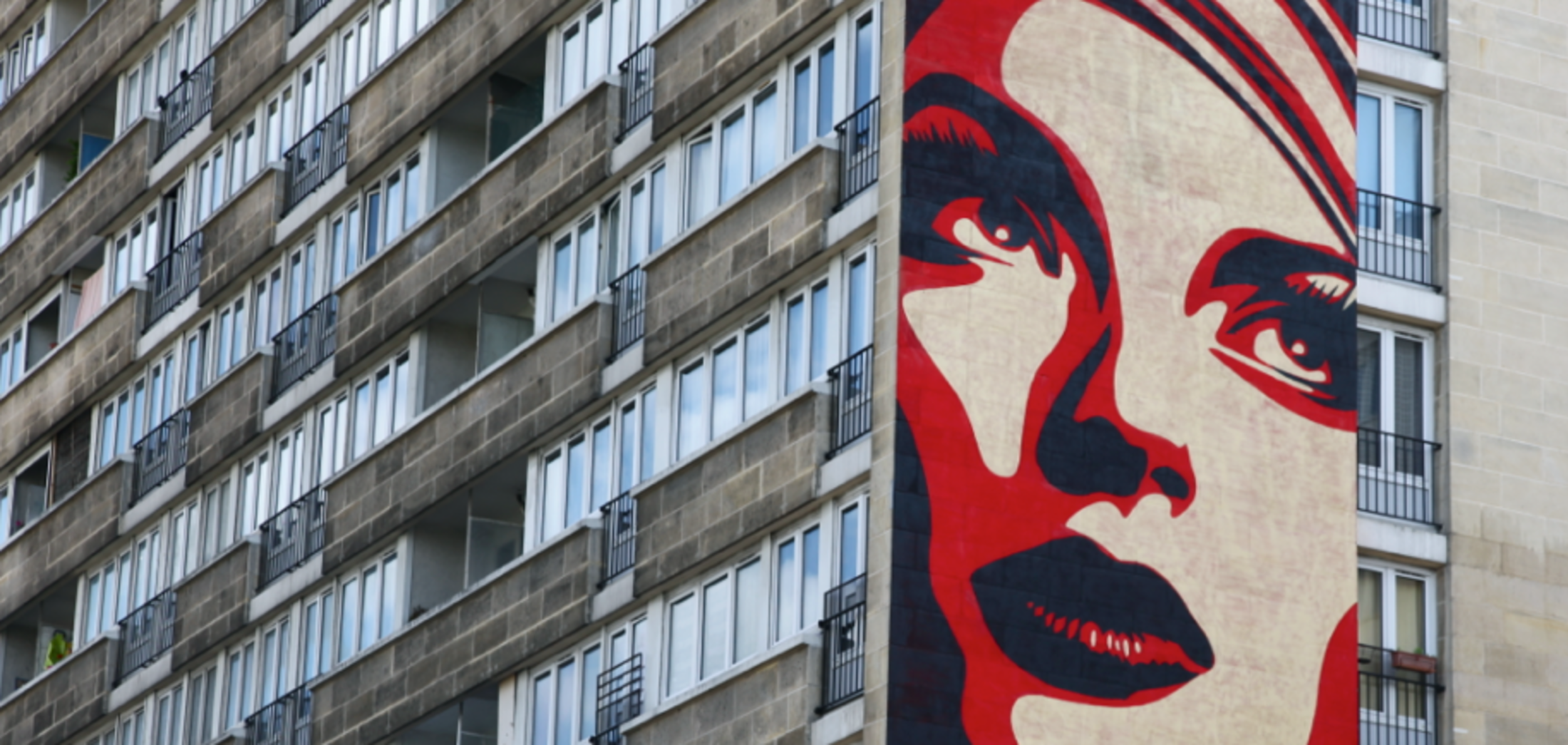
His contribution (see photo below) was the face of a young woman, seemingly lifting her saddened, defiant eyes in a moment of determined hope, covering a wall at the angle of a grey, 13-storey, block of flats on the corner of the rue Jeanne d’Arc and the boulevard Vincent Auriol and reaching up 40 metres to the sixth floor. It appears to draw inspiration from past revolutionary art and current social protest movement iconology - and an echo of 'Hope'.
Enlargement : Illustration 3
Fairey’s formal training began with the Idyllwild Arts Foundation in California, when he created his ‘ the Giant Has a Posse‘ illustration, before entering the celebrated Rhode Island School of Design, from which he graduated with a Bachelor degree of fine arts in illustration. While a student, he entered the early clandestine street art movement, transforming urban landscapes by spray-bombing and posting up his screen prints and stickers in his spare time.
Twenty years and two front covers of Time magazine later, Fairey has had his revenge on those, teachers and critics, who dismissed street art as a lowly and marginal hobby of little artistic interest. In the US, his work has been showcased at the New York Museum of Modern Art, the Smithsonian Institution, the Los Angeles County Museum of Art, the San Diego Museum of Contemporary Art, the Virginia Museum of Fine Art in Richmond, and in the UK at the Victoria and Albert Museum in London.
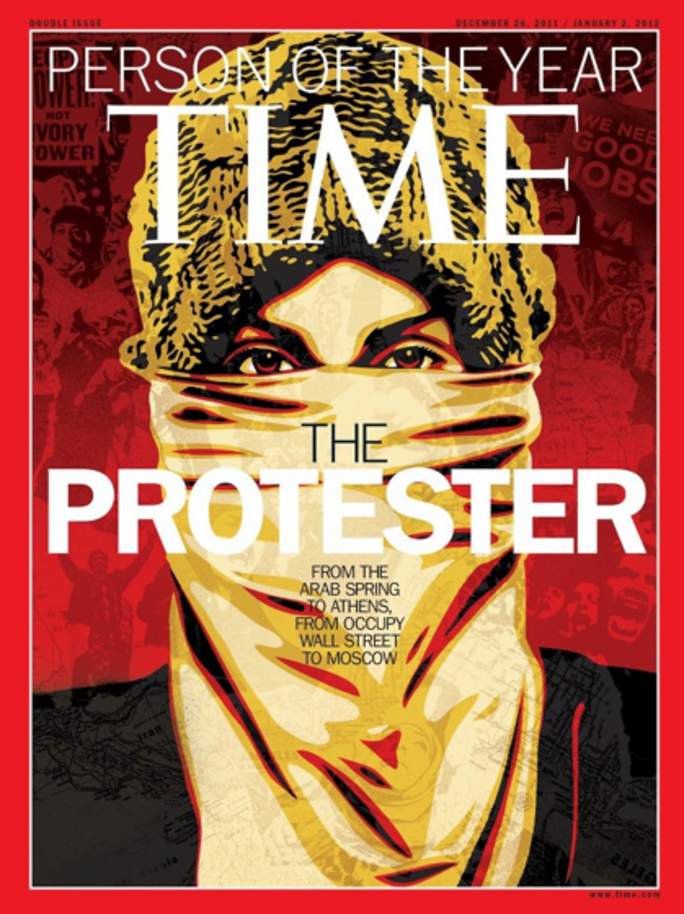
In 2009, his Obama campaign poster ‘Hope’, which has been described as the most effective political poster image since that of the Uncle Sam army recruitment campaign, was acquired for permanent display by the US National Portrait Gallery in Washington. It was also his first front cover for Time, followed by another in 2011, when he was invited to create ‘The Protester’ to incarnate the magazine’s Person of the Year, attributed to that year’s international revolt movements, notably that of the 'Arab Spring'.
Doing himself
With its re-mix take on Soviet aesthetics, Fairey’s work shakes up the public places controlled by public authorities and advertisers. He sprays Left-handed, targeting the excesses of consumer society, capitalism and, previously, the US-led war in Iraq. The first major artist to denounce the politics of George W. Bush, he became a protégé of Obama, revolutionizing presidential campaign imagery with ‘Hope’.
The ‘fabulous destiny’ of Shepard Fairey was the subject of Mediapart’s aforementioned interview with the artist in Los Angeles in April 2011 (see below).
Critics accuse the art activist of having lost his street cred, turning his back on his underground roots to become a careerist, taking the poisoned penny offered by designer labels and creating Studio Number One. Fairey’s anti-propaganda message, some argue, has itself become the propaganda he once declaimed.
Such accusations, naturally, irritate the artist, who claims he enters into business collaboration only with trademarks that he considers respectable, defined as those with popular urban culture, engaged in humanitarian or ecological programmes, or from the music industry. He insists that the money he earns from such ventures pays for projects like his loss-making art gallery that showcases emerging or sidelined artists. Fairey believes he is still following the ‘Do it Yourself’ slogan from his underground days
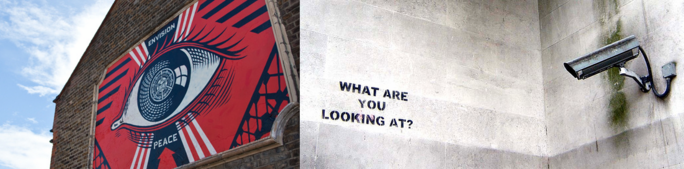
Enlargement : Illustration 6

After leaving Paris, Fairey moved on to London to paint a city wall beside a corner shop on Turnpike Lane with his trademark eye and the slogan ‘Envision Peace’, close to where, amid the surveillance cameras of the capital of CCTV, his friend and fellow street artist Banksy had had his own bit of fun (photo above).
-------------------------
English version: Graham Tearse
