


A painter whose family found refuge in France from Franco's Spain is back in this country both in person and on screen. Nicolas Rubió, who was born in Barcelona in 1928, came with his family to live in a small rural hamlet called Vieille at Ytrac in the Auvergne region of central France in 1938 and stayed until 1948, when they all emigrated to Argentina.
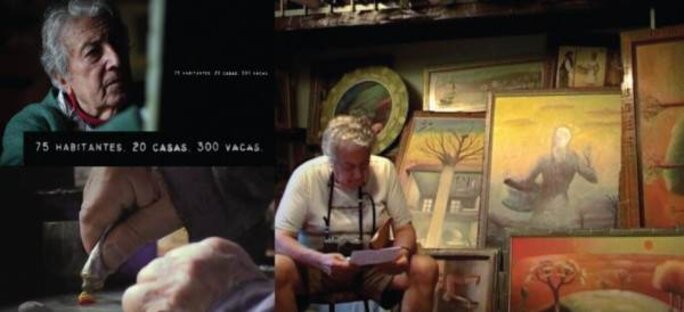
It was in South America that Rubió's talents as a painter in the naïve art tradition blossomed, but it was his ten years spent deep in the countryside of central France that provided the inspiration for much of his work. And it is that work and his life that is the subject of a fascinating documentary by Fernando Dominguez called 75 habitantes, 20 casas, 300 vacas ('75 inhabitants, 20 houses and 300 cows').
Appropriately enough this documentary, which is in Spanish with French subtitles (see trailer with English subtitles above), is being shown at locations across the Auvergne until July 15th. Moreover Nicolas Rubió, who is now 85, has made the long journey across the Atlantic to be present at the screenings.
This unassuming documentary focuses on the artist's depiction of a rural France from just before, during and after the Second World War that has now disappeared. It is an atmospheric, crackly work with silences and sounds of the countryside, punctuated with small-town gossip. Using the artist's works the director manages to reveal the mysteries that unite memory and art; the flight of a bird in the Auvergne with a painting in Argentina.
Gradually, the viewer starts to get a grasp of the essence of a village that belongs to another time. There's the well-established Roquetanière family and also Father Mathieu, a gruff priest from a bygone era, who reassures the child who has an unfortunate attack of the wind during catechism with an enigmatic and blunt phrase: “Better to have a fart in public that to die alone.” Nicolas Rubió himself comes across as a singular individual; a humane, modest, tenacious, demanding and good man. He has a radiant face upon which the camera lingers.
While in France, Rubió is taking part in discussions - in his perfect French - poking fun at human follies. During the 1940s, whenever he was deemed to be hanging around too much with the locals, the artist's principled mother used to remind him: “Don't forget that you are the son of an engineer.” Seven decades later and in this showcase documentary of secularism and republicanism the painter is still seen to be angry about this “pride in qualifications that makes it ok to scorn friends...”
Enlargement : Illustration 2
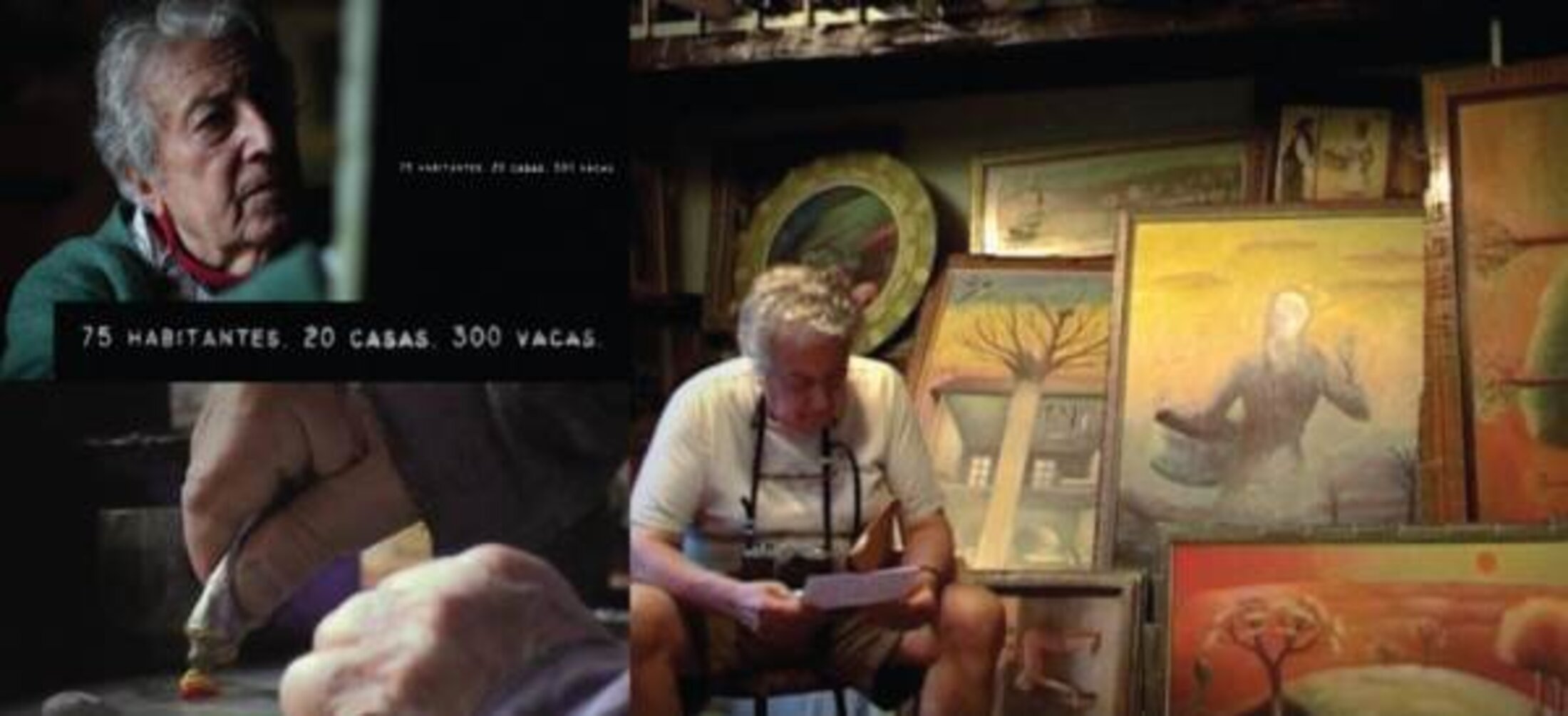
75 habitantes, 20 casas, 300 vacas is being shown at 3pm in Ytrac on Saturday July 13th and at 8.30pm at La Jetée film centre in Clermont-Ferrand on Monday July 15th.
---------------------------------------------
English version by Michael Streeter