


Throughout 2025, two young Palestinians, Nour Elassy, a journalist, poet and writer, and Ibrahim Badra, 23, a journalist and human rights activist, have been reporting for Mediapart from within the Gaza Strip on the horrific reality of the war there.
The war began after the October 7th 2023 Hamas attacks on Israel that left more than 1,200 people, mostly civilians, dead, and since when, according to the Hamas-run health ministry, close to 70,000 Gazans have been killed in Israel’s subsequent retaliatory invasion, during which, as recorded in a recent United Nations report and also by NGOs including Amnesty International, the Israeli government pursued acts of genocide against the civilian population.
Elassy left Gaza in July, with the help of the French authorities when she was offered a place to study at the prestigious Paris School of Advanced Studies in Social Sciences (EHESS), leaving behind her mother and sister. Since her arrival in France this summer, she has continued to contribute her chronicles on the situation in Gaza, where a tenuous ceasefire was officially declared on October 10th.
Elassy, whose higher education studies were in English and French literature, was born and raised in the Gaza Strip, in the north-east neighbourhood of Tuffah. After Israel’s invasion of Gaza, she and her family were displaced and lived for almost 15 months in Deir al-Balah, a town in the centre of Gaza.
She returned to the north in February this year, but in April she and her family were again forced to move.
She says writing is essential for her. She began composing poetry shortly after the October 2023 Hamas attacks against Israel, and has published them online, notably on Instagram.
In this latest contribution to Mediapart, below, Elassy denounces what she sees as the hypocrisy of European governments which recognise the state of Palestine, but which “also fund Egypt’s border fortifications and vote to renew EU missions that transform Gaza into a supervised enclosure rather than a free part of a sovereign state”. It is, she writes, “to recognize a state on paper while accepting its erasure in practice”.
-------------------------
Will there still be Palestinians within this future vision for Gaza?
From Paris, I watch the European continent congratulate itself for finally recognizing Palestine, even as it bankrolls the walls, buffer zones, and “migration management” systems that make it easier to empty Gaza of its people and harder than ever for us to go home.
On paper, Europe has never sounded more pro-Palestinian. France has officially recognized the state of Palestine at the United Nations (UN). President Emmanuel Macron insists that “the Palestinian people are not a people too many,” and calls for an international stabilization mission in Gaza. Several European governments frame this as a moral turning point, a belated correction after nearly two years of devastation.
But if you follow not only the speeches, but the contracts, the border missions, the migration-control funding, and the new maps of Gaza, another story emerges. It is the story I see as a Palestinian from Gaza now living in Paris, with my family still sheltering in tents and ruined apartments: Europe is building the infrastructure for a Gaza where Palestinians are either gone, sealed in, or governed as a problem to be managed rather than as a people with a right to live and return.
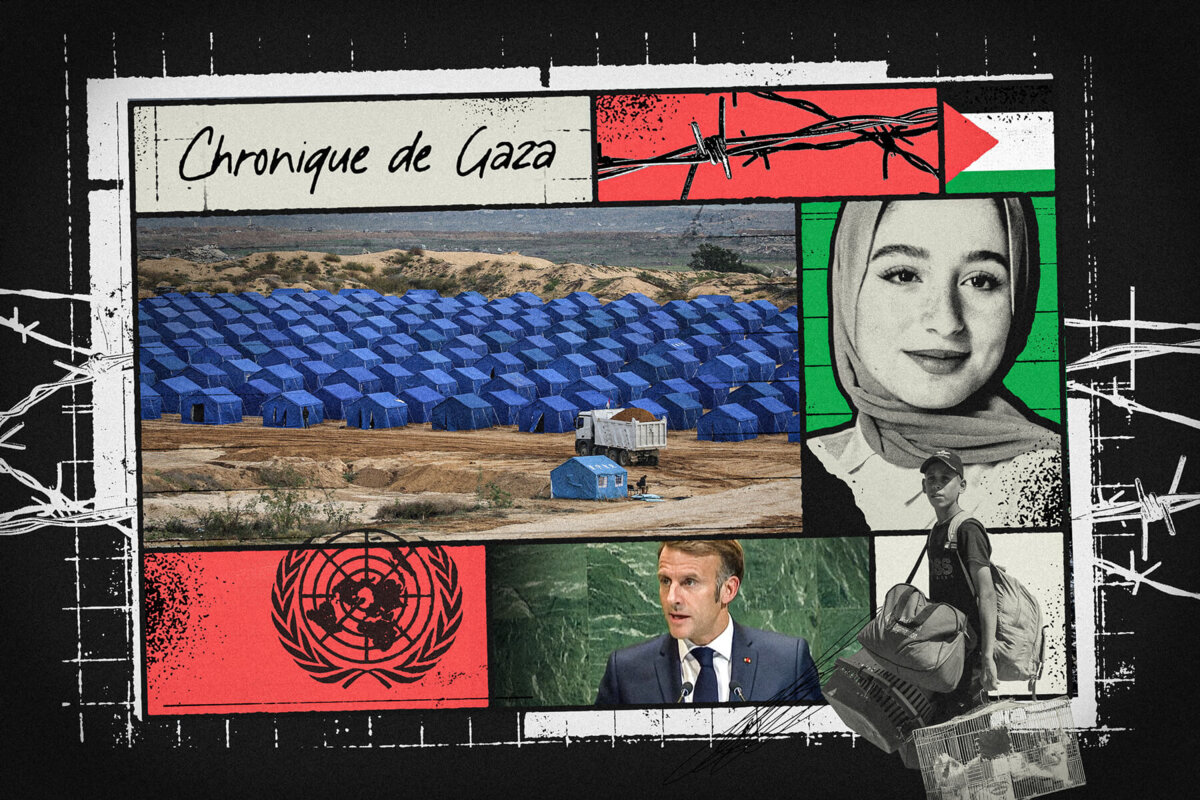
Enlargement : Illustration 1
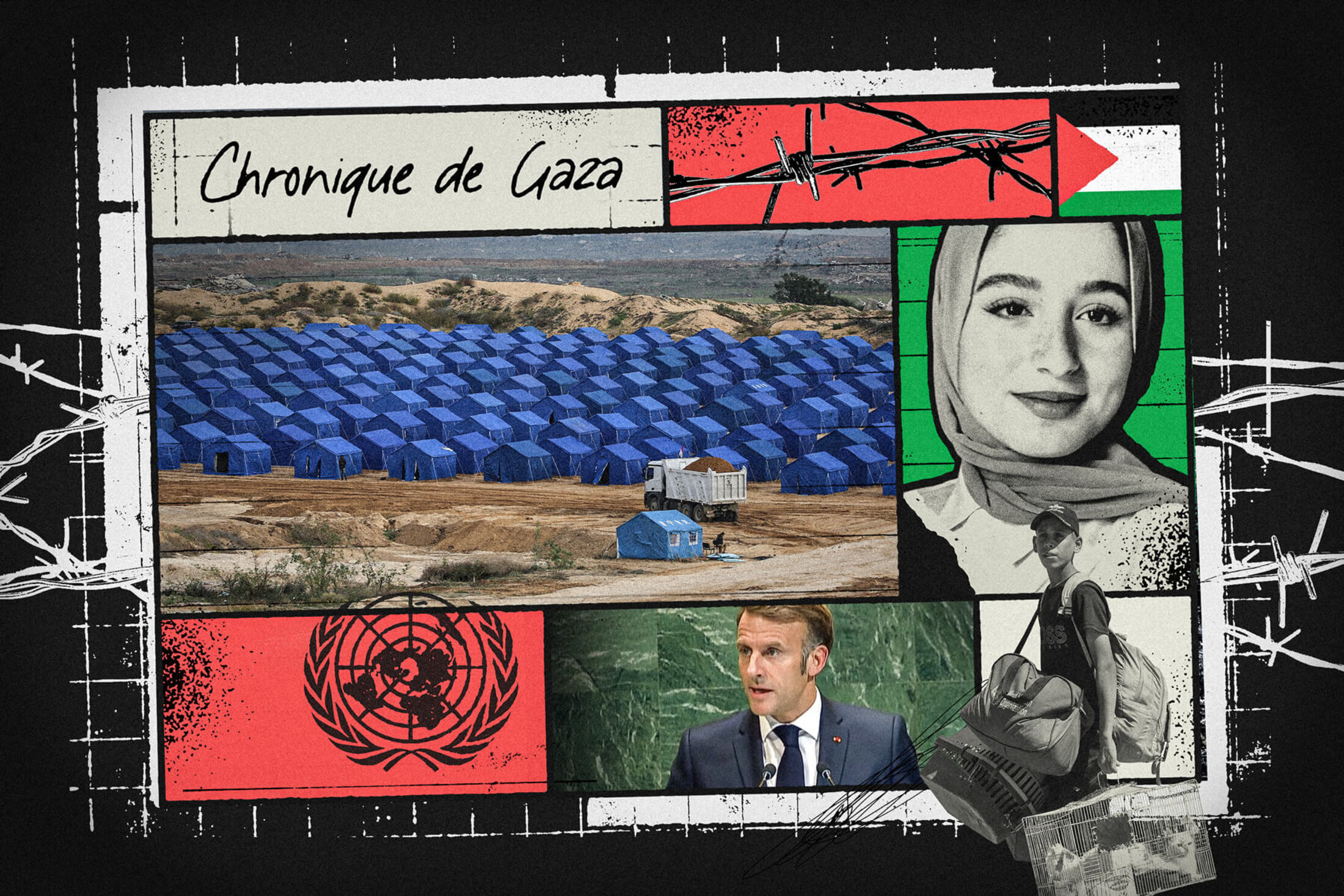
I am not claiming the existence of a single secret master plan. But when policies are placed side by side the physical destruction of Gaza – the open advocacy of “voluntary emigration,” Europe’s massive investment in border containment, and the push for international governance schemes – a coherent direction appears.
It points toward a future in which Gaza remains, but Gazans themselves become optional.
Making Gaza unliveable is not a side effect
Any discussion of “the day after” must begin with the day we are living through now. A UN Commission of Inquiry has concluded that Israel is responsible for four genocidal acts in Gaza, finding that Israeli leaders, including the president and prime minister, have “incited the commission of genocide.”
Amnesty International has reached a similar conclusion. On the ground, these legal terms translate into numbers and ruins. UN agencies estimate that at least 1.9 million people, representing around 90 percent of Gaza’s population, have been displaced, many of them repeatedly.
OCHA reports that roughly 86 percent of Gaza is now either under Israeli displacement orders or designated “militarized zones”, forcing Palestinians into ever-shrinking and unsafe pockets of land.
Families are now facing a third winter in tents that flood with sewage water when it rains. Making a territory physically uninhabitable is not an accident of war, it is a method. And that method is paired with political and military mechanisms that point toward a single outcome: fewer Palestinians in Gaza, less Palestinian land, and more permanent external control.
This is not speculative. Israeli officials say it openly. Finance minister Bezalel Smotrich has argued that Israel should occupy Gaza and “encourage” half of its 2.2 million residents to emigrate within two years.
In July 2025, Israeli minister Gila Gamliel released an AI-generated video depicting a future Gaza filled with luxury resorts and Trump-branded towers—a beach paradise built on the promise of Palestinian disappearance. The caption was blunt: “It’s us or them.”
These words are enforced by bulldozers. The UN human rights office has warned that the scale and nature of Israeli evacuation orders and “no-go zones” suggest an intention to permanently remove civilians from large areas of Gaza.
Europe’s multi-billion-euro deal with Egypt
It is within this context that Europe is shaping its policy. Officially, Europe insists that the displacement of Palestinians into Egypt is unacceptable. Unofficially, it is paying Cairo precisely to manage and contain the human consequences. In March 2024, the European Union (EU) and Egypt signed a “strategic and comprehensive partnership” backed by a 7.4-billion-euro package for 2024–2027.
This includes 5 billion euros in concessional loans, 1.8 billion euros in investments, and 600 million euros in grants – of which 200 million euros are explicitly earmarked for “migration management”. EU documents make clear that this funding is intended to fortify Egypt’s borders and enable Cairo to host refugees so they do not move onward to Europe.
It is a familiar externalization deal: Europe pays others to keep displaced people out of sight. Soon after, satellite imagery revealed Egypt constructing a fortified buffer zone and concrete-walled compound in Sinai near Rafah, widely interpreted as infrastructure to receive large numbers of Palestinians if pushed across the border. Egyptian officials deny any intention to accept mass displacement. But the groundwork exists.
At the same time, EU institutions have fast-tracked additional macro-financial assistance to Egypt, explicitly citing its “strategic role” amid the Gaza war and regional migration pressures. This is not neutral aid. Pouring money into border fortification and containment, while a neighbouring state openly discusses emptying Gaza of its people, makes Europe a participant in the architecture of possible ethnic cleansing whatever its stated intentions.
Gaza as a cage to be internationally managed
Europe is not acting alone. Gaza’s future is increasingly discussed as though it were an empty territory to be administered by security forces, donors, and foreign leaders. A US-brokered ceasefire proposal envisages an international governing body, the “Board of Peace,” chaired by US President Donald Trump, to oversee Gaza’s reconstruction for at least two years under a UN mandate. A multinational stabilization force would control security, while a technocratic Palestinian committee handles daily administration.
Trump himself has spoken publicly of “cleaning out” Gaza and resettling Palestinians elsewhere. France has aligned itself with the idea of an international security presence. In his UN speech recognizing Palestine, Macron proposed a transitional administration involving the Palestinian Authority, “young Palestinians,” and security forces trained by France and its partners, backed by an international stabilization mission.
Nowhere in this vision is there a guarantee of the right of return for displaced Gazans to areas turned into buffer or kill zones. Nowhere is there a clear rejection of Israel’s territorial seizures. Meanwhile, the EU has reactivated and expanded its border mission at Rafah (EUBAM Rafah) to monitor crossings and facilitate exits from Gaza primarily for the wounded, students, and “exceptional cases.” Its mandate has been extended through 2026.
As a journalist who left Gaza this year through an evacuation process managed by the French consulate and the occupying authorities, I know what this looks like on the ground: buses lined up under UN and EU logos; lists of “approved” names decided in distant offices; a narrow corridor of exit for a few, while the majority remain trapped.
You can call this humanitarian. It is also a laboratory for a future in which Palestinians are selectively extracted from a controlled enclosure that itself becomes permanent. Europe will argue that recognizing Palestine proves its commitment to our presence rather than our removal. France’s recognition is historic, particularly as it cites the catastrophe in Gaza as a moral breaking point. But recognition without confrontation is hollow.
European states continue to export arms and dual-use technologies to Israel despite mounting evidence of genocidal acts and a Palestinian death toll now estimated at more than 60,000. The same governments that speak of equal human worth also fund Egypt’s border fortifications and vote to renew EU missions that transform Gaza into a supervised enclosure rather than a free part of a sovereign state.
To recognize Palestine while enabling Israel to retain land seized through buffer zones, while allowing officials who advocate “voluntary emigration” to remain unsanctioned, is not to defend Palestinian presence. It is to recognize a state on paper while accepting its erasure in practice. From my room in Paris, my phone fills with videos: tents collapsing in November rain; children trying to sleep on sewage-soaked mattresses; a grandmother whispering that she now fears clouds more than bombs.
These are not a people “too many”. They are a people whose grandparents lost villages in 1948 and who are being told again through rubble and borders that there is no place for them.
Europe still has a choice
If European leaders truly oppose a Gaza without Palestinians, they must express it in policy, not poetry. That means explicitly rejecting Israeli “voluntary emigration” schemes and conditioning relations on the abandonment of demographic engineering and permanent buffer zones. It means tying reconstruction and border missions to the right of return for all displaced Gazans, including to areas currently declared “no-go zones.”
It means ending migration-control deals that turn neighbouring states into Europe’s jailers unless they are conditioned on firm guarantees against forced or economically coerced resettlement. It also means ensuring that any international force or governing body in Gaza is accountable first to Palestinians not to Washington, Brussels, or Tel Aviv, and that it protects our right to live at home, not Europe’s desire not to see us. Otherwise, the conclusion is simple.
Europe will be remembered as the continent that wept over Gaza, recognized Palestine in New York, and quietly helped design a future in which Palestinians are either scattered in camps along its borders or trapped under international management on a shrunken, securitized strip of land.
I write this not as “an angry woman from Gaza,” as some prefer to dismiss me, but as a witness who has lived both realities: the flooded tent and the Paris seminar on “peace”. If my voice trembles, it is because I know how easily policy language – “migration partnership,” “buffer zone,” “stabilization force” – turns into bare feet in mud and the sound of my little sister coughing all night under plastic. Europe is already deciding what Gaza will look like after the bombs. The only honest question left is this: will there still be Palestinians within it?
-------------------------
- A French translation of this chronical, written by Nour Elassy in English, can be found here.