


On the surface it might look like just another refuse collection strike in Marseille. This 16-day stoppage was, after all, the third such dispute in the space of three months over the working hours of garbage collectors in the major Mediterranean port city. But in reality, say observers, a social revolution has taken place. Indeed, the agreement reached on Wednesday February 2nd between the Aix-Marseille-Provence metropolitan authority and the Force Ouvrière (FO) trade union represents an unprecedented challenge to a political-union system that goes back more than 70 years. And it was brought about through a mixture of people power, politics – and a little help from a strong wind.
After World War II the socialist and strongly anti-communist mayor of Marseille Gaston Defferre had to deal with a city with a strong communist following and in which thousands of dockers wielded considerable industrial clout. To manage the situation Defferre, who was mayor from 1953 until his death in 1986, encouraged the creation of Force Ouvrière (FO), a breakaway union formed by those who opposed the French Communist party's hold over the major CGT trade union. He then granted FO all it asked for, with the aim of weakening the CGT's influence. Municipal staff in the city soon got the message: to get a wage rise, a promotion or your son hired, you had to get a FO membership card.
Pierre Godard, a retired refuse collector, former union boss and something of an intellectual in the waste collection world, recalls a scene which sums up the prevailing climate at the time. Soon after Godard was hired he went into a large council building to collect his wages, which at the time were paid in cash. Everyone was queueing up. Standing at the exit was a FO official who asked him: “Right then, your card?” The new employee asked: “What card?” The official replied that he was referring to membership “of the union”, and when Godard, in his own words, naively asked which union the room suddenly went silent. “FO,” said the official. “Never that one,” Godard replied. The rubbish collector said that from that day on they “set about crushing me”.

Enlargement : Illustration 1

Under Gaston Defferre the FO ruled the roost at City Hall and everyone yielded to them. After his death the system continued and from 1995 to 2020 the centre-right mayor of the city Jean-Claude Gaudin took it over. Only officials from Force Ouvrière were received in his office and he would talk to them alone. The situation was grotesque; delegates at the FO's annual conference got to their feet to applaud the right-wing politician. The original aim of the system – to weaken the CGT – no longer applied as the trade union landscape had changed enormously, but by maintaining this system Gaudin and FO shared power and thought they were untouchable.
“The municipal authority followed the logic of clientelism to the bitter end, to the point where it became absurd,” said Pierre Godard, who wrote an interesting book on the system, 'Éboueur de Marseille - entre luttes syndicales et pratiques municipales' ('Marseille refuse collector – stuck between union struggles and City Hall practices') with André Donzel, published by Syllepse in 2014.
In such a situation the FO – whose refuse collection agents were often used to stick up political posters, from parties of all political hues - asked for and received ever more. “The citizens are not idiots,” said Laurent Lhardit, the socialist assistant mayor in the city in charge of economic dynamism, jobs and sustainable tourism. “They look at the tax that they pay for household refuse [editor's note, 18% of the overall local tax bill in Marseille] and compare it with the state of their streets, the collection of their bins. There is no climatic or geographical reason for it to cost much more in Marseille. Practices have been occurring that are far removed from public service,” he said.
In June 2021 a report from the local authority accounts watchdog stated that in the city of Marseille and the wider metropolitan authority area the “tonnage collected annually per inhabitant is below the objective” set by the local authorities. “They are also below the objectives imposed by law.” The cost of the area's collection service and its refuse treatment, it says, is “systematically above the national average”.
On average a Marseille refuse collection agent works 3.5 hours a day for an average salary of more than 2,000 euros net a month. Doubtless no one would have found fault with it – after all, who wants to go behind a rubbish bin collecting their fellow citizens' rubbish? - if the service had been up to scratch. But under a system known as “finish and go” - the working day ends when the rounds are finished – some of the staff used to do a rushed job. Some ended their rounds in two or three hours and had another job on the black. This could cause fatigue and lead to a high rate of absenteeism - affecting around 20% of refuse collectors according to the head of Force Ouvrière in Marseille, Patrick Rué.
Such a system could not last: the 2019 law changing the way the public sector operates gave local authorities three years to get rid of work regimes that opted out of a 35-hour working week. In Marseille virtually all of the the metropolitan authority's workforce has indeed already moved to the 1,607 hours a year imposed by that law.
But for the most physically demanding jobs, in particular refuse collectors, the authority deferred the negotiations. Had they opened talks sooner this would have meant that the switch to longer working hours would have been gradual. But at the time the ruling right-wing majorities, headed then by Jean-Claude Gaudin in the city of Marseille and Martine Vassal in the metropolitan authority - the body with responsibility for refuse collection - preferred to hold back. They wanted to wait until after the 2020 municipal elections, polls at which the FO were precious allies. As a result it was not until the autumn of 2021 that the metropolitan authority headed by Martine Vassal opened talks. This meant that the staff concerned would be facing an abrupt doubling of their working hours from January 1st 2022.
Behind the scenes of the negotiations
The aim of the talks was to calculate a rate regarding the toughness of the work, which would then be translated into a reduction in working time. “All the unions were invited,” said Serge Tavano, an official at the FSU trade union representing many metropolitan authority staff. “We were seen two or three times and were asked for our proposals. Then, one morning, we learnt that an historic agreement had been reached between the vice-president in charge of refuse and Force Ouvrière.” This was the old style of doing things, except that this time the majority trade union – the FO had 38% of the vote at the last workplace elections, against 26% for the second-placed FSU – had gone down a dangerous path.
It turned out the FO union had negotiated a 9.6% reduction in working time for the most physically demanding jobs – in theory a local authority cannot offer more as it is not allowed to exceed the conditions for the best-treated state employees – plus an 80 euro bonus per person. When these details emerged the refuse collectors decided that it was not such an historic deal at all and the strike continued, marking the end of the first act of the drama.
Faced with a continuing conflict, the FO did not want to be overtaken by events. So the union went back on the agreement it had just reached, using the pretext that one of its points had not been respected by the metropolitan authority. The latter then changed its strategy. A councillor from the ruling right-wing Les Républicains, Yves Moraine, a lawyer and former assistant mayor under Jean-Claude Gaudin in Marseille, took over as lead for the authority in the negotiations. “I broke with the historic tradition of co-management of this city,” he claimed. “I announced that we were going to work in a transparent way with all the unions, and to end up this time with a written agreement.”
Enlargement : Illustration 2
For that was another peculiarity of the Marseille system: the agreements between City Hall and the FO have always verbal in nature. “I was told that's how it is here,” continued Moraine. “You gave each other a high five to signify agreement. Well no, I said from now on, there'd be no more high fives.”
As a result a conference was held in December with all the unions around the table. “That's never been seen before,” said one FSU union official. The CGT union demanded a reduction in working hours of 20% for the toughest jobs and the metropolitan authority in the end accepted a reduction of 15%. The FO, which had accepted a figure of 9.6% just a few weeks ago, had now been calling for a cut of 30%.
“It was completely contradictory,” said the authority's negotiator Yves Moraine. However, the FO's Patrick Rué said: “But at the beginning they told us they could not legally do more. Once this barrier was no longer there then we could ask for more.”
The other unions signed an agreement to end the dispute on December 14th but not the FO. Having been accustomed to get all the benefits from strikes for itself alone, the union did not enjoy the new rules of the game. This signalled the start of the third act.
As they sought to mobilise for a new strike a few days before Christmas, FO demanded a 100-euro bonus for working on Sundays. The metropolitan authority gave way, to avoid uncollected rubbish piling up over the Christmas period. Then, at the start of January, the authority went back on its word, informing FO that this measure was illegal and that it did not have the right to grant such a bonus. “The problem was that they had said yes to us and we had told the agents,” said Patrick Rué. “The [membership] said to us that either we're jokers who just tell them any old thing or that we get conned each time.”
The union had no choice but to dig in its heels and on January 10th gave notice of a new strike.
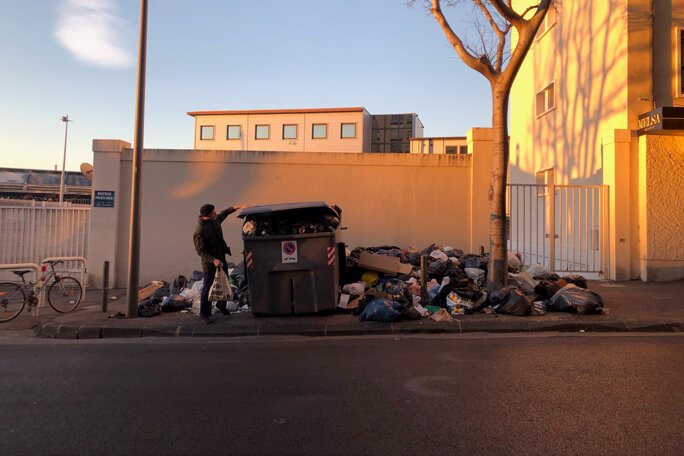
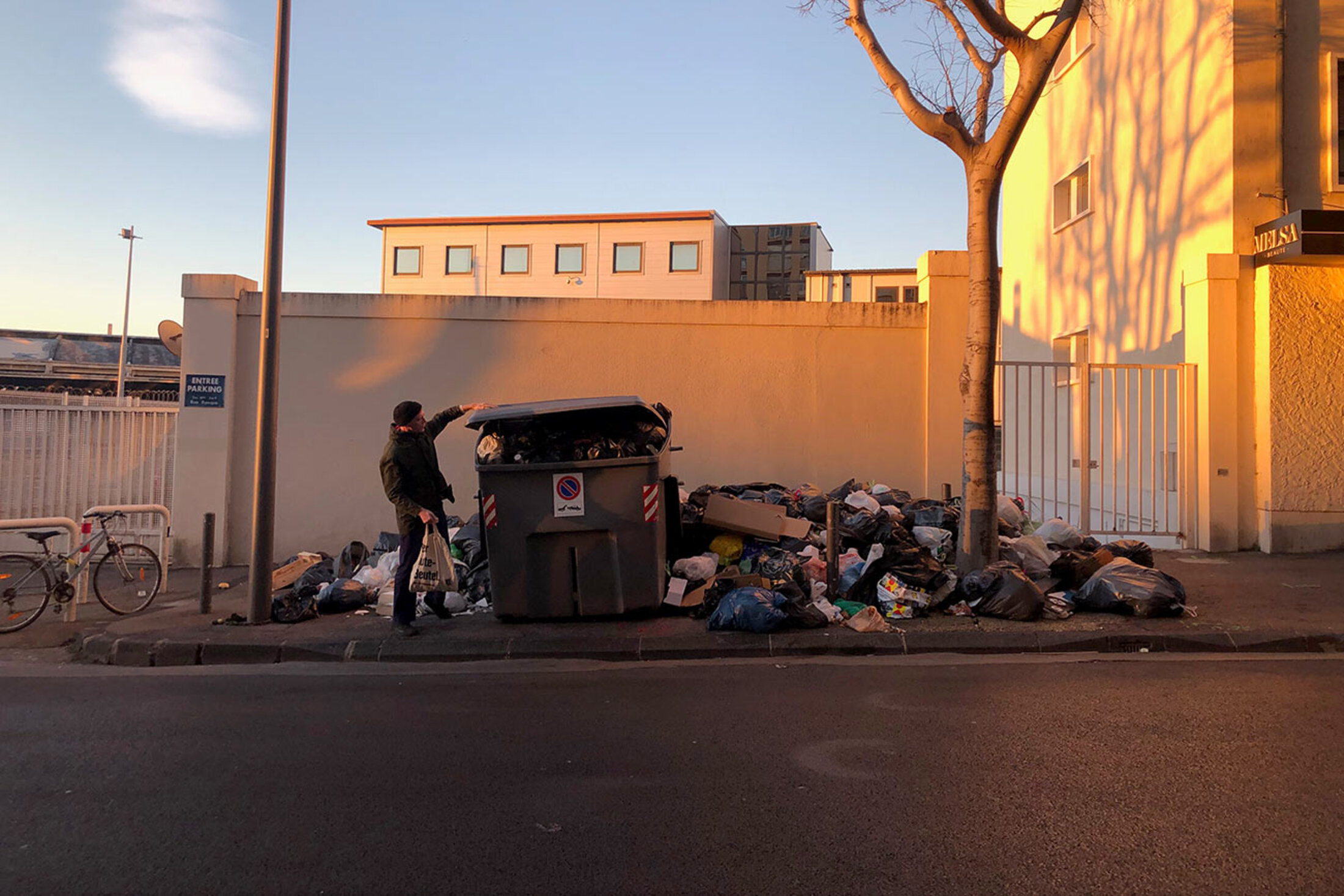
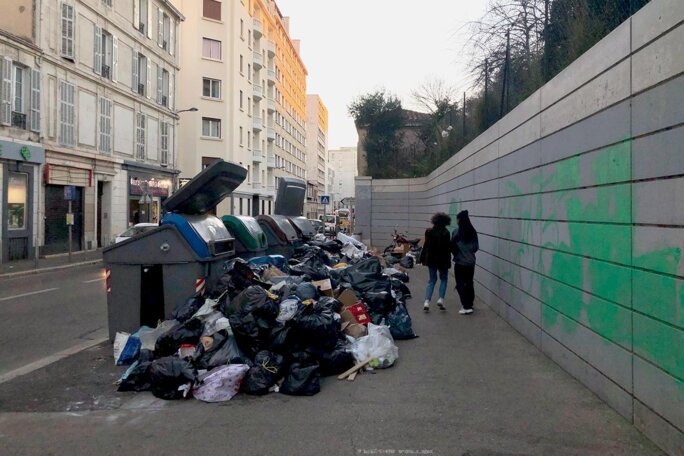
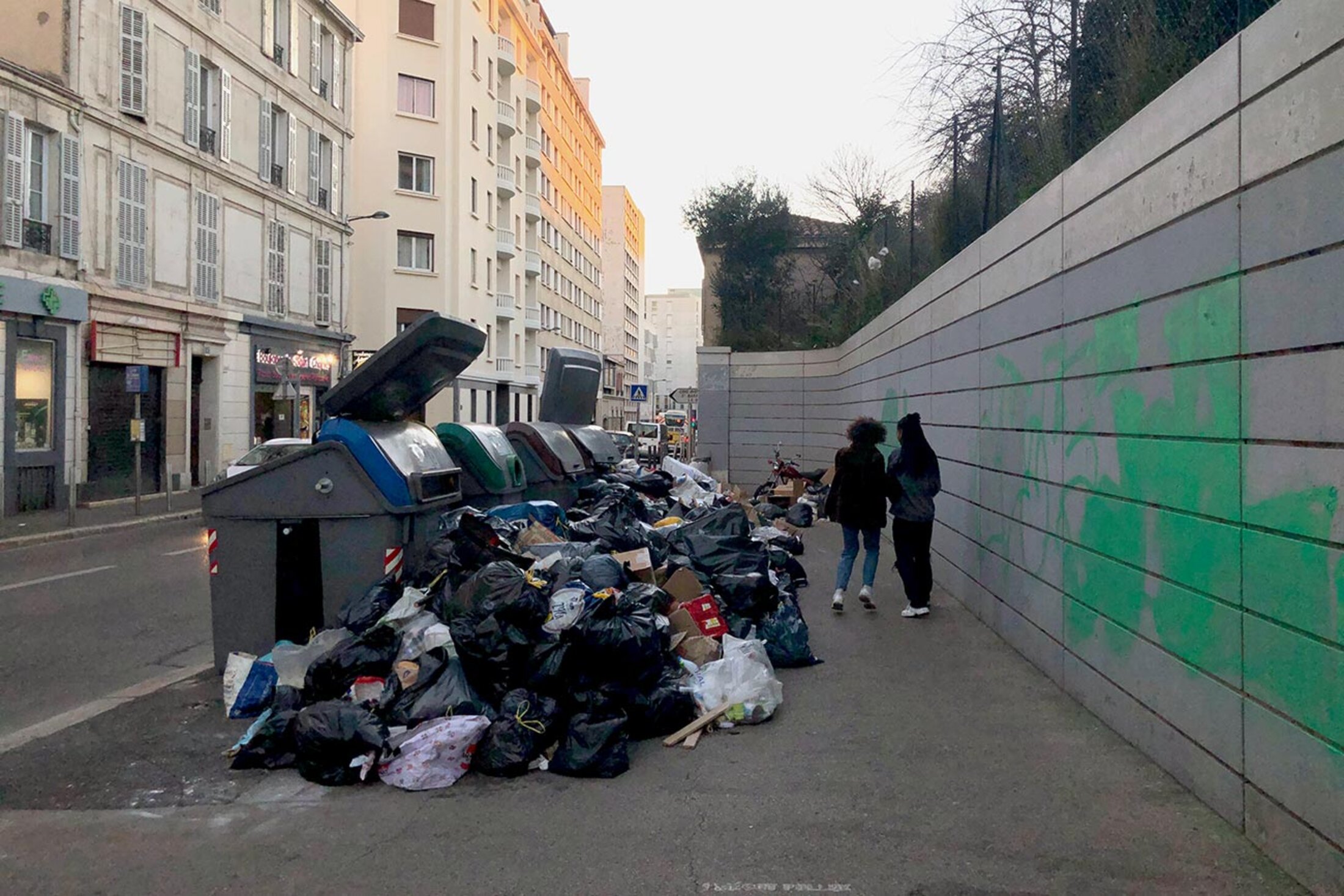
Then a new factor emerged in the middle of the dispute. The local cold, blustery wind known as the mistral sprang up violently and swept across Marseille, adding to the local anger. Under a clear blue sky the rubbish flew in all directions, covering the streets. The main shopping centre was more or less spared as its rubbish is collected by a private company. But the poorest streets were a mess of burst bin bags.
Two events now occurred. First of all, local residents began arriving and placing their rubbish in front of the headquarters of the Force Ouvrière (FO) branch that represents the refuse collectors. Then the left-wing mayor of Marseille Benoît Payan - Gaudin's successor - ordered a digger and several bin lorries to circumvent the lack of rubbish collection. It was not within his official powers and remit to do so, but he said he acted on the basis that this was an issue of public health. His initiative was plastered all over the local media and on social media.
Enlargement : Illustration 3
“The actions of the residents were invaluable,” said Sophie Camard, the local mayor for the first district in the city which includes the shopping centre, and who represents Printemps Marsellais, the city's ruling group which brings together councillors on the Left. “This kind of social conflict is not a comfortable one for councillors from the Left but we saw that the citizens understood perfectly well that a refuse collector should be well paid. They just wanted to live in a clean city. We built on their movement, we helped them, and when the mayor gave us the resources we guided the vehicles in our streets, passing on what the people were telling us. This episode allowed us to move on from a confrontation between Force Ouvrière and the metropolitan authority.”
The Left's actions in Marseille could have put the metropolitan authority in a difficult situation. When mayor Benoît Payan announced he was taking charge of cleaning the streets, his supporters on social media called for the city to send the bill to the president of the metropolitan authority, Martine Vassal. That in turn could have tempted the authority once again to give way to FO. Instead, it was the union that found itself trapped.
Yves Moraine, the right-wing councillor on the metropolitan authority who led the negotiations in December, said that the intervention by the city's mayor Benoît Payan was “pure PR”. Moraine added: “It wasn't important, we left the PR to him and took over the lorries which allowed us to say to FO: 'Look, everyone's left you, you're cornered, you have to let go now, and agree to move on to another way of working.'”
The end of 'finish and go'
In the end, the FO union announced on Wednesday 2nd to the metropolitan authority that it was ending its strike movement, having received a letter earlier that day had satisfied its demands. Yet the only concession in the document, which Mediapart has seen, is the promise of a “lower limit of 40 euros minimum” during talks to take place in March to compensate for inflation. “They have capitulated in mid-battle,” said a union figure involved in the December negotiations.
“This is a watershed moment,” predicts the socialist assistant major Laurent Lhardit. “The citizens' awakening and the actions of the Marseille councillors created a triangulation which broke the one to one relationship that had been imposed by FO. The metropolitan authority could not have requisitioned the lorries: it would have been accused of strike breaking. The fact that we did it and that residents got involved started to create panic within the FO. The fear of a common front had not existed before. It put FO in an untenable position. It's a real political turnaround.”
The mayor for the city's first district, Sophie Camard, thinks that the issue of “waste management is a leftover from a system that's collapsing, this is its swansong”. Yves Moraine from the metropolitan authority even talks of a “revolution” having occurred. While the FSU official Serge Tavano said that “a page is turning, even if the past has bitter memories”.
The FO's head Patrick Rué was visibly shaken by the turn of events when Mediapart saw him in his office on the morning of Thursday 3rd February. “They handed us over to public opinion. Two years ago we were the heroes collecting rubbish during lockdown, two years later they disapprove of us,” he said. However, he appeared to have understood that things have changed, and admitted that the “finish and go” approach was “over”. But he also warned: “ We're going from one extreme to another. Three-and-a-half hours was doubtless over the top, but going to seven hours would be as well. The agents will work more slowly, there's a risk that car horns will be blaring behind them.”
The issue of working hours is likely to end up very soon in an administrative court as it is not certain that the metropolitan authority has the right to cut working time by 15%. The authority says it intends to defend its agreement but if it is impossible in law then that will be down to the judge.
Meanwhile the refuse collection restarted on Thursday, just as the cold and blustery mistral started to subside.
---------------------------------------------------------------------------
- The original French version of this article can be found here.
English version by Michael Streeter