


The freedom to inform is a fundamental principle, one that is an integral part of human rights. This is true not just in France, but everywhere. The job of a journalist is to serve the right to know and the freedom to speak out, taking care over the truth of the facts and respecting sources, while ensuring people have the chance to respond to accusations.
The right of each person to have access to news and ideas is set out in Article 19 of the United Nations' Universal Declaration of Human Rights. When Algeria joined this world body upon its independence in 1962, it de facto signed up to this 1948 resolution.
On December 3rd, having just heard the evidence and legal arguments, the appeal court at Tizi Ouzou in Algeria upheld the seven-year prison sentence given months earlier to the French reporter Christophe Gleizes. Our fellow journalist, a contributor to the publications So foot and Society, had been arrested on May 28th 2024 and placed under judicial supervision, accused among other things of “entering the country on a tourist visa” and of “glorifying terrorism”. Gleizes had gone to Tizi Ouzou to report on Jeunesse Sportive de Kabylie (JSK), a highly-successful Algerian football club.
Giving evidence in his appeal, the 36-year-old urged the judges to show “mercy”, admitting he had made “many journalistic mistakes despite my good intentions”, according to a reporter from the AFP news agency present in court. Christophe Gleizes accepted that he should have applied for a journalist visa, not a tourist one, before setting off on his assignment.
That did not stop the prosecution from calling for his initial sentence - pronounced in June - to be increased to ten years. “The accused did not come to Algeria to carry out journalistic work but [to commit] a hostile act,” the prosecutor argued. The court also asked him whether he knew that the Movement for the Self-Determination of Kabylie (MAK) had been listed as a terrorist group by the Algerian authorities back in May 2021 when he met its leader, Ferhat Mehenni, in Paris in October of that same year.

Enlargement : Illustration 1
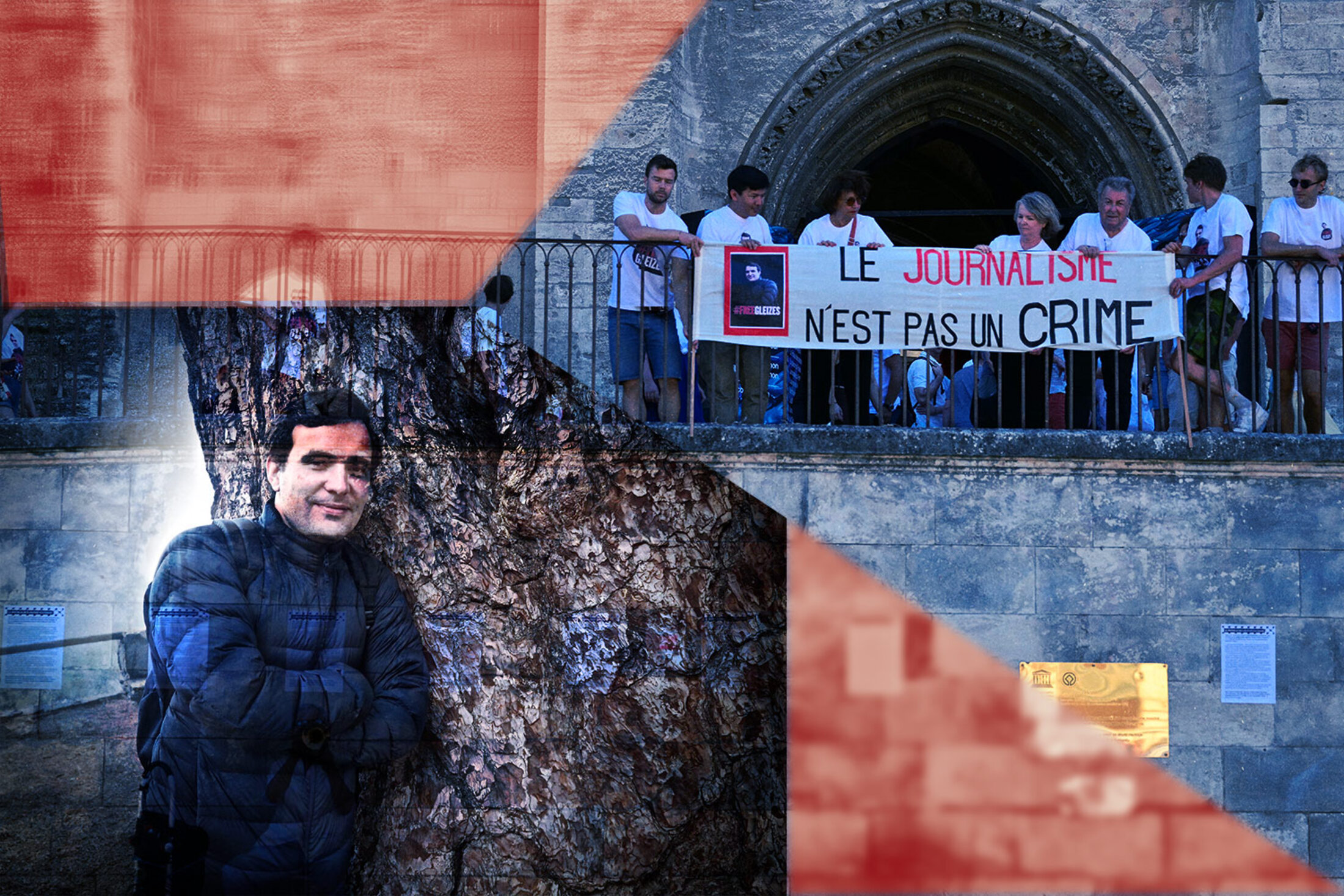
Whatever the answer – as it happens, Christophe Gleizes said he did not know – it needs to be spelt out once again that journalists must not be identified with the people they potentially implicate, with witnesses or even with their sources. They are not there to defend any of them. They speak for others: for the citizens who want to know. They gather facts of public interest once they have been researched, cross-checked and verified.
To interview, investigate and inform is not a crime. “Journalism is about gathering news, including from controversial people or organisations,” say the many French media organisations who are calling for the journalist’s release. “To call this ‘glorifying terrorism’ is to deny the nature of the job itself and threatens the freedom to inform, which is guaranteed by international conventions. A reporter who interviews a sports leader is not complicit in that person's stance: he's doing his job,” say the media organisations.
The public interest
After the judgment Thibaut Bruttin, secretary-general of the press freedom group Reporters Without Borders (RSF), voiced his shock. “RSF firmly condemns the outrageous decision by the Tizi Ouzou Court of Appeal, which has chosen to continue jailing a journalist who was just doing his job,” he declared.
Before the hearing the journalist's lawyer Emmanuel Daoud had said: “We must explain to the appeal judges that a journalist does not do politics … is not an ideologue … not an activist.”
He sought, rightly, to avoid tying his client’s fate to the chaotic state of relations between France and Algeria, after the latter pardoned and freed the French-Algerian writer Boualem Sansal on November 12th. Emmanuel Daoud also rejected use of the word “hostage” to describe his client, noting that Christophe Gleizes had been able to receive visits and had had access to his case file and his lawyers.
Even so, by locking up a journalist, whatever his nationality (as the same goes for Algerian journalists who have been unfairly jailed), the court is trampling on the right of citizens – again, whatever their nationality – to have the news they need to form their own views freely and independently.
Ratified in Tunis in 2019, the Global Charter of Ethics for Jouralists, which adopts the principles of the 1971 Munich Charter, says the same thing: “The journalist's responsibility towards the public takes precedence over any other responsibility, in particular towards their employers and the public authorities.”
Only the public interest of readers, transcending frontiers, matters. Christophe Gleizes must be freed. Under Algerian court rules, there is only one path left, which is a pardon that could be granted by the Algerian president, Abdelmadjid Tebboune; this can only come after the reporter’s definitive conviction, as he can still appeal to the country's supreme court.
Achieving this will require citizens mobilising alongside news professionals to ensure that their right is respected: the right to be informed openly by those who testify and investigate.
--------------------------------------------------------------------------------------
- The original French version of this op-ed article can be found here.
English version by Michael Streeter