


Far-right leader Marine Le Pen this week begins a high-stakes legal appeal whose potential impact reaches far beyond the courtroom. On Tuesday January 13th the court of appeal in Paris will start what is effectively a re-trial of the case involving the far-right Rassemblement National's (RN) European parliamentary assistants in which she and others were convicted of embezzlement last March.
Le Pen, her party - which was called the Front National (FN) before being renamed Rassemblement National (RN) in 2018 - and several senior figures and elected representatives of the far-right movement face stringent criminal penalties that could have decisive political consequences for the country’s future.
The biggest issue concerns whether the veteran politician – who has twice stood before for the highest office in the land – will be eligible to contest the 2027 French presidential election.
Having its case reheard as a legal entity, the RN itself risks having to pay a hefty fine - up to five million euros - not to mention enormous damages claimed by the European Parliament, which would seriously undermine its finances. At first instance, the far-right party was fined two million euros, one million of which was suspended, and ordered to pay 4.4 million euros in damages.
Besides the party itself, twelve individuals are having their cases reheard in this five-week hearing – twelve others chose not to appeal their first-instance convictions.
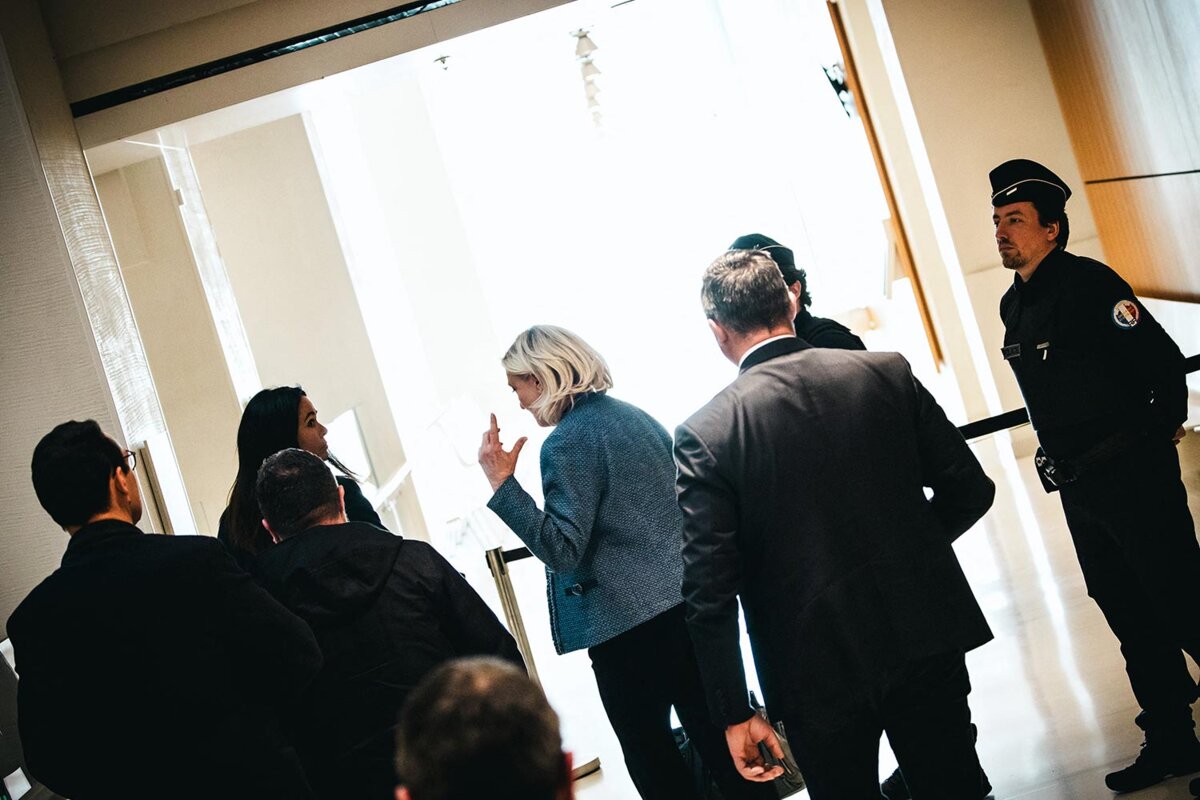
Enlargement : Illustration 1
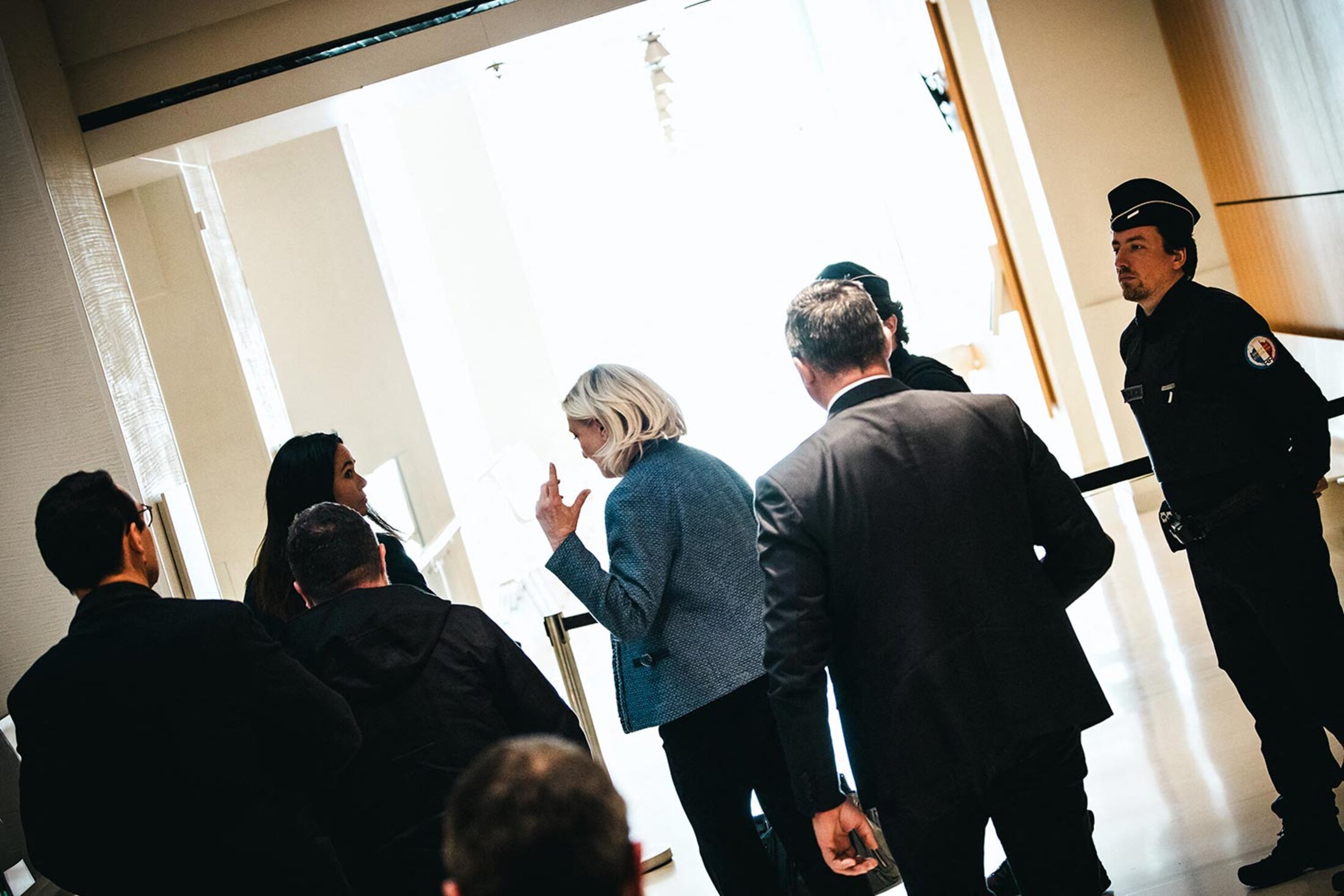
Marine Le Pen, 57, the daughter of the late far-right politician Jean-Marie Le Pen and leader of the far-right group in the National Assembly, is clearly the one with the most to lose in this appeal case.
Tried both as the former president of the FN/RN and as a former Member of the European Parliament (MEP) who employed as assistants people who in fact worked as permanent party staff, Marine Le Pen is in a precarious position. The prosecution regards her as the person responsible for a fraudulent system designed to save the party money on its wage bill at the expense of European taxpayers.
On March 31st 2025, following her trial at first instance, she was sentenced to four years in prison, two of them suspended, a fine of one hundred thousand euros, and five years of ineligibility for public office with immediate effect.
At the end of this appeal case Marine Le Pen risks seeing her sentence of immediate ineligibility for public office upheld, which could bar her from standing at the next presidential election, a prospect about which she has bitterly complained.
There is also the risk she could face the maximum penalty of ten years in prison and a fine of one million euros for misuse of public funds.
If she cannot get a complete acquittal at this appeal, a prospect which seems unlikely given the case against her, her aim will be to at least avoid a fresh order that the public office ban should have immediate effect.
If immediate enforcement of the ban were to be ordered, Marine Le Pen could still appeal again on points of law, but she would remain ineligible for office until the ruling by the next and highest appeal court – the Cour de Cassation.
If this Paris appeal court rules that the political ban stands but should not take effect immediately, then Marine Le Pen would still be obliged to appeal against the ban itself. This is because if she does not appeal then in effect she is accepting the new ruling, and the ban is automatically applied; in French law some sentences are effectively held in abeyance until the appeal process has ended. After lodging this further appeal, Le Pen would become eligible to seek public office pending the final decision of the Court of Cassation.
Elected representatives worried about their futures
At the end of this second court case, a number of far-right elected representatives risk either losing their mandates or being unable to stand for election in the future. This is because of possible additional penalties of ineligibility that could be imposed by the appeal court.
That is the possibility facing Louis Aliot, 56, whose case concerns the disputed employment status of one of his assistants at the European Parliament between 2014 and 2015. The mayor of Perpignan in southern France, he was also Marine Le Pen’s European parliamentary assistant from 2011 to 2014 while serving as vice-president of the Front National (FN), as it then was, and also practising as a lawyer. He was declared ineligible for office for three years at first instance, but that sanction was not ordered to take effect immediately.
The same applies to Julien Odoul, 40, an MP from the Yonne, a département or county south-east of Paris, and Timothée Houssin, 37, an MP from Normandy.
Two MEPs are also being retried: Nicolas Bay, 48, former vice-president of the FN and an MEP since 2014, and Catherine Griset, 53. A long-standing assistant and close friend of Marine Le Pen, she became an MEP in 2019.
Other figures in the far-right party, who do not hold elected office, mainly risk their reputation and their wallet. This is notably the case for two RN veteran figures: Bruno Gollnisch, 75, the party’s former number two, and Wallerand de Saint-Just, also 75, former treasurer and head of finance and human resources at the FN.
Marine Le Pen's sister Yann Le Pen, 62, is also involved. She was employed by MEP Bruno Gollnisch as a parliamentary assistant from 2009 to 2011, then from 2012 to 2014, while she was a permanent party employee responsible for events and rallies.
Nicolas Crochet, 62, meanwhile, fears losing his livelihood. The party’s regular chartered accountant during election campaigns, he must answer as a third-party payer responsible for the contracts and salaries of European assistants over the period 2012–2016. The same goes for Charles Van Houtte, 59: this Belgian accountant is seen by the prosecution as the “linchpin of the system” set up within the FN for diverting European funds.
Finally, Fernand Le Rachinel, 82, will also be retried. The long-standing printer for first the FN and then the RN, and for many years an elected representative of the far-right in Normandy, he was also an MEP and fictitiously employed Jean-Marie Le Pen’s private secretary and bodyguard as parliamentary assistants between 2005 and 2009.
A complicated defence
What defence strategy will Marine Le Pen and her lieutenants adopt before the appeal court judges? Faced with a truly colossal file against her, the RN leader initially played for time during the investigation, before adopting a very political and sometimes aggressive stance during the first trial. But her arguments - that the work of MEPs and their “shared” assistants was compatible with activity mainly carried out within the party itself - failed to convince the criminal court.
Some of the elected representatives on trial chose to advance far-fetched explanations that ultimately worked against them. As for the claim of an anti-RN political plot, consistently brought up by Marine Le Pen, it simply does not stand up when one recalls that former minister François Bayrou’s centrist MoDem party, along with other parties, have also been caught out for identical acts, albeit on a smaller scale.
Other than an extremely unlikely display of repentance and self-flagellation before the appeal judges, the RN and its lawyers are likely to rely on technical arguments. They will probably stress the alleged vagueness of the European Parliament’s operating rules, the changing status of assistants over the years, and the absence of any intent to defraud on the part of the far-right party. But, once again, these defence arguments failed to win over the first-instance judges. There is nothing to suggest they will be any more effective this time.
-----------------------------------------------------------------------------
- The original French version of this article can be found here.
English version by Michael Streeter