


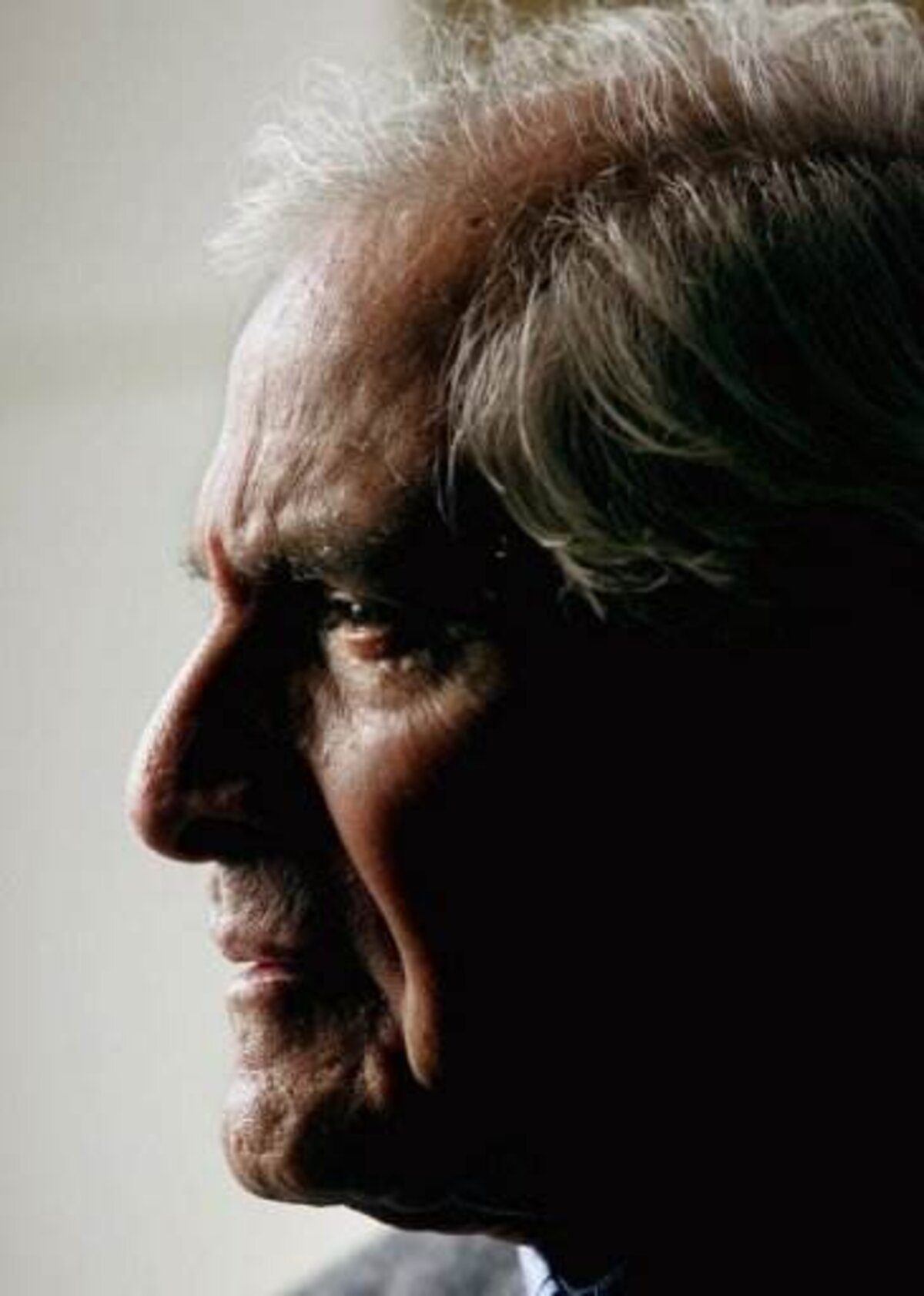
Cinema producer and director Nico Papatakis has died in Paris at the age of 92. The cast in his life story reads like a surrealist blockbuster, from Emperor Haile Selassi to John Cassavetes, from Anouk Aimé to Jean Genet, and from Jeanne Moreau to the other Nico (she of the Velvet Underground). Antoine Perraud pays tribute to an extraordinary artist.
-------------------------
The fabulous Nico Papatakis, adventurer, filmmaker, reveller, revolutionary and meditative, has died at the age of 92. His death, on December 17th, 2010, was marked by an announcement and a brief news agency report, published in chorus by indolent media.
Nicos - who dropped the 's' and became Nico - Papatakis was born in 1918 in Addis-Ababa, capital of the marvellous, old and moth-eaten empire in Africa that was Ethiopia. That was where his father, from the north of Greece, and having fled some kind of a vendetta in Macedonia, had taken root, and where he became attached to a local aristocrat.
Ethiopia was coveted by Mussolini, who, lusting after a colony, returned with a vengeance to this fierce country, which the Kingdom of Italy had failed to tame in the battle of Adowa (1896). The young Papatakis enlisted in 1935 with the bare-foot warriors who tried, this time in vain, to oppose the colonial stranglehold. Defending the Negus of Abyssinia, Haile Selassi, self-declared descendant of the Queen of Sheba and King Solomon, against the inventor and vector of fascism certainly has a touch of grand style.
Nico had striking looks. After a time wandering through Lebanon and Greece, he arrived in France, intending to become an actor, in 1939. There he found war, the Nazi occupation, poverty, and a friendship with Jean Genet marked by pilfering and quarrels over money.
In 1947, with the flair that is created by a renewal of hope, Nico Papatakis opened La Rose Rouge at 46, rue de Rennes in Paris. This archetypal Saint-Germain-des-Près cabaret was to become the subject of a film of the same name, shot in 1950 by Marcel Paliero, with Nico playing himself. The cast included the Frères Jacques quartet1 themselves, and the famous comic actor Louis de Funès playing ‘Manito, le poète qui mange les verres' (‘Manito, the glass-eating poet' )2. Fifteen years later, pioneering television presenter Pierre Tchernia and the actress and singer Juliette Greco paid fond homage to this legendary venue in a French television programme.
The Red Rose had above all allowed Nico Papatakis to fund the writer and poet Jean Genet's only film, Un Chant d'Amour, shot on the sly by the walls of the Paris prison La Santé, at Milly-la-Forêt, near Jean Cocteau's home, for a few outdoor scenes, and above all in the restaurant of La Rose Rouge, where the sets for the film's steamy, dreamy prison cells were built.
On this silent, incisive work, it is worth returning to a passage from Notre-Dame-des-Fleurs (Our Lady of the Flowers), one of Genet's major works, written while he was behind bars in Fresnes prison in 1942.
"I look on the walls for the traces of my earlier captivities, that is my earlier despairs, regrets, desires, that some other convict has carved out for me," he wrote. "I explore the surface of the walls, in quest of the fraternal trace of a friend. For, though I have never known what friendship could be, what vibrations the friendships of two men sets up in their hearts and perhaps on their skin, in prison I sometimes long for a brotherly friendship, but it is always for a man - of my own age - who is handsome, who would have complete confidence in me and be the accomplice of my loves, my thefts, my criminal desires, though this does not enlighten me about such friendship, about the odour, in both friends, of its secret intimacy, because I make of myself, for the occasion, a male who knows that he really isn't one. I await the revelation on the wall of some terrible secret: murder above all, murder of men, or betrayal of friendship, or profanation of the dead, a secret of which I shall be the resplendent tomb."3
Jean Genet swiftly turned his back on the film, which disturbed the morals of the time and even remained banned from public viewing until 1975. In order to break even, Nico Papatakis offered a very private copy to Genet's benefactor Jacques Guerin (1902-2000), a famous collector of Marcel Proust's manuscripts. Once Un Chant d'Amour was at last allowed an audience, Nico Papatakis won an award as its producer.
Genet, furious that the film he had disowned should be unearthed, demanded that Papatakis hand over the prize money, in the last falling out the two men were to have over finances. But the writer was to remain a long thread, albeit of barbed wire, in the consciousness of his too-handsome young acolyte.
------------------------
1: The Frères Jacques quartet, formed in 1945, marked the French stage and music scene, first as a cabaret act then also with dozens of highly popular records, over more than three decades until their last performance in 1983.
2:Glass is ‘verre' in French, which sounds like 'vers' (verse) and 'ver' (worm).
3: This extract from Our Lady of the Flowers is from a translation by Bernard Frechtman, published by Olympia Press, Paris.
'Two sluts represent France'
However, Nico Papatakis was far from indifferent to the charms of the fairer sex, who returned the compliment. He married actress Anouk Aimé, and they had a daughter in 1951, ten years before the release of Jacques Demy's film Lola, starring Aimé (see video immediately below).
Papatakis, having fought Italian colonialism, was hardly going to stand by and watch France literally get away with murder in Algeria. Disgusted to see the self-proclaimed land of human rights regard General Massu1 and Colonel Bigeard1 as good soldiers, he took off for New York. There he gave John Cassavetes a very big hand in the financing of Shadows (1959), a film (extract immediately below)set in a Manhattan that had strong echoes of Saint-Germain-des-Près and its jazz scene. Papatakis very much personified this trans-Atlantic connection.
It is difficult to pass up this opportunity of paying homage to a young woman who inherited Nico Papatakis' name. She - Nico - was a muse of Andy Warhol, who played herself in his Chelsea Girls, and whose acting career included a cameo in Fellini's Dolce Vita. As a singer she lent her voice to the Velvet Underground.
Born as Christa Päffgen (1938 - 1988), she became Nico after taking part in a fashion shoot, when the photographer Herbert Tobias named her, when then a model (see video immediately below), after his ex-lover, one Nico Papatakis.
Nico Papatakis didn't hang around. He wasn't one to rest on his laurels gorging on the fruits of his labours. He was a risk-taker who triggered censorship. When France claimed at long last to have withdrawn from Algeria in 1962, Papatakis wouldn't let sleeping dogs lie. Instead he set about finding a way of preventing the 1954-1962 war of independence from sinking into some comfortable oblivion in the collective consciousness.
To do so he returned to Genet, who, though a dab hand at leading young men away from the straight and narrow, would hear nothing of his young accomplice's desire to hijack his work. Les Bonnes (The Maids) was the play Papatakis wanted to ‘Algeriarize'. It was about the true story of the Papin sisters, two maids who murdered their two mistresses in 1933, in an act that came to symbolize social rebellion, a great inspiration for the Surrealists.
Papatakis didn't beat about the bush. He tried to organise a photo shoot with the two actresses who had been singled out for the roles, Jeanne Moreau and Annie Girardot, dressed up as maids. Genet kicked up a fuss about this and dropped the whole project. In the end Jean Vauthier wrote the script of Les Abysses, directed by Papatakis and starring the Bergé sisters, Francine (born in 1938) and Colette (1942-2008).
Its selection in the 1963 Cannes Film Festival caused a scandal: ‘Two Sluts Represent France', read an indignant press headline. Interviewed by François Chalais, Papatakis defended himself with jaunty dignity. Minister of Culture André Malraux stood his ground in its defence and Jean-Paul Sartre flew to its rescue with his rhetorical enthusiasm, generous to the point of appearing terribly naïve: "Cinema has given us its first tragedy," he wrote in French daily Le Monde (April 19th 1963). "Its subject: evil."
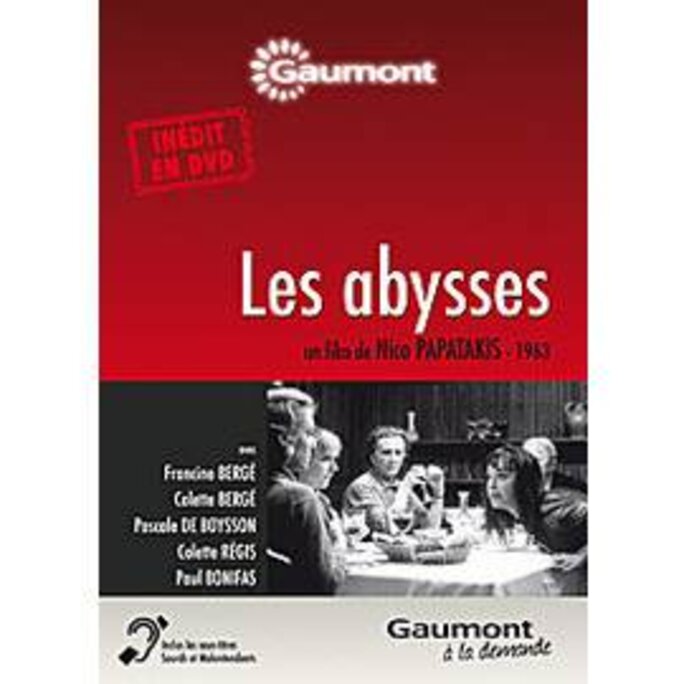
Simone de Beauvoir let loose in favour of this feature film "in which reason is on the side of madness, love painted under the face of hate", adding, "It shows us naked revolt. Only the crime committed by the two heroines allows us to measure the atrocity of the invisible crime of which they were victims". Jacques Prévert defended its representation of the furies, "infernal goddesses who torment the villains". André Breton chimed in with a couplet on the Abysses' "gift of lyrical expression".
Here is how, at a Paris screening in 2008, his 90th year, Nico Papatakis looked back on his film, about which he let slip a few words that said much: "It would seem it still exists".
1: French General Jacques Massu and Lieutenant General Marcel Bigear, both highly decorated French army officers, were implicated in the torture of Algerian independentists during the 1954 - 1962 Algerian war of independence, notably during their conjoint operations in the 10th parachute regiment during the Battle of Algiers.
Between Apollo and Dionysus
And then came the Colonels, seizing power in Greece, like a comet's tail following on from fascism. Nico Papatakis once again turned to the 7th art and made Les Pâtres du Désordre (The Shepherds of Disorder), released in the US as 'Thanos and Despina. At the very end of the film there is a dreamlike violence mixing death and marriage. The theme returns 20 years later at the end of his 1987 film La Photo (The Photograph). Violence, a subject for reflection, not of fascination, obsessed Nico Papatakis.
Released in 1974, Gloria Mundi (see video extract immediately below) remains his most ardent gospel against the humiliation of others in the name of reasons of State or private loss of reason.
Nico Papatakis was fiercely on the side of life, and against all dealers in death. His final trial of strength with Jean Genet was on this very on this very issue. In 1964, Papatakis had been to the funeral of Abdallah, a young man who had been driven by the writer to put his life, quite literally, on the line as a circus tightrope artiste, before being ditched.
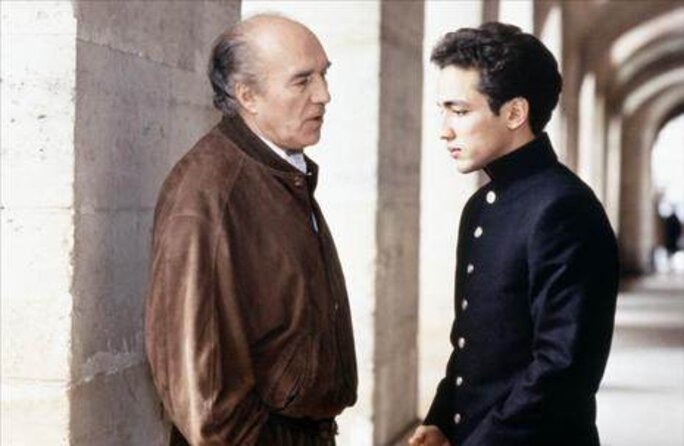
In 1991, with a brilliant Michel Piccoli in the role of Genet distraught at the fatal fall, Papatakis offered his cinematographic testament: Les Equilibristes (the English title was Walking a Tightrope).
His life, on a razor's edge, offers us a message of a complex, rich equilibrium between the Appolonian and the Dyonysian. The works of Nico Papatakis demand a re-discovery.
-------------------------