


Last month Mediapart's editor-in-chief Edwy Plenel wrote an open letter to François Hollande saying the French president was “leading France astray” over his policy towards Israel at the time of that country's attack on Gaza. In particular the article attacked the government for banning a number of pro-Palestinian demonstrations in Paris, accusing the president of “losing his way” by giving in to this “easy, short-term” measure. Now, in an interview with Mediapart, France's interior minister Bernard Cazeneuve tackles head on the issue of why the government chose to impose the bans – decisions for which he says he takes full responsibility and which he stands by.
-----------------------------------------
Mediapart: At the height of the recent Israeli military operation in Gaza you banned demonstrations in support of Palestine on several occasions. Isn't it, though, the role of the state to guarantee a fundamental freedom – to gather and protest - while stopping those who want to infringe that liberty because they're just there to cause a riot or to provoke?
Bernard Cazeneuve: I want to respond to that on the basis of principles and the law. Let's go back to the facts: 485 demonstrations took place in Paris and the regions, only five were banned. Contrary to what I've read, it was not the president of the Republic or the prime minister who took the decision to ban. It was me. And I put forward this course of action to them for reasons that I want to take the time to explain, and which I stand by.
First of all, on the substantive issue, it's obvious that the cause over which the demonstrators have been rallying is a just one. Demanding that the Palestinians have a right to their own state, demanding that the war in Gaza stops and that children are not killed is a cause that could have justified the whole of France taking to the streets. I have myself demonstrated for these causes many times in the past and I would have done so once more were it not for the responsibilities that I carry out.
With respect to the organisation of demonstrations there is an inherent responsibility on the state to take all measures to avoid events getting out of hand. As a general rule, this state responsibility involves judging the ability of the organisers themselves to guarantee the smooth functioning of the demonstrations that they are organising. That's the reason why the great majority of proposed demonstrations took place.
But the freedom to demonstrate is not the freedom to shout “Death to the Jews!” in the streets of Paris or Sarcelles [editor's note, an area in the northern suburbs of Paris with a high immigrant population including a large Jewish community, and where violence broke out after a pro-Gaza protest] and to attack synagogues with Molotov cocktails. We must not confuse the freedom to shout one's anger with the right to commit crimes which can never be allowed in the Republic. For anti-Semitism is not a right. It's a crime. And yet what did I have in my hands? Precise and concrete information that synagogues and businesses were going to be attacked and that anti-Semitic acts would be committed.
Enlargement : Illustration 1
Mediapart: What was this “precise and concrete” information?
B.C.: Appeals that were circulating on the internet, posters put on bus shelters in Sarcelles which indicated they were going to descend upon Jewish areas...I didn’t want those who wanted to demonstrate, and who were motivated by a sense of responsibility and by an ideal of peace, to see their approach compromised by the behaviour of a minority, blinded by hate and anti-Semitism. So I had a moral responsibility to ban. I should add that the minister of the interior is also the minister responsible for religious faiths. The problem is certainly not exclusively a religious one, but there can be inter-faith clashes. And on all these issues I must be the minister for respect and tolerance. As soon as I knew that confrontations of this sort could take place, I had to take preventative action.
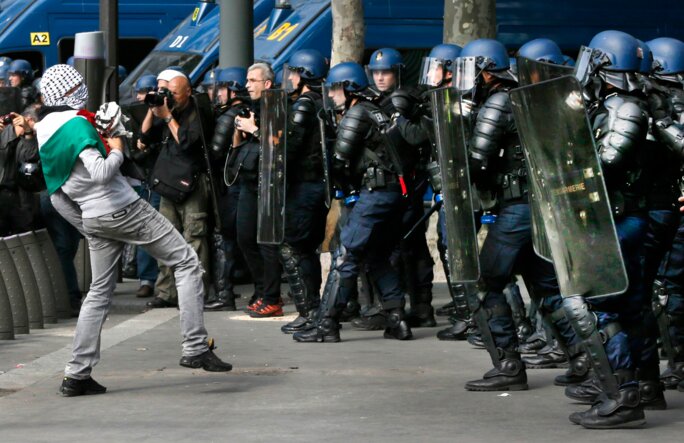
In addition, these demonstrations were banned after a previous one had degenerated, close to the synagogue in rue de la Roquette in Paris [editor's note, on July 13th]. That could have ended in extremely serious violence and the ransacking of a synagogue if the forces of law and order hadn't been there to ensure security. So it wasn't the bans that led to the violence, it was the violence that led to the bans. Once again I stand by my decision.
However, does this mean that we are crudely lumping together anti-Semitism and anti-Zionism? No. That's not my position at all. I've never said that and I don’t think that. But it is a reality that there are some anti-Semites who hide behind anti-Zionism. You just have to walk next to the Main d'Or [editor's note, the Paris theatre used by French comedian Dieudonné, who is frequently accused of anti-Semitism] to realise that. Not to say so would be a mistake. At the end of it all, I banned five demonstrations out of 485 and yet what people condemn are not the anti-Semitic acts that justified the bans, but the bans themselves...
Enlargement : Illustration 2

Mediapart: There are accounts that contradict the story of what happened at rue de la Roquette. Are you in favour of an independent commission of inquiry to look into these facts?
B.C.: People have been arrested, in some cases have appeared before a judge, been tried and imprisoned. If now there is a request, for example from parliamentarians, we will give them the information. I have no problem at all with that.
Mediapart: The person who signed at the prefecture as the person responsible for the banned demonstrations, Alain Pojolat from the New Anti-capitalist Party (NPA) [editor's note, in French administrative law anyone organising a protest or public gathering has to fill in a declaration at the office of the local prefect and sign it], is today facing legal proceedings. Do you not feel there is a risk of reviving a version of the “anti-rioters” law that existed in the 1970s and which was strongly criticised by the Left at the time? There is often excessive behaviour at demonstrations. What the Left criticised at the time was that the conservatives wanted to make the organisers responsible for it, even when they did not carry out those acts.
B.C.: We live under the rule of law. I don't make a distinction in the way the law is applied based on the circumstances. If I started to think that certain principles should apply according to who is asking, the circumstances or to certain political judgements, then the Republic would lose its very foundations, there would be no force behind the institutions when they proclaim Republican principles.
Let's take a close look at the facts. Mr Pojolat decided to organise a demonstration. We told Mr Pojolat that there was a risk of events spilling over of an anti-Semitic nature. We explained to him why, in the event that he was unable to guarantee the supervision of these demonstrations, as other large organisations can, we preferred that they didn't take place. He took it to an administrative court and lost. He lost before the Conseil d'État [editor's note, France's highest administrative jurisdiction] too. Despite this, these demonstration took place and violence ensued. Thus he broke the law. I don't see why he should not be accountable before the justice system. I'm minister of the interior – how can you expect me to say anything else? There is no “anti-rioters” law. There is a Republican law. It's being applied.
Mediapart: Is it down to the organisers of the demonstration to organise the security of the march? Isn't that rather the job of the forces of law and order? There are demonstrations that don't have the benefit of the CGT's stewards [editor's note, the Confédération générale du travail trade union that is used to handling big protest marches], which is one of the “large organisations” you referred to...
B.C.: Of course. But in a democracy such as ours, the banning of a demonstration is not based on emergency legislation. It is a possibility that is foreseen and enshrined in our law. I knew the risk of what might happen at Sarcelles, where a grocery store was set fire to because it was run by a Jew. How can it be that such despicable acts elicit less indignation than a ban aimed at avoiding such acts from taking place? I can understand all the background noise and posturing, but what matters for me is the reality.
Mediapart: Of course there are anti-Semitic acts, and they are deeply reprehensible. But we also see, as the reports of the [national consultative commission on human rights ] Commission nationale consultative des droits de l’homme show, that in our country the most basic, everyday racism targets those of our compatriots who are Muslim by culture, faith or origin...
B.C.: I don't want to go down that line of reasoning. If just one Muslim is the object of a racist attack, then that merits identical indignation. It's not the number [of cases] that should make us respond, but the very fact that discrimination can exist at all, whether towards a Jew, a Muslim, a Christian...I don't want to get involved in that kind of numbers game, because I don't want to weaken the Republic.
Mediapart: Do you understand how the peaceful demonstrators, who formed the great majority and who were not responsible for the disturbances, felt these bans to be a form of discrimination?
B.C.: When you have a context of hatred and violence, the responsible course of action must be to favour reality over impressions. In all sincerity, and this is from the bottom of my heart, the reality is that I had to ban these demonstrations, because there was a risk of anti-Semitic outbursts from groups that are uncontrollable. I can say this all the more easily as I was, fundamentally, in agreement with the cause defended by those who demonstrated genuinely for peace in Gaza.
Mediapart: In bringing out the bazooka of a ban on demonstrating, wasn't that something of an admission of the weakness of the police? As you had “precise and concrete” information on what was going to happen, why didn't you put in place the authority of the state to stop the excesses, while guaranteeing the freedom to demonstrate? In addition that would not have encouraged the idea that this involved some kind of anti-Semitic march.
B.C.: It is in no way an admission of weakness by the state, on the contrary. The state, like, the police, played its role fully. What shocks me is there is no recognition that it was the state that made sure there was no confrontation close to religious sites, attacks on property and damage to public areas. It's an integral part of the authority of the state that it can, in particular circumstances defined by the law, use the weapon of banning demonstrations to avoid things getting out of control.
Mediapart: What's the situation with plans to dissolve the Ligue de Défense Juive [editor's note, the radical Jewish Defence League which has been blamed for fuelling community tensions in France] on the one hand and movements such as the Gaza Firm [editor's note, a new far-right group which has links with supporters of comedian Dieudonné and right-wing essayist Alain Soral] and the Collectif Cheik Yassine [editor's note, a small group named after Hamas-founder Sheikh Ahmed Yassin] on the other?
B.C.: They are on the table and being examined by the public liberties unit at this ministry. I will make a decision based on the law on these issues because that's the best way to be powerful and strong in affirming republican principles when faced with these groups. It will be the same for all groups that preach racial hatred. When the Republic faces being undermined by the risk of tension, conflict and violence, the ministry of the interior must, first and foremost, be a bulwark of the law.
Mediapart: Are you satisfied with the level of Franco-Israeli cooperation in the “Ulcan” affair, involving a hactivist known online as 'Ulcan' - a French national based in Israel - who is suspected of carrying out an online attack on French news site Rue89 and harassing journalists after it published a profile on him and his activities?
B.C.: France has begun proceedings [in relation to this affair] with great determination and firmness. It's the justice system, which acts in an independent manner. All legal means will be brought to bear to make sure that the law is respected. I'm not going to make public what's being done, out of respect for the proceedings under way.
Mediapart: Are the Israeli authorities cooperating?
B.C.: The matter has been raised with them and continues to be so.
This is a shortened version of a lengthy interview with the interior minister which also touched on other issues such as antiterrorism laws and the legalisation of cannabis.
--------------------------------------------------------------------------------
- The French version of this interview is available here.
English version by Michael Streeter