


The two men in the video above are from the Communist Party of Great Britain (Marxist-Leninist) celebrating, in 2008, the 91st anniversary of the October Revolution. The man in the foreground is the party's leader Harpal Brar. The elderly man behind him is the late Jack Shapiro (1916-2010) who, among other things, defended Yiddish-speaking tenants in pre-war London's East End against eviction by "predatory landlords". They are listening to the Soviet national anthem sung in English by the erudite American colossus Paul Robeson (1898-1976), who was received with pomp and ceremony in the USSR when he took up the Communist cause during the Cold War.
Polyglot Paul Robeson liked to sing in Yiddish. In June of 1949, in a rousing concert at the Moscow Conservatory, he dared to intone Zog Nit Keyn Mol(זאג ניט קיין מאל, ‘Never Say'), the unofficial anthem of Holocaust survivors. The song was written in 1943 by Hirsch Glick (1922-1944), a Jewish partisan in the Vilna Ghetto, when he heard the news of the Warsaw Ghetto uprising (click on video below).

In The Undiscovered Paul Robeson, Paul Robeson Jr points out that his father's remarks on the ties between American, Russian and Jewish culture were censored back in 1949, during the virulently anti-Semitic terminal phase of Stalinism. The fervent applause after the performance was likewise excised from the official recording.
Robeson was tragically behind the times. Beyond the usual well-worn slogans, he truly believed in friendship between the peoples of the earth. He was close to Solomon Mikhoels, an actor and director of the Moscow State Jewish Theatre, who was liquidated in 1948. He was comrades with the poet Itzik Fefer, who was eventually executed in 1952. He fraternised with Afro-American agronomist Oliver Golden, who had left New York with his second wife Bertha Bialek, a Polish Jewish immigrant, to lend his expertise to the cotton industry of the Uzbek Soviet Socialist Republic.
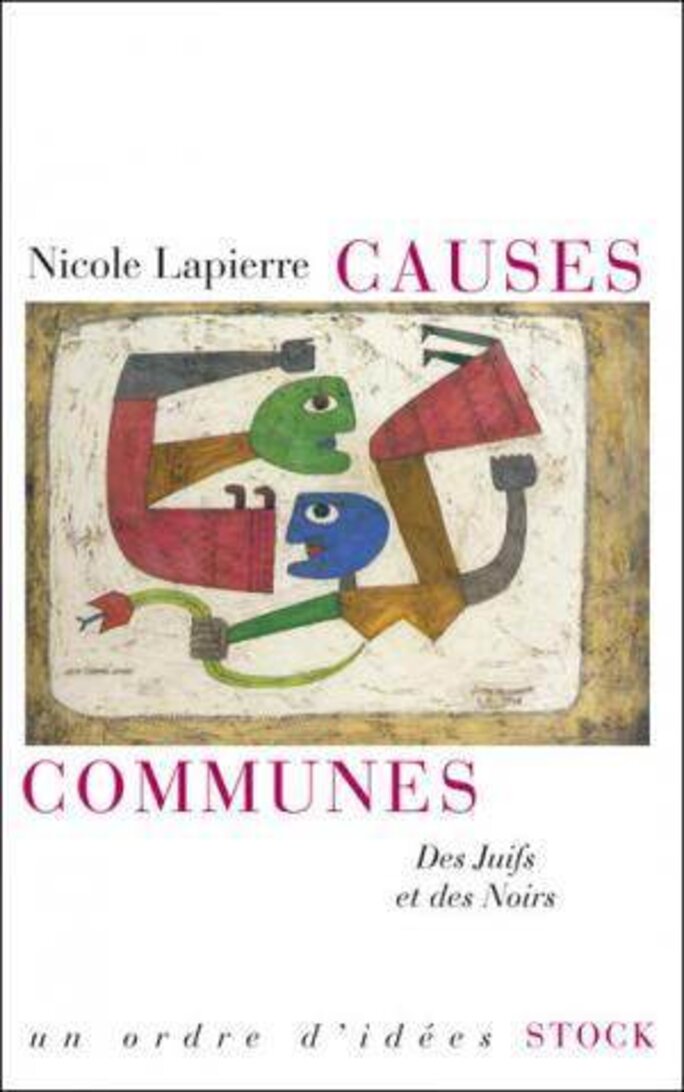
"Running through their stories is the red thread of the communist ideal of a society stripped of inequalities and racism, on which a great many Jews and many blacks had pinned their hopes," writes French social anthropologist Nicole Lapierre, in her recently published book on the subject, titled Causes communes (‘Common Causes'). "Theirs is the story of an Atlantis swallowed up by the sea, at once far away and close at hand."
During the first three quarters of the 20th century, victims of invidious distinctions, discrimination and exclusion stood by one another, across cultural and ethnic divides, all the way from the Pacific to the Urals and down to South Africa.
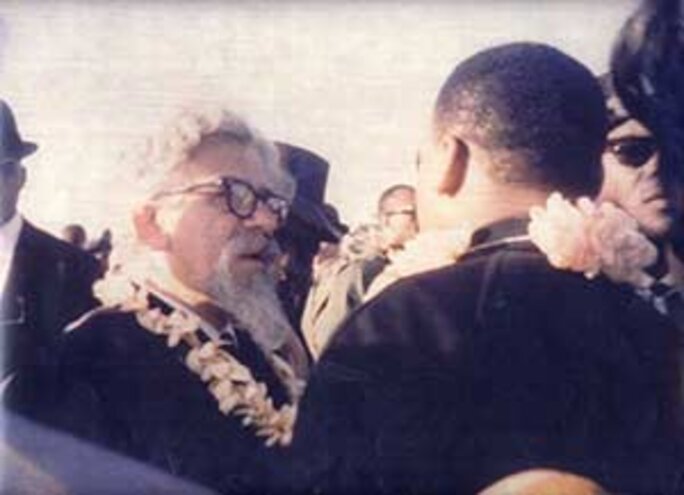
Lapierre's essay retraces the history of a comradeship between blacks and Jews, two communities that had long been confined to their respective ghettos and now sought to throw off the yoke of oppression. Their fellow-feeling seemed a matter of course back then, before the divisions that set in from 1968 on. This "concrete humanism", this brotherly meeting of hearts and minds, was to culminate in the anti-segregation marches undertaken by two men who "prayed with their legs", side by side: Rabbi Abraham Heschel (1907-1972) and the Reverend Martin Luther King (1929-1968).
Nicole Lapierre eschews the broad general view to retrace individual 20th-century destinies, starting with the friendship between two pioneering American progressives who shared a passion for Goethe, among other things: W.E.B. Du Bois (1868-1963) and Joel Elias Spingarn (1875-1939). It is important to grasp the collective ramifications of certain individual trajectories, as the author explained in an interview last year (click on video below) whilst working on her book.
Nicole Lapierre interviewed in 2010 by La vie des idées(in French only).
Pushing back ethnic boundaries
Black experience was re-examined through the prism of Jewish experience, and vice versa, by individual men of conscience who found the oppression and humiliation of others unconscionable. Rabbi Abraham Heschel, for instance, argued in the early 1960s: "Seen in the light of our religious tradition, the Negro problem is God's gift to America, the test of our integrity, a magnificent spiritual opportunity."
For mystical, progressive, conceptual or sentimental reasons, these outstanding individuals refused to be consigned to their ethnic pigeonholes. Contrary to Baudelaire's Beauty, who "hates movement, for it displaces lines", these men pushed back ethnic boundaries, blurring the dividing lines between communities and mixing their memories, though without diluting them. In his 1952 psychoanalytical study of black experience in a white world, Peau noire, masques blancs (1952, Black Skin, White Masks), the revolutionary Martiniquo-Algerian writer Franz Fanon put it like this: "When you hear people badmouthing Jews, prick up your ears: they're talking about you."
The idealistic, creative and political alliance between blacks and Jews takes a heavily novelistic flavour in Causes communes, in which some of the stories seem as though drawn from a saga or a documentary film. One case in point is that of the French writer André Schwarz-Bart (1928-2006), who lost most of his family in the Nazi death camps and in 1959 won the Prix Goncourt, France's highest literary prize, for his novel Le Dernier des Justes (The Last of the Just). Later he devoted himself to forging a shared literature with his West Indian wife Simone Schwarz-Bart (b. 1938). He once wrote: "The essence of dialogue lies not in universal ideas shared by interlocutors or in ideas we may have of each other, but in the encounter itself, in invocation, in the power of the Self to say Thou."
And then there is the Haitian poet René Depestre (b. 1926), who in 1949 married Edith Gombos Sorel ("Dito" in his poetry), a Hungarian Jewess from Transylvania. The couple spent several horrific months holed up in a castle in Bohemia, at a time when the Democratic People's Republic of Czechoslovakia was sealed off from the outside world, and were eventually expelled in 1952. Depestre, who thought of himself as a tree with multiple roots or as a nomadic 'geo-libertine', later settled down in the village of Lézignan-Corbières in the Aude region of France.
In 1995, Quebecois filmmaker Jean-Daniel Lafond made a documentary about him entitled Haïti dans tous nos rêves (Haiti in All Our Dreams), featuring interviews by Depestre's niece (and Lafond's wife), the journalist Michaëlle Jean, who later became Governor General of Canada (click on video below).
Another protagonist of Causes communes is Alain Albert. He was actually born in a post office in Lyon, in the clandestine secrecy of the French Resistance. As a budding 16-year-old poet, he was taken under the wing of avant-garde French poet and former Resistance fighter Jean Cayrol. Later on Albert assumed his Jewish patronymic name Ilan Halevi. And as a Jewish anti-Zionist, he took up the Palestinian cause, serving as the PLO's vice-minister of foreign affairs under Yasser Arafat. Nicole Lapierre extols "the joyful manner in which Ilan Halevi sacrificed ethnic affiliation on the altar of solidarity. Ever since adolescence, he has regarded himself as a generic outsider, identifying with all the damned of the earth and defying hard-and-fast ethnic identities. He even confounds the tally by describing himself as ‘100% Jewish and 100% Palestinian'." Moreover, Lapierre adds, "When dancing with his eyes closed, swept up in the rhythm of a jazz band in Martinique, he also seems a bit West Indian, just as, through music and sheer empathy, he was once a black in Harlem."
Jazz is in fact one of the leitmotifs of the book by dint of its magnetic force of attraction, its renegade rhythms and its penchant for concealment and disguise (note the fine pages on the phenomenon of blackface, when Jewish musicians got made up to look like blacks).
Beacons for the future
Nicole Lapierre ends her book with a reasoned tribute to empathy, to the reception and acceptance of the other, to the hospitality of remembrance. She champions permeability and the possibility of impermanence in a world of gate-keepers and pigeonholers. And yet, is "this mixing that introduces nuances and variation", as the late poet Edouard Glissant called it, still topical in our day and age?
Nicole Lapierre is loathe to see Jews and blacks staring stonily at each other across a new divide. Respect and reciprocity remain her watchwords. She balks at intoning the litany of ‘competition between victims', which "gives credit to what it claims to denounce". She prefers to stick to examples drawn from the past that may serve as beacons for the future, she says.
"Changing places," writes Lapierre, "putting ourselves for a moment in someone else's shoes, not only enables us to get closer to and understand one another, it also enables us to reassess our own point of view. And that, it seems to me, is the most important thing."
Causes communes is a bulwark against such latter-day, retrograde outrages as the 'prize for political incorrectness and insolence' awarded to Holocaust denier Robert Faurisson by the anti-Semitic French black comedian Dieudonné in December 2008; or the aspersions cast on Arabs and blacks by political commentator Éric Zemmour, for which he was convicted by a Paris criminal court last February for inciting racial discrimination.
-------------------------
Nicole Lapierre's Causes communes. Des Juifs et des Noirs is published in France by Stock, priced 21.50 euros.
-------------------------
English version: Eric Rosencrantz
(Editing by Graham Tearse)