


Public liberties groups have launched more than 100 legal actions alleging abuse of power by the French state over official decrees that authorised the use of surveillance drones during this autumn's social protests, Mediapart has learnt.
It is a legal offensive on an unprecedented scale, involving around 30 members of the lawyers' representative body the Syndicat des avocats de France from across the country. There has been legal backing, too, from the judges' body the Syndicat de la magistrature and the civil liberties body the Association de défense des libertés constitutionnelles (Adelico), plus technical help from internet freedom body La Quadrature du Net and its Attrap search engine which keeps tabs on orders made by state prefects.
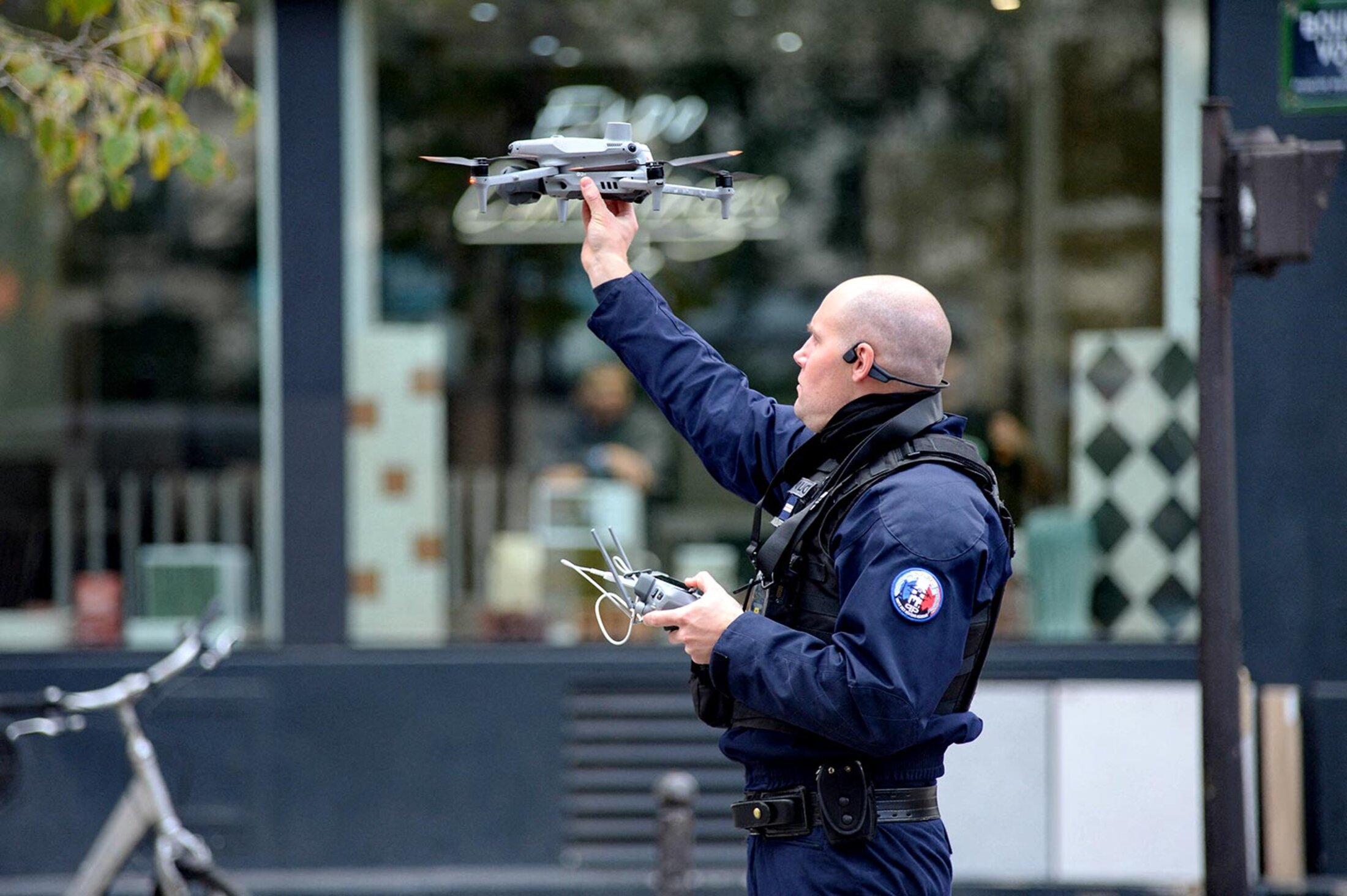
As Mediapart has already reported, the social protests on September 10th, September 18th and October 2nd saw an unprecedented deployment of drones by the authorities. In every département or county where demonstrations were held, the local state prefects issued orders allowing the protestors to be kept under surveillance by “cameras fixed on an aircraft”, as the wording of France's interior security code, the Code de la sécurité intérieure, puts it.
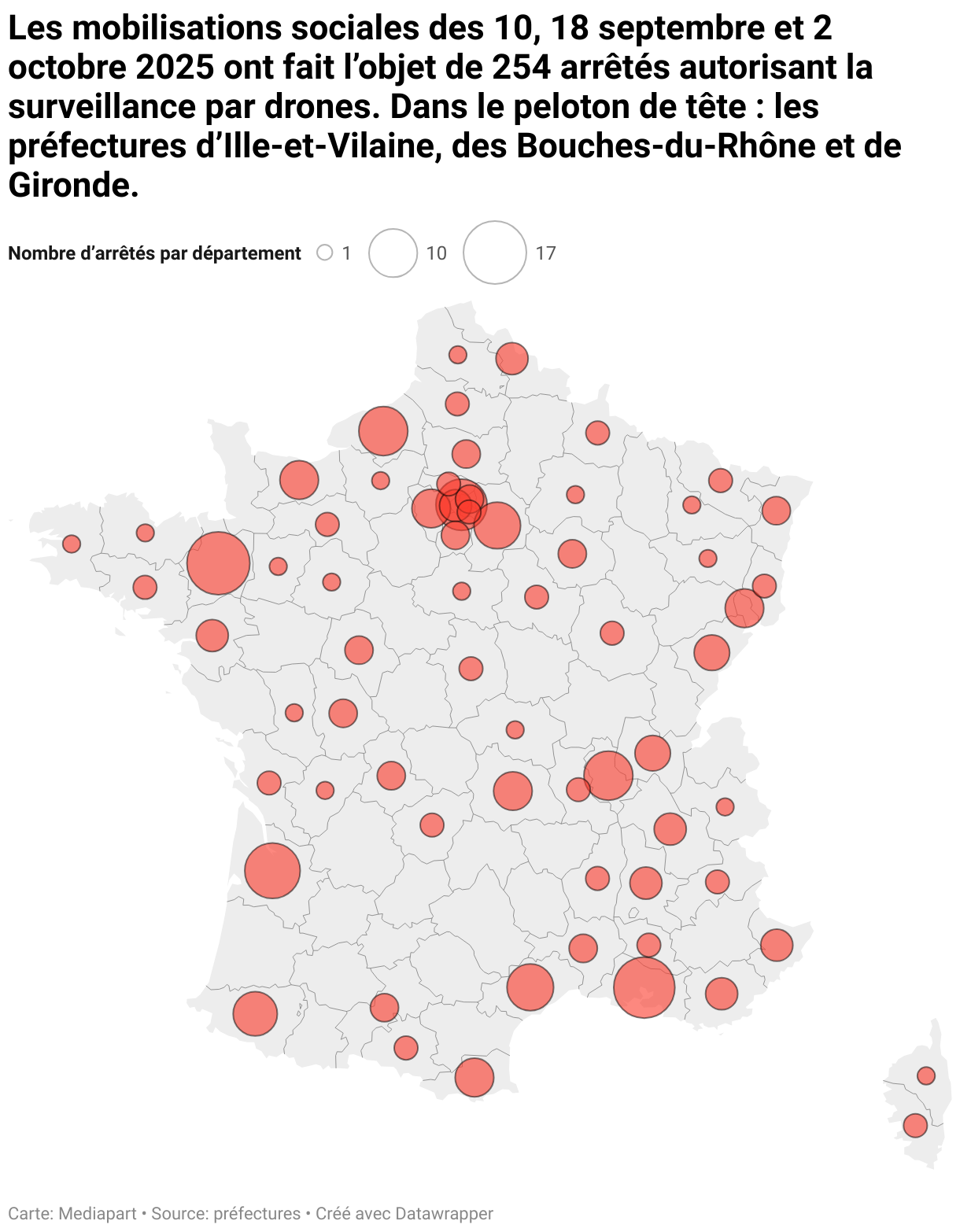
Some of these orders had already been challenged by the same collective that is coordinating the various legal groups; it sought temporary emergency injunctions at the time. In French law this urgent procedure allows the administrative court to be seized when there is a grave and clearly unlawful breach of a fundamental freedom. The judge then hands down a judgement, sometimes within hours; but it is temporary and does not rule on the substance of the case.
To obtain a ruling on the substance requires a parallel legal action for abuse of power, which is examined later, after months of more detailed examination. In cases concerning breaches of the freedom to protest, actions over abuse of power have little practical use, since the event at stake will have already taken place anyway. But such cases can help create a legal precedent.
“With an injunction it's a single judge making an urgent ruling based only on the information that they have in front of them,” says Vincent Souty, one of the four lawyers who has coordinated the legal operation along with Raphaël Balloul, Sophie Bensmaine and Julie Gonidec. “So it's a form of [legal] control that's limited at times. And above all, the ruling has limited wider implications.”
“The authority of an injunction ruling... is not at all the same as it is for legal action for abuse of power, which will be a joint judgement delivered by three judges,” Vincent Souty continues. “The latter carries more weight. When judges are deliberating over a ruling they have to give, they give more weight to rulings that decide the substance [of a case]. The aim is therefore to try to build a body of case law.”
Late publication of orders and bare-minimum info
These actions on the substantive legality of the drone orders will also shine a light on the vexed issue of the late publication of local state decrees, a problem that is often raised by civil liberties groups. While the dates of protests are known long in advance, and police demands are known several days ahead, some prefects wait until the last moment to publish their order, making any challenge very hard or even impossible.
“In many cases, either we could not mount a challenge because it was too late, or the court handed down a ruling that there was no case to answer, saying in essence that there was not enough time to organise a hearing and give a ruling,” says Vincent Souty. “It's a practice we want to flag to politicians, the press and lawyers, since it shows a desire to dodge judicial scrutiny.”
The one hundred or so drone orders that are being challenged were not picked at random. The collective's lawyers chose those that allowed them to target certain recurring practices by prefects. “We chiefly targeted the lack of public information provided,” says Serge Slama, professor of public law at the University of Grenoble and general secretary of Adelico. “In a large number of the orders, either there's no public information at all, which goes against case law from the Conseil d’État [editor's note, the Council of State is France's top administrative court], or the prefects do provide public information, but of the bare-minimum kind.”
Some prefects settle for “just publishing the order on a resources page on the prefecture's website”, which few people would think to check. “And often this is done late, the night before, the same day, or at times even afterwards,” notes Serge Slama.

Enlargement : Illustration 2
“Some prefects post information on social networks, but again, it's rarely detailed,” the lawyer continues. “At times it's just a short message on X or a link to the prefecture's website, but always with very little detail. There are some prefectures who do make the effort to publish press releases. And indeed the local press picks them up. And a handful of prefectures provide information in situ. That is the only information that counts and that lets people know what's really going on and allows them to adjust their behaviour.”
Vague and patchy drone zones
Many actions also challenge the vagueness of orders, chiefly in the way they draw the zones within which drone surveillance is allowed, with a boundary which in theory should be strictly set.
“Often the order gives a perimeter, but in vague terms, without street names or a clear map. At times there's a map, but when you look at it, it's often taken from Google Maps and you can't work out the exact boundary,” says Serge Slama.
Some maps do detail the drone fly-zone perimeter, but in a way that is disproportionate, covering for instance a whole town even though the protest follows only a set route. “We even had one order in Lyon where the lawyer realised that the perimeter was not fully closed,” says Serge Slama. “There was a list of streets, but once plotted on a map, one side was open. This meant that the perimeter was, in theory, infinite! It may have been a simple slip, but it shows how poorly prepared and patchy these orders can be.”
More broadly, the issue of disproportionality is raised in many of the legal actions, for various reasons: a lack of proportion in terms of the space allowed for the surveillance, a disproportionate length of time when the order exceeds the duration of the protest or, more broadly, a lack of proportion in the means deployed compared with the actual risk to public order.
“The legislation specifies that this kind of surveillance can be used only as an alternative measure, in other words when there are no other means of maintaining law and order,” says Serge Slama. “Yet in most cases, there were other ways to keep the peace. I'm thinking in particular of small towns, in the Drôme [editor's note, in south-east France] for instance, where huge areas were watched by drones.”
“At times the prefects also produce a number of reasons for the surveillance,” the lawyer adds. “They cite the maintenance of law and order but also several other grounds, such as traffic flow. In these cases, it will be for the judge to consider whether it's appropriate for the situation.”
We want the courts to strike down the mass use of drones in the public domain.
But above all, the groups within the collective want to use these legal cases to challenge and - if possible - halt the systematic and massive use of drones that now seems to be the norm for the Ministry of the Interior.
“There are clearly ministerial orders going in this direction,” estimates Serge Slama. “The aim is plainly to allow as many drones as possible in as many places as possible. The prefects cast the net very wide, even if it wasn't in fact useful to them, as a kind of precautionary principle.”
“That is what we want the courts to strike down: this mass use of drones during the three national days [of protest], this flooding of the public domain with drones,” the academic goes on. “If we end up with even 30% of orders being quashed by administrative judges, that in itself would be telling. It would show how disproportionate the use of drones has become. It would allow us to challenge the Ministry of the Interior and tell it: ‘Do you realise that a third of your orders were unlawful?!’”
---------------------------------------------------------------------------
- The original French version of this article can be found here.
English version by Michael Streeter