


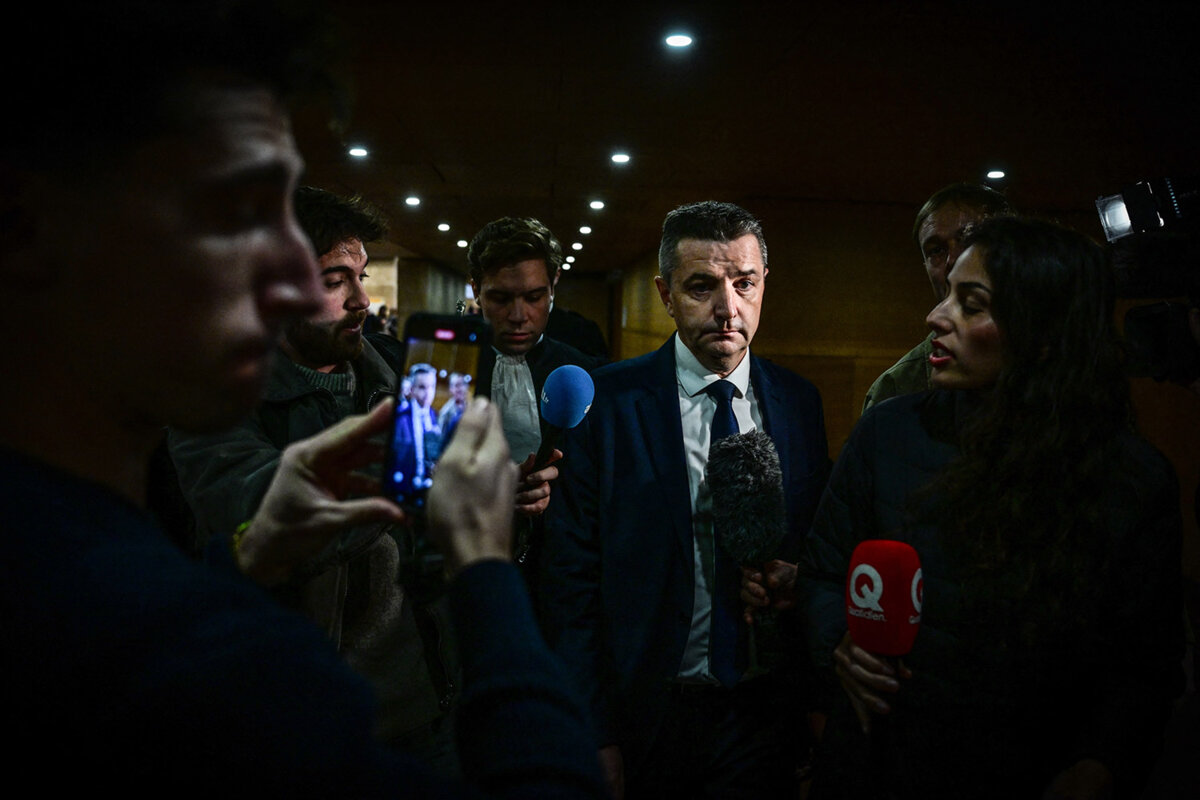
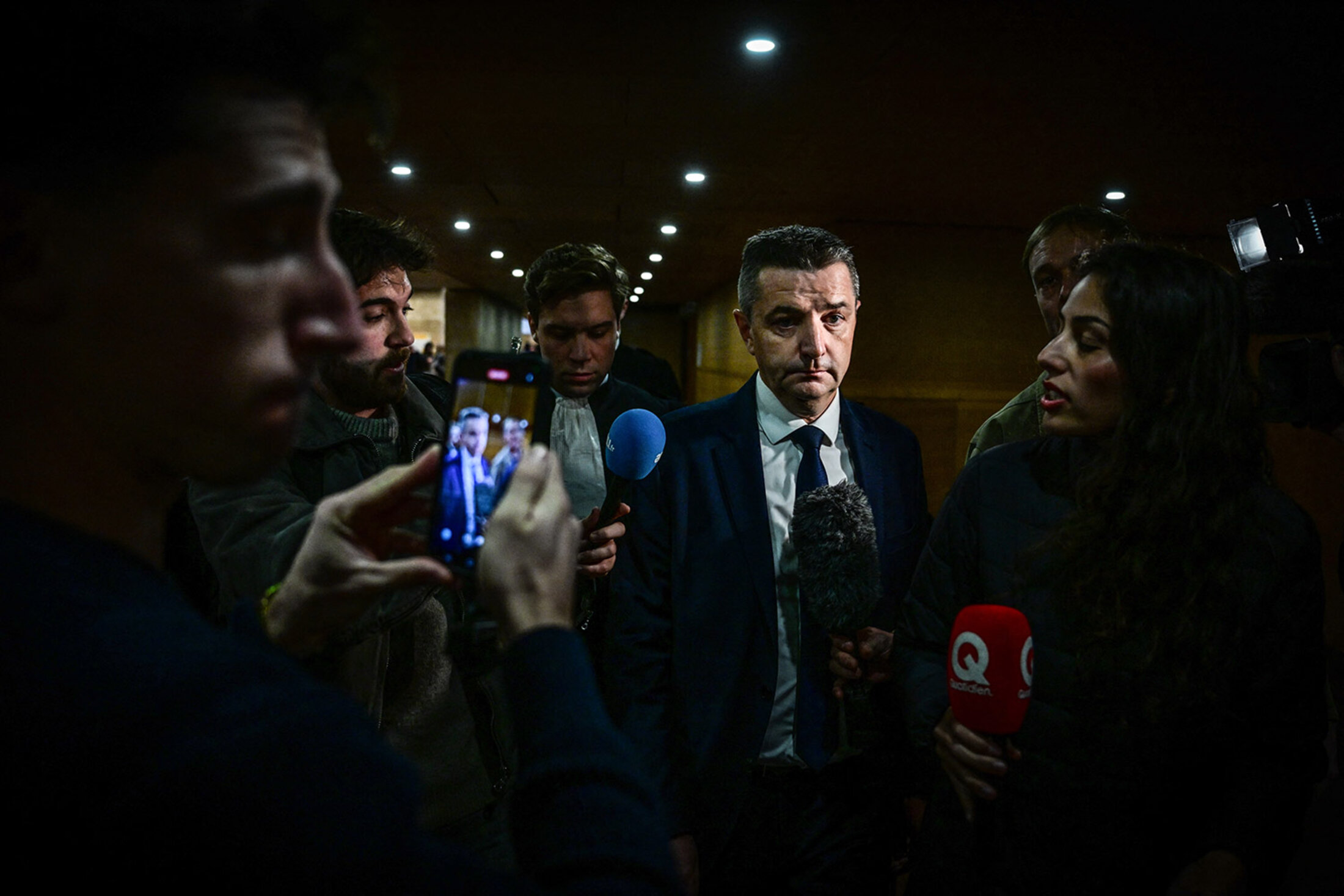
The south-eastern city of Saint-Étienne is at last liberated from its mayor. On December 1st a court in Lyon gave Gaël Perdriau a five-year jail term, with one year suspended, after finding him guilty of blackmail, criminal conspiracy and misuse of public funds. And because of the seriousness of the offences, the elected representative was also declared immediately ineligible from holding public office for the next five years. “You can no longer be mayor of Saint-Étienne,” the presiding judge Brigitte Vernay bluntly told him.
Gilles Artigues, too, has been freed by this verdict. At the end of the case, the former deputy mayor, who for years had been the target of a vile sex-tape blackmail, fell into the arms of his loved ones. “You've saved our family,” his wife told Antton Rouget, the Mediapart journalist who, after months of work, exposed the affair in August 2022, before going on to document each part of it.
Completely unaware of what Gilles Artigues was going through, for years his family had looked on as the former Member of Parliament fell apart. The local politician secretly thought of killing himself. He recorded proof of the blackmail, but only so that after his death there would be a record of what had happened. He could not file a complaint, for fear that a video of a compromising massage he had been given by a male escort – part of a plot ordered by the mayor and paid for by the taxpayers - would be broadcast on social media.
Enlargement : Illustration 1
Now, three years after Mediapart's first article exposing the affair, Gilles Artigues and the people of Saint-Étienne can at last regain their dignity. But journalism cannot do everything. Faced with a mayor clinging to his post despite clear proof of his part in the affair, it took the justice system to stop him: nothing would have made him resign.
While his chief of staff and friend Pierre Gauttieri, feeling cornered, ended up admitting the facts (see his video interview in French here), along with the two others involved in the plot, the mayor has always denied any involvement. As soon as the verdict fell he announced that he would appeal.
This stance – one of denial and claims of a plot - strongly recalls the defence line adopted by two other accused this year: Marine Le Pen and Nicolas Sarkozy. They, too, were found guilty at first instance and given a prison sentence and immediate bans from office, something the court saw as necessary in order to protect society without delay. It is the citizens who are the direct victims of their deeds.
These two convictions, of a former president of the Republic and of a far-right candidate who has twice reached the second round of a presidential election, have already in their own way highlighted the important work of the press. In the Libyan affair, as with the Saint-Étienne case, legal proceedings began thanks to the publication of Mediapart investigations.
A check on power
To state this is not to boast but simply to welcome it. Measuring the value of journalism is absolutely not about counting the years of jail time to which this or that figure is sentenced. The criminal law is, fortunately, not our domain: we do not claim to be judges, prosecutors or the police.
Moreover, many investigations lead to neither investigations nor court convictions: that does not make them any less useful.
Instead, it is simply about recalling what the role of the press can and should be. This role is to provide a check on power when, for instance, the counter-balances offered by a city council opposition are so limited, despite all the various citizen-led movements trying to make their voices heard.
Why do we need to point this out? Because we live in a sombre and at times oppressive period: one in which the far-right is gaining ground everywhere, thriving on falsehoods, skewed opinion polls and propagandist media that serves its ideology. The political battle is also a media battle faced with the power of billionaire media owner Vincent Bolloré.
There is much to fear. And fear can make us freeze and can lead to self-censorship. That is why we must also highlight it out when checks on power do work, when plans to rig votes do fail, or when mafia-like practices are punished by the courts.
But who does highlight this? Who does welcome it? Citizens, perhaps. But not the great majority of our elected officials, whose support is barely audible when the independent press and courts come under attack. They are even less vocal when it comes to providing profound answers to a structural problem.
A silent Left
When, just a few days ago, Nicolas Sarkozy was found definitively guilty - and also given a prison sentence - in the so-called Bygmalion election funding case, there was no political reaction. It was as though it was seen simply as the story of one man's downward spiral.
Yet, once again, here was proof of a deep failure in the checks made on the funding of election campaigns: Sarkozy's unsuccessful 2012 re-election bid cost 42.8 million euros, nearly twice the legal spending limit. The commission in charge of checking campaign accounts, which actually checks almost nothing, managed to miss an overspend of about 20 million euros without prompting anyone to question how it works or how effective it is.
Even the Left holds back from taking a stand: these cases simply feed a mood of a “plague on all their houses”, we are told, which in turn fuels the far-right. And it is said that this constant refrain that all politicians are “rotten” inevitably helps the far-right Rassemblement national (RN).
But the factors driving the far-right vote go far deeper - social breakdown, racism - and the argument can be flipped on its head: if the Left were to tackle head-on the fight against so-called “white-collar” crime and embrace public ethics, might it not become more credible as a force seeking to represent a different approach to power and money? This is a necessary, even vital debate to have.
Only then could we fully celebrate: for the fight against corruption and for honesty must not remain the preserve of a few whistleblowers and committed citizens, backed by the press and carried out by the courts. It should be a matter for us all.
---------------------------------------------------------------------------------------
- The original French version of this op-ed article can be found here.
English version by Michael Streeter