


The head of France's agency dedicated to collecting motorists' speeding fines has avoided paying for his own tickets by getting the state organisation itself to pay them, Mediapart can reveal. Jean-Jacques Debacq, who has the rank of prefect and who is director of the Agence nationale de traitement automatisé des infractions (Antai), has also avoided collecting any penalty points on his driving licence for speeding offences committed when driving his civil service car, by claiming that the driver “had not been identified”. This is despite the fact that these contraventions took place on Sundays or in the evening when the only other person who drives his publicly-owned Peugeot 508 – his chauffeur – does not work.

Documents obtained by Mediapart show that between the end of 2010 and the summer of 2013 Debacq, whose agency collects the fines from 12 million or so speeding tickets handed out each year, escaped paying for speeding or parking offences on around a dozen occasions. The fines on those offences amount to 700 euros.
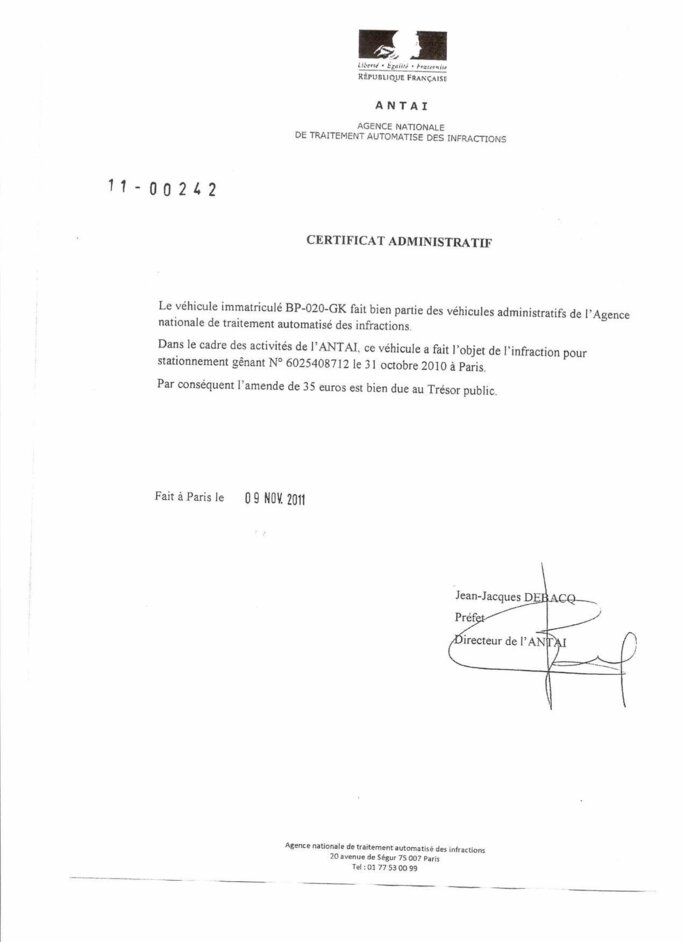
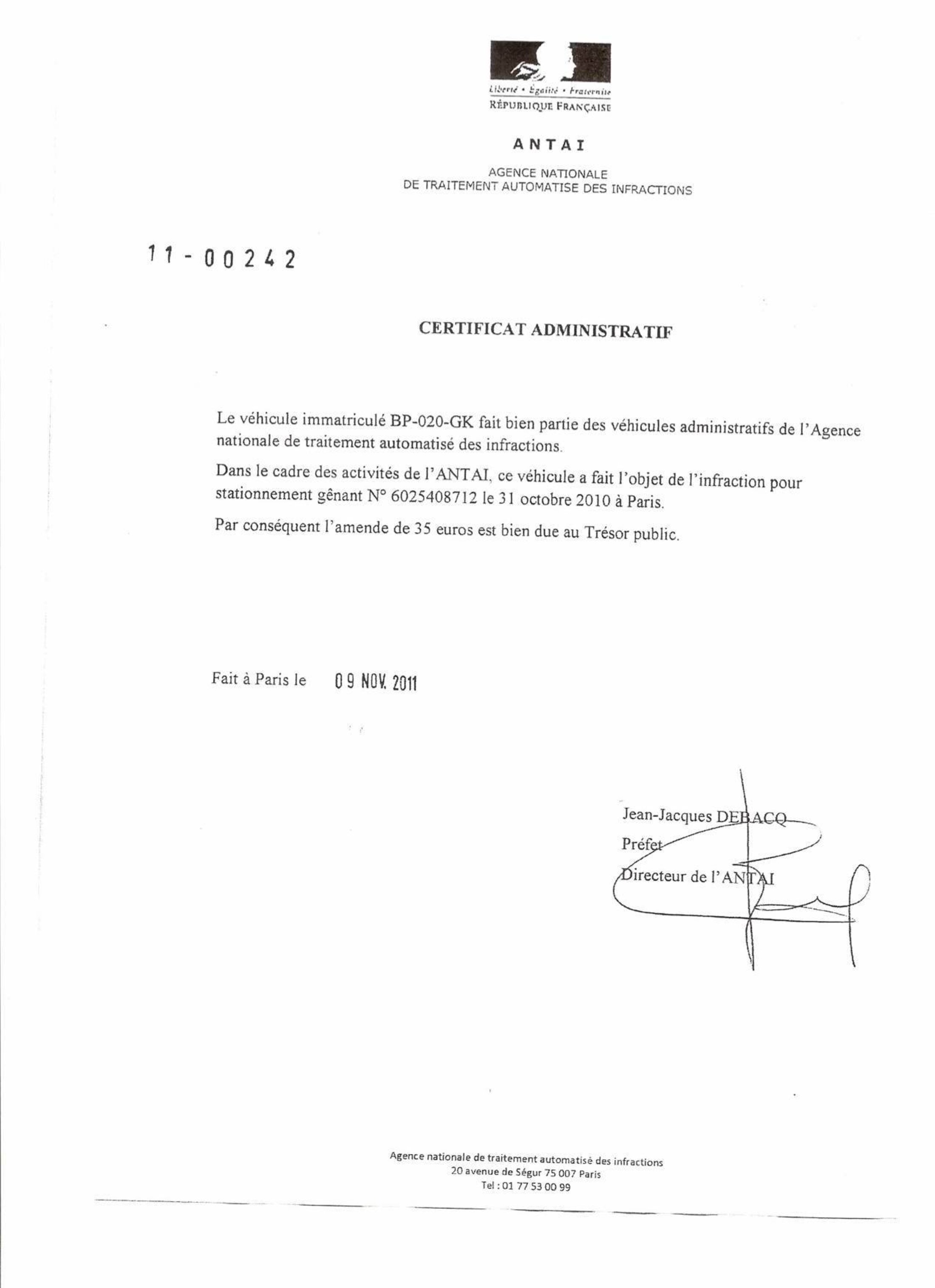
A document relating to the first of these offences, committed on October 31st, 2010, was signed by Debacq himself (see below). It concerned a parking offence involving the public servant's Peugeot, registration number BP-020-GK, for which only he and his chauffeur are designated drivers. This offence took place on a Sunday; his chauffeur works neither in the evening nor at weekends.
“This vehicle was the subject of a ticket in the course of official Antai business,” writes Jean-Jacques Debacq on the official document. On other documents concerning speeding offences for the same vehicle he also adds: “The driver of the vehicle has not been identified.” In France a clean driving licence starts with 12 points, and the driver loses points for specified offences, for example speeding. But if the driver of a speeding car is not identified they do not lose any points.
Another speeding offence was recorded by a speed camera on July 14th, 2013, a bank holiday in France that this year fell on a Sunday. Jean-Jacques Debacq says he is unsure where he was on that day. “Quite honestly I do not know at all where I was...in my opinion I wasn't here [editor's note, Paris] and must have been in the provinces.” According to the records from an automatic motorway toll, the public servant's car was somewhere on the coast of Normandy in north-west France. As with half of the cases seen by Mediapart, this offence involved speeding recorded by a speed camera, meaning the driver was not stopped by a gendarme or police officer. In such cases it is quite easy for a motorist to deny having been at the wheel at the time of the offence.
Enlargement : Illustration 2
The other documents seen by Mediapart relate to parking offences. Some of these are new electronic tickets, in which the ticket is sent automatically to the registered owner of the vehicle in question, rather than being left on the car's windscreen. In other words, the parking tickets relating to Debacq's car are sent to his own Antai headquarters.
In the past Jean-Jacques Debacq has spoken out forcefully against drivers who break the speed limit or park illegally. In 2011, for example, Debacq told a parliamentary committee: “If you are asking me if a point should be withdrawn for speeding slightly over the limit, my answer is a firm 'yes', for that's the real sanction, it applies to everyone.” As recently as July 2nd this year Debacq told a gathering of senior public servants and politicians: “In fraud there is fraud within the fraud...motoring offences are already a fraud in a certain sense, but there are those who are not only caught but who also want to escape the punishment.”
In Debacq's case, however, it certainly appears from the documents seen by Mediapart that fines relating to his car have been paid for by the state, and not by the public servant himself. “It's fortunate that I don't pay for all of Antai's expenses!” commented Debacq, while not denying that he signed documents relating to the vehicle “to protect the person who was driving at that time”.
A lawyer specialising in the highway code and motoring offences, Caroline Tichit, says there are serious issues raised by Mediapart's investigation. “According to article L121-3 of the law on motoring, when a legal entity – for example Antai – is the registered owner of a car flashed by an automatic radar and the driver is not identified, it is down to its legal representative to pay the fine,” she says. “It is moreover the same with company cars, unless the individual driver is revealed it's down to the head of the company to pay!”
Jean-Jacques Debacq himself rejects the suggestion that he is personally responsible for these fines, stating that he is under “absolutely no obligation to pay”. However the interior ministry, which is responsible for Debacq's agency, says that in the light of Mediapart's revelations it has started an investigation into the affair. “The facts reported in the press are serious. We must shed every light on this matter and establish the truth,” said ministry spokesman Pierre-Henry Brandet.
------------------------------------------
- Update: Following Mediapart’s revelations, Jean-Jacques Debacq resigned from his post as head of the Antai on October 8th. His resignation followed the opening of an enquiry by the French interior ministry into the information provided in this article. “An investigation demanded by the interior ministry has been opened and placed under the management of the administration’s general inspectorate,” announced interior ministry spokesman Pierre-Henry Brandet on October 2nd. “The events reported by the press are serious. The point is to shine every light on this case and to establish the veracity of what happened.”
English version by Michael Streeter