


Following the Paris terror attacks on November 13th, Mediapart interviewed Belgian academic Cédric Poitevin (below, right), deputy director of the Brussels-based independent research centre the Group for Research and Information on Peace and Security (GRIP), about the issue of the illegal firearms trade across Europe.
-----------------------------------------------------------------------------
Mediapart: Is Belgium the hub for illegal firearms trafficking in Europe?

Cédric Poitevin: Yes, in a way, Belgium is a hub. But to say that it's 'the' hub in Europe would be an exaggeration: one must be wary of the effect of focussing on just one area. Since January 2015 we've considered the issue of arms trafficking exclusively through the prism of the people carrying out the attacks in Paris [editor's note, the Charlie Hebdo attacks in January and the attacks on November 13th] or the person carrying out the failed attack on the Thalys [editor's note, the attempt to attack an Amsterdam to Paris train in August 2015]. But these terrorists have very particular profiles, most are French-speakers, and they are not at all representatives of those involved in arms trafficking in general inside the EU. If other terrorists had wanted to attack capitals such as Berlin or Vienna, for example, I'm not sure they'd have come to Belgium.
We have to approach the problem from a European angle and recall, first of all, the absence of borders in the Schengen area. In addition, the fight against arms trafficking was not, until recently, considered a priority by the authorities. The fight against human trafficking, of course, and also trafficking in drugs, manufactured goods and cigarettes has always taken priority. These choices have had an impact in terms of financial and human resources, including in research, in connection with the weapons found at crime scenes.
The challenge is to understand at what point a weapon has switched from the legal to the illegal sphere. With the serial number one can go right back to the last legal owner of the weapon. From there you can follow the thread. And if you do this research systemically with every illegal firearm that you find you can start to establish trends, identify networks and so on. All that work hasn't been done in Europe, because it was not judged a priority. In the last few years that's been in the process of changing. But it takes time.
Mediapart: Of the illegal arms circulating in Belgium do most of them come from the former Yugoslavia? What is the scale of the problem?
C.P.: As there is a lack of research, one can only base oneself on the impressions of people working on the ground. Since the end of the war in former Yugoslavia the number one source is, in fact, the Balkans. As with each time a conflict ends, weapons leave the country to find other markets. They're sold in small or medium-sized deliveries, which makes the fight against this trade particularly difficult for governments. After the fall of the Berlin Wall, some former Soviet bloc countries, but in particular countries in the Balkans - in the widest sense - had colossal stocks. A tiny country such as Albania was totally over-armed.
Mediapart: In a 2014 report [editor's note, see here] the European Commission spoke of 67 million illegal firearms in the EU. Is that a solid estimate?
C.P.: I don't know where they got these figures from. In the community of researchers we're quite perplexed by these figures.
Mediapart: Has the collapse of Libya opened another network, towards northern Europe?
C.P.: One indeed reads accounts along those lines. But there's no proof. It is, anyway, a more distant country. And if you know that the network that comes from the Balkans is based on already well-established routes, I don't see why you'd bother to open other, more difficult routes. There are other sources from which to supply yourself with weapons of war: the hijacking or theft of stocks held by the state - the army, police, gendarmes. Because of a lack of statistics it is difficult to know the size of the problem. Governments, understandably, communicate very little on the issue. Of course, the French and Belgian armies don't use Kalashnikovs [editor's note, the firearms used in the terror attacks in France in January and November].
Enlargement : Illustration 2
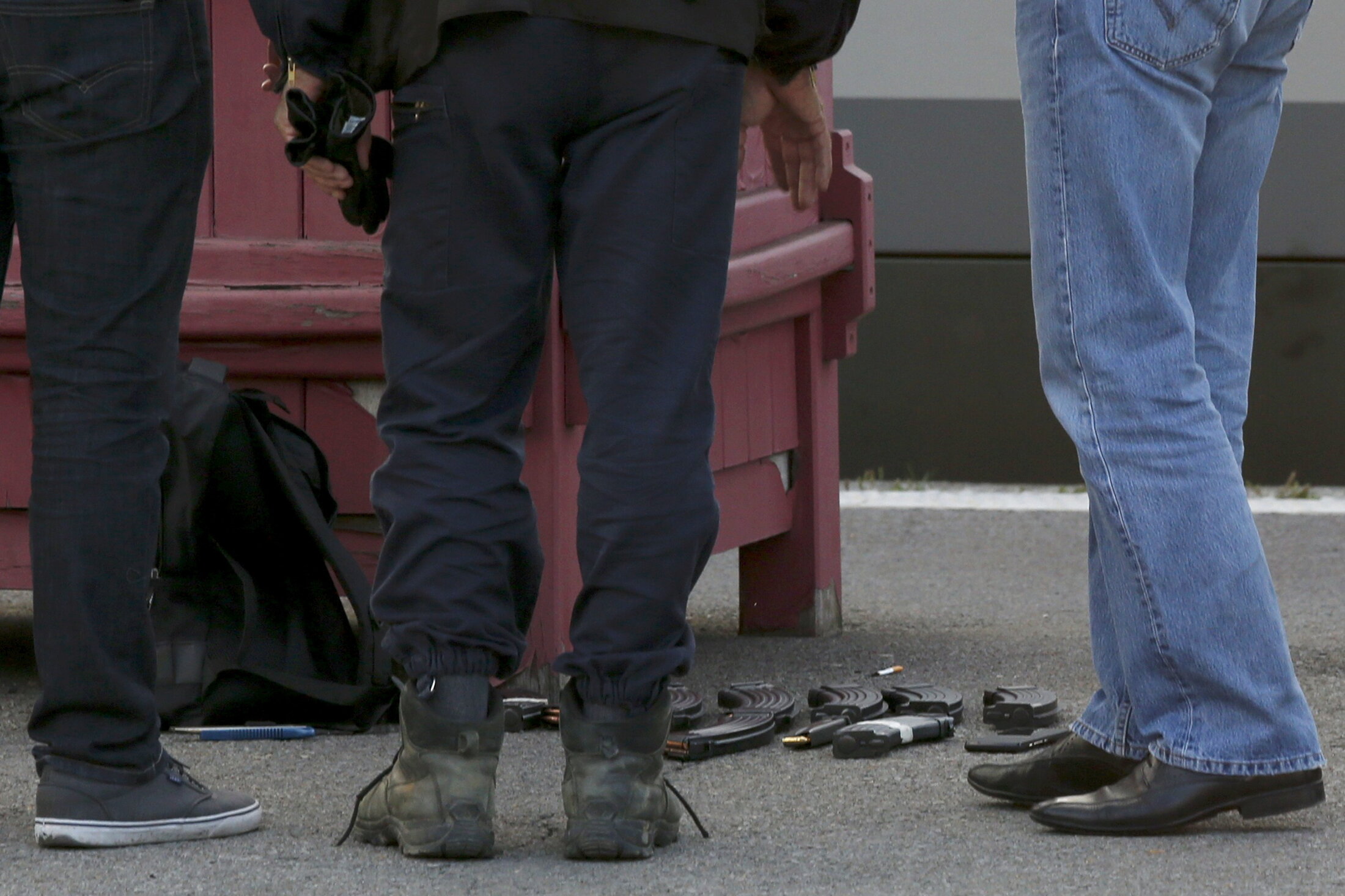
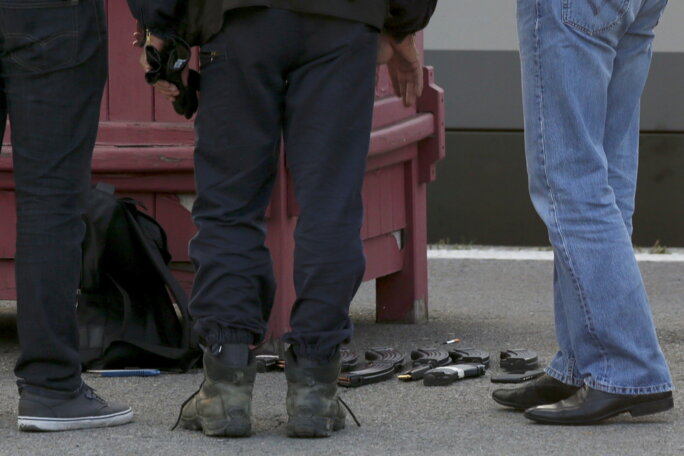
Mediapart: In the case of the attempted attack against the Thalys Amsterdam-Paris express train, the weapon used was an AKM assault rifle, apparently bought in Brussels, with parts produced in Germany from a decommissioned gun that was later reactivated. Which is probably why the gun became stuck when the first shots were fired. Is this an example of another underlying trend?
C.P.: Yes. Here we are talking about a quite different market. On one side you have the legal sphere of weapons sales. On the other, the black market, illegal and fed for the most part by the Balkans. Then you also have grey areas, where individuals take advantage of differences between European legislations - in particular concerning the question of deactivation - to get hold of other weapons. Originally, the idea of ‘deactivating’ a weapon came about because it was thought that arms were necessary for collectors, museums, films and so on. But in countries like Slovakia or Germany, the required standards regarding deactivation are reputedly less strict than elsewhere, and so much easier to reverse.
Mediapart: Amedy Coulibaly, one of the terrorists involved in the January attacks in Paris, got hold of one of his guns from a Belgian so-called collector who himself gets his supplies of weapons through a website based in Slovakia which sells ‘demilitarised’ parts. What’s your reaction to that?
C.P.: In this kind of business, there is a major question about the responsibility of those implicated. To resell deactivated weapons that come from a country which is known to have insufficient standards on the subject is pretty questionable. And it is more than probable that some of his clients are aware of how easy it is to reactivate these weapons. Whatever the case, the answer is to work within the EU for a common required standard for the deactivating of weapons. The [European] Commission began a procedure in 2013, but it’s very slow. These efforts will only begin achieving results in five or ten years, and that’s logical. It must be understood that until very recently violence involving firearms in Europe was not a major concern.
Mediapart: Another point which is specific to Belgium is that based in its French-speaking region, Wallonia, is one of the biggest weapons-exporting companies in Europe, FN Herstal. Can that explain the parallel surge of an illegal firearms market?
C.P.: In theory, it has nothing to do with it. It is a company which manufactures civil and military weapons, almost exclusively destined for exportation, in particular for the American civilian market and ‘allied’ armies in the Middle East. However, what is true is that the region around [the Belgian town of] Liège, a bit like that of Saint-Etienne in France, has a tradition of manufacturing weapons. An industrial fabric has developed there. In Liège you have people who have an expertise and, in some circles, a culture in weapons, and with real know-how.
In 2011, the person who carried out the killings on the main square in Liège had reconstituted a weapon from parts and components that he collected on his own, proving a certain know-how. The principal part in fact came from an FAL - a light assault rifle equivalent to the Kalashnikov that was produced in large numbers by FN Herstal during the Cold War – that had been part of Israeli army stock. That demonstrates the extreme complexity of things. There was also talk, at a certain period, of retired workers from FN Herstal who topped up their monthly incomes by trafficking arms parts from home.
Mediapart: What is the lifespan of a war weapon?
C.P.: At least 50 years. If you don’t maintain it properly, it wears down. Otherwise, it can last 100 years. In Afghanistan, some of the Taliban used British weapons dating from the First World War to fight against British NATO soldiers in the 2000s. We hit here on another problem, often raised by NGOs. Some companies are authorised to export arms to sensitive areas, with governments believing in the stability of local regimes, but it is impossible to know what will happen in ten or 50 years. Weapons can rapidly change hands.
----------------------------------------------------------------------
- The French version of this story can be found here.
English version by Michael Streeter and Graham Tearse