


Following the results of the legislative elections held in Germany on September 26th, it is probable that the country’s new chancellor will be a social democrat. Yet just a few months ago such an outcome appeared highly unlikely.
Since 2005, the recurrent poor electoral performance of the German Social Democratic Party, the SPD, allowed the conservative Angela Merkel to govern for 16 consecutive years. During the same period, the SPD appointed no less than seven successive leaders. Even in June this year, opinion surveys were still predicting a catastrophic outcome for the SPD, credited with little more than 15% of voting intentions, and the Greens threatened to replace it as the alternative party of government.
But not only has the SPD increased its share of the vote by 5% compared with the last elections in 2017, it took the lead, ahead of the conservatives of the CDU/CSU alliance. It was the first time that the social democrats overturned the conservatives since 1998, when Gerhard Schröder, beating Helmut Kohl, became chancellor. The new dynamics of the SPD, with the change in the balance of power and the lassitude of the partners in the outgoing wide coalition, all point towards a favourable of the ongoing negotiations between the social democrats, the Greens and the liberals of the FPD party to form a government. That will be played out over the next few weeks, although on paper, the emergence of other potential ruling coalitions is a possibility.
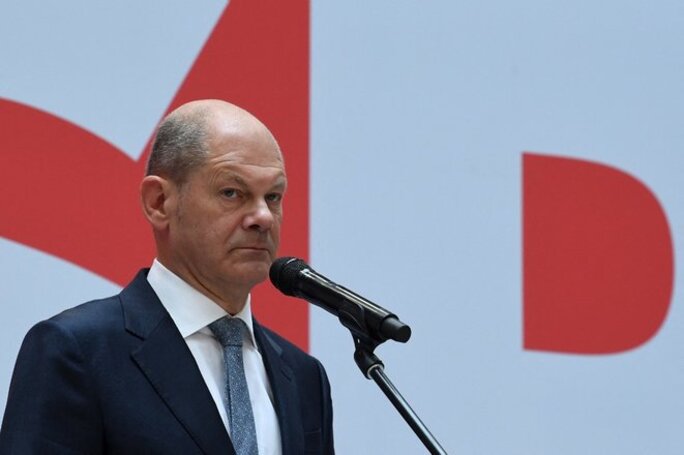
This new situation is an encouragement to the hopes of France’s centre-left, as presidential and legislative elections, beginning next April, approach. Paris mayor Anne Hidalgo, widely tipped to become the presidential candidate for the Parti Socialiste (PS), was swift to post on Twitter her support for Olaf Scholz, the SPD’s candidate to become chancellor (see below).
Tout mon soutien à @OlafScholz qui sera, je l’espère, le prochain Chancelier. Durant cette belle campagne, le SPD a déjoué les pronostics grâce à un programme ambitieux : revalorisation du salaire minimum, plan pour le logement, mutation de l’économie face à l’urgence climatique.
— Anne Hidalgo (@Anne_Hidalgo) September 26, 2021
Meanwhile, PS general secretary Olivier Faure tweeted that the results of the German elections demonstrated, “Lesson number 1: never think that things are lost in advance. Lesson number 2: think in terms of a coalition”.
Those unsurprisingly gleeful reactions prompt a closer look at the performance of the social democrats in Germany, and an evaluation of the strength of the social democrat family elsewhere in Europe, in particular with regard to recent electoral gains; on September 13th, the social democrats returned to power in Norway in a landslide victory that ousted the governing centre-right coalition, in power since 2013. Similarly, the social democrats are in power in Denmark, Finland and Sweden, while the socialists govern in Portugal and Spain.
In many ways, and without predicting the result of the negotiations to form a government, the success of the SPD is but a relative one, and firstly in relation to the past performance of the party. Its slice of 25.7% of votes cast is between ten and 20 percentage points below the electoral scores of the party during the period from the late 1960s to 2005, when Schröder’s reign as chancellor came to an end. In fact, it represented much the same score that the SPD managed in parliamentary elections in 2013, and which at the time was regarded as a defeat.
“Today’s score is still part of the sequence that began in 2009, characterised by results of less than 30%,” observed Pascal Delwit, a political sciences lecturer at the Free University of Brussels. “If the performance [last month] is a little surprising, it’s with regard to the particularly bad scores recorded in the 2017 legislative elections, and then the regional and European elections which followed.”
Above: a graph showing the percentage of votes cast that went to the social democrats in legislative elections between 1949 and 2021.
Secondly – and this is the reason why its performance could see it in the chancellery in 2021, as opposed to the outcome in 2013 – the SPD owes its first place to the huge slide in support for the CDU/CSU, its principal opponent on the Right. Armin Laschet’s gaffe-prone leadership of the CDU proved a failure, notably in face of the Covid-19 pandemic and the severe flooding which hit Germany in mid-July. On top of this, the Right is more fragmented than previously, with 10% of votes going to the far-right AfD (around which the other parties had created a cordon sanitaire).
The failed campaign of Green party candidate for chancellor Annalena Baerbock, at a time when climate change was a priority issue for many voters, also opened up a space for the social democrats. Meanwhile, some supporters of the radical-left Die Linke party may have been tempted to make a practical, ‘realistic’ choice by voting for the centre-left SPD. The party drew votes from outside the camp of party loyalists, firstly from the CDU and former abstentionists, and secondly from its two leftwing rivals.
Enlargement : Illustration 3
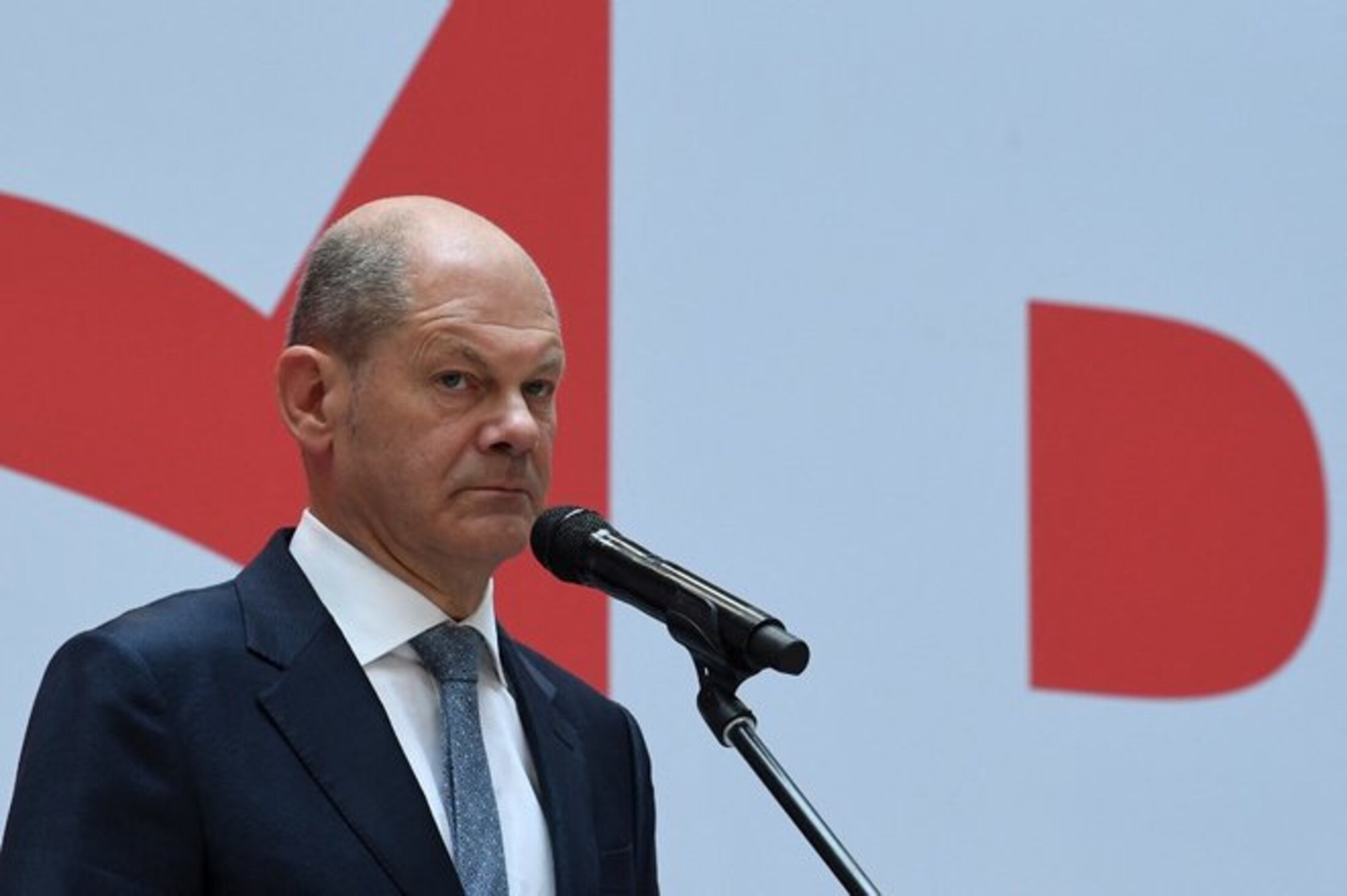
But a favourable context does not suffice on its own – what is also required are individuals capable of seizing the moment. That is where lies the undeniable success of Olaf Scholz, working in harmony with the party’s co-leaders Saskia Esken and Norbert Walter-Borjans. There was no guarantee of this; in December 2019, the two party leftwingers won the leadership tandem after distinguishing themselves from Scholz’s orthodox approach. While their appointment did not signify a grass-roots revolt against the party apparatus, they were hostile towards the conservative-led ruling coalition in which Scholz served as finance minister, and their avowed ambition was to see the adoption of a more redistributive set of economic policies (and which was hardly conceivable within the framework of the coalition).
"There could have been an incompatibility between Scholz, Angela Merkel’s vice-chancellor and the figurehead of the centrist wing of the party [SDP], and a [party] leadership that was concerned with placing a course to the Left,” commented Amandine Crespy, a teacher and researcher in political sciences at the Free Brussels university. “But there was no discord. Scholz was credible in the field of social justice, taking up the party’s key policy measures on controlling housing costs, or dismantling the most punitive aspects of social policies put in place by Schröder. In parallel, he held back from pronouncements on certain questions which could have been stumbling blocks, like fiscal discipline, to which he’s attached.”
As was well set out in an article in The New Statesman, the outgoing finance minister made the clever decision early on to reach an understanding with the new duo leading the SPD. In parallel with his general respect for the neo-liberal model, he sought to unify the party behind demands on social policies that were compatible with that model and which could rally both the middle- and lower-classes, pitched around notions of “respect”, dignity”, and “decent life”.
Finally, he has imposed himself as an experienced and pragmatic leader, unhesitatingly using the theme of continuity with regard to the outgoing chancellery. Thanks to this subtle balancing act between ideological demarcation and conformism, Scholz now appears the winner in the race to represent a ‘Merkel 2.0’ .
Above: a graph showing the comparison of votes cast, by age group, for the social democrats in Germany’s legislative elections in 2017 (in pink) and in 2021 (in red), beginning with a bar showing 18-24-year-olds, and ending with the over-70s.
“If the SPD wins the chancellery, it will rapidly face complicated regional elections, with the risk of being punished by the those unhappy with it, as its popularity level in the Länder has been particularly weak over the past five years,” said Pascal Delwit. From a structural point of view, time is not on the SPD’s side. On the one hand, the decline of the social democrats is slowed by its historic and deep links with the working population, on the other, these links have not been refreshed with new generations, and its electorate is ageing, unlike that of its potential partners, the FDP and the Greens.
Among those parties which have lost the most electorate through natural mortality since the federal elections in 2017 (around 700,000), the SPD is the party comes in in second place, after the CDU. Revealingly, the SPD’s progression since 2017 is not uniform across age groups, and its electoral support continues to be over-represented among ageing voters. While its support grew in the latest election from its 2017 score by about 5%, it rose by more than 10% among the over-60s while falling among the under-30s. For all these reasons, Delwit said he cannot see “the seeds of a structural recovery” from the results of the September 26th elections. Instead, they appear more illustrative of a halt in the party’s until-now spiralling decline, which can also be seen in the number of votes garnered by the SDP in comparison to all the parties of the Left, including the Greens (see graph below).
Above: the percentage of votes cast for the SPD as part of the total for all parties of the Left in Germany’s legislative elections between 2002 and 2021.
Since 2002, which was the last time that the SPD won the chancellery, with Schröder’s re-election, the party’s share of the leftwing vote has declined from 75% to just less than 58%. While it has managed to retain its role as a political counterweight, it has become a more modest one, and closer in size to its rivals on the Left.
A similar observation can be made regarding the victory of the Norwegian Labour Party in parliamentary elections on September 13th, returning to power after eight years in opposition. Its return is not due to a surge in popularity – with a 26.4% share of votes cast, the party lost 1.1% of the votes it garnered in the previous parliamentary elections in 2017. Apart from in 2001, when the Labour Party suffered an electoral disaster, its score in the elections last month was the most mediocre since 1924. Although the French socialist party would be happy with such a result in parliamentary elections due next year, it should be remembered that the Norwegian Labour Party had previously, and on several occasions, come close to an absolute majority, and that until the beginning of the 2010s, it recurrently captured a third of votes cast.
While the Labour Party lost one seat in parliament, two radical-left parties and the Greens all increased their representation. As in Germany, the percentage of votes garnered by the Labour Party from among all votes captured by the Left has diminished, down from 81.7% in 2009 to 62.2% today. With progress of support for the agrarian Centre Party, which capitalised on anger in rural areas over perceived disregard for them by the previous rightwing ruling coalition, with its reforms for increasing the centralisation of administrations and public services, which should provide a partner for Labour in forming a ruling coalition. As in Germany, the poor performance of those parties that are the most conservative was down to voters’ primary concerns over climate change and social inequalities rather than migration and national identity issues.
If northern Europe is now home to several governments led by social democrats, it is far from representing the cradle of the renaissance of social democracy. Despite obtaining what would be viewed from France as honourable electoral scores, support there for the social democrats has nevertheless dissipated to the point of making them an unremarkable political player.
The case of Sweden illustrates this quite well. The government of social democrat Prime Minister Stefan Löfven, in a coalition with the Greens since 2018, has only held on to power through a politically costly alliance with a party of the Right. It almost fell this year following a no-confidence motion in parliament, tabled by the far-right and adopted thanks to the support of the radical-left, which was prompted by government plans to ease rent controls. Löfven, who survived as head of government but only just, has nevertheless announced his resignation as head of the Swedish social democratic Party, the S/SAP, which will be effective as of its next congress due to be held in November.
In Finland, social democrat prime minister Sanna Marin leads a coalition government made up, along with her own party, of two leftwing parties – the Green League and the Left Alliance – and two centrist parties – the Centre Party and the Swedish People’s Party – the latter two rendering uncertain a promise to break with austerity policies.
As for Iceland, which also went to the polls at the end of September, and where the social democrats have followed a more uneven electoral path than those in other Nordic countries, the Social Democratic Alliance party (Samfylkingin) went back under 10% of votes cast, whereas it hovered at around 30% in elections between 2003 and 2009.
Denmark is the only one of these northern countries where the social democrats, led by Mette Frederiksen, appear to have a solid popular base, but this is at the price of borrowing support from the rest of the Left when it comes to policies to boost welfare state provisions, and from the Right and far-right when it comes to policies to restrain immigration and harden criteria for granting asylum in the country.
Elsewhere, the historically traditional members of the social democrat family are in poor shape, aside from the centre-left in government in Portugal and Spain who rule with the support of the radical-left.
In France, despite its pretention of being a “driving force” of the Left, the PS has remained for several years a party in collapse, a situation which is up for fresh judgement in the elections in 2022. That is also the case of the Pasok party in Greece, frozen in isolation since its mismanagement of the country’s debt crisis ten years ago. In the Netherlands, the Labour Party (PvdA), once a major alternative political force, gained just nine seats out of 150 in the lower house in the 2017 parliamentary elections. As for the British Labour Party, it is still struggling following the Jeremy Corbin era. His centrist successor at the helm of the party, Keir Starmer, has so far failed to place it as a credible alternative to the ruling Conservatives of Boris Johnson, and in May it suffered heavy losses in local elections.
These observations were placed in a historical context in a study published this year by Pascal Delwit (in English, here) entitled ‘An electoral history of European Social Democracy (1870-2019)’, in which he analyses the results of 692 elections in 32 European countries between 1870 and 2019. Apart from some variations, the broad picture is a rising and falling curve of fortunes. This begins with the construction of a social democrat electoral force at the end of the 19th century and early in the 20th century, followed by a growth and peak in support between the 1930s and the 1970s, before then falling into decline.
In general terms, social democracy is still struggling to present an original political identity, one that addresses the aspirations of electoral masses which are as important today as in the past. If it surmounted the crisis it was in during the 1970s, it managed to do so by espousing an economic model that is today in decay, one which has generated social and ecological ills for which social democrat leaders have only modest, partial or passing remedies.
At a European Union level, the social democrats show no unified approach for disengaging with the pillars of the neoliberal order that are the free circulation of capital and goods. As for disengaging with budgetary orthodoxy, the SPD’s Olaf Scholz has made very clear that this is not on the agenda. “Olaf Scholz has always been an advocate for fiscal discipline, and so a change in the treaties is out of bounds,” said Amandine Crespy. “But while the rules will not disappear, everything will depend upon their application, knowing that the European Commission has launched a flexible approach since 2016. In this respect, the negotiations for the [German] coalition will be crucial.”
In those, the liberal FDP party may well raise the stakes, and even if the Greens are pushing in the opposite direction, their preferences, which will have to be accommodated, augur no radical change of German government policies. The constraints are indeed the same in other countries where the social democrats have to compromise with the Right in order to govern. “Greater fragmentation makes the composition of national governments more complex, and restricts the margin of manoeuvre for their leaders at a European level,” added Crespy. “From a democratic point of view, that’s not a negative thing. The problem at heart is that the [different] Lefts in nation states are not strong enough.”
To which can be added the fact that even without these constraints, the doctrine of social democrat parties has not evolved since the financial and economic crises of 2008, despite them highlighting the imbalances and the running out of steam of contemporary capitalism. In a research paper published in 2019, Björn Bremer, a senior researcher with the Cologne-based Max Planck Institute for the Study of Societies, analysed the SPD’s economic programme since the “Great Recession” of 2007-2009. He concluded that the party had evolved towards a greater attachment to the welfare state, but without it placing in question orthodox budgetary policies, nor a brash model for economic growth. Thus it is that the incoherencies persist, with the primacy given to electoral considerations over and above those of building economic policies that are truly different to those of the Right.
On the European stage today, there is no grand revival of social democracy, neither in the urns nor in policy programmes. If the German chancellery falls into its net, the Party of European Socialists, which regroups social democrats across the continent, will certainly be revitalised with regard to its power balance with the conservatives, notably the European People’s Party, the largest group in the European Parliament.
However, if that is the outcome, it will represent but an internal readjustment to those political forces that have long governed in Europe, and which, at different rhythms, are shrinking in electoral size and influence.
-------------------------
The original French version of this article can be found here.
English version by Graham Tearse