


In Lebanon, the lockdown on public movement introduced on March 15th to contain the coronavirus pandemic had the effect of largely knocking out the remains of an economy that was already on its knees, having shrunk by 6.9% of gross domestic product (GDP) last year and officially forecast to contract by a further 13.8% of GDP in 2020.
The Lebanese government’s financial recovery plan submitted last month to the International Monetary Fund (IMF) in its bid for a multi-billion dollar bailout begins quite bluntly with a description of the country’s economy as being “in freefall”.
As unemployment soars, almost one-in-two of the country’s population of around 6 million are already living under the poverty line, while many among its middle classes have seen their jobs and living standards sink into the quicksand of the economic collapse. In this context, the shutdown in March of all but essential business activities in response to the Covid-19 virus epidemic – restrictions which have begun being gradually lifted – was a hammer-blow.
Mass anti-government protests erupted last October, initially prompted by planned tax hikes on consumer goods and services but which rapidly spilled over amid the already dire economic situation into a popular explosion of widespread anger. The grievances centred on endemic corruption among the wealthy ruling class, the collapse of public services, and a sectarian power-sharing government regime that is regarded as self-serving; in this Middle East country of diverse religious communities, bordered by Syria to the north and east and Israel to the south, the political system dictates that the president must always be a Maronite Christian, the prime minister a Sunni Muslim and the speaker of parliament a Shia Muslim.
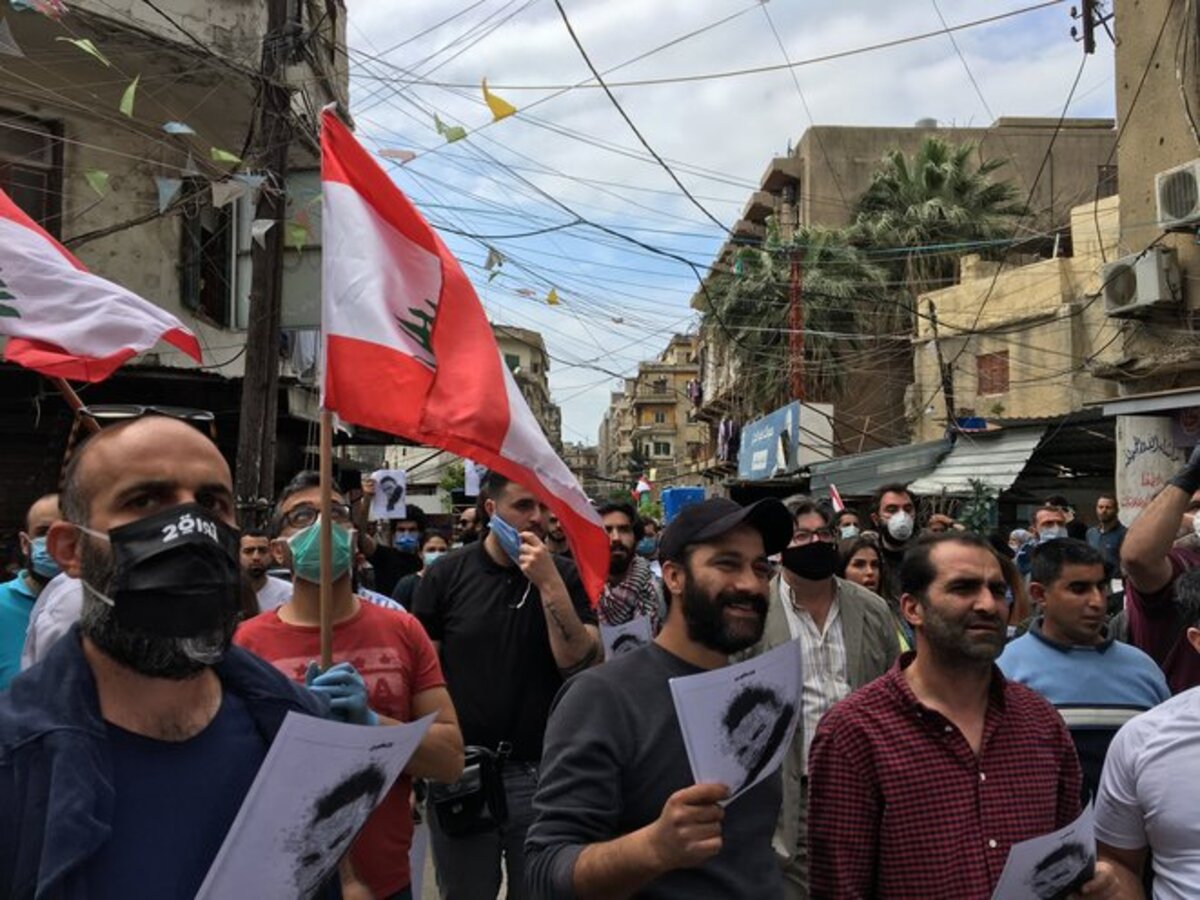
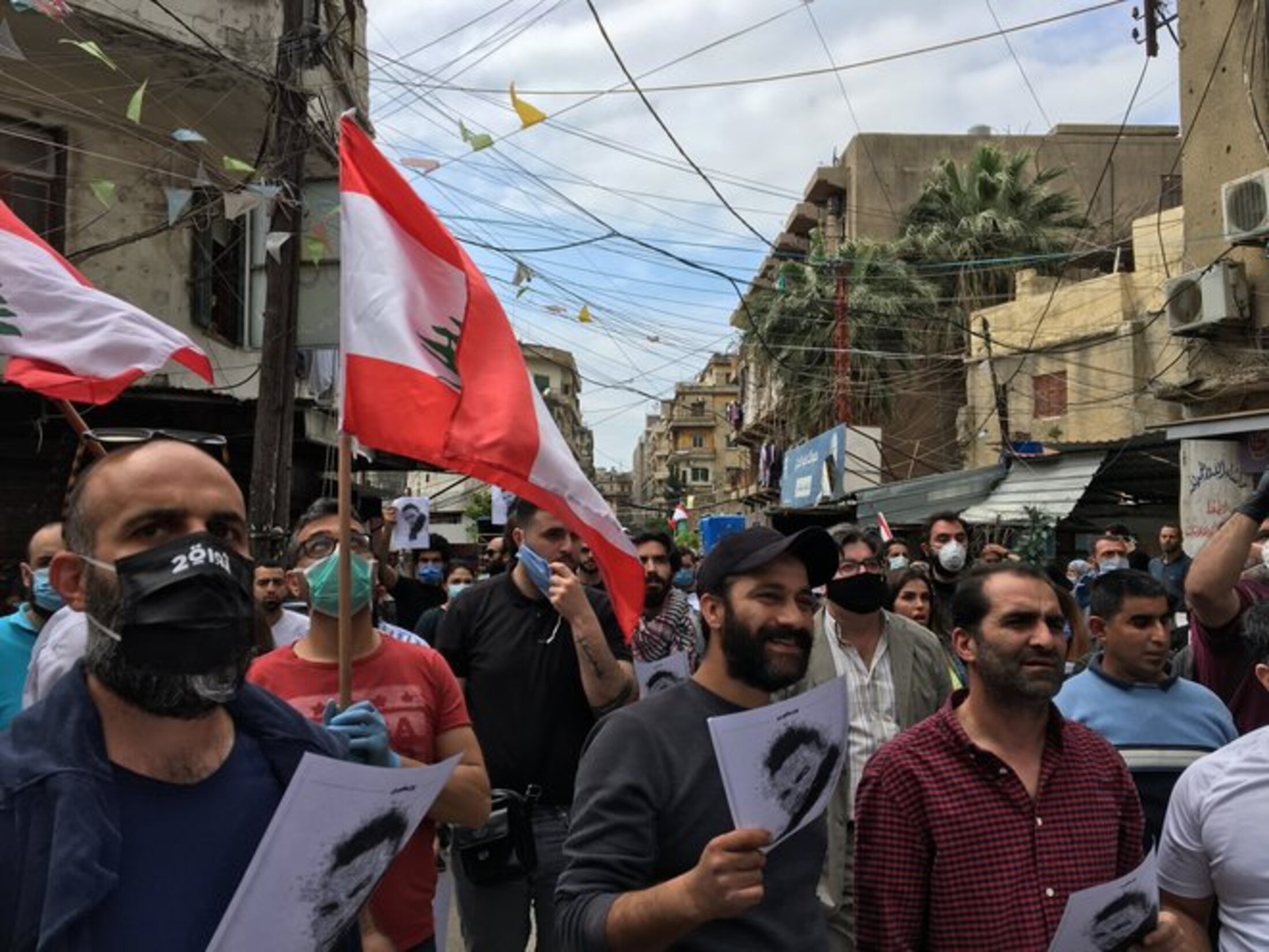
Following the resignation last October of prime minister Saad Hariri, the protests have continued, although the lockdown imposed in mid-March caused a brief lull of mass gatherings. But they have flared up again significantly since the end of April, centred on the northern city of Tripoli, the country’s second-largest after the capital Beirut, where violent clashes between security forces and demonstrators are in stark contrast to the largely peaceful demonstrations of last autumn.
“People can no longer buy what they need to feed themselves,” said one man during a march through Tripoli last Sunday in homage to Fawaz al-Samman, a 26-year-old man who was killed by soldiers on April 27th during a demonstration. Amid soaring price rises, the dangers of the coronavirus pales for many in contrast to the problem of simply being able to feed themselves. For another demonstrator, it was a case of, “Rather die from the coronavirus than from hunger”.
Enlargement : Illustration 1
The Lebanese pound has lost around 40% of its value since last October, and while the country’s banks have been lending funds to the government they now find themselves in a dollar liquidity crisis. The dollar is the currency in which many Lebanese have placed their savings, and the banks have severely reduced the limit for withdrawals, some even allowing as little as 100 dollars per week. Meanwhile, the scarcity of dollar flows has seen a major slowdown in imports, including critical supplies like grain and medicines.
The banks have become a target for protestors; at the end of April, a number of branches in Tripoli were firebombed and looted, and in the southern town of Saïda one branch was even attacked with explosive devices.
It is a sharp contrast to a bygone period when Lebanon’s banks enjoyed a flourishing role. “As of the 1950s, a dense banking network developed and constituted the heart of the Lebanese economy,” said Rosalie Berthier, co-founder and specialist in Lebanese macro-economics with the Beirut-based research group Synaps Network.
In 1990, after 15 years of civil war, when Lebanon sought to become a financial hub in the Middle East region, the reconstruction of the country was funded by massive borrowing. The treasury borrowed from the banks, first in Lebanese pounds and later in US dollars, in exchange for highly attractive returns, allowing the banks to offer their clients similarly attractive interest rates. The rise in deposits were above all the effect of the development of a rentier economy, to the detriment of investment in production sectors. The high interest rates attracted vast foreign inflows, allowing the payment of imports despite low exports. In parallel, the public debt rose ever further.
This rentier system progressively took the form of a Ponzi scheme, offering high interest rates to further deepen borrowing in order to be able to pay back previous debts. In 1997, in a bid to contain inflation and maintain confidence in its finances, the governor of the Lebanese central bank, Riad Salameh, pegged the Lebanese pound to the US dollar, at a rate of 1,507.5 pounds to the dollar. Maintaining that parity became his priority.
But the financial crisis worsened, notably with the crash in oil prices as of 2011, which slowed capital inflows from Gulf states, and also the outbreak of the civil war in neighbouring Syria. The central bank’s currency reserves reached a critical low in 2016, threatening its capacity to maintain its propping up of the Lebanese pound. Salameh sought to win time by offering very high interest rates to the private banks in exchange for their dollar reserves.
The system rolled on for another three years until the summer of 2019 when the outright dollar liquidity crisis began. “The pyramid collapsed as soon as fresh capital stopped arriving,” analysed Rosalie Berthier.
On March 9th, Lebanon failed to repay a 1.2 billion-dollar Eurobond, the first default in the country’s history, forcing the government to announce a restructuring of all the country’s public debt which, at the end of 2019, was estimated to reach 90 billion dollars, representing 176% of GDP.
For having maintained the illusion, for more than two decades, of a prosperous economic and financial situation, Lebanese central bank chief Riad Salameh, who took up his post in 1993, gained a prestigious reputation. The rentier system had benefitted the banks, their savings depositors and the ruling class – as demonstrated in a 2016 study of the ownership of 20 major Lebanese commercial banks by Jad Chaaban, an Associate Professor of Economics at the American University of Beirut. Using data from 2014, he found that 18 of them “have major shareholders linked to political elites, and 43% of assets in the sector could be attributed to political control”.
“’Crony capital’ within the banking sector is also shown to impact the quality of banks’ loans, and their exposure to public debt,” he writes on his website.
Rosalie Berthier said that “for many” of those who deposited savings with the banks, and who received handsome interest rates, “these revenues are an insurance in the absence of social protection”.
But now that the new restrictions on accessing dollars has brought the party to a close, the central bank and the commercial banks have been apportioning to each other the responsibility for the crisis. Prime Minister Hassan Diab, formally designated in December as Hariri’s successor and officially in post since January, last month targeted central bank governor Salameh as responsible for the currency crash and for a lack of transparency, and announced an audit of the accounts of the institution.
The government’s financial recovery plan, adopted on April 30th and submitted to the IMF, includes a restructuring of all the country’s banking sector. It also underlined that the banks would receive no bailout of the estimated 35 billion dollars of losses they have incurred in the crisis.
In an almost hour-long televised address on April 29th, Salameh rejected Diab’s criticism, and argued that his monetary policies – dubbed “financial engineering” – had gained the political powers time in order to put structural reforms in place. “This engineering, we were forced to do it to buy time for Lebanon, so Lebanon could reform,” he said, adding that it was “not the responsibility of the central bank” that the state did not enact agreed reforms.
The commercial banks, meanwhile, reject their responsibility in the meltdown. “By placing their money with the central bank, they consider that they did not take uncontrollable risks,” said Marwan Mikhael who between 2008 and 2019 was head of economic and equity research with Lebanon’s BlomInvest bank. “It’s not like an investment on the stock exchange, we’re talking about the sector’s regulation authority. Even if they had wanted to, to refuse these [interest] rates would have amounted to losing their clientele to the competition.”
But for Adham Hassanieh, an activist with the group Li Hakki, part of the current contestation movement, “The banks, the political class, the central bank, all of them profited from the system and together share responsibility”.
-------------------------
- The French version of this report can be found here.
English version by Graham Tearse