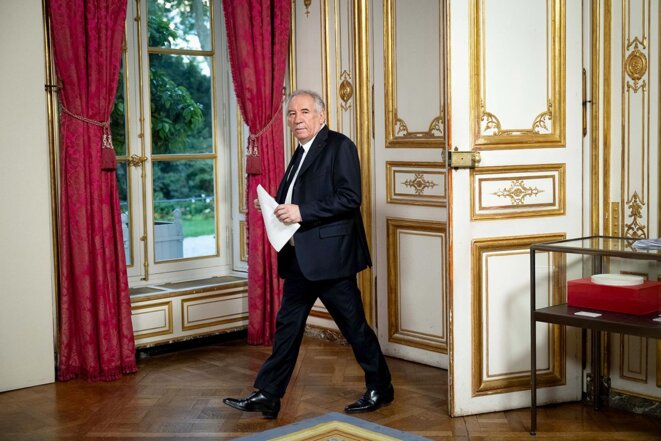
François Bayrou may be forced out of the role he has only held since December if, as expected, he loses today's vote, a scenario that could have dire consequences for the French economy and President Emmanuel Macron.
As 10 September nears, the emerging movement 'Bloquons Tout' – “Let’s Block Everything” – is calling to bring France to a standstill in protest at economic policies.
On September 8th the government of François Bayrou looks set to be toppled in a vote of confidence that the prime minister himself has called. Since his appointment at the end of December 2024, Bayrou’s government has obviously struggled because of its lack of an overall majority in the National Assembly, but it has nonetheless clearly pursued a liberal and conservative path. Here, members of Mediapart's editorial team look back at the nine months of an administration whose time in office has been marked by environmental setbacks and by its endorsement of the anti-immigration line espoused by the rightwing Les Républicains party.
Move against Google risks provoking ire of President Trump who has threatened huge tariffs against countries that impose “discriminatory” regulations on American tech companies.
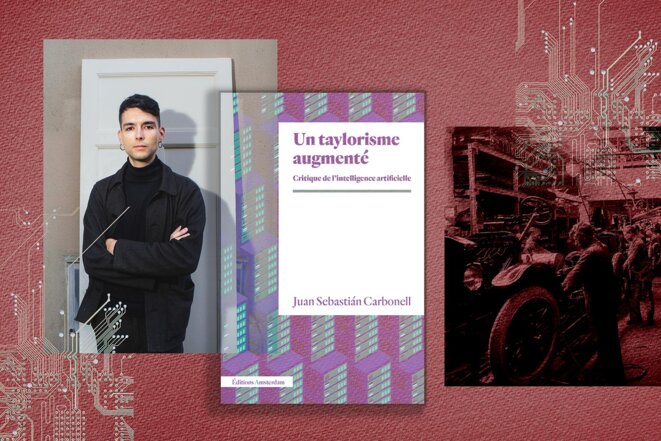
In his latest book 'Un taylorisme augmenté' ('Enhanced Taylorism') the France-based sociologist Juan Sebastián Carbonell offers a fresh perspective on the likely impact of artificial intelligence on the labour market. Rather than seeing it as a boost for productivity on the one hand or as a destroyer of jobs on the other, the academic instead describes artificial intelligence as a capitalist tool for tighter control over already downgraded work. And he calls for a social struggle centred squarely on the issue of technology and its role in the workplace. Romaric Godin reviews the academic's book.
Police in the French port city of Marseille on Tuesday killed man suspected of stabbing five people in the city centre after he was evicted from an hotel for refusing to pay his bill.
French art world is fiercely opposed to the project to display artwork in London, with experts fearing the 230 foot-long masterpiece is in far too delicate a state to be transported across the Channel.
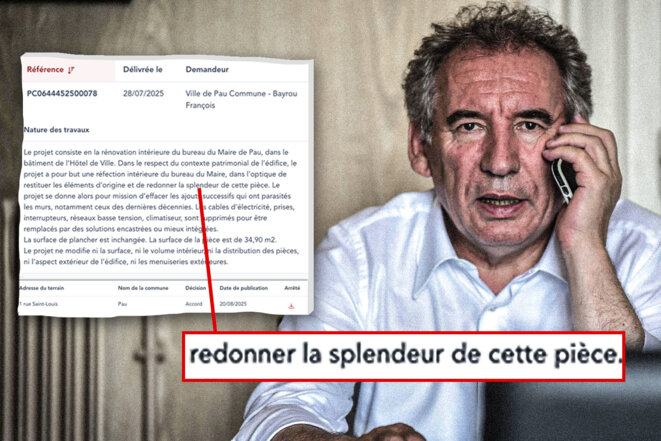
Prime minister François Bayrou has approved the renovation of his office in Pau, the small city in south-west France where he is also still the serving mayor. The aim of the work is to “restore the original splendour” of that office, and the bill - to be paid from public funds - comes in at 40,000 euros, according to Mediapart's information. Such a move is politically explosive in the middle of a national austerity plan being pushed by the prime minister himself and against the backdrop of a city council whose public debt has soared since it came under Bayrou's control. Fabrice Arfi and Antton Rouget report.
Earlier this month a screening of the hit film 'Barbie' in the Paris suburb of Noisy-le-Sec was cancelled after local protests. Yet the move to stop this film being shown was just the latest episode in a long list of cancel-culture attacks on the freedom to stage artistic performances across France. Many of these interventions have come from fundamentalist Catholic and nationalist groups, with some also emanating from the Left. Faced with such threats, some local elected representatives have felt obliged to yield to the pressure and cancel events. Laura Wojcik reports.
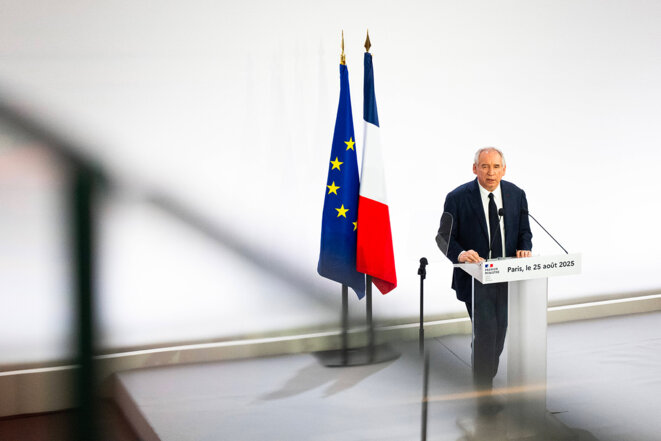
Following the surprise announcement by French Prime Minister François Bayrou on Monday (photo) that he will submit his government to a confidence vote in France’s hung parliament on September 8th, which several opposition parties have announced they will reject, his fate now appears sealed after less than nine months in office. As Pauline Graulle reports, the parties of the Left and Right are now preparing for the post-Bayrou period, with the looming possibility of new snap parliamentary elections amid the deepening political chaos.