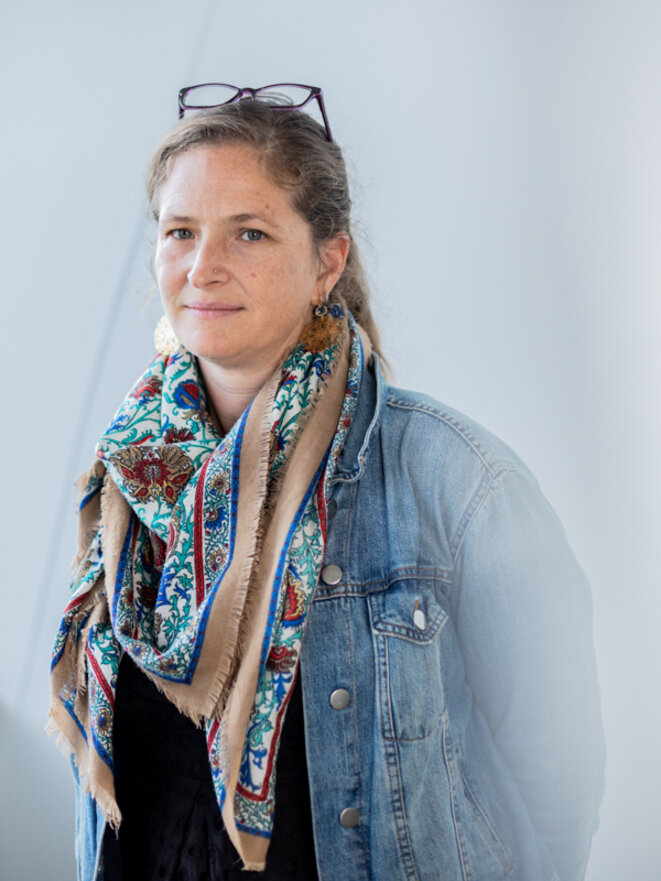
Journaliste à Mediapart depuis novembre 2010. J'ai longtemps écrit sur la politique française, avant de me consacrer aux enquêtes sur les violences sexistes et sexuelles. Je suis responsable éditoriale aux questions de genre depuis 2020. Et, depuis le 1er octobre 2023, je suis codirectrice éditoriale aux côtés de Valentine Oberti.
Avant, j'ai passé plusieurs années à m'occuper d'économie (à l'AFP) et de social (à l'Huma). Coauteure de Tunis Connection, enquête sur les réseaux franco-tunisiens sous Ben Ali (Seuil, 2012). J'ai aussi dirigé l’ouvrage collectif #MeToo, le combat continue (Seuil, 2023).
Declaration of interest
In the interest of transparency towards its readers, Mediapart’s journalists fill out and make public since 2018 a declaration of interests on the model of the one filled out by members of parliament and senior civil servants with the High Authority for Transparency and Public Life (HATVP), a body created in 2014 after Mediapart’s revelations on the Cahuzac affair.
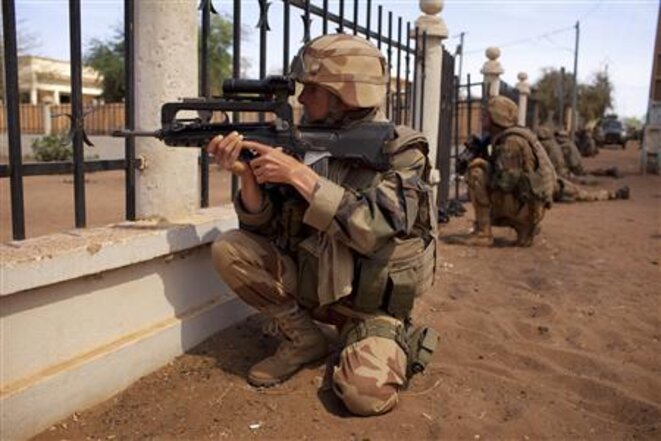
The French government last week announced major cuts in defence spending which include the axing next year of 7,500 jobs in its armed forces, the subsequent closure of several military bases, the scrapping of an artillery regiment and the decommissioning of several warships. "The sovereignty of our country depends as much on tackling our public accounts as on our defence," said defence minister Jean-Yves Le Drian as he detailed the cull on October 15th. But the minister is also under intense pressure over the massive, budget-busting spending of ongoing French military operations abroad, principally in West and Central Africa, and now also against Islamic State militants in Iraq. Lénaïg Bredoux reports on the opaque funding of the campaigns, including the indirect contribution of the French education ministry, and Le Drian’s controversial and urgent plans to set up public-private partnerships to finance French defence procurement through leasing deals.
Three high-profile ministers left the government when it was reshuffled at the end of August, having signalled their disagreement with the economic policy being pursued by President François Hollande. Former minister for the economy Arnaud Montebourg and ex-education minister Benoît Hamon have both recently returned to the political fray, with more public criticism of the direction the administration is taking. Now, in an exclusive interview with Mediapart, the third minister, former culture boss Aurélie Filippetti, talks about how her “conscience” compelled her to leave government, the need for a fresh approach to the economy and her wish for a major reform of the French Constitution to make government “less monarchical”. She spoke to Lénaïg Bredoux.
The French Communist Party (PCF) was once a major political force, but which has declined over recent decades into a marginal party with just seven Members of Parliament. It was arguably saved from collapse by the Front de Gauche alliance it formed five years ago with the radical-left Parti de Gauche. But despite the deep difficulties of the socialist government, the PCF and its ally have been unable to establish a popular alternative on the Left, while the spectacular surge of the far-right Front National has included significant gains among the blue-collar electorate which was once the lifeblood of the PCF. Sociologist Julian Mischi is the author of a book published last month which studies the long divorce between the PCF and its working class base, and in this interview with Lénaïg Bredoux he explains how the party has become an organisation ‘dominated by teachers and regional public service managers’.
After less than a fortnight in his new job, France's overseas trade minister Thomas Thévenoud has dramatically and abruptly quit over problems with his tax returns. According to Mediapart's sources, the new minister had not filled in his tax returns for several years. In a statement Thévenoud admitted to “delays” in his declaration and payment of tax owed, though stressed that the matter has now been sorted out. Nonetheless the sudden loss of another minister in this manner will come as a blow to the new government formed by prime minister Manuel Valls on August 26th, which saw the enforced departure of heavyweight economy minister Arnaud Montebourg. It also comes against a backdrop of poor economic results and plummeting opinion polls for Valls and, above all, President François Hollande. Mathilde Mathieu and Lénaïg Bredoux report.
Emmanuel Macron this week replaced anti-austerity rebel Arnaud Montebourg as France’s new economy minister, a role that places him at the forefront of the socialist government’s struggle to return the country to growth and bring down record unemployment. Macron, who was latterly President François Hollande’s deputy chief-of-staff, has until now remained a figure unknown to the wider public, and an even more obscure one concerning his political vision. In an interview with Mediapart’s Lénaïg Bredoux and Joseph Confavreux last year, of which the principle extracts are published here, he detailed the reasons why he believes the Left must undergo a profound renovation to rid itself of what he believes is antiquated ideology and past certitudes that he described as "dead stars".
The French government reshuffle on Tuesday saw the replacement of rebel economy and industry minister Arnaud Montebourg by Emmanuel Macron, a former banker and deputy chief-of-staff to President François Hollande. Macron, 36, who first began a career as a philosopher, is unknown to the public, but has played a crucial role as advisor to the French president on economic policies. Lénaïg Bredoux and Martine Orange profile the man in the hot seat in charge of steering France through increasingly dangerous economic waters.
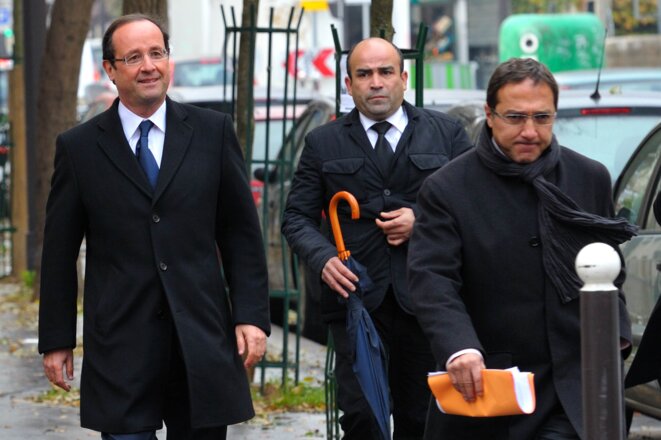
Faouzi Lamdaoui, one of François Hollande's advisors at the Elysée and a close ally of the president for many years, has been questioned by detectives investigating allegations of “misuse of company assets” and “tax fraud”. Lamdaoui, who advises the French head of state on diversity and equality issues, has denied any wrongdoing. Nonetheless, an investigation by Mediapart has shown that the advisor has been the shareholder, manager or director in a range of similar companies, two of which have been the target of legal proceedings. Lénaïg Bredoux and Emmanuel Morisse report.
President François Hollande this month announced the broad outline of sweeping territorial reforms that will see the number of official regions in mainland France reduced from 22 to just 14. The move is designed to give them greater political power and efficiency in the coordination of local resources and economies. Some among Hollande’s camp claim this major plank of a decentralisation programme will prove to be the most significant reform of his presidency. But Hollande, whose political legitimacy is questioned after recent election debacles for his ruling Socialist Party, has met with sharp criticism from both Left and Right for the monarchic manner in which he has redrawn the map of France. Lénaïg Bredoux and Mathieu Magnaudeix report.
Former interior minister Manuel Valls officially took up office as France’s new prime minister on Tuesday in a handing over ceremony with the outgoing Jean-Marc Ayrault. The composition of the new government will be announced on Wednesday. President François Hollande’s nomination of Valls on Monday followed the Socialist Party’s historic debacle in local elections last weekend, but the move has met with mixed reaction among the ruling majority, divided into pro- and anti-Valls camps. Lénaïg Bredoux reports on the behind-the-scenes manoeuvring that preceded his appointment, and hears from insiders on how, over several months, worsening relations between Ayrault and Hollande reached a point of no return.
Paris is about to have its first woman mayor in the city's long history. But the certainty that either socialist Anne Hidalgo or right-wing candidate Nathalie Kosciusko-Morizet will take the reins of the French capital after the two rounds of local elections that start this Sunday masks the fact that most French towns and cities will be run by a man whichever of the main parties wins the local vote. An examination of the mayoral election candidates by Mediapart has revealed that the great majority are male, white – and not very young. Lénaïg Bredoux and Ellen Salvi report on the slow progress made by the country's two major mainstream parties in making their politicians more representative of the populace.
A collective of French female journalists have launched a campaign against what they call the “invisibility” of women in the media and the often sexist stereotypes of women presented by the media. Their manifesto, published earlier this week with signatures of support from more than 400 media professionals, calls for tough new measures to guarantee gender parity in the journalistic profession and among pundits invited by the media, as already required by law. Here, Mediapart political correspondent Lénaïg Bredoux, a member of the newly-formed collective, explains why she and her colleagues have had enough of the macho media.
After 20 months in power, relations between French President François Hollande and Prime Minister Jean-Marc Ayrault are showing cracks. Despite a public show of solidarity, in private the two men are at odds over the management of economic and social policies, and Ayrault’s future appears increasingly uncertain. Lénaïg Bredoux traces how the two men have begun drifting apart and hears the views from insiders close to both, one of whom insists: “François Hollande fired Ayrault in December, but no-one knows.”
All his blog posts
The Mediapart Club
Join the discussion
Mediapart’s journalists also use their blogs, and participate in their own name to this space of debates, by confiding behind the scenes of investigations or reports, doubts or personal reactions to the news.
L’essayiste publie un nouvel ouvrage consacré à #MeToo dans lequel elle met gravement en cause le travail de Mediapart sur les violences sexistes et sexuelles. Au mépris des faits, et sans nous avoir contactés au préalable.
Plusieurs journalistes ou militants des droits humains, tous critiques du régime marocain, ont été graciés par le roi du Maroc. Pour Omar Radi, Soulaimane Raissouni, Taoufik Bouachrine, Imad Stitou, Hicham Mansouri, Maâti Monjib et Saïda El Alami, notre soulagement est immense.
Dans un long entretien complaisant au Journal du dimanche, paru le 11 juin, la réalisatrice et comédienne s’en prend, sans point de vue contradictoire, au travail de notre journal sur les violences sexistes et sexuelles, et croit pouvoir justifier ainsi l’agression du président de Mediapart. Nous ne sommes pas dupes.
Le célèbre youtubeur a dénoncé dans une vidéo diffusée le 19 novembre l’enquête que nous avons publiée le 23 juin à propos des violences sexistes, sexuelles et psychologiques qu’il aurait commises. Explications sur nos méthodes d’enquête, qui ont permis la publication d’un nouveau volet.
« Cot cot cot codec. » C’est le caquètement d’un député de droite contre une élue écologiste qui a suscité la création de notre « Machoscope » en 2013. Depuis, Mediapart, recense le sexisme subi par les femmes en politique. Après une décennie de bons et loyaux services, la formule disparaît. Pour mieux s’imposer dans nos pages.