


The scene was Waterloo, just south of Brussels, and the date was June 18th 1815, in other words the location and date of the famous battle that sealed the fate of Napoleon Bonaparte's brief second reign as emperor of France.
Having been exiled on the Mediterranean island of Elba after his abdication in April 1814, Napoleon 1st had escaped in late February 1815 and had then taken over once more as emperor, a period of rule later known as the Hundred Days.
On that June day in question Napoleon and his troops were lined up against soldiers from a European alliance on a battlefield at Waterloo. At his side was Pierre Jacques Étienne Cambronne, a faithful officer who had been at Napoleon's side since the latter's landing at Vallauris in the south of France following his escape from Elba. He was still there on the evening of June 18th 1815 as what remained of Napoleon's Grande Armée collapsed, sealing Napoleon's fate and forcing him, four days later, to abdicate a second time.
But if General Cambronne's name has survived down the years, it is as much for what he is supposed to have said when surrounded by the enemy – of which there are two versions – as for his military prowess.
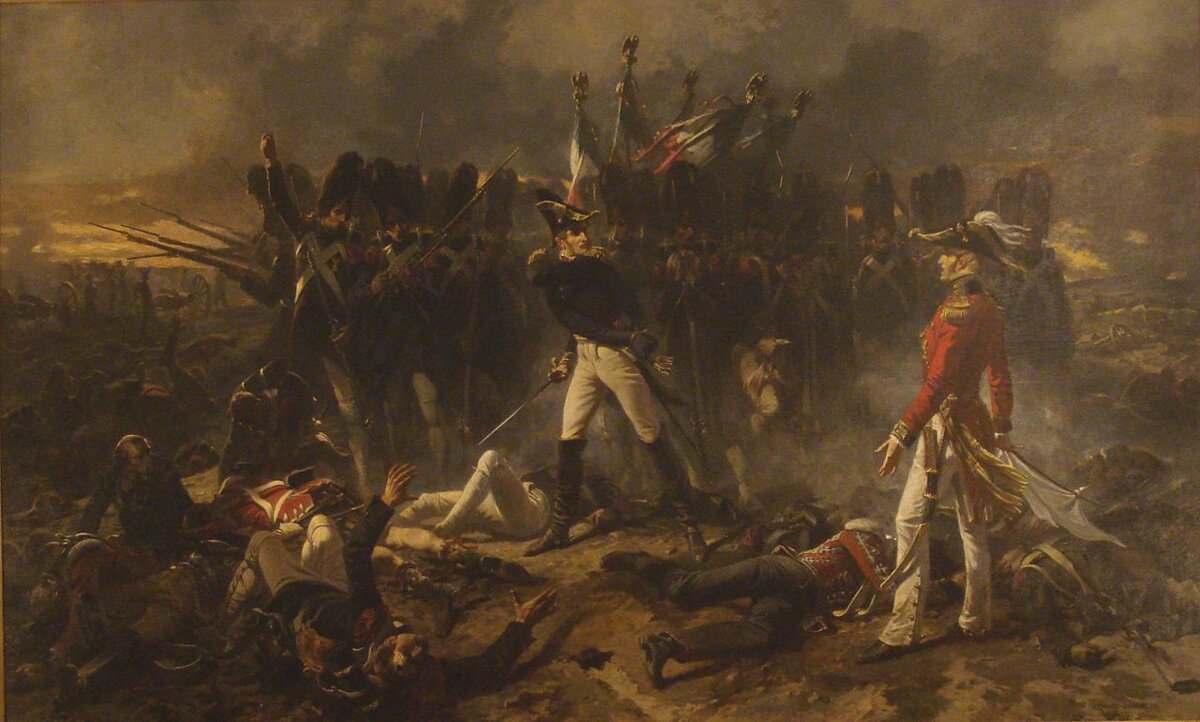
Enlargement : Illustration 1

The key moment came at around 7.30pm after battle had raged throughout the day. The outcome had seemed unclear until the arrival of Prussian troops tipped the balance against the French. Having been relieved on their east flank by the Prussians, the Duke of Wellington's British troops were able to focus on the centre of the battleground and unleashed their full fire on the French regiments ahead of them.
In a desperate attempt to regain the upper hand, Napoleon called up “The Guard”; the veteran grenadiers, cavalry and artillerymen who were the truest of the true.
- The last veterans
Among these troops was an infantry regiment of the Old Guard commanded by General Cambronne, two battalions of fighters who has already fought on every European battlefield and knew how to fight. But even they could do nothing against the withering British firepower which was mowing them down on the spot.
Amid the utter confusion Cambronne, having been wounded to the head by shrapnel from a shell, fell to the ground. Surrounded by troops commanded by General Sir Charles Colville, who were telling him to surrender, the French general is said to have retorted: “The Guard dies but does not surrender!”. A less glorious alternative version, later attributed to him by the French writer Victor Hugo, was that the general simply exclaimed: “Shit!”.
The press in Paris ran with the more elegant turn of phrase. On June 24th 1815, six days after the battle, an article in Le Journal Général de France used the most pompous words in the dictionary to relate the admirable bravery shown by the last remnants of the Old Guard.
It was a winning description and, though we do not really know where the journalist got it from, hundreds of thousands of copies of it spread across a nation which found some small comfort in defeat through the example of a general who preferred death over surrender.
- Who said what and to whom?
Amid all this, it seems that no one took the trouble to raise the issue of one small snag with the story: not only was Cambronne not dead, he did in fact surrender.
This is not to criticise the general's courage. For he was the first to state, and later repeated endlessly, that he never uttered the words that were attributed to him. Indeed, he could become quite irate over the issue. Many years later, in August 1862, Louis de Kerjean, a journalist at the Revue de Bretagne et de Vendée, went so far as to state that the general “would lose his temper … sometimes violently, even though he was the gentlest and best of men, with those who were determined to insist that he had said what he hadn't said!”.
It was not until December 1818, more than three years after the battle, that the Journal de Débats publication devoted a short item to the story, writing that “all of Paris has heard from General Cambronne's own mouth that he had learned of this imposing exclamation from the gazette and that he in no way recalled having said something like that”.
But it was no use; the denial did not stop this lovely story from taking on a life of its own.
After all, if Cambronne himself had not uttered those words, perhaps someone else did? That was the theory that re-emerged in 1842 in any case. At the time the general had just died and the nation was getting ready to honour his memory by putting up a statue of him with the well-known words written on it. Then the family of an officer killed at Waterloo, Lieutenant-general Michel, approached the then-monarch King Louis Philippe and stated that it was he and not Cambronne who had sent the English packing with those words.
But 27 years had already passed and there were few surviving witnesses. The matter was closed. That was until the French writer Victor Hugo, who had been aged 13 at the time of Waterloo, stirred things up again when in 1862, at the age of 60, he published Les Misérables. In a well-known passage in the book, an exasperated General Cambronne is quoted as saying “Shit!” as the British troops surrounded him.
- Prefect investigates
That caused something of a controversy. For Victor Hugo was at the time a significant figure in the opposition to Napoleon III and the Second Empire, and Napoleon Bonaparte's nephew was not amused by the writer's version of events at Waterloo. With good timing, a journalist at the Journal des débats, Mr Cuvillier-Fleury, called for the full facts to be known about what was becoming an affair of state. And so at the express demand of the minister of the interior, the prefecture in the Nord – the area of France which borders Belgium where the battle took place – was put in charge of carrying out an investigation.
The prefect, a Mr Wallon, made his conclusions public in Le Moniteur in June 1862 having managed to track down a survivor from the Old Guard, Antoine Deleau. And in a dramatic twist this former grenadier, now aged 70, insisted that General Cambronne had indeed uttered the words that he himself swore he had never said.
What did this mean? Well, though the prefect appears to have been completely oblivious to it, Deleau clearly lied to the state official. For there is no chance that the old soldier could have been next to Cambronne on the day in question, as the general commanded a different Old Guard regiment – the infantry.
None of this dampened the prefect's enthusiasm, and he duly confirmed to Napoleon III that his uncle's ultra-loyal officer had not been uncouth enough to exclaim “shit!” on the evening of his last battle. Never mind if that version sounded rather more credible than the original.
-------------------------------------------------------------------------
- The French version of this article can be found here.
English version by Michael Streeter