


Recent Russian statements alleging a highly-dubious Ukrainian attack on a Vladimir Putin residence were intended to justify a hardening of Moscow’s negotiating stance. They underline just how much the sought-after “peace” in Ukraine depends first and foremost on the Russian president, who launched this war to further entrench his authoritarian system, and justified it with clearly imperialist, even colonial, motives.
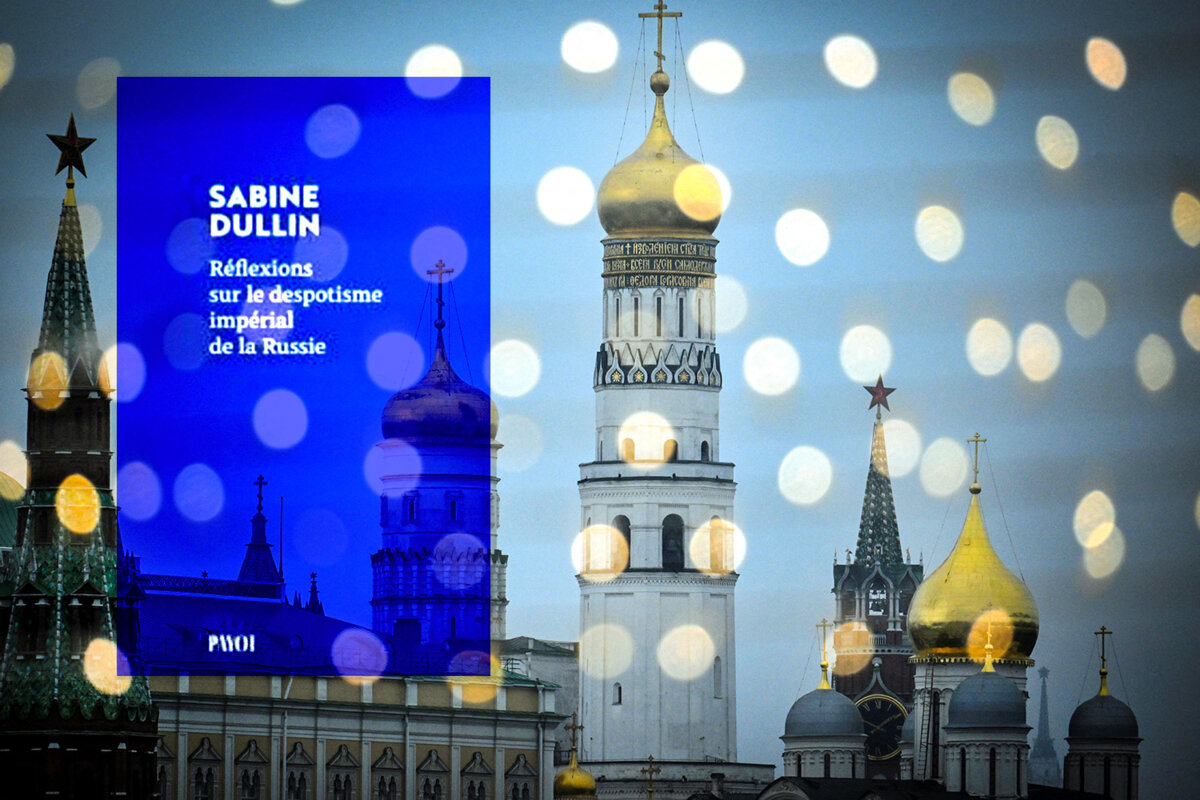
A recent book by French academic Sabine Dullin, Réflexions sur le despotisme impérial de la Russie ('Reflections on Russia's imperial despotism'), published by Payot in late 2025, is valuable because it offers an historical perspective on how Vladimir Putin wields power. According to her argument, he has simply recreated the straitjacket in which “Russian identity has been locked for centuries”.
In an original approach, the book consists of two parts. The first is a synthesis written by the historian, a professor at Sciences Po University in Paris, in which she shows how “autocracy and empire have fed off one another” time and again. The second is a collection of texts written by outside observers of the country between the 16th and the 21st centuries, who come at this Russian Sonderweg or unique national path from different national and ideological viewpoints.
Enlargement : Illustration 1

Sabine Dullin points out that the initial expansion of the Grand Principality of Moscow, before the coronation of Ivan IV as “tsar” in 1547, went hand in hand with an internal consolidation of central power, with claims of a lineage stretching back to the Byzantine Empire. While Russian power shared absolutist traits with other models of government in Europe, including France, the enslavement of the peasantry stood in contrast to the move from feudalism seen in the west of the continent.
At the head of a vast multinational empire, stretching to the Far East and to the Black Sea, the tsars of the Romanov dynasty in the 19th century “played the role of counter-revolutionary leaders of princely Europe”. Russian troops and spies thus helped repress various peoples and the working classes beyond their own borders. This was enough to inspire Karl Marx to defend the Polish nation against a Russia that, in his view, regularly donned the “garb […] of the predestined saviour of order”.
The 1917 Revolution, or the mirage of anti-colonial democratisation
Without adopting the essentialist language of the German philosopher, who spoke of “Asian barbarism”, a few years later the anarchist French geographer Élisée Reclus reacted to the abortive 1905 revolution in Russia by stating the factors undermining that country's regime. “The primary cause of the instability of the entire Russian nation stems from serfdom and the unjust distribution of land,” he wrote. “But another issue inevitably arises, that of peoples of different languages, of distinct [and] subjugated national consciences.”
By contrast with the 1905 event, the 1917 revolution was successful in that it led to a radical redistribution of social power. But though this power changed hands, an imperial-minded centre quickly re-established a monopoly over it, in a development far removed from the initial promises of Vladimir Lenin and his Bolshevik comrades. Sabine Dullin here sums up what she had already set out so well in a previous book, L’Ironie du destin. Une histoire des Russes et de leur empire ('The irony of fate. A history of the Russians and their empire') published by Payot in 2021.
Not only did none of the democratic forms that had begun to take shape in 1917 come into being – they were replaced by a “new kind of absolutism” exercised by a single party - but the “postcolonial ambitions” of the early years of the Soviet Union were also short-lived. They were swept aside by a policy of annexation, predation and persecution against neighbouring peoples, particularly under Joseph Stalin.
After victory over the Nazis in 1945, the anti-colonial creed preached abroad did not prevent ethnic discrimination being applied within the Soviet bloc as well as the theory of the “limited sovereignty” of the so-called “people’s democracies”. And it was a colonial-type war, in Afghanistan during the 1980s, that helped bring about the collapse of the supposedly communist regime. Under Mikhail Gorbachev, notes Sabine Dullin, the “outer fringes of the empire were the most receptive to new possibilities for change and began, through democratisation, their decolonisation”.
For Russia itself, the heart of the empire which also broke away from the Soviet Union in December 1991, matters were more complex. On the one hand, its “liberation” went hand in hand with the spread of a mendacious and xenophobic argument portraying Russia as the victim of a system that had benefited “non-Russians”. On the other, Russia still remained a multinational federation, and it took fewer than five years for the front of a “colonial war” to open up in Chechnya.
It was in this context that Vladimir Putin's power developed. With despotism and imperialism always going hand in hand, Putin aligned his “verticality of fear” approach to governance with the writing of a falsified historical narrative, to grant himself the right to reconstitute a “Russian world” that had wrongly been dismantled.
The limits of a label
The historical sweep offered by Sabine Dullin is convincing, even if more would have been welcome on the precise distinction between the “multinational” and strictly “colonial” dimensions of the Russian Empire, plus more detail about which territories they applied to over the centuries.
On the notion of “despotism”, Sabine Dullin herself notes how readily it lends itself to essentialist thinking, by labelling Russia as “oriental” and thus keeping it as a reassuring 'otherness'. The historian herself continues to use the term while being mindful of the “mirror held up to Europe, reflecting back what it was: colonial, imperialist and fascist, and what it could yet become: anti-democratic”. Geopolitical alliances and exchanges of authoritarian and dictatorial practices give the lie to any idea there could be geographical containment when it comes to despotism.
This was the point made by the Russian intellectual Ilya Budraitskis in an article published in autumn 2022 in the journal Spectre. The Putin regime, he explained, pursued a gradual evolution over two decades from “depoliticized neoliberal authoritarianism into a brutal dictatorship”. He described this as a “grotesque development out of the 'normality' of capitalist society when it is subject to economic crisis, massive social inequality, and order maintained through repression at home and imperial war abroad”.
This brings us to another limit of the word “despotism”, a term which tends to lump together the very different dynamics of the regimes that have followed one another in Russia. Calling Nicholas II, Stalin or Putin a “despot” is not inaccurate, if the aim is to denote a personal autocratic power. But while they repurposed certain instruments of power and certain shared ways of imagining authority inherited from previous regimes, they did not rule within the same kind of frameworks.
The tsars' were hierocratic regimes, meaning they claimed to draw their power from a higher sacred principle, religious in this case – hence the Romanov formula “Orthodoxy, autocracy, national spirit”, as Sabine Dullin reminds us. Soviet leaders exercised power in the name of a secular ideology that became totalitarian, and within a modern class structure in which the “organising apparatchiks” crushed both the bourgeoisie and the common people in order to enjoy their privileges.
Putin, by contrast, draws his domination from his past assets in the secret services and from resources extracted from a rentier capitalism riddled with mafia-style practices. The enlistment of the Orthodox Church and nationalist sentiment are expedient policies that barely conceal the initial absence of a mobilising vision or something of a sacred character widely shared by the population.
What remains is the observation that with each change of regime the imperial, even colonial, framework has endured, and thus clearly so has its autocratic character. “I think that Russian colonialism and colonial identity are not reformable, just as communism was not,” the historian Botakoz Kassymbekova told the Kyiv Independent in December last year. Escaping the hellish recurrence of imperial despotism requires Russians to confront this issue.
-------------------------------------------------------------------------------
- The original French version of this article can be found here.
English version by Michael Streeter