


It is written in black and white in article 3 of the École Polytechnique's own code. “Outside, Comrade, the people you speak to will form their view of the École from your comments. Be discerning and avoid flaunting our customs because they are idiosyncratic, even impenetrable, and sometimes shocking for those who don't practice them.” For a long time the students at this prestigious school of engineering south-west of Paris, where military training is still compulsory, have felt bound by a duty of confidentiality, which has stopped them from reporting potentially criminal acts.
Times are changing. The management at the École Polytechnique has confirmed to Mediapart that in March of this year it informed the state prosecution services of an incident dating from the end of 2014 that could amount to rape. It is, however, impossible to give any more information; the student who was reportedly attacked by a fellow student does not want to talk and would prefer to forget about it. The École itself does not want to say any more on the matter.
However, it is hard not to make a link between this allegation and the stifling atmosphere of an institution where daily life is punctuated by incidents, even assaults, which a number of young women there are now starting to talk about.
It was not, however, the Harvey Weinstein scandal that began to change things at the École. In February 2017, eight months before the American producer's very public fall from grace, this prestigious establishment was already facing unprecedented revelations. In a special edition of the in-college student publication IK, ten current and former students revealed they had been victims of sexual violence or had been on the receiving end of sexist comments.
In this special edition, which was called L'IK au Féminin, the authors of the articles tried to analyse what it was like to be a “female” in what remains a predominantly masculine world. The 2015 intake had 522 students of whom 75 were women; in 2016 there were 536 students in total including 80 women.
All those cited in the publication describe an “overbearing, sexist” atmosphere where they feel like “bits of meat” or “prey”. During their first evenings at the École several of them recall male students trying to kiss them “without even asking my name”. Others say they they constantly had men putting hands on their backsides. It was so bad for some that they felt obliged to go to social events with a male friend as a kind of chaperone to guard against inappropriate behaviour. Others got into the habit of leaving parties early to avoid excessive behaviour, which was made worse by alcohol.
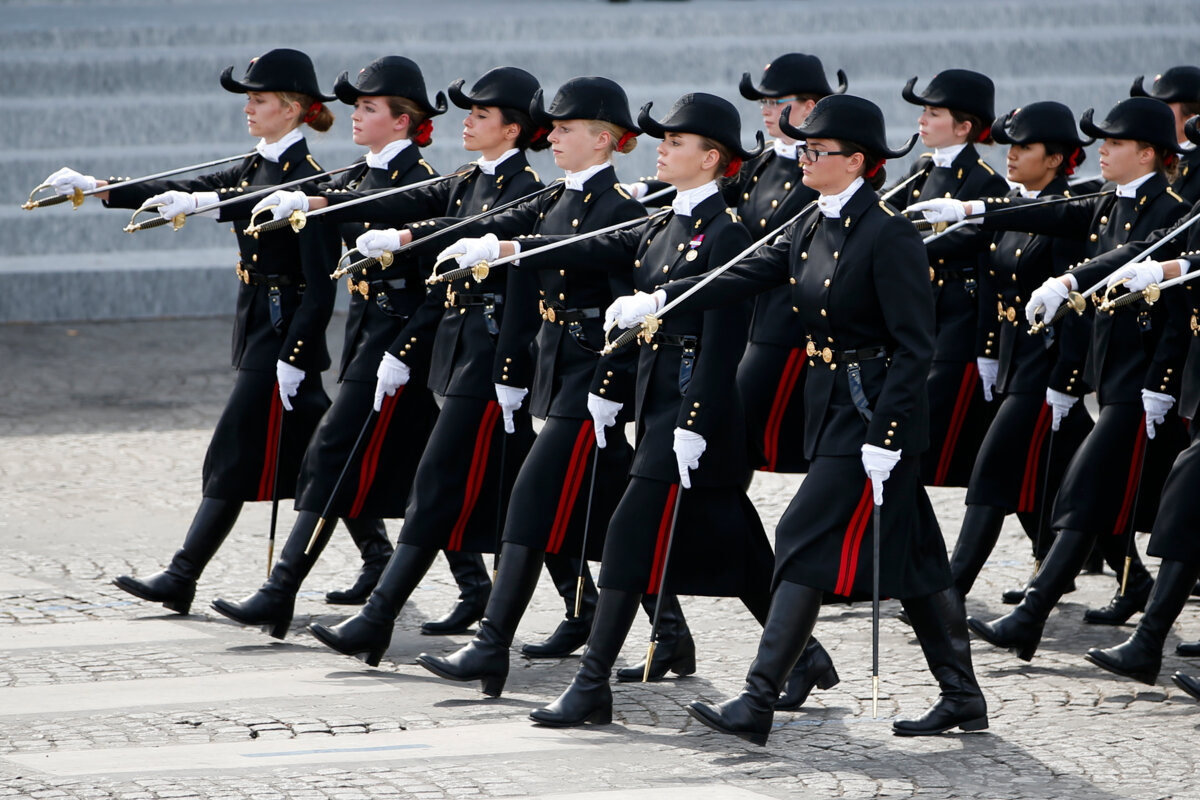
Enlargement : Illustration 1
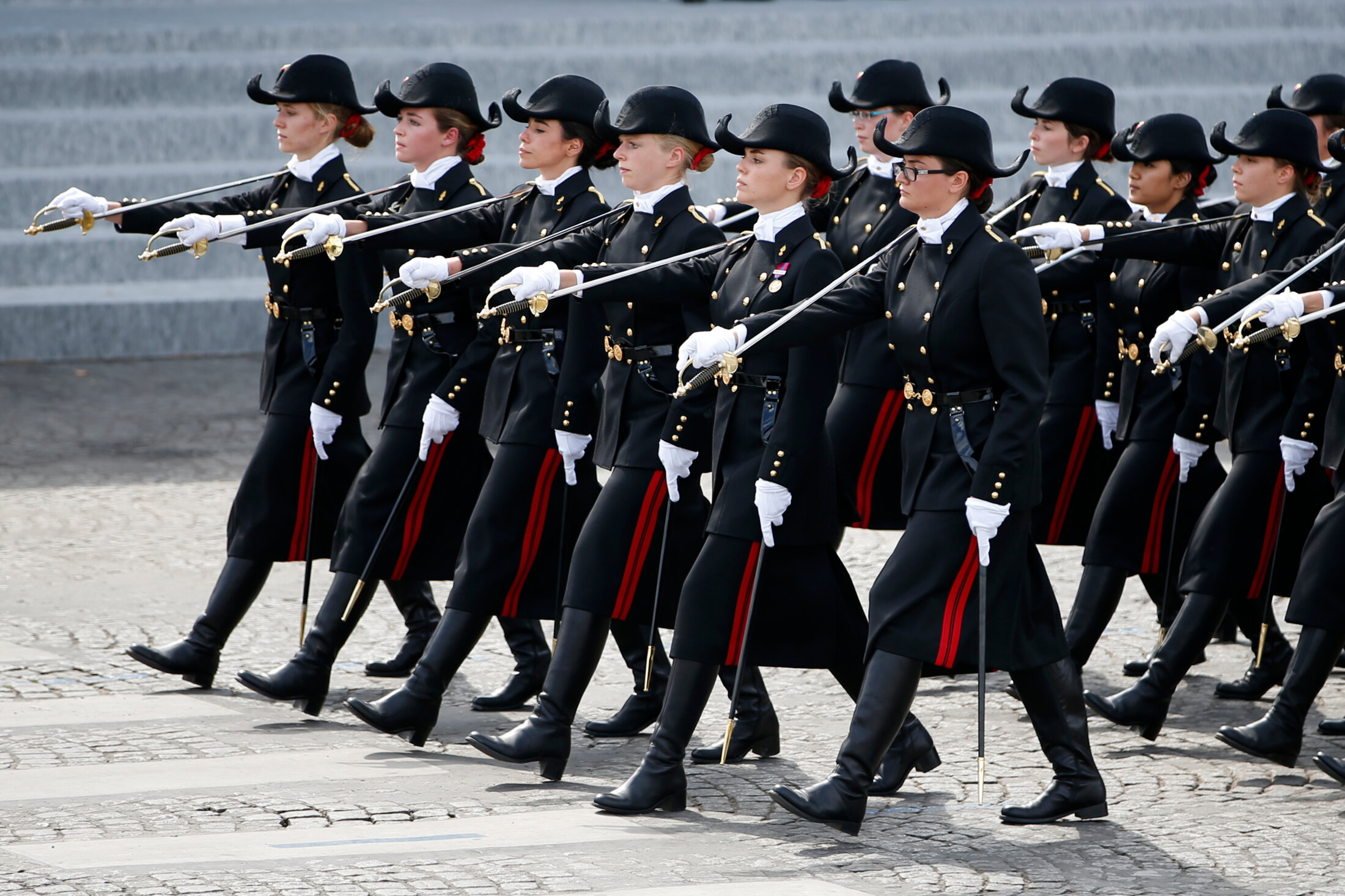
Nor were the military personnel who work at the school spared in the students' assessment. One woman recalled her initial military training, which included three weeks at La Coutine camp in the département or county of Creuse in central France. A female instructor called together all the female students in their year to tell them that they had to stop going to the bathroom in their pyjamas because it “disturbed the men in the unit”. She added, without any irony: “If you heat them up you have to cool them down again.” On another occasion a male examiner told one of the students he could not concentrate on her comments because he was too disturbed by her outfit.
One former student, Lola Guillot, recalls presenting her dissertation in which she tackled the division of tasks between couples. The instructor in charge replied to her: “If women do more of the household chores, isn't it because they find satisfaction in it?”
Other students describe being whistled at when they went to the front of the class, remarks about their outfits and young men watching pornographic films in communal areas, in full view and knowledge of everyone. There are also stories of male students walking around naked in the evenings. Meanwhile sexist posters featuring scantily-clad young women were everywhere, including one with a “sexy nurse” to publicise a blood donation campaign, and others to promote evening events.
The school also has what is called the “last-chance evening” where male students who do not have a partner are supposed finally to find a girlfriend. Some female students have become so surrounded by sexism that they put up with being on the receiving end of remarks against their sex. An example of the kind of comments is this maxim which does the rounds of the École, which is sometimes just referred to as 'X': “A girl who's not in a couple at X is either a dog or a whore.”
In some cases the incidents went much further than words. One of the women students who has spoken out, Juliette Buet, in unlikely to forget in a hurry the induction weekend she spent in the spring of 2014. The students got on a bus one night and headed for a location in the Ain département in central eastern France. It was a happy atmosphere and Juliette got on the bus with no concerns, keen to have a good time and relax. While on the bus she reclined in her seat and put her arms on the armrests. She did not know the young man behind her who suddenly pressed her against the backrest, immobilising her and grabbing her chest. “Let me go, I told him, you're touching my breasts. He replied 'I know',” she recalls. “It lasted 30 seconds but it seemed a very long time to me.” Juliette gave a despairing glance at the man sitting next to her who shrugged his shoulders, not knowing what to do. In the hubbub she thought there was little point in crying out.
Later, after the attack, she took part in some of the games organised on the bus, something she says the police reproached her for when she lodged a formal complaint for sexual assault in September 2016 at a police station in Palaiseau, south west of Paris. The young man concerned denies the allegations. She meanwhile is sure of his identity and says she recognised his voice.
During that same induction weekend in 2014 Juliette Buet was subjected to similar incidents. On the Sunday evening two male students tried at the same time to touch her genital area. Their hands crossed just over her pubis. She says she fled to the other side of the room, giving them both an angry look as she went. “I don't know if it was coordinated or not but they followed me and put their hands on my backside. They congratulated themselves and put their thumbs in the air.” Because it was dark Juliette says she was not able to recognise the two men involved. She left the event in tears.
An elite institution in a world of its own
After these assaults Juliette Buet informed the military hierarchy but they took no action. An additional trauma for her was that she was in the same maths class as her bus attacker. Worried and upset, she found it hard to concentrate and went to the director of studies in tears. According to her account he said he “might” let her change course but said that as the academic year was already well under way that would be damaging for her. At no time did he suggest taking action against the male student concerned. Juliette says bitterly: “Some young people at X fell themselves to be above the law, in a world outside the real world, where they will never be punished.” A world where everything is dealt with internally.
Following these incidents Juliette Buet became depressed, a problem exacerbated by the fact that other years at the École had taken against her. She was “tormented” on private Facebook groups, the favoured means of communication for Polytechnique students. Many fellow students criticised her for wanting to defend feminist values at all costs, to correct anyone who indulged in smutty or sexist jokes. Someone wrote in the student magazine: “She was there defending the rights of women, gays and all kinds of the oppressed in every debate, from the most interesting to the most sterile.” According to several accounts it is not uncommon to hear students get referred to as a“poof” or “big girl's blouse” during sports training at the École.
Other young women have described how they they feel unsafe on a campus which forms its own little world. On some occasions young men have tried to enter the rooms of female students against their wishes or stopped them from going into their own rooms. Lola Guillot experienced this in the spring of 2011. She had just got back to her room on campus after an evening out when a male friend tried to extract a kiss from her. “He told me that he wouldn't let me enter if I didn't give him a kiss. I saw from his trousers that he was excited by the situation and that it wasn't a game,” she said. “He was really boozed up so I didn't know what to expect. He was bigger, broader. Even though I knew him you never know what people are capable of doing. I said no several times, it went on for quite a while. He ended up by leaving. The next day I spoke to him about it in front of his friends. He left and his friends told me that it was inappropriate to speak to him about it because he had been ashamed. At that moment I told myself they were right,” says Lola Guillot.

Another young female student, who wants to remain anonymous, recalls a similar episode. She had to use all her qualities of patience and persuasion to remove from her room a male student who had designs on her. “I tried to make him leave but he kept putting his arm around my shoulders,” she says. The woman says she found it “bizarre” that she had to say no to him “ten times”.
Yet another student, who likewise wants to stay anonymous, recalls how she was kissed against her will by a fellow student after a night out, out of sight of other people. Having danced and had a lot to drink, she was having a problem walking on her own. A male friend – who remains a friend – offered to go with her. “He'd also drunk a lot and he started taking my face in his hands,” she says. “I turned my head. I didn't want to. I indicated to him to carry on walking. But he took my head in his hands again and kissed me. I didn't move.” Much later she confronted her friend and told him about what is, in the eyes of the law, a sexual assault. He said that he did not remember the details of that evening.
Are these normal scenes from student life? Many would say they are far too normal. Yet behaviour that was not questioned in the past is now being challenged. In common with other students Élodie – not her real name – says she has not noticed more sexism at the École Polytechnique than elsewhere. But she does remember a remark that was made in public. It came when she and five other female students arrived late for a ceremony. “Well, it takes time to put your make-up on,” said the military instructor in charge. Even within the group of women concerned there was a debate about whether these comments should be regarded as sexist or not.
Another École Polytechnique student Margaux – not her real name - has her own views. “Personally I'm well supported. I have respectful fellow students. I don't want to play down the accounts in L'IK au Féminin, but I don't feel like a piece of meat. It's more along the lines of ordinary sexism, it's difficult to notice, we go along with a lot of this sexist side of things,” she says.
Lola Guillot explains: “Not all women agree on sexism, I think each one experiences it differently. For example, if you're in a couple with a fellow student at X, you're more protected. If you're with a non-Polytechnique student then it's considered fair game to split you up.”
A strong collective spirit where it's hard to speak freely
To understand how the École Polytechnique could provide such fertile territory for sexual violence one has to look at the general atmosphere that prevails at this elite educational institute. When asked, a majority of people quite spontaneously describe it as “macho”. Behaviour considered to be masculine is praised. Part of this stems from its history and tradition. The École was barred to women until 1972 and even today women on average make up only around 15% of the intake.
Until 2013-2014 there was a competition for the prettiest women in her intake, which was decided by an online vote. This practice disappeared thanks to the efforts of several female students such as Juliette Buet who attacked it as sexist and humiliating. When Lola Guillot protested about the practice a fellow student told her: “The women who don't like it are either ugly or unhappy with how they look.” One of the women quoted in L'IK au Féminin sums up the obstacles to speaking out in public. “X conditions you on a daily basis to accept the sexism around you. If not, you're seen as having no humour or wit and you're seen as mad,” she says. “In the small village that is X, to rebel against the clichés and non-egalitarian behaviour is social suicide.”
A strong collective spirit is also fostered at the École Polytechnique and this does not make it easy to speak out freely. One male student, Adrien, not his real name, considers that the students are not politicised enough and that feminist, race and LGBT issues do not get considered. There is also a theory that sexual frustration is one of the explanations for the prevalence of sexism at the École. Lola Guillot does not go along with this theory. “There's no correlation as far as I am concerned. There are sexist people everywhere and it's not reserved for those who don't have sexual relations,” she says.
Since 2012 the French government has issued a number of circulars setting out a policy to prevent and deal with sexual harassment in higher education. However, there is still a long way to go.
Antoine, a former student at the École Polytechnique, thinks the reason for this is a desire not to create waves. “You mustn't speak about things that divide. There's very strong pressure from the administration. The duty of confidentiality has a very strong grip.” Yet he does think things are slowly starting to change, even if this is only because the special edition of IK has reached beyond the confines of the educational establishment.
The École Polytechnique's director, Jacques Biot, wrote in the IK issue that followed the special edition on sexism. “This article indeed reveals behaviour by personnel and students which, if they turn out to be true, range from the very regrettable to the reprehensible, are profoundly contrary to the values that we profess, and cannot be justified by so-called traditions,” he stated. The director urged students to make formal complaints. He then noted that such denouncements could be damaging for the institution's image. “It beholds us to avoid all generalisations and more generally any divisions between members of our community,” said Jacques Biot.
He also set out quite explicitly the responsibility that lies on those who have criticised incidents at the institution. “The very widespread broadcast of the IK one-off [issue] well beyond the confines of the École's students and management, several weeks before the [entrance] competitions and before candidates choose their [higher education institutions] runs a real risk of a new reduction in the recruitment rate for female students or students from industry-based universities and [technical, science and engineering courses], just as progress had been seen in the 2016 intake, following actions by the École's students and management to increase awareness among businesses.”
He is not the only one who is worried. “Some say that the special edition harmed the general atmosphere,” says Lucie, who says the key to the problem lies in the lack of parity. If there were more women at the École Polytechnique then the pressure on the relatively few women currently there would relax. Lucie is even worried about the impact of this Mediapart article and weighed each and every word carefully, for fear of portraying a negative image of the institution and dissuading other young women from applying.
The management itself prefers to go down the route of full honesty and says they did not wait for the publication of IK au Féminin to “get the measure of the problem”. However, in that special edition the École's former diversity advisor gave an eloquent interview. Young women were advised to deal with problems “at the time” and with “repartee”. The advisor, who is in the military, said that young women also had to “harden themselves and be able to react on the spot and have the courage to be able to do it. For example, on evenings out if there are wandering hands it's also good to deal with that when it happens, a good slap and you're done” she concluded, laughing.
Interviewed by Mediapart the new diversity advisor, Stéphanie Lakehal, said that “women, military or otherwise, don't speak straight away. They do so if they are encouraged to. By the way, we don't hush up anything, it's often the women who ask for discretion to avoid everything becoming public”.
Colonel Bernard Tourneur, director of military and personal development training at the École, explains: “We take this very seriously, these facts shock us, we are in no way complacent about this sexist behaviour which we don't deny.” The colonel says he understands how people could be shocked by the reports. “You expect something different in an elite school but we also reflect society.”
Alice Carpentier, who runs the diversity centre at the École, says that when IK au Féminin was published they started re-examining what they had been doing. An administrative investigation was carried out under the control of Colonel Tourneur to establish the basis of the claims. The subsequent interviews established their truth, including the allegations that involved some of the École's 70 military personnel. The institution issued three warnings for inappropriate comments, something which stays on the military career file of those concerned and which could compromise promotion in the future.
One member of the teaching personnel who was found to have made sexist comments on several occasions was moved sideways and no longer teaches students. The claims of online bullying of students were too old for action to be taken under limitation rules. But the École says that it will reinforce preventative measures. The process by which students can flag alleged crimes has also been simplified. The École Polytechnique says that the Thémis unit on bullying and sexual harassment run by the Ministry of Defence – to which the institution reports in part – details the protocols to follow, ensuring such cases are handled better. Since September two working groups at the École have met to discuss the issues and produce new procedures and ways of helping students. The first group involves management while the second group of 15 people, which meets once a week, includes several students. The groups' conclusions are due to be published on Friday December 8th.
-----------------------------------------------------------------------------
- The French version of this article can be found here.
English version by Michael Streeter