


“I am determined to take this pension reform to its completion,” said French Prime Minister Édouard Philippe in an interview published on Sunday by weekly paper Le JDD. But Philippe is due to unveil the detailed contents of the reforms only on Wednesday, and some members of his government, not least economy minister Bruno Le Maire, also speaking on Sunday, have begun hinting at a softening of the planned legislation.
The suggestion that the government is ready to climb down on parts of its pension reforms follows a massive general strike in opposition to the move by mostly public sector workers last Thursday, when the country was paralysed amid a vast turnout in nationwide demonstrations.
The essential drive of the planned legislation is, however, already known. This involves doing away with the 42 different retirement schemes and replacing them with a unified system that is equal to all. The government wants to introduce a universal points system that culminates in a person’s eventual pension payment rights, and which would follow their employment, whether in the public or private sector, or both, through their lifetime.
While the precise details will not be known until Wednesday, trades unions warn that the reforms will see a rise in the retirement age and a fall in the value of pensions, while some public sector schemes which allow for relatively early retirement, will disappear.
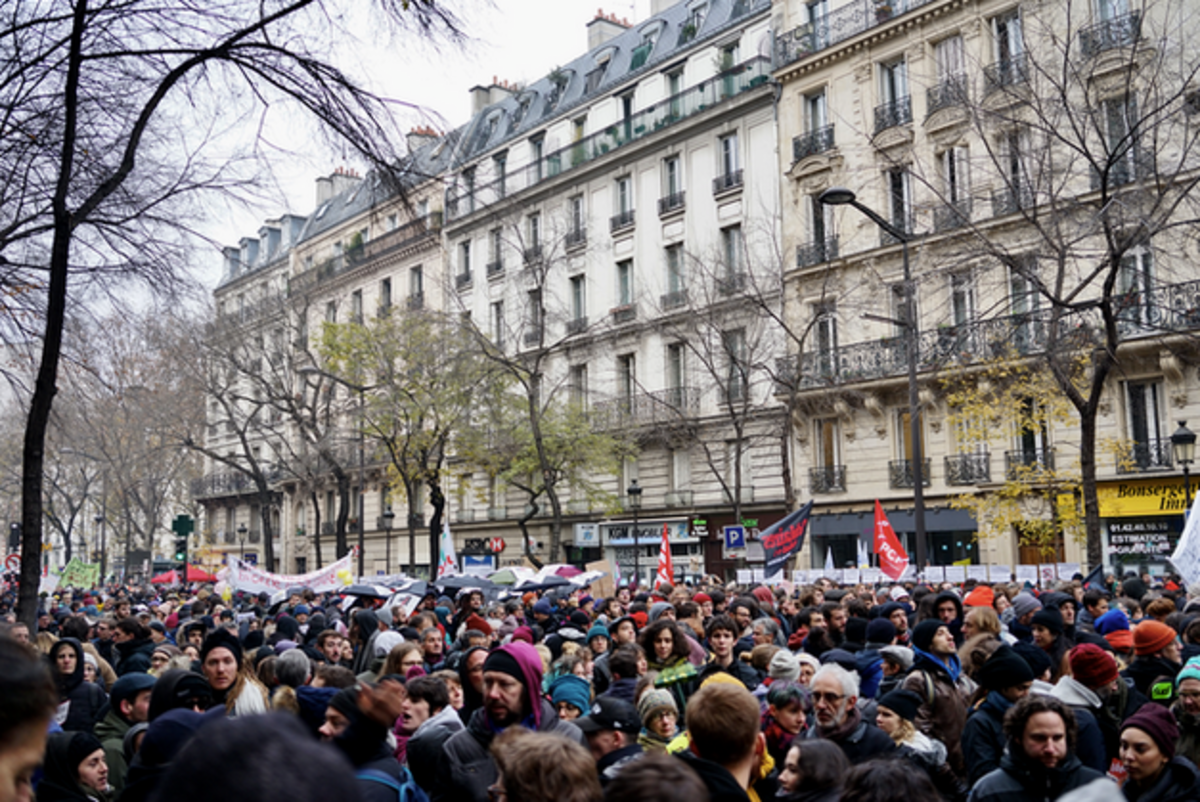
For the unions, the scale of the general strike last Thursday, and especially the turnout for mass street demonstrations the same day, came as a relief. The numbers of protest marchers across the country – just more than 800,000 according to the interior ministry, 1.5 million according to union officials – represented their largest mobilisation in a decade.
Enlargement : Illustration 1
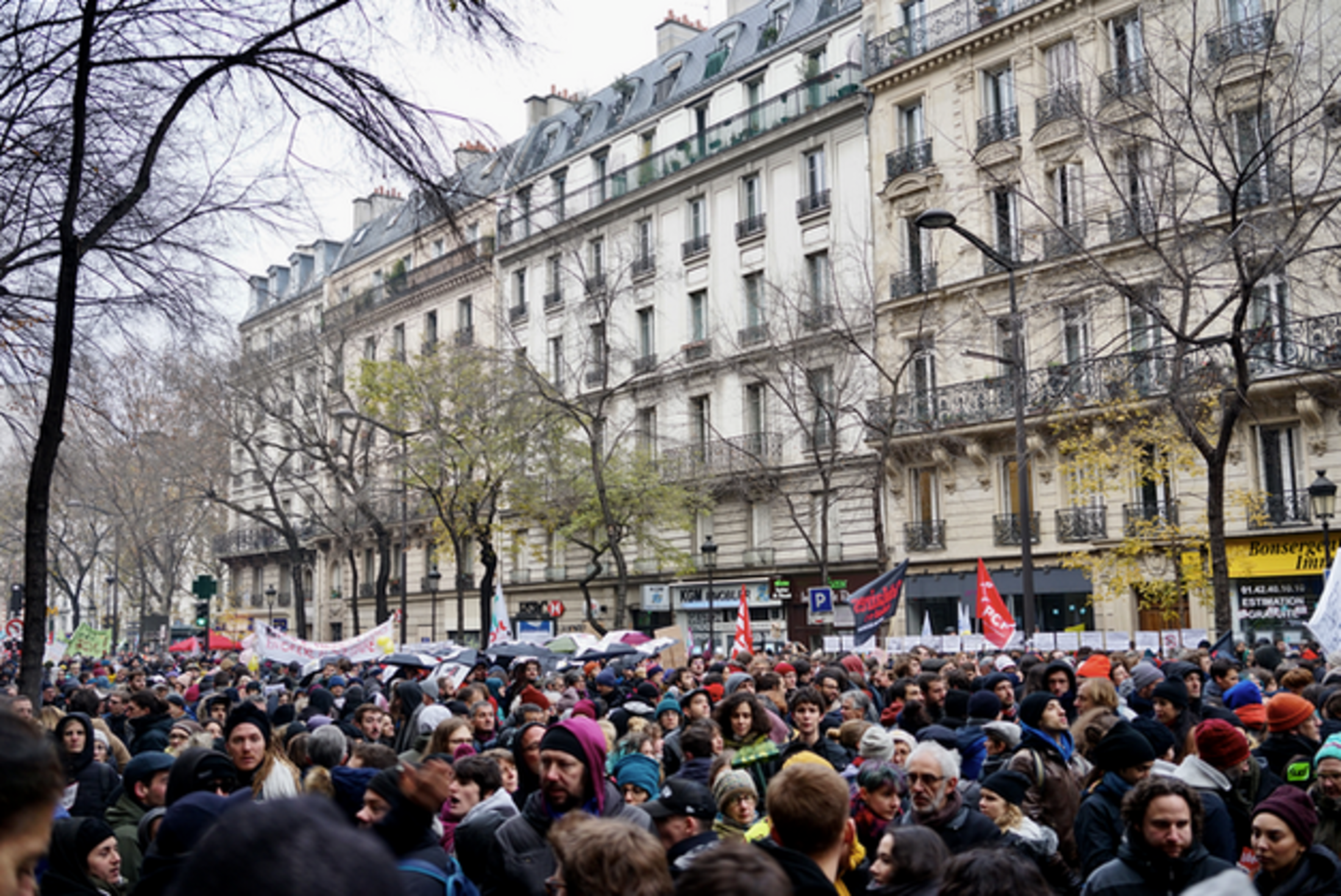
But despite comparisons with the three weeks of nationwide protests in 1995 which led to the withdrawal of the then-conservative government’s planned reform of the social security system, the unions know that their battle against the government’s reforms is far from won.
On Friday, a meeting of the different trades unions behind the movement called for a repeat day of action this coming Tuesday. “There were a lot of people on strike, but that must increase still more if we want to weigh upon the [reform] decisions,” said Philippe Martinez, general secretary of one of France’s most militant unions, the CGT. The success or failure of the opposition to the reforms will depend upon the capacity of unions – which in France are, like the CGT, mostly national confederations representing members in different professional branches – to mobilise members in certain key sectors, outlined below, and to keep them mobilised.
The SNCF, the state-owned railway company
Rail traffic has remained largely inexistent since the strike began on Thursday, and is likely to remain so into at least the first few days of the coming week. Union branch meetings held across the country on December 6th saw a majority in favour of rolling on the strike action. “A new balance of power has set in,” commented a Paris CGT railway branch official Bérenger Cernon. “There were 1.5 million people who demonstrated on the 5th. We haven’t seen that in a long while.”
While the average total number of railway workers on strike nationwide on Friday was, according to the SNCF, down slightly at 31.8% of the workforce, more train drivers and ticket inspectors had joined the movement.
The railway workers are one sector targeted by the government, which wants to remove their preferential pension status, like that of staff with the Paris transport system, the RATP, which includes retirement rights at a comparatively early age. The government has highlighted such favourable special pension rights accorded to a relatively few sectors as one of the reasons for the reforms, but for the unions, the strength of last week’s demonstrations suggest the PR battle is not working. “People have understood that we’re not only fighting for our own pensions, but those everyone,” said one SNCF employee quoted by news agency AFP.
While the SNCF may requisition middle managers to drive trains on Monday, a spokesman for the company, speaking to AFP, admitted that services were likely to remain severely affected. “According to initial feedback from the ground, we can unfortunately now say that Monday will be very difficult,” said the spokesman, adding that there would be only a “feeble level of traffic” on both commuter and long-distance services.
With the broad strike action walled for Tuesday, the railways are likely to remain affected well into the week ahead.
The Paris transport system, the RATP
The walkout by bus and train staff across the Paris region that began Thursday is set to continue at least until Wednesday, although bus traffic picked up slightly at the weekend. Nine of the capital’s total of 16 metro lines remain completely shut down, and minimal services were operating on the others operating manned trains, after the principal staff unions announced not only a vote to continue with the strikes through Monday, but also to join the general strike called again for Tuesday.
The RATP unions have echoed the bullish statement by CGT union boss Philippe Martinez that they will continue their action until there is a total withdrawal of the pension reforms.
The state education system
The strike last Thursday was joined by 47% of teachers, according to the education ministry, while unions claimed the figure was 70%. The teachers’ unions did not call for further strike action on Friday, when some staff however did stay at home (ministry figures said this involved 4.55% of primary teachers, and 5.42% of secondary school teachers), but they have officially warned of further strikes between now and Christmas.
Education minister Jean-Michel Blanquer, speaking on Friday to BFM TV, adopted a conciliatory tone when he said that “it was quite normal that there was a strong number of strikers yesterday [Thursday], because many people wanted to say to what extent they have questions and concerns”. While he pledged that teachers will benefit from a rise in remunerations and bonus payments, Blanquer insisted that the government would not change course.
Two education staff unions alliance committees, the CGT-FO-Solidaires-FSU and that representing the FSU, CGT, SUD Éducation, Snalc, called on members to join next Tuesday’s general strike. Another union, the SE-Unsa, which had taken part in last Thursday’s strike, called off its participation in the walkout on Tuesday, calling for a pause for negotiations.
Frédérique Rolet, spokeswoman for the Snes-FSU union, which has the largest membership among secondary school teachers, said she had been “surprised” by the mobilisation last Thursday against the reforms. “As of Tuesday we’ll be mobilised again,” she said. “Everyone thinks that this will last despite the fact that the government says it will be making announcements on Wednesday.”
Francette Popineau, a spokeswoman for the Snuipp-FSU union, the largest of those representing primary school staff, claimed a “historic” walkout of seven teachers out of ten last week, causing the closure of two schools out of every five. She said that the movement was set to last, “of course with variable moments of intensity”, adding: “We’re putting all our energy for the day of [December] 10th.”
The movement of opposition to the pension reforms is also joined by the higher education students’ union Unef, and secondary school pupils’ unions, the UNL and MNL. Several universities in Paris, Lyon and Bordeaux have closed their sites in preventive action for fear of sit-ins, while last week groups of secondary school pupils blockaded their schools in Nantes, Montpelier and Nimes.
Utility companies EDF and Engie
The numbers of employees who took strike action last Thursday at French utility companies EDF and Engie, are unprecedented. It is estimated that one-in-two employees in the French electricity and gas industry joined the walkout on December 5th.
“It’s historic,” said Hamid Ait-Ghezala, a CFE-CGC union official at Engie, a supplier of gas and electricity to households and industry in which the French state holds almost a quarter of shares.
At EDF, the electricity supply and engineering giant, in which the French state holds a majority stake, unions claimed that 48.86% of the group’s staff went on strike last Thursday, while the management put the figure at 42%. Unions at Engie reported that 53.34% of staff in the gas distribution branch joined the walkout, along with 42% in its electricity branch.
Tensions with unions are running high in both companies, where there are reported plans to break up activities into separate entities. At EDF, this involves a plan, supported by the government, to divide its nuclear energy production branch from its distribution and transport activities. At Engie, unions have promised strong opposition to a rumoured intention, denied by management, to sell of its gas distribution network.
While most of EDF and Engie staff who walked out last Thursday returned to work on Friday, the joint union committees in both companies have called on members to join next Tuesday’s day of action.
Oil refineries
Seven out of ten oil refineries in France were blocked last Thursday because of strike action, when no fuel left the depots. On Friday four remained at a standstill for part of the day. However, both unions and management insisted that production was continuing. A CGT union official said that following staff consultations on Friday, “The tendency is for the movement to be suspended [and] to re-join it on Tuesday”. For the moment, it appears that unions will continue to join in future general strike calls.
Healthcare workers
Public hospital staff, notably those in Accident and Emergency services, have been engaged for the past eight months in protest and strike action (the latter largely symbolic and not involving a walkout) over pay and working conditions amid budget cuts. Many joined in the strike and demonstrations last Thursday against the planned pension reforms.
House doctor unions had already planned a day of action next Tuesday over pay and working conditions, and it appears certain that they and other hospital staff will join in the broader demonstrations on December 10th.
-------------------------
- The French version of this article can be found here.