


Crammed into one of the little basements you reach via the central paved area in Paris's business district La Défense, they observe each other stony faced. On one side of the barriers last Friday, March 9th, were the small shareholders of the SoLocal Group, which owns both the Pages Jaunes ('Yellow Pages') business directory service and the mapping service Mappy. They were hurrying to the group's annual general assembly where, among other things, they were about to approve the executive pay policy.
That policy included a salary of 520,000 euros a year for Éric Boustouller, the former corporate vice president for Western Europe at Miscrosoft, who joined the group last autumn as its new director general. Boustouller also has the right to a bonus that could triple that salary depending on how well the group performs on the Bourse, the French stock exchange, its overall profitability and its reduction of costs. He was also given a golden 'hello' of one million shares, worth around 1.1 million euros today, awarded in “exchange for the interested party relinquishing significant rights to long-term pay through his former employment”, according to documents presented to the assembly general.

Enlargement : Illustration 1

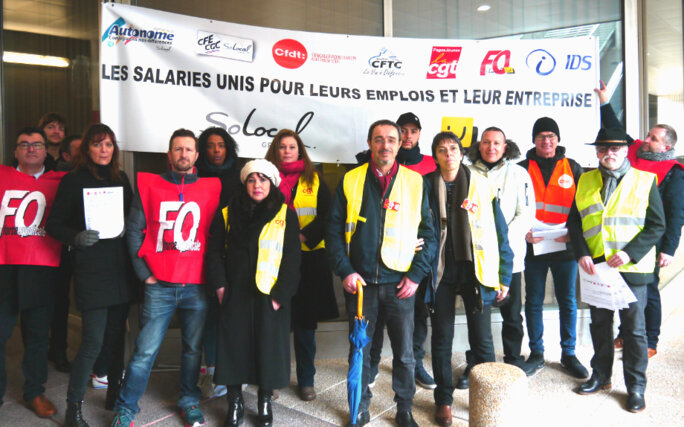
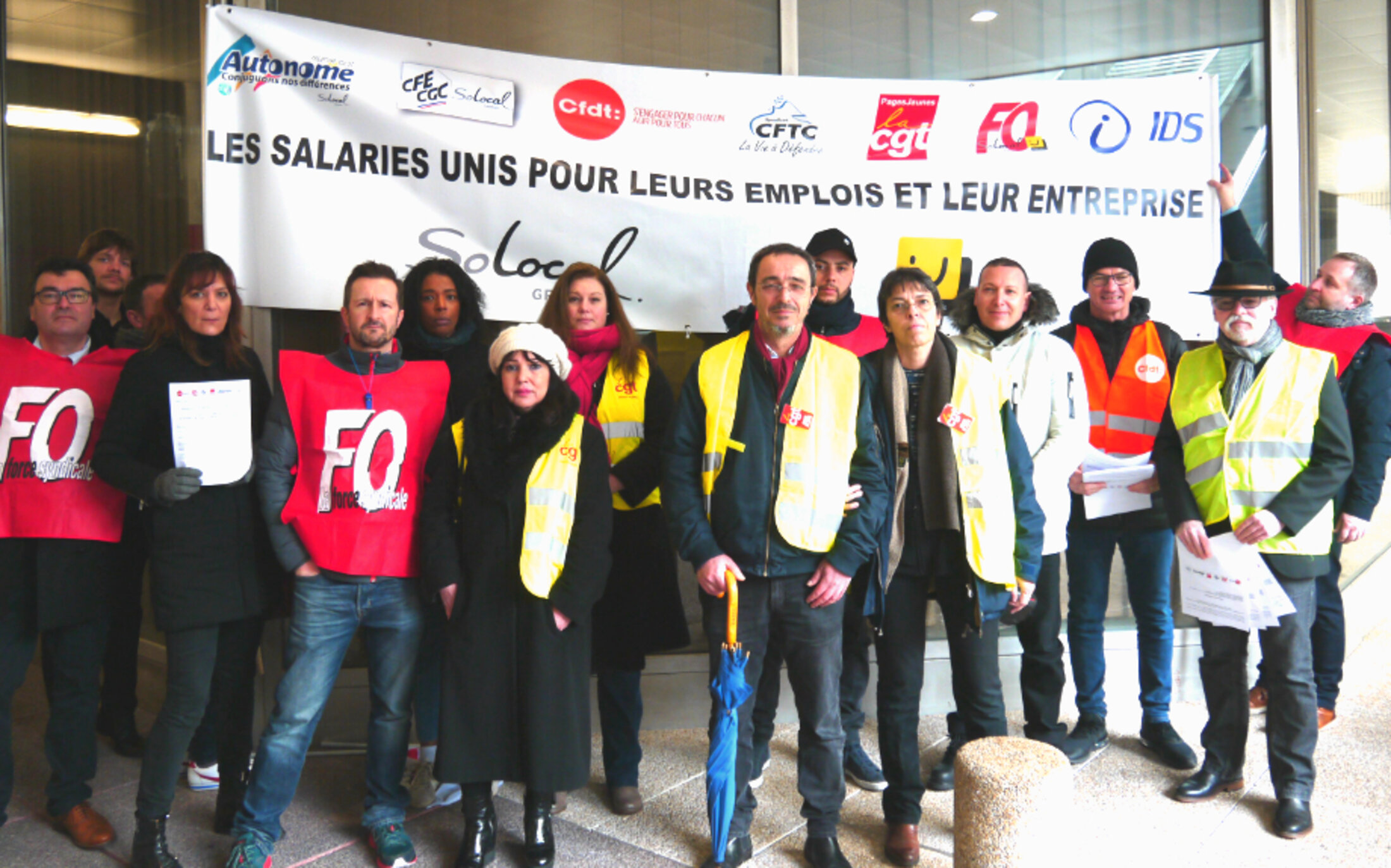
On the other side of the barrier stood a few dozen employees, most of them union activists, who were hoping to give voice to their anger. They have repeatedly criticised the drastic restructuring plan that the SoLocal management team announced on February 13th this year: it involves shedding 1,000 jobs within two years in a group which employs a total of 4,400 people. But the job losses will be concentrated on and felt most keenly at Pages Jaunes, where 3,600 of those staff work. Some 40% to 50% of the axed jobs will involve salespeople there, while the marketing and managerial teams will each lose 15% of their workforce.
The group currently operates from 23 sites in France but is now planning to base its activities around seven hubs: its headquarters at Boulogne-Billancourt in the western suburbs of Paris, plus four sales sites and two production sites. On March 1st, 600 employees from across France gathered in front of the group's HQ to protest. Represented by a large inter-union body, they were staunchly opposed to the job cuts.
Aged 55 and having worked at the group for 28 years, Erik was representative of the workers present. Based at Nancy in north-east France where the local Pages Jaunes base currently has 150 staff, he has good reason to be worried: that site is to be closed entirely and the staff encouraged to go to Lille, some 250 miles to the north west. That is unthinkable for Eric who has children in school and a mortgage to pay off.
The situation is made worse for the family by the fact that his wife also works at the group, in her case for 18 years. “I got my wife to join, we all did that, encouraged members of our family to join what was, and still is, a great company,” says Erik. The couple learnt the bad news via the radio, before the news was confirmed by an internal company email. It was, he says, a shock. “It was like being hit head on by a car on the way to your holiday,” he says. Erik says his mood has now changed. “After the shock came the anger,” he says, and he is now getting ready to “go into battle”.
At La Défense on March 9th, the tone was the same. The mood had not been helped by the fact that details of the 240 posts to go out of the 1,200 jobs at the group's headquarters were starting to be known. “The employees are sickened, disgusted, we've very angry,” said Hélène Ganchou and Clarisse Bénard, representatives of the CGT trade union at the group's HQ. “Management is treating us with contempt. They have started to inform the employees at headquarters who are involved, department by department. Some [departments] are being merged, others disappearing, it's a sop, everyone is going to be hit. Some learnt in the middle of a meeting that they were affected, and that will continue until mid-March,” they said. Not far aware a distraught employee says: “It's hellish, we can't do anything.”
Enlargement : Illustration 2
The unions hope to put an end to such fatalism even if, for the time being, they have little solid on which to base their hopes. On Friday March 2nd, they tried to present an alternative plan to management, demanding genuine visibility as to the company's strategy for the next three years and calling for a commitment to reinvest 90% of profits back in the company and to maintain both jobs and the group's current sites. They got a very clear refusal. The next planned meeting is on Tuesday March 13th, but there is no sign that the company is going to change its plans. The unions speak of “violence”, “cynicism” and “contempt for the workforce” on the part of management.
The company itself points to financial problems to justify its planned redundancies; turnover was down by 6% to 756 million euros in 2016 and profits were also down 6% to 51 million euros in the same year. It is an argument that stuns employees: for after the redundancy plan was announced SoLocal posted net profits of 336 million euros for 2017, an increase of more than 500% on the previous year. This excellent figure was largely down to the restructuring of its debt, which went down from an astronomical 1.2 billion euros to 400 million euros.
The switch to digital has already occurred
Officially, the ambition behind the plans is for the group to become a “French digital champion”, the “unique portal for digital services for companies” which can offer a wide range of online services to firms: online advertising, building websites, online reputation management, managing online audiences and so on. But the unions criticise what they see as the bad faith of this slanted approach. For they say the company has already transformed itself from being the publisher of paper directories into a digital communications agency targeting small businesses.
“The public think that we're protesting because the paper directory is dead, and that it's a story about adapting badly to the modern world but those aren't the issues for us at all,” says Frédéric Gallois, a representative of the Force Ouvrière (FO) trade union. “The digital transition took place at Yellow Pages more than ten years ago. Eighty-six percent of the turnover is already from digital activities! That switch is already behind us.”
Nadine Champrou, from the CFDT and a member of the inter-union team, has a similar message. “We are already today the privileged partner of professionals for local digital communications, and we're leaders in that domain,” she says. “The people who consult Pages Jaunes are looking for professionals in order to purchase [things], to spend money, we have real added value. Not to mention our subsidiary that specialises in targeted online marketing.”
The employees' mistrust has deepened since the announcement that SoLocal could bring to an end its paper directory altogether. This fits in well with the narrative that the company is having to adapt to the demands of the digital world. But this narrative is in fact wrong: the Pages Jaunes still generate 120 million euros in turnover and are, according to the unions, still very profitable, with a profit margin of between 40% and 50%.
The creditors have become the leading shareholders
The employees all agree that what they are facing is simply a “financial hold-up” at their expense. “How can you see any logic other than financial?” asks Nadine Champrou. “They've presented us with the outward appearance of a strategy without us being able to decode what's behind it, and how it can create growth for the company. We're asking for a clear and structured explanation for the company: why are so many jobs being lost? Why is such and such a job going and not another? And if there really are jobs that have to go then we only want there to be voluntary departures.”
An external observer who has close knowledge of the group's financial practices says that the plan it has announced “isn't at all in the company's social interest but rather in those of its creditor shareholders”. The source says: “The announced restructuring is not financed; in contrast the management teams could share a financial bonus of 18 million euros, in the form of shares, if they reach the objective of a share price of 1.98 euros in December 2020 and if they manage to increase its EBITDA [editor's note, earnings before interest, taxes, depreciation and amortization].” To increase a firm's EBITDA a strategy of choice is to reduces costs, in particular staffing levels – exactly as SoLocal are planning. “They want a 120-million-euro reduction in costs every year, that's their sole aim,” says trade unionist Frédéric Gallois. “It's a short-term financial plan. We fear that between now and 2020 no industrial plan will be implemented, and that the company will be in danger of dying.”
The employees do indeed have reason to be wary of the group's financial manoeuvres. Mediapart's Martine Orange revealed in a detailed article a year ago how Yellow Pages has already been the victim of the worst form of financial capitalism. It was sold and floated on the Bourse – France's stock exchange – in 2004 and 2006 to reduce the debt of its parent company, France Télécom, which had been hammered by the end of the dot.com bubble. This sale was carried out through the largest leveraged buy out (LBO) seen in France at that time. The deal, orchestrated by investment bank Goldman Sachs and global investment firm KKR, meant that in effect the company bought itself at the cost of colossal debt and excessive repayments which finally turned out to be unsustainable.
Ten years after this disastrous LBO, and confronted with this crushing burden of debt, the employees were called upon to sacrifice themselves during an epic general assembly held on December 15th, 2016, to avoid a collapse organised by the company's creditors. These vulture funds finally succeeded in getting their hands on the majority of SoLocal, and at the same time turned a profit on their investment.
A year ago Mediapart was already forecasting that the next logical step to keep it highly profitable financially would be job losses. That is what is now happening. “The creditors have very largely been reimbursed and now they want to make more money. Everyone has their own job: they're sharks, that's all there is to it, so how can you blame them?” says Saïdi Ichir, from the CFDT union. The management pay policy that was approved by the group's general assembly on March 9th was designed precisely to ensure that the executives at the head of Pages Jaunes aligned their interests with those of the creditor shareholders. And not with the interests of their employees - or even the company itself.
-------------------------------------------------------------------------
- The French version of this article can be found here.
English version by Michael Streeter