


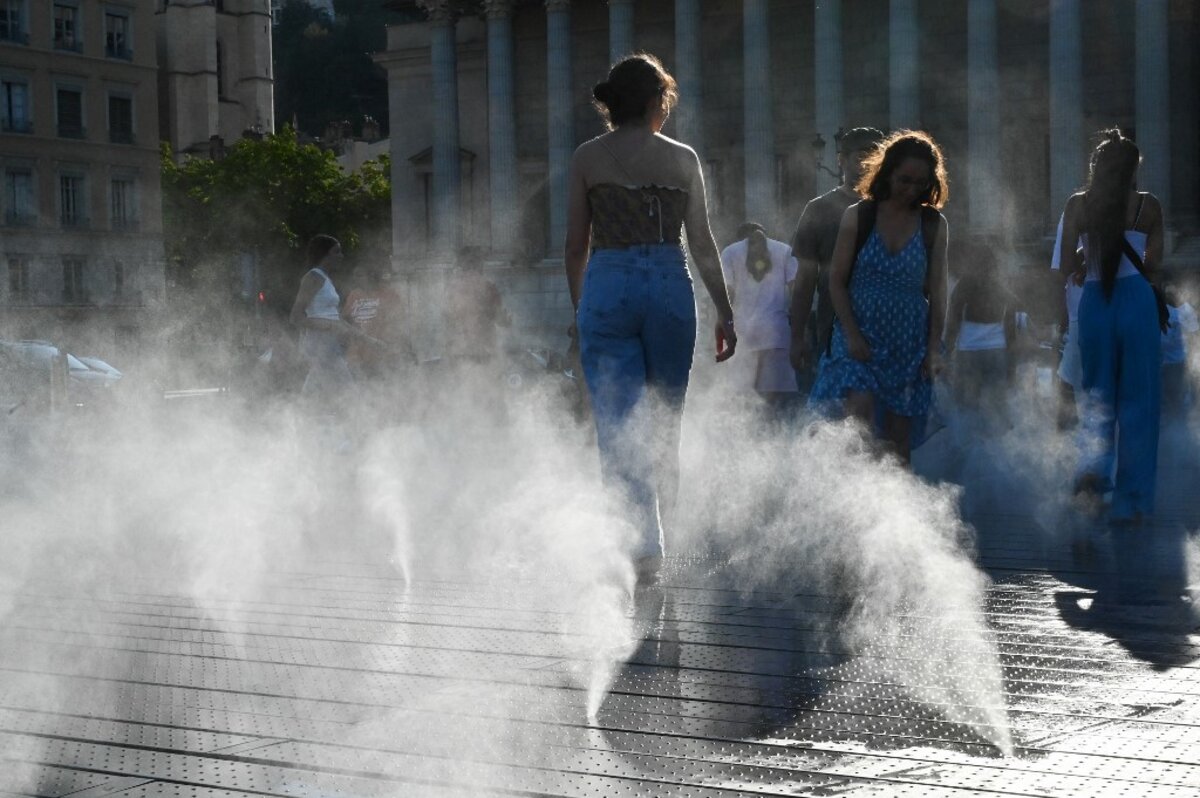
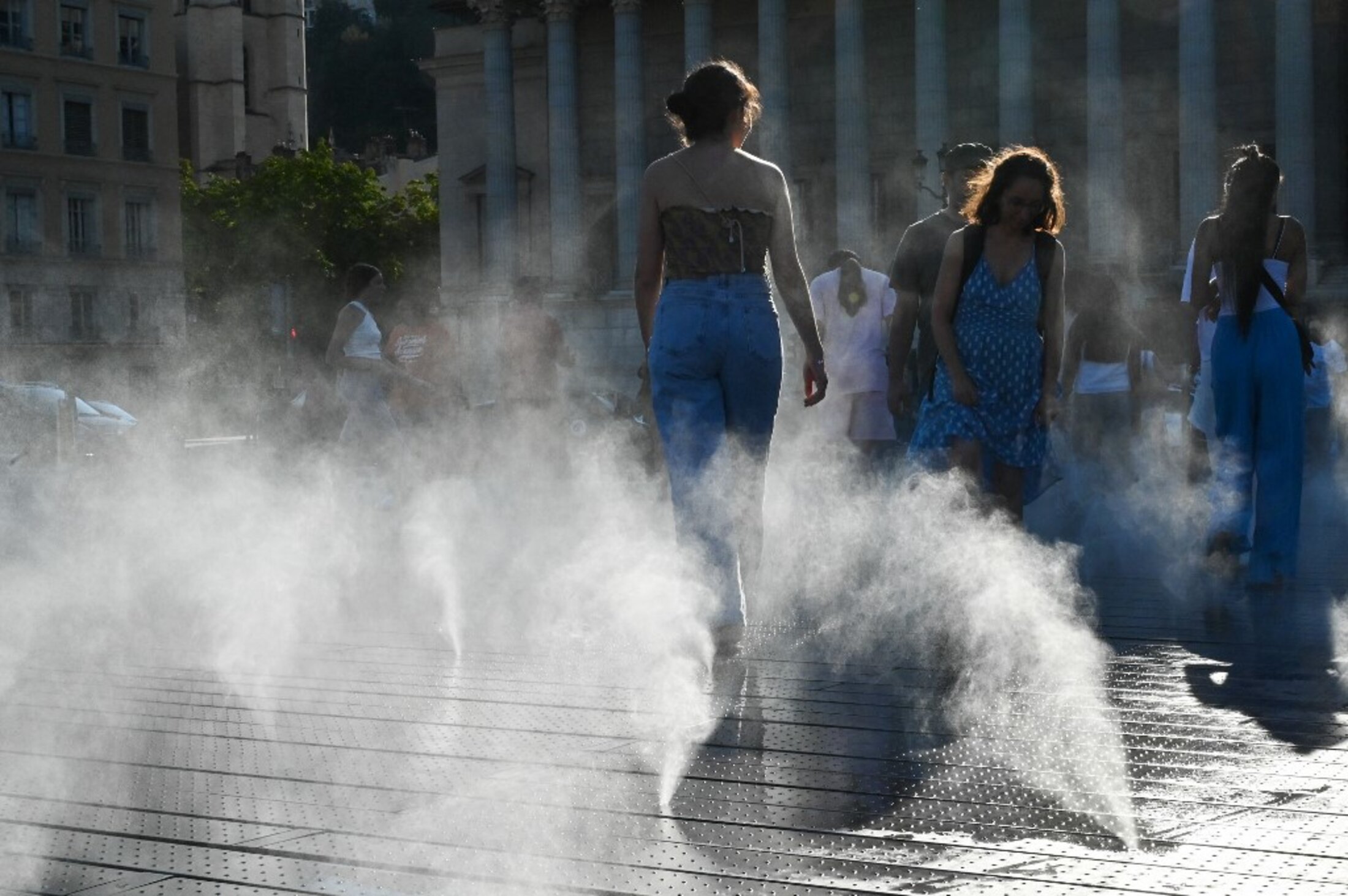
As temperatures steadily climbed across France last weekend, peaking on Monday with 40 départements (counties) on official heatwave alert when between 36°C and 38°C (96.8°F – 100.4°F) was reached in Normandy and the Paris region, central and south-west France, and the south-east.
The meteorological office, Météo-France, described the episode as “not exceptional but quite enduring”.
“We’ve become accustomed, we forget that having 40 degrees was almost impossible in the 2000s,” commented Magali Reghezza-Zitt, a geographer and senior lecturer with the École normale supérieure in Paris.
Sophie Szopa, a director of research at the Laboratory for Climate and Environment Sciences, attached to Versailles university, and who was the principal coordinator for the sixth report published by the UN’s Intergovernmental Panel on Climate Change, said the peaking temperatures were “totally characteristic of climate warming, fully due to human activity that makes heatwaves more frequent and more intense”.
As climate change increases at an unprecedented rhythm, 13 consecutive monthly temperature records have been recorded around the world, while on July 22nd the daily global average temperature reached the highest that has ever been measured.
Enlargement : Illustration 1
In Antarctica, currently in the middle of the Southern Hemisphere winter, ground temperatures on ice sheets in July reached an average 10°C above normal for the season, and as much as 28°C on some days. “With a climate warming up by plus 1°C as it is currently, there is one chance in 50 that such heatwave episodes happen,” said Magali Reghezza-Zitt. “At a plus 1.5°C rate of warming there is one chance in four, and one chance in two at a rate of plus 2°C. That means it won’t happen every year but these incidents will become a normality.”
Temperatures are rising in Europe twice as fast than on the rest of the planet, and Paris has the highest risk of excess mortality due to heatwaves among European capitals, according to a study published in The Lancet.
The Mediterranean region is among the most affected by climate change worldwide, according to a 2021 report by the Intergovernmental Panel on Climate Change. Last week, temperatures recorded in the Mediterranean Sea off the coasts of south-east France and north-west Italy averaged close to 30°C, and reached 30.4°C off the coast of Corsica on August 5th, according to a report by Météo-France. That represents an anomaly of around plus 4°C.
In its sixth annual report, published in June, France’s High Council for the Climate (Haut Conseil pour le climat), an independent body which reports to the prime minister’s office, warned of the social and demographic inequalities in face of climate change, and the risks of these worsening. As calculated in a study published in the magazine Science, on a global basis, those people born in 2020 will experience an up to seven-fold increase in extreme weather events during their lifetime compared to those born in 1960.
Meanwhile, a study published last year by the French public health agency Santé publique France reported that between 2014 and 2022, close to 33,000 people died from extreme summer heatwaves in the country.
“One concern that has begun to emerge is the rise in episodes of tropical nights, which can be dangerous for patients with underlying health problems because their organisms can no longer rest during the night,” said Magali Reghezza-Zitt. “The other concern is humid heat, and we’ve begun receiving low alarm signals [about this] on the Mediterranean coast. These are climatic conditions that prevent the skin from perspiring, and that heats up the body.”
“National announcements cannot reflect the meteorological situation in each region,” said Grégory Emery, director of the administration for healthcare strategy, the Direction Générale de la Santé, at the French health ministry. “A few weeks ago, when I was talking in Paris about the threat of a heatwave while it was 20 degrees [outside], the message didn’t really get through. And in matters of public health, it’s a bit like the boy who cried ‘wolf’ – when one repeats preventive messages that are not adapted to the local situation, people don’t listen anymore.”
“There is a question of individual responsibility in face of these risks,” added Emery, who warned that “we must expect over the coming years to face heatwaves sooner and later, before and after the summer”.
In its annual report published in June, France’s High Council for the Climate also warned that the effects of climate chaos are expanding faster than the introduction of measures to face up to them. While Météo-France forecasts that the numbers of heatwaves in France will grow two-fold between now and 2050, the Council underlined that certain regions “have already reached the limits of their capacities to adapt to climate change”.
“We now adapt to a climate that already no longer exists,” commented Reghezza-Zitt.
After the French government in February announced it was reducing the yearly budget of the environment ministry (officially called the Ministry for Ecological Transition) by 2.14 billion euros (representing 21% of the budget), the chairwoman of the High Council for the Climate wrote in April to Prime Minister Gabriel Attal to warn about “the risk of a depletion of the ambition” in France’s policies on climate change. Neither the draft legislation on energy and climate, nor that concerning the third national low-carbon strategy (SNBC), nor that of the third national plan for adapting to climate change (PNACC) have yet been adopted into law.
In January, environment minister Christophe Béchu triumphantly announced the new PNACC which included around 50 measures to adapt France to a global warming of up to plus 4°C between now and 2100. Although technically ready for implementation this summer, the current political crisis in France, which is left with a hung parliament and a caretaker government following the parliamentary elections in June, means it will now only be ready for parliamentary scrutiny at the end of the year. Despite the two recent heatwaves in the country, Béchu’s posts on social media have been almost totally focused on the medals won by France in the Summer Olympics.
Meanwhile, according to the climate change tracking by the European Union’s environment monitoring programme Copernicus, it is now “quite possible” that 2024 will prove to be, globally, the hottest year on record.
-------------------------
- The original French version of this article can be found here.
English version by Graham Tearse