


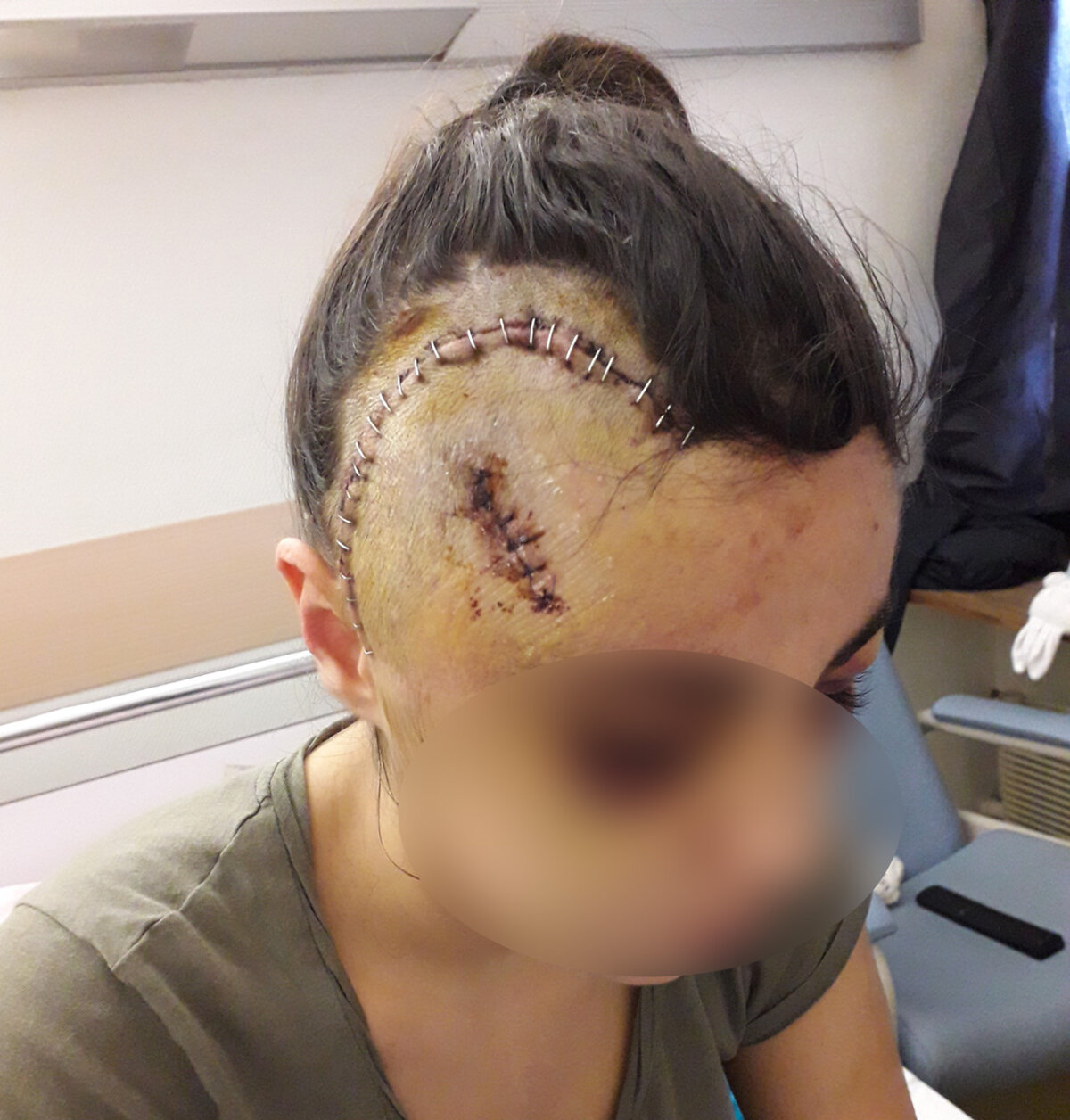
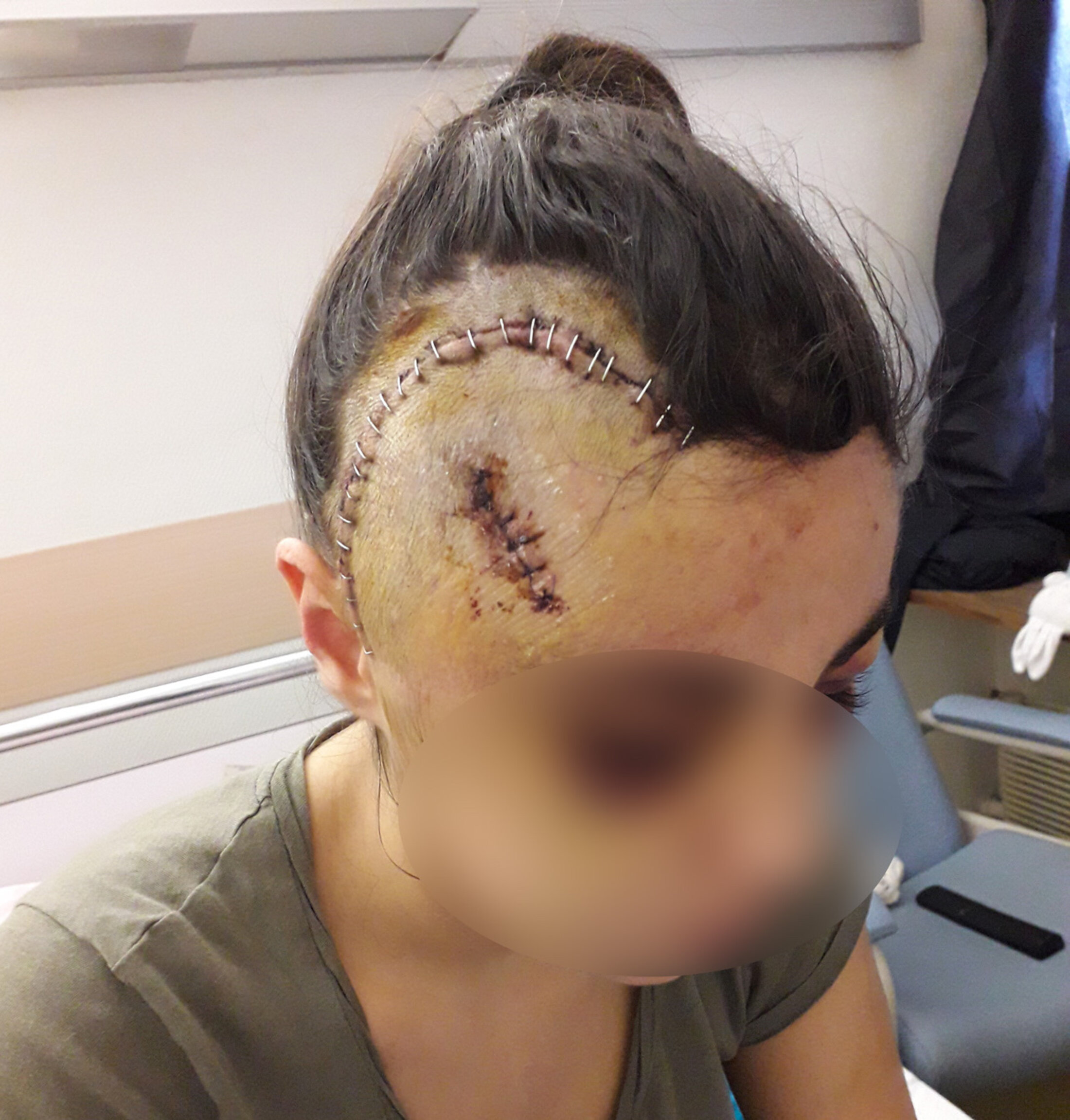
It was around 6.40pm on December 8th 2018 and at the corner of an alley in the centre of Marseille around a dozen armed men, dressed in black and wearing helmets and masks, were kicking and hitting a young woman with batons as she lay on the ground, fracturing her skull. One of the attackers said: “You want some more?” (see video here).
These men were in fact members of a police squad created to help maintain law and order in the face of the so-called 'gilets jaunes' or 'yellow vest' protests which swept across France in late 2018. As Mediapart reported in April 2019, the young woman, 19-year-old 'Maria'* – not her real name – was badly beaten up in the assault.
Enlargement : Illustration 1
Just seven days earlier, on December 1st 2018, 80-year-old Zineb Redouane was killed when she was struck in the face by an exploding police tear-gas grenade as she closed the shutters of her Marseille apartment. On December 5th the minister of the interior, Christophe Castaner, and the director general of the national police force, Éric Morvan, sent a telegram – of which Mediapart has seen a copy – which outlined an unprecedented plan. The French police unit known as RAID – the Recherche Assistance Intervention Dissuasion is an elite outfit usually reserved for terrorist operations or in hostage-taking situations – had been called up. “The intervention reserves could be deployed within the remit of RAID's devolved missions,” the telegram stated.
The chief of staff at the police's Direction Départementale de la Sécurité Publique (DDSP), Jean-Marc Luca, who had planned and directed operations from the police command centre, was later questioned by the police complaints organisation, the IGPN, as part of their investigation into the attack on 'Maria'.
He described what he called an “extraordinary involvement by the forces of law and order”. He confirmed that the RAID unit had been on standby “in reserve ... listening to the radio” and ready to intervene at the police headquarters in Marseille.
Meanwhile Marseille police's Brigade de Recherche et d’Intervention (BRI), which usually handles major crime or terrorist attacks, as they did in January 2015, and which is not trained in dealing with demonstrations, was deployed on the ground.
When the head of the Marseille BRI, Pascal Bonnet, was questioned by the IGPN he accepted that such deployment was “not part of our prerogatives” but said that the “BRI is taking part in the war effort in the context of the yellow vest movement”.
The word “war” was used freely and without any qualms, and that was indeed the apparent mindset the police adopted when dealing with the citizens who demonstrated in Marseille on December 8th 2018.
“It was war,” Jean-Marc Luca said simply when he was questioned by the IGPN. When he was asked to comment on the video of the police officers kicking Maria on the ground, the senior officer replied: “I'm not seeing violence, violence is everywhere.”
In the same vein, the Ministry of the Interior's note on December 5th also proposed a special plan which would lead to the deployment of particular units of officers: what are known as “demo companies” or squads created initially to tackle urban violence.
These squads are formed from various groups of police officers, between eight and nine at a time. Some are uniformed officers, others are plain-clothed, and they come from different units. These include “office civil servants”, agents from the rail security organisation the Service Interdépartemental de Sécurisation des Transports en Commun (SISTC), local detectives, and members of the local Brigade Anti-criminalité (BAC), which specialises in tackling crime in sensitive urban areas.
On the afternoon of December 8th 2018 there were nine such demo squads, four of them in plain clothes.
The divisional commander in charge of operations on the ground, Philippe Combaz, himself told the police investigation that these squads were “people who are not experts in maintaining order” before adding that they “move during the course of demonstrations so you can't know their position precisely”.
There remains great uncertainty about how these squads worked, and the actions of their officers who were both unaccustomed to intervening in demonstrations and apparently without leadership. A police major who headed one of these squads, and who was usually in charge of a complaints bureau, told the investigators that he had not given “particular instructions” to his team, whose precise movements during the protests she was unable to give. The chief of staff Jean-Marc Luca himself acknowledged that he was “unable to say who was where” when Maria was struck.
“It's appalling and above all very worrying to hear a chief of staff acknowledge that he doesn't know who's doing what when that is his job. If there's no leadership, some officers will feel they are allowed to do anything. The demo squads were decided upon at national level and you can see the results,” said one police source, worried by this case and by the sense of impunity that exists inside the force.
“These are officers who have no training in public order maintenance who are left free on the ground. If there's a problem the hierarchy can say: we didn't know, it wasn't us. But on the contrary, those who are responsible are the ones who authorised the creation of these squads outside the law,” added the same police source.
The witness statements obtained by the IGPN tend to confirm this view. “There were no more rules, no more limits,” noted Jean-Marc Luca, as if to justify the police officers' actions, whatever their status. But what exactly was the nature of the threat that might explain the crazed response of the police that day in hitting Maria and others?
'A war effort'
December 8th 2018 was the fourth weekend of action by the 'yellow vests' who had started their national protests the previous month. It was also a day of protests in Marseille against poor-quality housing in the city. Yet according to the fire service the damage caused that day was considerably less than that on a typical July 14th or Bastille Day, with around 50 rubbish bins set alight and one car. Faced with around 2,000 demonstrators the 458 police officers and gendarmes on duty fired more than 680 tear-gas grenades.
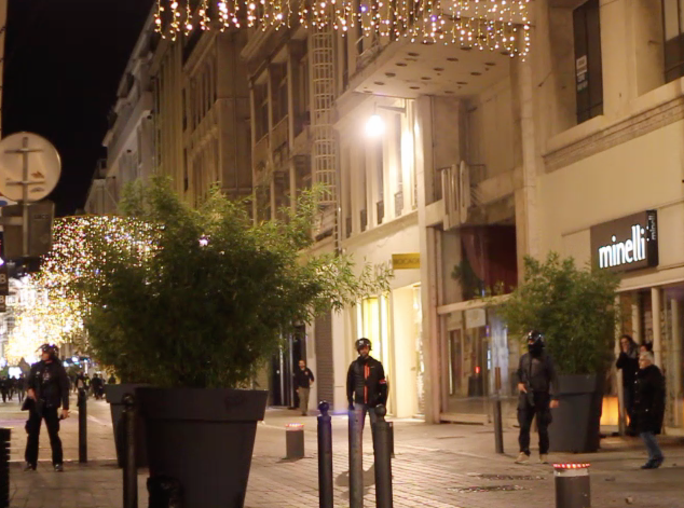
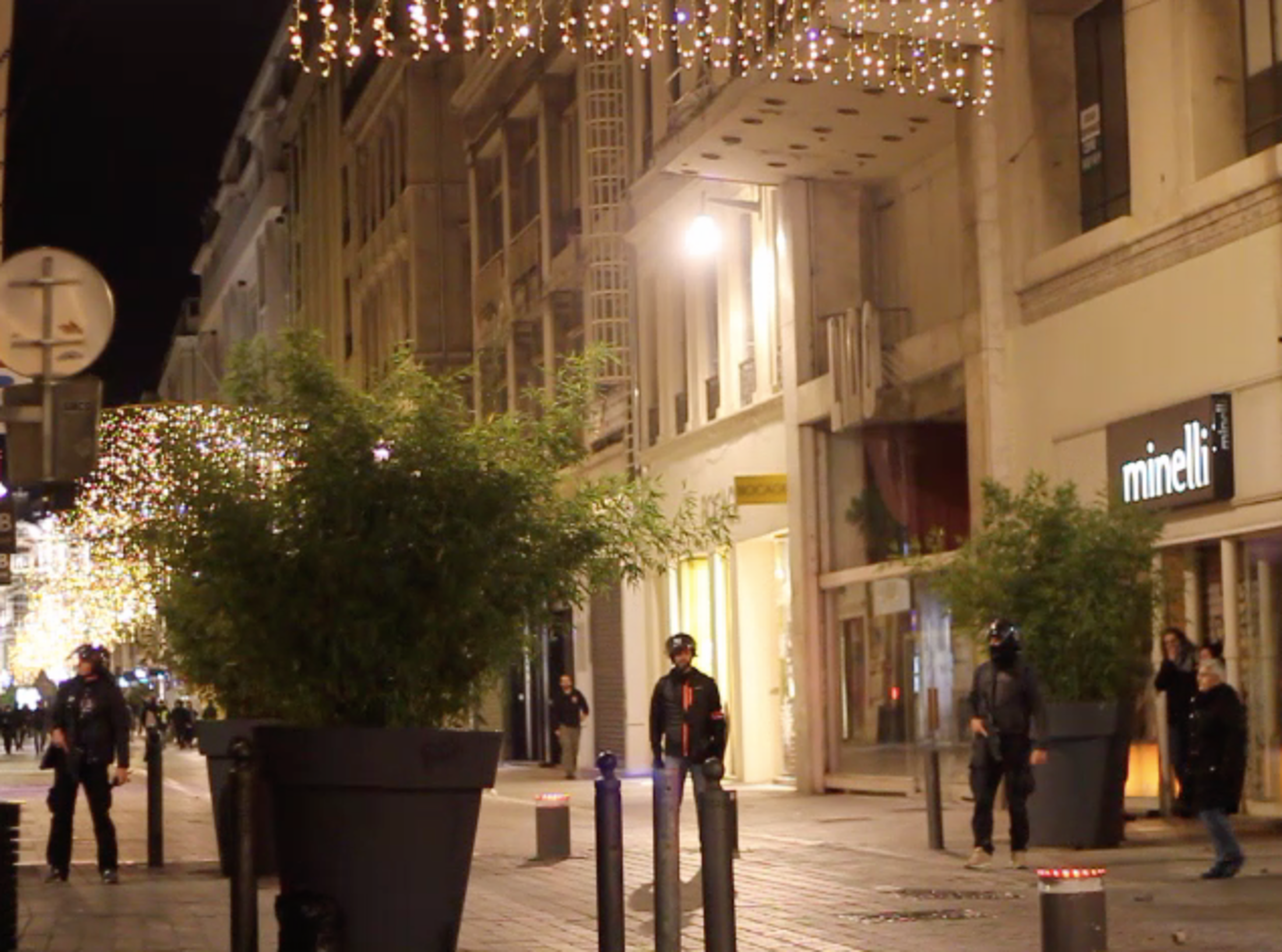
Several shops were ransacked on the day (see videos here) but at around 6.40pm, the time when police officers were attacking Maria, the street in which she had been walking was calm, as the clashes were taking place further away in the city's Old Port or Vieux-Port and the Canebière area of the old city.
When he gave evidence to the IGPN investigation the advisor to the prefect at the time, Jean-Michel Hornus, stated that at around 5pm the centre of the city – the area where Maria was injured – was “quite calm”. Photographs taken by several witnesses back this up.
Enlargement : Illustration 3
However, when he gave evidence the chief of staff Jean-Marc Luca had a very different take on the day's events. He explained that the deployment of 458 personnel, including 300 police officers, the use of 680 tear-gas grenades and 80 shots of non-lethal projectiles, were all aimed at limiting the “ransacking of shops” and “avoiding the need to put up barricades” in an atmosphere that was “insurrectional and chaotic” .... in which the objective was to “injure the forces of order”. He even stated that “some police officers used their bodies as a shield to make sure it didn't degenerate”.
Some officers certainly employed their weapons in a frenetic manner. Of the 80 non-lethal projectile shots, 70 were fired by just three members of the local BAC police squad in the space of six hours. This works out at around 20 to 25 each.
By the end of the day two officers were slightly injured, one of whom was hurt when they fell running without anyone else being involved. On the other hand nine people were victims of the security forces, among them a 14-year-old boy who was hit on the head by a projectile from a non-lethal weapon (read here) and Maria.
Nonetheless, by the end of the IGPN investigation the noose seemed to be tightening around police officers from a plain-clothed squad containing officers who usually worked on rail safety for the SISTC. They were given away by their outfits, their 'skateboard'-style helmets, the splint one of them had on their left hand and the first name of one of them which was recorded in a video (see earlier story here). Yet ten months after the event, none of them had been interviewed.
However, the SISTC's divisional commander, Didier Delacolonge, was questioned. He explained that 30 of his officers, including nine not in police uniform, took part in operations that day. But he said that he was unable to give many details about these nine officers. Rather than exonerating them, he often simply replied to questions: “I don't know.” It was impossible for him to say, for example, whether they had been wearing their own personal helmets, or what kinds of weapons they had on them. “It's possible they had been carrying [tear-gas] grenades but I'm not at all sure about that,” he said.
Despite the tragic occurrences, the events of December 8th 2018 did not lead to Didier Delacolonge questioning the practices of his men, nor indeed his own control of them. He acknowledged that in February 2019, two months after those events, he had agreed to a request from his team for leisure sports helmets, even though they were not standard issue, and had regretted the fact that the police service had not finally agreed to this.
In a letter on this, dated February 13th 2019, which Mediapart has seen, the brigade chief justified the request to Didier Delacolonge by stating that his officers “are equipped in some cases in a personal manner with equipment found here and there, from shops or the internet”.
He said he wanted to order not regulation-style headgear but instead “skateboarding/cycling-style light helmets that would ally discretion and protection”, and he even attached a photo showing an example. The officer also added to his shopping list goggle-style “masks” found in “motorbike, skiing or DIY catalogues”, protective gloves and “discreet” hands-free kits that would enable them to listen to the radio unnoticed. The requests were being made, he said, so they could “walk around inside [protest] marches”.
The police officer also asked for units to have “plain-clothed” training in maintaining order”, a measure that had in fact been in place for several months.
This letter is clear proof that there were officers involved in handling protests who were untrained and had non-regulation equipment, and that this was with the blessing of their superiors. For Didier Delacolonge gave a “favourable” response to the request for the new kit, adding: “The deployment of staff in demonstrations indeed requires the appropriate equipment.”
The IGPN received an email from the head of the police's management services saying that the kit request did not ultimately get the go ahead as this kind of equipment was “not approved by the central administration”.
Maria's lawyer, Brice Grazzini, told Mediapart: “My fears have been confirmed. The police officers who tried to kill Maria acted illegally, in non-regulation outfits, but above all with the backing of their line managers, right up to the highest level of decision-makers.” He continued: “Reading this document gives the impression that the Ministry of the Interior had been preparing its troops, had approved an explosive organisation, and that this was more about using soldiers in a civil war than managing a demonstration, in other words an operation in maintaining order.”
The Ministry of the Interior declined to comment.
-------------------------
If you have information of public interest you would like to pass on to Mediapart for investigation you can contact us at this email address: enquete@mediapart.fr. If you wish to send us documents for our scrutiny via our highly secure platform please go to https://www.frenchleaks.fr/ which is presented in both English and French.
-------------------------
- The French version of this article can be found here.
English version by Michael Streeter