


Following the murder in a Paris suburb last October of French school teacher Samuel Paty, who was beheaded in a street in broad daylight by a young Chechen Islamist terrorist, the government set about a crackdown on Muslim associations, places of worship, and individuals which were considered to be involved in the promotion of terrorism.
Paty was assassinated after he held a class on the subject freedom of expression, during which he had shown pupils some of the cartoons of the Prophet Mohammed published in the weekly magazine Charlie Hebdo, whose editorial team were massacred in a 2015 terrorist attack.
Immediately after Paty’s murder, French interior minister Gérald Darmanin announced the dissolution of a number of associations considered to be closely linked to “radical Islam”, some of which he said received public funding. This September, Darmanin announced that more associations were the subject of investigation, and the latest dissolution was the subject of a government decree issued this month.
The measures have led to the disappearance of a number of cultural associations and others which denounced discrimination against the Muslim community, and which for Sihem Zine, the head of the l’Association de défense des musulmans (“Association for the Defence of Muslims”), the ADM, have been unjustly closed down amid what she called a “deafening silence”.
On September 24th, the highest French administrative court, the Council of State, confirmed the legality of the government’s dissolution by decree in October 2020 of the Collectif contre l’islamophobie en France, the CCIF, (the Collective against Islamophobia in France), which provided legal assistance to individuals pursuing cases of anti-Muslim discrimination. The principal reason cited in the decree was that it propagated the idea that the state was Islamophobic, “with the risk of inciting, in return, acts of hate, violence or discrimination”.
The Council of State also, on the same day, validated the dissolution of BarakaCity, an Islamic organisation close to Salafists and self-described as dedicated to providing humanitarian assistance, but which the government said “incited hate”, was linked to radical Islamist groups and “took pleasure in justifying terrorist acts”.
It was Council of State’s upholding of the decree controversially disbanding of the CCIF which prompted an eclectic group of associations, NGOs and trades unions to issue a joint statement of protest against the ruling. The signatories included Sihem Zine’s ADM, the French Human Rights League, the Paris-based alter-globalisation and social welfare association ATTAC, the like-minded Fondation Copernic think tank, the Syndicat de la magistrature (the SM, a French magistrates’ union), the French lawyers’ union and the French anti-racism organisation MRAP. They criticised the Council for accepting “at face value the accusations of the minister, without taking the least distance”, and not fulfilling “its mission of control”, which it described as a “worrying” development.
“The statement was strong, even if it came a little late,” commented Sihem Zine. “Amnesty International [and] Human Rights Watch also reacted, but the CCIF was a partner of many organisations and I was very surprised to see so little [demonstrations of] support in the end. The CCIF worked with the [French public human rights monitoring commission] CNCDH, the office for the defence of citizens’ rights [Défenseur des droits]. Nobody said anything.”
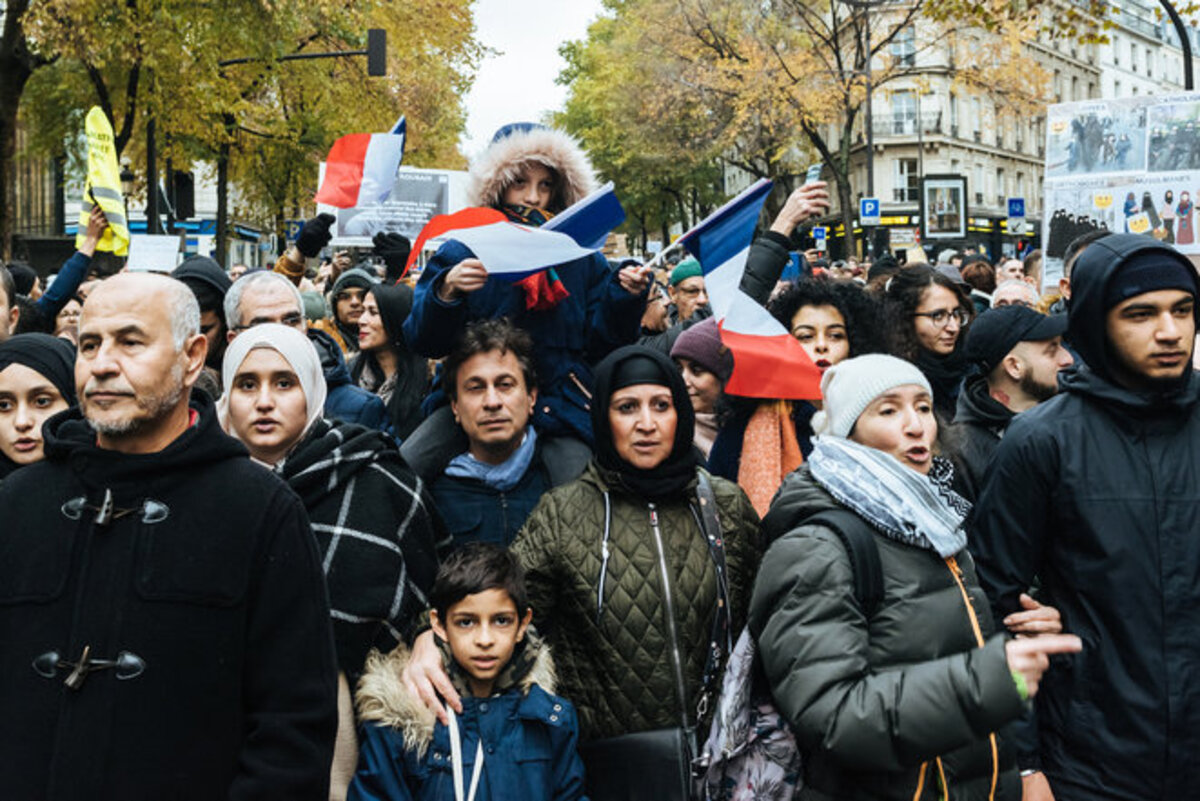
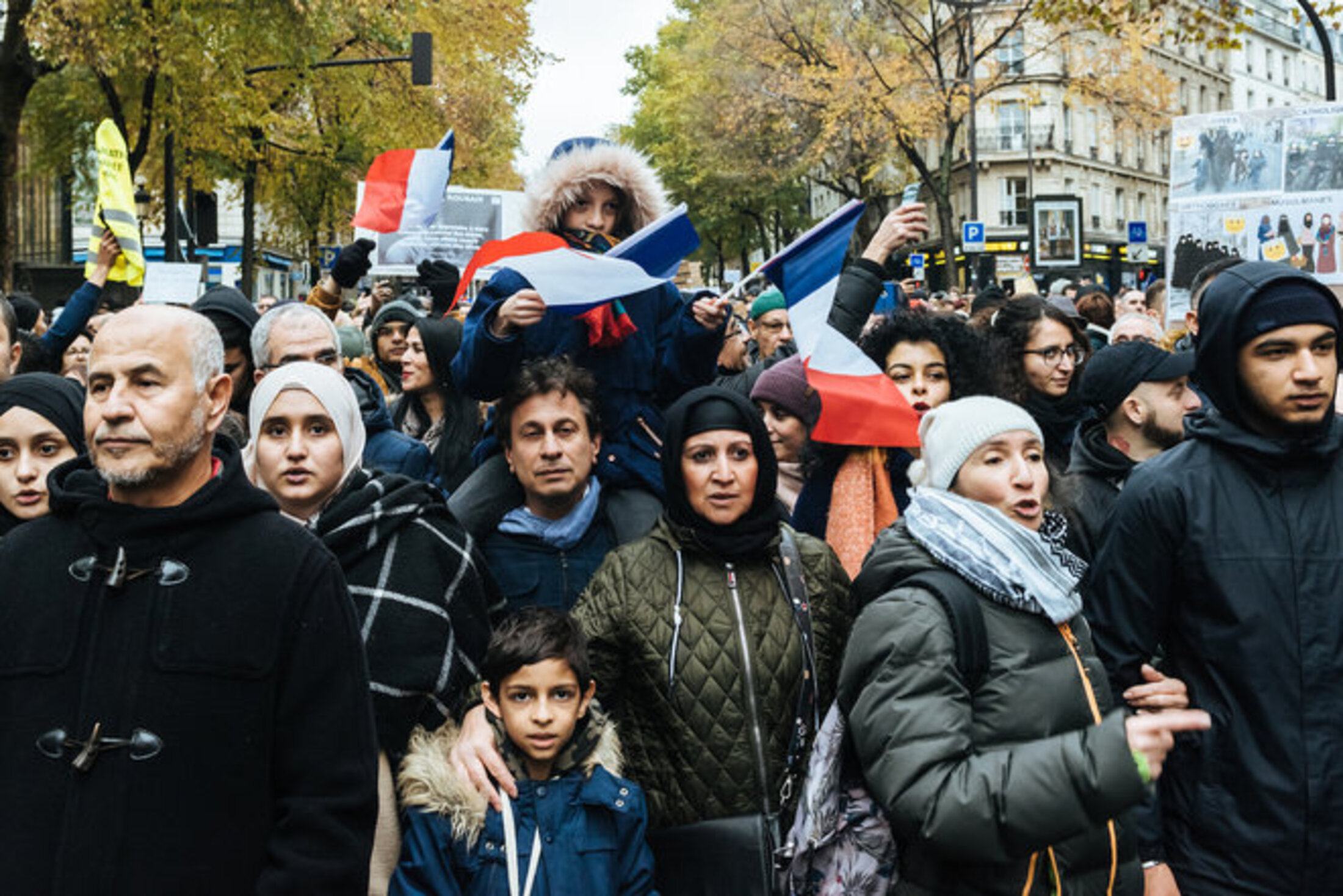
Enlargement : Illustration 1
On October 20th, the interior minister announced another dissolution by decree, this time of a small association called the ‘Coordination against racism and Islamophobia’ (CRI), which he said promoted “hate, violence and discrimination”. Darmanin said that “under the cover of denouncing Islamophobic acts”, the CRI distilled “a message inciting the perception of French institutions as being Islamophobic, in this way feeding a permanent suspicion of religious persecution [and which was] liable to arouse hatred.”
Meanwhile, over the past 12 months several less high-profile Muslim associations and places of worship have also been closed down at Darmanin’s request.
Among the many organisations that did not take a public stand over the dissolution of the CCIF was the principal teachers’ union, the FSU, and the CGT trade union, one of the largest in France. “The FSU union, for example, was afraid of joining in, because of a strong internal debate,” confided a source, whose name is withheld, and who was close to the discussions during the preparation of the statement. “At the CGT, things turn one way or the other according to who shouts the loudest. [CGT general secretary] Philippe Martinez joined in the 2019 march against Islamophobia, but that earned him a serious backlash.”
Representatives of organisations, contacted by Mediapart, who were involved in the discussions for a joint mobilisation against the ruling against the CCIF by the Council of State all spoke of internal divisions, to varying degrees of intensity, about taking part. “Support for the CCIF was the subject of enormous debate within the union,” commented Sarah Massoud, national secretary of the French magistrates’ union, the SM, which did finally co-sign the statement. “It is an extremely divisive subject – and it’s dramatic that it has become so – within all the organisations for the defence of human rights and which are generally classified as being on the Left.”
Malik Salemkour, president of the French Human Rights League (LDH), said that beyond the issue of the CCIF, his association intended to question before the European Court of Justice the legality of a law definitively approved by France’s parliament in July which targets “Islamic separatism” and which includes what some argue are measures that run counter to the rights of forming associations.
The LDH is also considering launching a challenge before France’s Constitutional Council over the new legislation’s so-called “republican engagement pact”, one of the most controversial articles of the law and which is yet to be implemented by decree. “[The process of] law is fine, but one must also keep public debate alive,” said Salemkour. “That’s where our difficulty lies. In face of terrorism, of violence, we live in a collective and civil state of shock.”
Julien Rivoire, spokesman for ATTAC, said the current context is unfavourable for mobilisations in defence of rights “in particular when one touches on the issue of Islam”.
“The government, helped by a section of the media and politicians, has succeeded in its move to make a bogeyman of the CCIF,” he added, “a hot potato, to the degree that a certain number of organisations adopt the view that to show any sort of support for that type of organisation is in itself a problem.”
Simon Duteil, a senior official with the French trades union federation Solidaires, which also co-signed the statement criticising the Council of State’s ruling on the dissolution of the CCIF, observed that since the gruesome killing of school teacher Samuel Paty in October 2020, “there is a real offensive that mixes up every issue”.
“This offensive pays off,” he said, “it creates divisions, it leads to a loss of bearings, including internally in our own organisation.”
The SM’s Sarah Massoud said that by taking a stand to defend the CCIF, “we are immediately assimilated as belonging to the other side”, which she described as an “extremely worrying” situation. “Oppositions are reduced to [being labelled as] radical,” she added. “Whereas, the exercise of religions, of secularity, of the necessary protection by the state of these freedoms, are mistreated issues.”
There are also few among the Left, and notably among the parliamentary leftwing, who have readily defended dissolved or threatened associations, despite the stakes for the future of public freedoms. Those leftwing politicians who took part in a November 2019 march against Islamophobia in Paris continue to be criticised for doing so, in particular because of the presence of the CCIF at the demonstration.
The radical-left La France insoumise (LFI) party was the only one among those on the Left to agree to reply to Mediapart’s questions on the dissolution of the CCIF. “We took part in the march [against Islamophobia], we are happy to recognise that we did, and when the CCIF was dissolved, we spoke up in disagreement with that,” said LFI Member of Parliament Éric Coquerel. “But one has to admit that we have had a lot of attacks. And because the political arena is saturated by the ideas of the far-right, if we talk only of that, if we are only dealing in reactions to these issues, we become inaudible about the rest.”
“There has been no mobilisation worthy of the problem this decision [by the Council of State] poses with regard to legal rights,” he added.
The ADM’s Sihem Zine said she regretted the lack of support from other parties, even though “there have always been people who defend freedoms out of principle” and who are from across the political spectrum. “We’ve slipped from the fight against terrorism to a fight against the civil society of the Muslim minority, mixing everything with hotchpotch words,” she said. “These hate-filled comments propel the known candidates for the presidential elections, amid a climate of anxiety.”
Julien Rivoire of ATTAC observed that in the media coverage of these issues, what he called “the social and political Left” – meaning both the trades unions and other ‘civil society’ organisations as well as the parties of the Left – have “not turned up, and are divided”. Such nervousness was illustrated during nationwide demonstrations held on June 12th this year called for “in defence of freedoms” and “against the far-right” by a broad coalition of trades unions and associations. “Even there, we didn’t succeed in mobilising beyond the very militant sections,” said Rivoire. “It was a jolly demo, we had fun, but it wasn’t up to the occasion.”
He underlined that amid recent incidents of violent attacks against leftwing militants and the publication on a French far-right website of the details of so-called “Islamo-leftists”, including journalists and politicians, and now the emergence of two far-right candidates in next year’s presidential elections, “there is matter” for a broad mobilisation of the Left. “My fear is that with each new battering we lose ground, and that we no longer know what to do to prompt a reaction.”
-------------------------
The above article is a lightly abridged version of the original report in French which can be found here.