


When Morena Henriquez came to Paris from Los Angeles in late May, she had to use up all her annual holiday – a total of five days. Rafael León, who came with her, had to take unpaid leave. But this was no holiday for these two workers at Flying Food, an airline caterer with which a subsidiary of Air France-KLM has a joint venture. They came to highlight their struggle against harsh working conditions in front of Air France-KLM shareholders and top management.
Henriquez, 25, and León, 38, were part of a delegation from the American trade union Unite Here, which represents 27,000 employees in North America, who attended Air France-KLM's annual shareholders' meeting on May 21st. The Franco-Dutch airline is one of Flying Food's main customers for catering on its U.S. flights, and even describes the American group as a “privileged partner”.
But Flying Food, which reported turnover of 436 million dollars in 2014, is more than just a favoured supplier. In 2009 it set up a joint venture, Flying Food Servair America, with its French counterpart Servair, a 97%-owned subsidiary of Air France. The venture, owned 51% by Flying Food and 49% by Servair, runs five airport kitchens in the United States.
Enlargement : Illustration 1
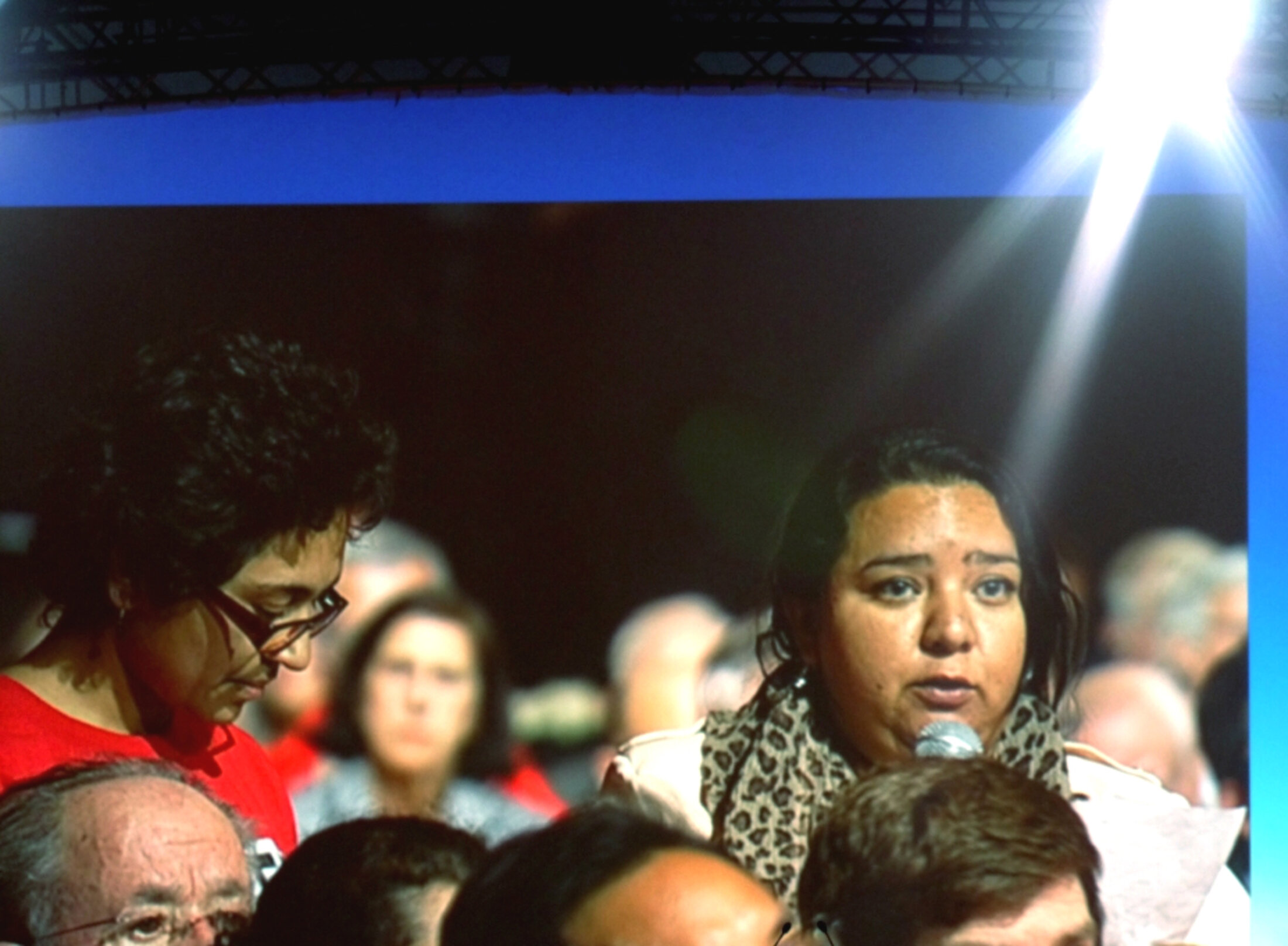
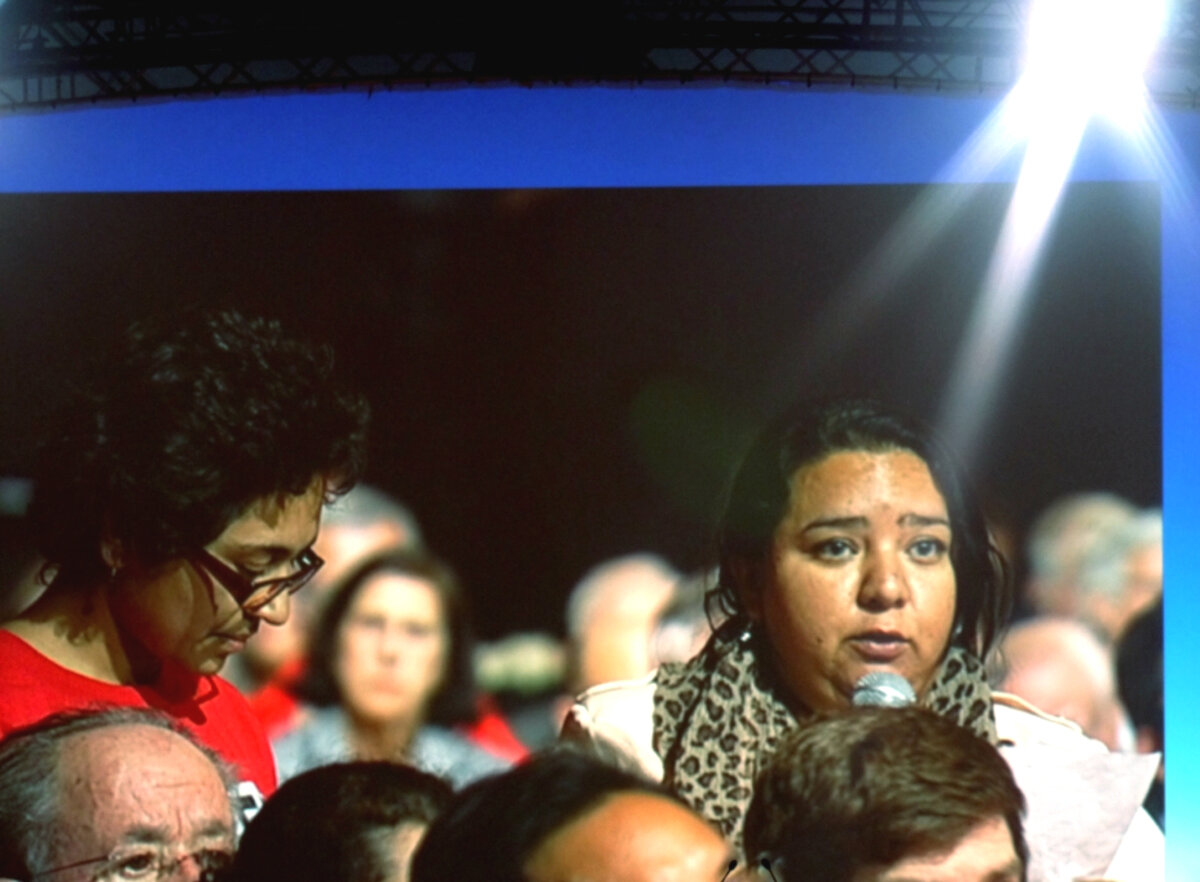
Henriquez was the first to intervene during the question-and-answer session at the annual meeting. Speaking in Spanish (1), she described working 10, 12 or even 16 hours a day to keep up with demands from Flying Food management. The workload keeps getting heavier without any increase in staff numbers, she said. Her unusually arduous work involves preparing and packaging meal trays, sometimes without adequate equipment, in a vast refrigerated area whose temperature never goes above freezing point.
For that she is paid 9.50 dollars (about 8.66 euros) an hour, which is just 50 cents above the minimum wage for Los Angeles – a level considered so inadequate that City Hall recently voted a two-thirds increase to be implemented by 2020.Nor does Henriquez benefit from any health insurance, which would in any case cost between 300 dollars and 400 dollars for a family, a heavy burden for workers whose income is generally below 1,500 dollars a month.
Enlargement : Illustration 2
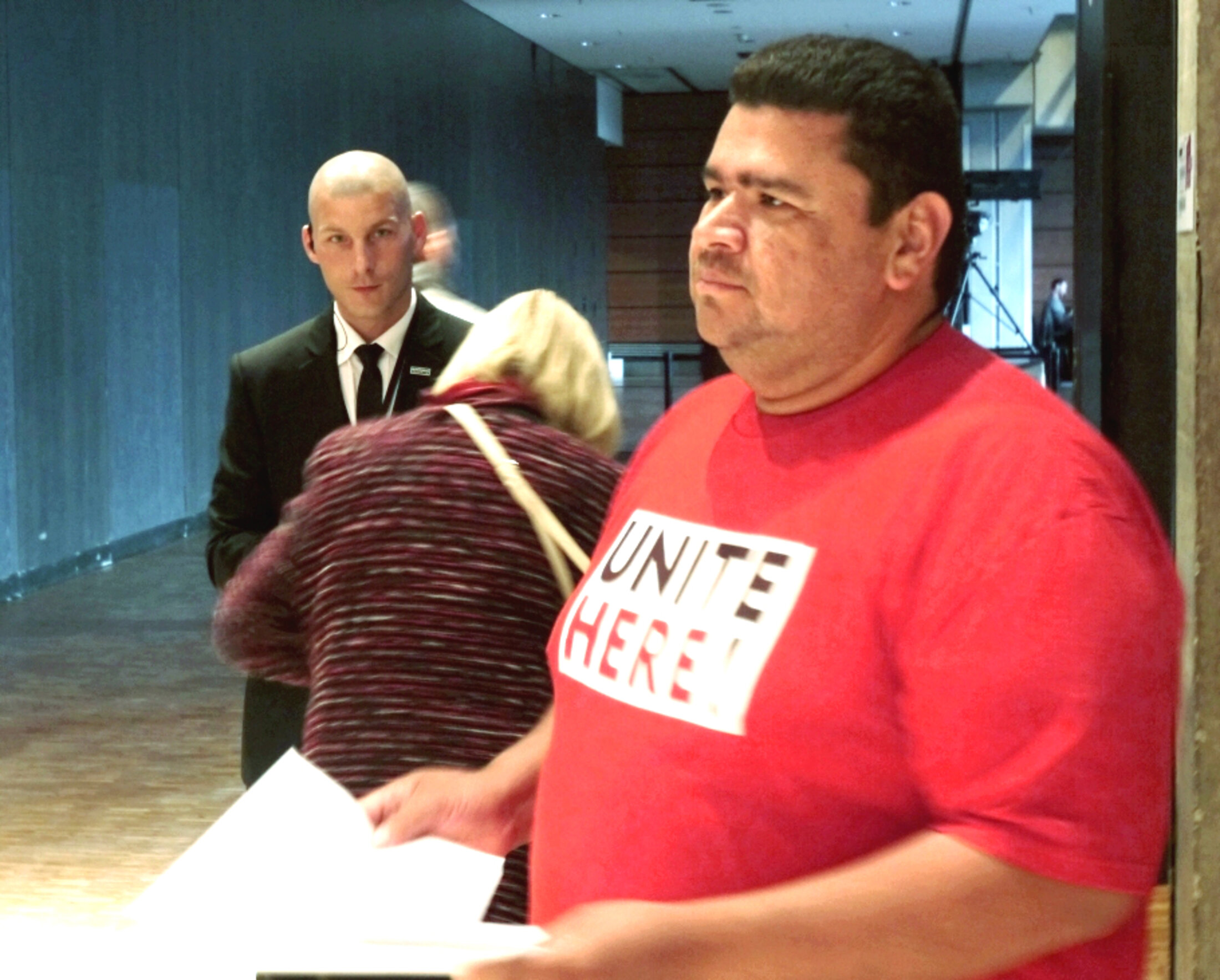
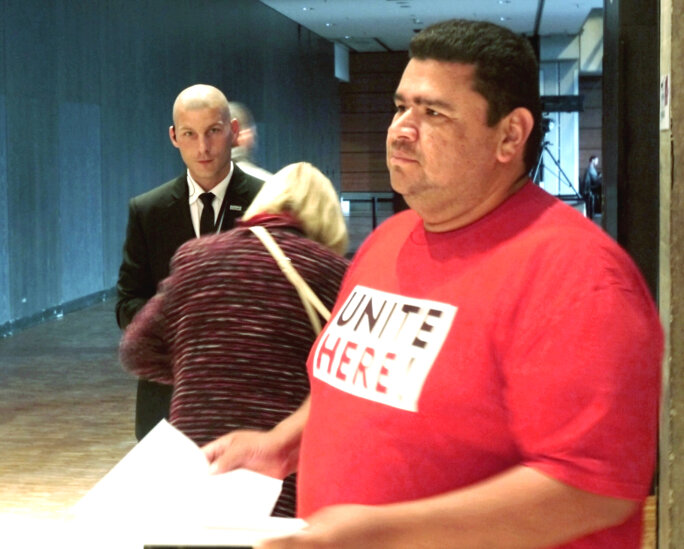
“If you hurt yourself or get sick, you have to choose between paying the doctor, paying the rent or buying food,” Henriquez told Air France-KLM shareholders, calling upon them to work together with Flying Food Servair's employees to get better conditions. The request seemed to cause some discomfort among the rows of shareholders, who later that same day confirmed Alexandre de Juniac as chairman and CEO of the Franco-Dutch group for a further four years. At the door León and Noel Rodriguez of Unite Here were handing out leaflets describing their working conditions.
Henriquez and León had earlier recounted their grievances to Mediapart. León is a chef paid 10.25 dollars an hour, and has had to supply his own knives for preparing the gourmet meal trays for business or premium class. “I have been working there for two years and I have never been given a single knife! It’s the same for a lot of utensils, we lack everything for our work. Even tables; sometimes we have to prepare dishes while squatting down. And there is only one oven, one grill, one deep fryer for hundreds of employees. People queue up to be able to use them.”
In the space of a year the Los Angeles kitchen – not one in which Servair is a co-owner – has apparently expanded from serving meals for five airlines to now catering for eleven. Its customers include Air France, Aeroflot, China Airlines, Japan Airlines and KLM. “When our kitchen has to prepare meals for a new flight, that means hundreds more trays without enough people being taken on,” Henriquez said. “Sometimes there are four of us to do the work of six or seven people.” That explains the long hours and overtime, which are simply imposed on staff without discussion. The workers describe the management as harsh and disdainful.
They say their line managers shout at staff and insult them, and tell workers that if anyone is unhappy they are free to leave - and that there are plenty of potential replacements. “We're just asking for respect, we are fighting for our dignity,” said León. “Everyone should respect other human beings. But our company tries to keep its employees in a state of submission. I want to be proud of working for this company.”
--------------------------------------------------------------------
1. The American workers spoke in Spanish. Their words were translated into French by Aswhini Sukhtankar, who came to Paris with Unite Here. The French was translated into English by Mediapart.
'Modern-day slavery'
Earlier this year, and helped by their trade union, León and eight other colleagues sued Flying Food, alleging 'wage theft'. The issue involves the Los Angeles kitchen and also the Miami kitchen, which, unlike Los Angeles, is co-owned by Servair, the Air France unit. Although employees are not paid less than the minimum wage, they are paid well below the Los Angeles 'living wage ordinance', which applies to companies that have a contract with City Hall, or are lessees – like airlines – or concessionaires on public land.
Flying Food's kitchen at Los Angeles International Airport is leased from the city. At 15.84 dollars an hour, the living wage would make a huge difference for workers like León, who lives with his wife and two young children in a garage converted into a living space, all sharing one bedroom. According to the trade union's calculations, the company owes some 15 million dollars in unpaid salaries and benefits.
Flying Food contests its employees' demands and denies allegations of poor working conditions. But it has just received an official letter from Los Angeles City Hall, dated May 13th, instructing it to apply the living wage retroactively from May 1st, 2010 for 271 employees. The company has so far refused to do so despite pressure, including a strike in April involving 60% of its 350 or so employees plus nearly 200 of their colleagues from Chicago.
“Speaking out gives you power and opens a lot of doors,” said Henriquez. “Four months ago no one had heard of us, and now we are in Paris, it's incredible!” She has reason to feel good. During her visit the French trade unions the delegation visited, the CGT, CFDT and FO, all supported their struggle. “It’s the 19th century! Their conditions are totally unacceptable, this is modern-day slavery,” said Karine Monségu, CGT representative at Air France. She promised her union would do everything possible to help the Flying Food workers, “including going over there”.
But that may not be necessary. Unite Here has been campaigning since February, sending letters and requests for meetings to Air France, Servair and even the Agence des Participations de l'État, the French government agency that manages state shareholdings – in May the government spent 42 million euros to take its shareholding in Air France-KLM to 17.58% from 15.88%. But it has got no response. Until now.
At the annual meeting on May 21st, Air France CEO Frédéric Gagey replied directly to the delegation. Although he made clear that the company did not part-own the Los Angeles kitchen and therefore “has no legitimacy interfering in operational management”, he did nevertheless say that Air France had passed on complaints from Flying Food employees several times, and that Air France and Servair would ensure their partner observed labour laws. Michel Emeyriat, CEO of Servair, met the delegation after the annual meeting and reiterated what Gagey had said.
“We can hardly do more than pass on the questions and requests to Flying Group, but we find the situation distressing,” a Servair official told Mediapart. “We expect Flying Group to deal with the situation, otherwise Air France will draw all the necessary conclusions.”
So now Air France has officially committed itself to putting pressure on its partners and subcontractors to observe employees' rights, as Unite Here has been seeking for months. This is simply in line with the company's own social rights and ethics charter, which has also been endorsed by Servair.
“We hope Air France will follow its own rules. We didn't write the charter. Is it just there to look good?” asked Rodriguez of Unite Here. Christian Magne, CFDT delegate at the airline who sits on the Air France-KLM board as the employee representative, confirmed that the Flying Food workers' case was indeed covered by the charter. “It seems to me that the right process has now been started. It would have been preferable if it had been done a long time ago, but the letter from the Los Angeles municipality judging that Flying Food was behaving illegally finally set the process in motion.”
----------------------------------------------------------------------------
- The French version of this article can be found here.
English version by Sue Landau