


A Paris court on Monday heard a case brought by Apple against alter-globalisation group ATTAC in which it is seeking a three-year injunction to prevent the French-based militant organisation from holding demonstrations at its stores in France in a campaign to denounce tax-dodging by the US electronics and IT giant.
ATTAC has recently carried out a series of high-profile protests at Apple stores in the country to draw attention to the California-based corporation’s alleged tax-evasion policies, when militants unfurled banners and daubing slogans, including “pay your taxes”, in whitewash on windows of the plush boutiques.
It was at the height of the campaign, during the busy shopping period in December, that Apple decided to launch its suit, citing a claimed infringement of its right to trade freely and the safety of its employees. It is demanding a three-year ban against the protests and that, if ATTAC did not abide by it, a fine of 150,000 euros for every subsequent recurrence of the demonstrations at its stores.
“ATTAC is threatening to repeat its actions which have already caused a prejudice for Apple,” the firm stated in its submission for the ban, “and which will lead to the vandalising of the stores run by Apple, to placing in jeopardy the security of its employees and its clients and to cause a commercial prejudice to Apple.”

Enlargement : Illustration 1
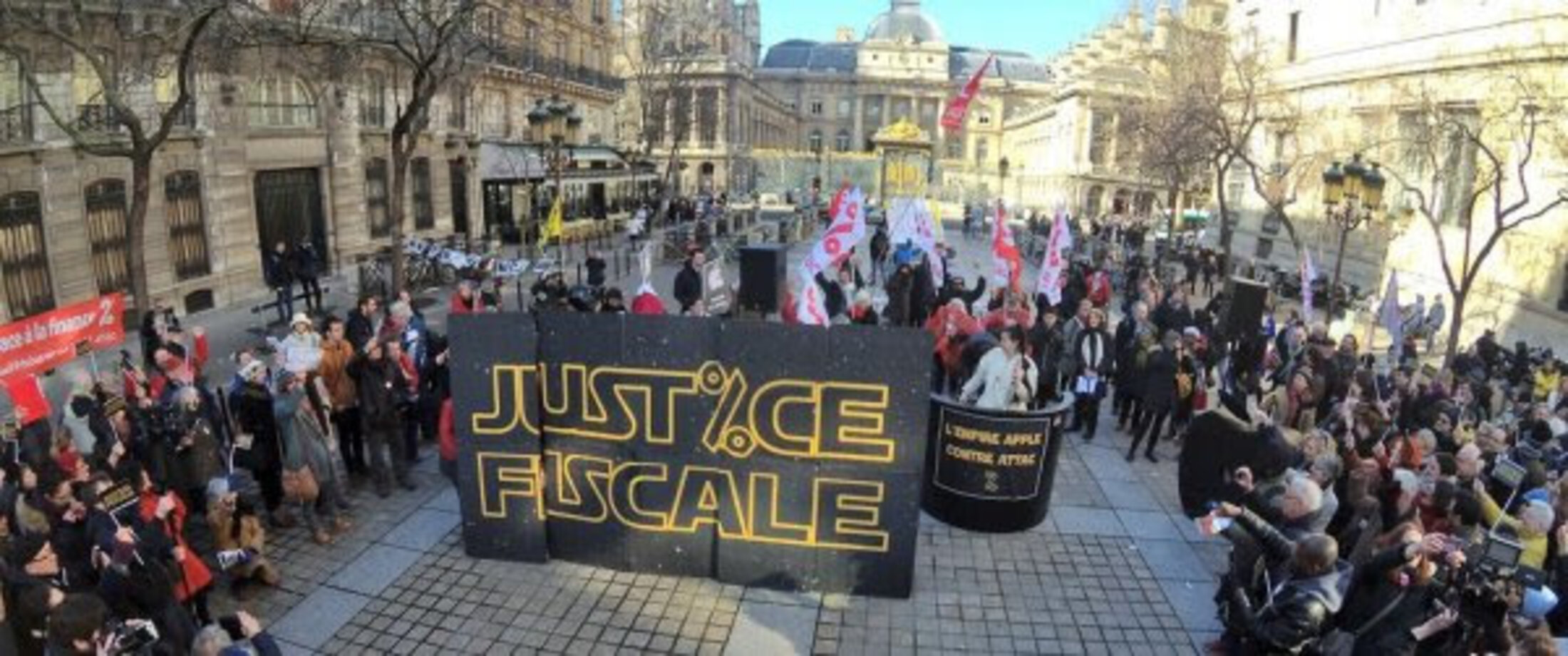
As the case was heard on Monday, a small crowd of about 100 demonstrators gathered in front of the Paris law courts building, where militants from ATTAC were joined by officials from a broad section of leftwing parties and also trades unions, with some chanting “Multinationals are attacking civil society”.
“This hearing is important because it concerns one of the ‘Gafa’ [Editor’s note: an acronym for Google, Apple, Facebook and Amazon], these large IT-based groups which escape all taxes on a world scale,” said ATTAC spokeswoman Aurélie Trouvé. “They have diverted the digital revolution to their own profit and turned it into a global income.”
Inside the court, one of Apple’s lawyers, Antonin Lévy, told presiding judge Bérengère Dolbeau: “You have seen the means that had to be mobilised for the demonstration outside. How can you expect our employees to cope when demonstrators carry out incursions into Apple stores?” In fact, there was a total of about six riot-control police officers stationed at some distance from the protestors in front of the court buildings.
Lévy, who is separately also legal counsel for François Fillon, the hapless conservative candidate in last year’s presidential elections whose campaign nosedived amid allegations that he fraudulently employed his wife and children as parliamentary assistants, was called on to the case to help his colleague Ivan Itzkovitch, the lawyer who initiated Apple’s legal action, indicating the importance of the case for the iPhone manufacturer.
Lévy detailed the series of protests organised by ATTAC, which began in the Spring of 2017 at stores in the French capital, followed by another in the southern city of Aix-en-Provence and others in several towns across the country. In what he called an “escalation” of the action, an Apple store situated on the Place de l’Opéra in central Paris on December 2nd was invaded by militants of the organisation chanting slogans denouncing tax avoidance by the firm and prompting management to hurriedly close the store.
“Apple does not want to gag anyone,” he declared. “It is for freedom of speech, for the right to demonstrate. But freedom of expression cannot be an excuse for everything. To enter a store is the limit. One cannot work like that. There was an attempt at dialogue with ATTAC which failed. The debate was vitiated. Just before Christmas, Apple was forced to lodge this suit in order to ensure the safety of its employees and its clients.”
For ATTAC, its lawyer Julien Pignon asked the court: “Where is the vandalism? Where is the degradation, or the threat of an imminent danger?” He reminded Judge Dolbeau that the organisation was known for the non-violent nature of its campaigns, detailing how it has for several years campaigned against tax fraud in the banking sector with attention-grabbing stunts like the removal of seats from bank branches – notably those of the BNP-Paribas bank – and which led to comic trials of those charged with stealing the furniture.
Similarly, argued Pignon, the protests at Apple stores involved the unfurling of banners and painting slogans in whitewash, “a product that disappears with water”, but at no time involved violence, including the December protest at the Apple store at the Paris Opéra square.
The question of Apple’s tax payments has become an issue of concern not only in Europe but also the US, where the tax authorities estimate the firm hides about 200 billion dollars in offshore schemes. In August 2016, the European Union (EU) Commission, prompted by growing public outrage at tax avoidance by large corporations, accused Apple of enjoying unwarranted tax leniency in Ireland where it had based offices, ordering the Irish state to reclaim 13 billion euros in unpaid taxes. A reluctant Irish government was finally forced into engaging the procedure in October last year, after the EU Commission took the case before the European Court of Justice, and in December the tech giant began making the first of the backpayments.
In a lengthy statement released on the Apple website last November, in response to reporting on its tax practices by the International Consortium of Investigative Journalists, the tech giant declared: “Apple believes every company has a responsibility to pay its taxes, and as the largest taxpayer in the world, Apple pays every dollar it owes in every country around the world. We’re proud of the economic contributions we make to the countries and communities where we do business.”
During the hearing in Paris on Monday, Apple’s lawyer Antonin Lévy said it was “a lie” to suggest, as does ATTAC, that the case involving Ireland called Apple’s practices into question. “It is not a case of tax fraud,” he told the court. “It is a case of state aid. It is Ireland that is subjected to retrieving tax back payments.”
“In France, the group employs 2,000 people,” Lévy added. “It is an honourable company which pays its social contributions, its charges.”
According to a report published in April 2016 by French business monthly magazine Capital, Apple declared a turnover for its two French-based entities in 2015 of 618 million euros. It cited an earlier estimation by business consultants Greenwich Consulting that the tech giant’s French operations in 2011 produced revenues of 3.2 billion euros which, projected alongside the subsequent growth of its Europe-wide operations, would mean that the real figure for its turnover in 2015 can be expected to be around 5.76 billion euros, about ten times the officially declared amount. Capital cited the firm’s declared 2015 turnover for commercial activities in its “Europe” zone, which in fact includes its operations in the Middle East, India and Africa, as 44.5 billion euros – which the magazine concluded meant that its operations in France represented just 1.4% of the total.
The low financial returns Apple declares in France is at least in part due to the financial structures it uses in Luxembourg and Ireland. As a result, in 2015 it posted profits for its French operations of just 38 million euros, to which it was subject to tax payments of 13 million euros, similar to what might be expected of a successful medium-sized company.
“To ask for 150,000 euros for each offence is to aim to silence ATTAC,” argued the organisation’s lawyer Julien Pignon on Monday, referring to the sum sought by Apple for any future protests at its stores if it is granted the three-year ban of ATTAC’s campaign. “It is a disproportionate measure in face of a campaign which causes displeasure. The debate is about tax evasion. It is a debate of public interest.”
The court will announce its verdict on February 23rd.
-------------------------
- The French version of this article can be found here.
English version by Graham Tearse