


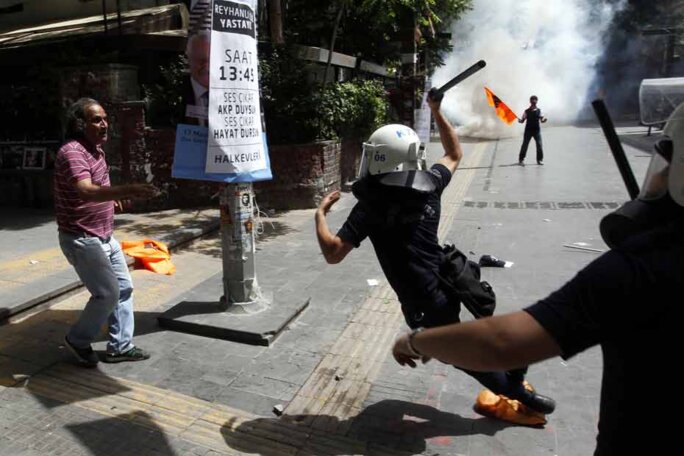
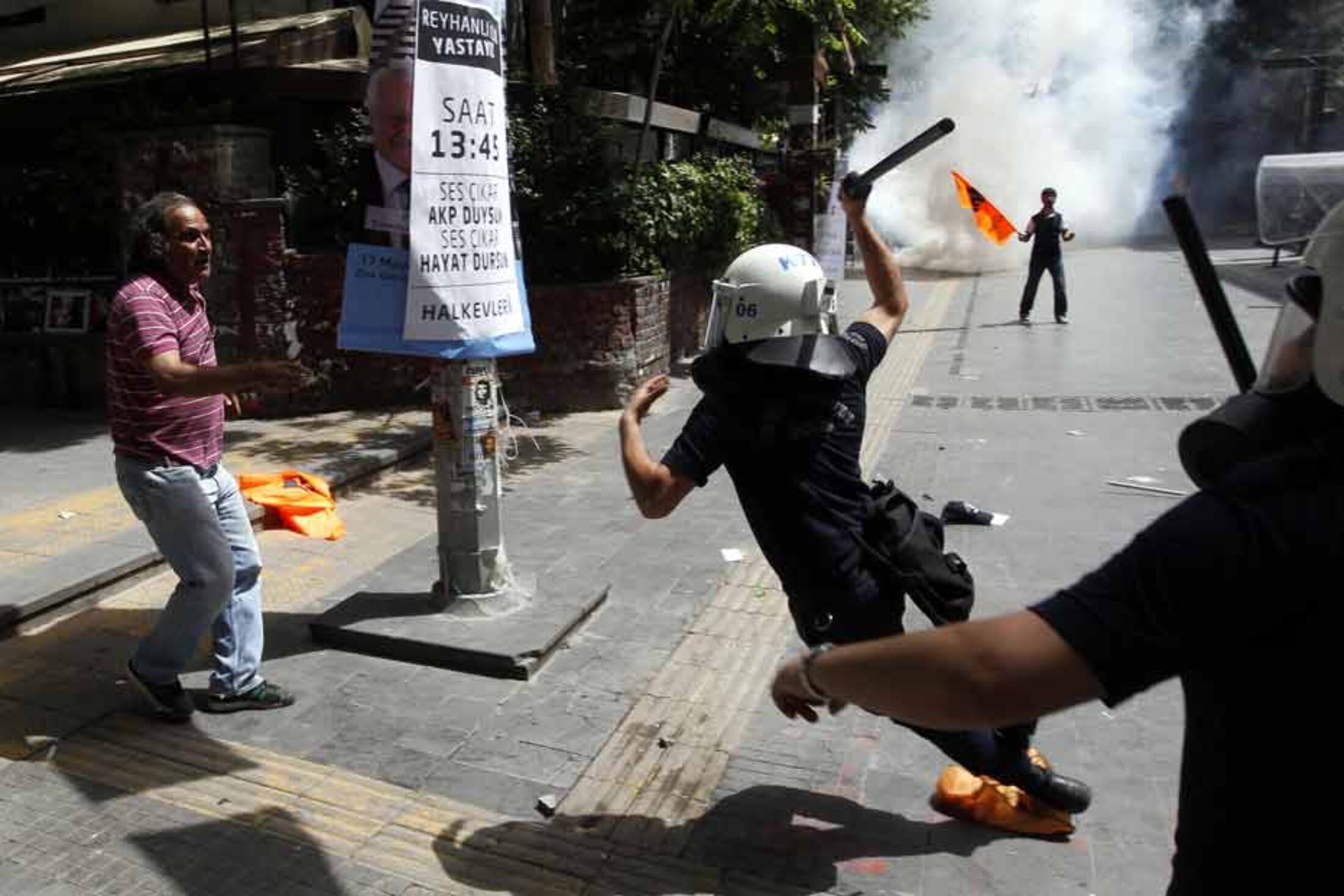
The current protests and violence on the streets of Turkey have thrown the spotlight on a little-known agreement by France to export its ‘internal security’ know-how to the authorities in Istanbul.
Signed by the then-Minister of the Interior Claude Guéant in 2011, the accord was backed by President François Hollande's government after his election last year and is now awaiting formal approval by the French Parliament.
The ‘Cooperation agreement in the field of internal security between the government of the Republic of France and the government of the Republic of Turkey’ (see the text in full in French here) is the culmination of 13 years of negotiations and is principally concerned with the fight against terrorism, drug trafficking, money laundering, counterfeiting and illegal immigration. In all there are 18 different areas of cooperation that feature in the bilateral agreement. It is the 18th, concerning “democratic crowd management”, that has provoked criticism, and has featured in comments on social networks after the scenes of violence seen recently on the streets of Istanbul and Ankara.
The agreement, which had already been delayed because of a legislative backlog, now faces being postponed even longer after the unrest in Turkey which has seen two people killed, thousands injured and led to calls for police chiefs to be sacked. Socialist Member of Parliament François Loncle, who already had strong reservations about the agreement, told Mediapart: “We wanted to put back the date for the scrutiny [of the text] because this agreement is problematic. And current events show we were right.”
The draft law proposed by the French government itself states that the section on crowd control was specifically inserted at Turkey's request. According to the French foreign ministry it relates to “techniques to maintain and regain order to control armed individuals without making use of lethal weapons”. That is exactly what the then-Minister for Foreign Affairs Michèle Alliot-Marie said when she offered Tunisian despot Zine al-Abidine Ben Ali French “know-how” to crack down on protests in the country in 2011, at the start of the so-called Arab Spring, which eventually led to the overthrow of Ben Ali’s regime (see video below of her speaking on the issue in parliament).
The agreement signed with Turkey gives no details about what is meant by “democratic crowd control”. According to the French foreign ministry and the Ministry of the Interior it is a “recognised expression”. Nor is there any detail on the 17th point of the text which concerns “the training of internal security forces”. Only the methods for fighting against terrorism, drug trafficking, illegal immigration and money laundering are spelt out in full.
“It's a very broad framework,” said an interior ministry source, speaking on condition of anonymity. “People are sent to undergo training in public order maintenance techniques. But the training is not only technical and tactical. It also concerns the legal area, like using video footage as evidence for the justice system, or the democratic legislative context with the concept of civil authority, the use of warnings or the right to protest.”
The French authorities have long taken pride in having developed effective techniques in maintaining law and order, and regularly point out that there have been no deaths during demonstrations in France since 1986. That was when 22-year-old student Malik Oussekine died after being beaten by baton-wielding police in the aftermath of a mass demonstration against changes to the university student selection system. This contrasts with the record of a number of other European countries, such as that of Italy where in 2005 a protester died during G8 summit demonstrations in Genoa.
“The professionalism of [the riot control police] the CRS and the [riot control] Mobile Gendarmerie is recognised, as well as their methods of intervening with little trauma,” said the source at the interior ministry, adding that the clause on “democratic crowd management” is one that appears in “the majority of international agreements” signed by the ministry.
Indeed, Paris has signed a large number of bilateral agreements to export its know-how in the domain. This has come in for sharp criticism, such as in the case of Bahrain where France helped train law and order forces to repress all protests and, to a lesser extent, that of the Democratic Republic of the Congo. The French interior ministry said “democratic crowd management” accounts for 20% of its international cooperation programmes.
It is therefore hardly surprising that such an accord found its way into the 2011 agreement with Turkey. Since his appointment in May last year, interior minister Manuel Valls has hosted a delegation of senior Turkish law and order officials on a two-day visit when they were shown how the CRS and the Mobile Gendarmerie crowd control squadrons operate.
'Democratic crowd management': an oxymoron?
The agreement with Turkey, signed by Claude Guéant under the presidency of Nicolas Sarkozy, was formally approved by ministers under President François Hollande at a cabinet meeting on 1st August 1st 2012, and was swiftly sent to the National Assembly, the lower house, to begin the process of approval.
But parliament’s foreign affairs committee has not yet examined the agreement, and the bill to be put before the house has not been scheduled. The foreign affairs committee’s members insist that the main reason for the delay is the nature of the legislative schedule. “The reason why it's been put back is because of a congested timetable, it has to be scheduled,” said Jean-Pierre Dufau, head of the socialist group on the committee.
When the scrutiny of the legislation was cancelled at the last minute in February, the committee's president Élisabeth Guigoutold MP Pierre Lellouche that “its removal from the agenda is due first and foremost to our schedule”. But she added: “In addition, it also appeared to us that it needed to be re-examined more closely before discussing it.” She finished by saying that the “scrutiny is therefore only postponed”
In reality there are considerable misgivings on the Left about the legislation. In February the French Communist Party (PCF) launched a series of petitions in a bid to get the agreement scrapped immediately. Then, during a meeting in early April of several socialist MPs on the foreign affairs committee, they called for more time to consider the agreement. “The timetable of events linked to Turkey, the specific character of this agreement, its European and regional context...justify a pause and reflection before any decision to ratify,” reads a summary of their meeting.
Enlargement : Illustration 2
At issue are alerts that have been sent for several months by human rights groups and Kurdish associations who have campaigned against the Franco-Turkish deal, especially in the context of the tougher line being taken by the government of Turkish Prime Minister Recep Tayyip Erdogan. They have also expressed notable concern about the section of the agreement dealing with the fight against terrorism, a subject which Turkish law defines very broadly – especially as far as pro-Kurd activists are concerned.
In France, MPs among the socialist majority publicly condemned the life sentence handed out in January to academic Pinar Selek for terrorist activities (interviewed by Mediapart in Strasbourg where she lives in exile), and the five-year jail term given to Franco-Turkish student Sevil Sevmili for 'terrorist propaganda'.
“In a context where the Kurdish minority are fighting to defend their rights, there's a major risk that there will be severe repression carried out under the guise of action against terrorism,” socialist senator Jean-Noël Guérini wrote in a written question to the government in mid-April.
“I am very reticent about this type of police cooperation if there is nothing on police ethics, the concept of public order or the profession of being a police officer,” commented socialist MP Pouria Amirshahi. He is also dismissive about the notion of ‘democratic management of crowds’. “I don't know if it's an oxymoron or cynical,” he said, adding: “ At its best, that's called ‘the vote’, not blows with a baton!”
Another socialist MP, François Loncle, commented: “We wanted to put back the date for the scrutiny [of the text] because this agreement is problematic. And current events show we were right.”
-------------------------
English version by Michael Streeter
(Editing by Graham Tearse)