


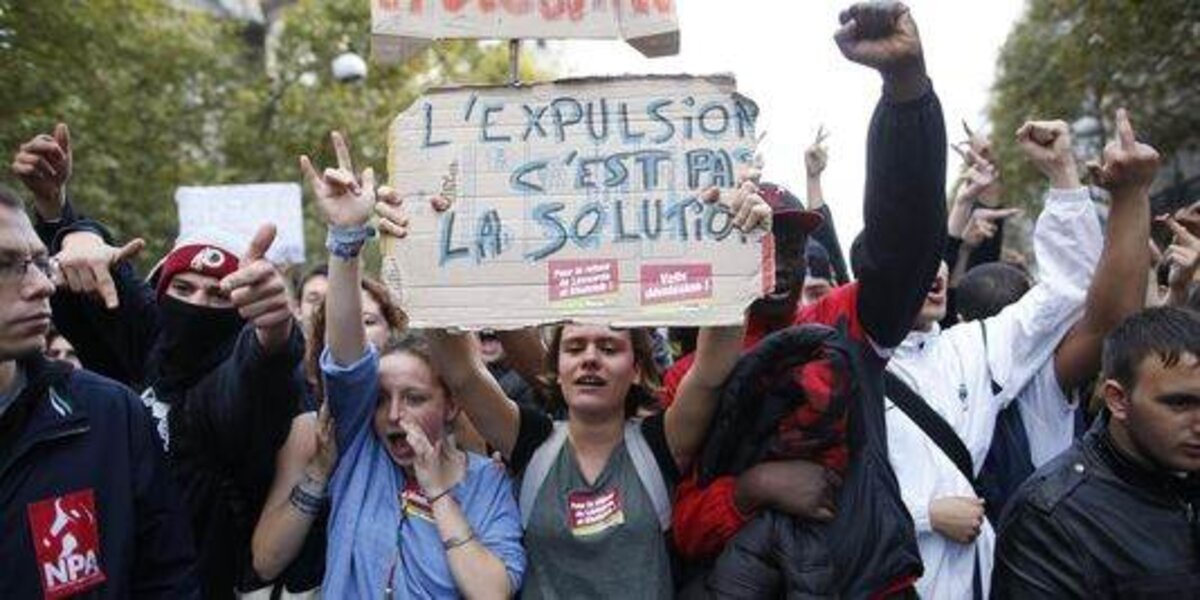
The controversy over school pupils without residence permits being deported from France refuses to go away. Before the recent half-term break school students began a campaign of demonstrations over the deportation of 15-year-old Roma schoolgirl Léonarda Dibraniwho was arrested while on a school trip, and those protests have since resumed.
The students claim that President François Hollande's response to the expulsion of the teenager – he ordered a ban on all arrests and deportations of youngsters while they are physically in or near their school or on school trips – does not go far enough. They want all such expulsions to be stopped until the pupils concerned have finished their schooling.
The protest movement, organised by school student unions UNLand FIDL and student union UNEF,is not just a reaction to the Léonarda case, which received international media attention. On October 12th, just a few days after Léonarda was sent back to Kosovo, 19-year-old Khatchik Kachatryan, a high school student in Paris, was deported to Armenia.
Nor is he the only school student over 18 to have been on the receiving end of such treatment since François Hollande became president in May 2012. Four had already been deported to their countries of origin before him; a significant rise in the frequency of such events compared with an unexpected decline during the presidency of Nicolas Sarkozy.
The roots of this apparent paradox are to be found in the emergence of protests against a slew of deportations over the years 2003-2005. The organisation Réseau éducation sans frontières (RESF - Education without Borders Network), which was then in its infancy in France, campaigned against the deportations and managed to limit them.
In September 2005 Sarkozy, then interior minister, intervened “on exceptional, humanitarian grounds” to stop Guy, 19, a high school student at Épinay-sur-Seine near Paris, being deported to Cameroon. At the time demonstrators, including Guy's local Member of Parliament, Bruno Le Roux, who is now leader of the Socialist Party group of MPs at the National Assembly, had massed on the airport runway and prevented Guy from being put on the plane for Cameroon.
On October 31st, 2005, Sarkozy put out a circular suspending the deportation of high school students and parents of schoolchildren until the end of that school year. At the end of 2006 deportations began again – there was the case of a young student called Jeff in Paris, Fatima in Montluçon in central France and Suzylene in Colombes north-west of the capital. But thanks to more protest campaigns Fatima and Suzylene were able to return.
According to RESF, such cases then became less frequent. The cases that did occur involved Ibrahim, a young Kurd, in February 2007, Taoufik, a Moroccan, in September 2008 who returned in April 2009, then Mohamed, Samira and Najlae, who were all allowed back after a few weeks. And in 2011 Ilyès, from Montceau-les-Mines in eastern France, was expelled but returned three weeks later after a vocal campaign by his friends.
Some observers believe that Sarkozy, who became president in 2007, came to understand that he stood to lose more if young immigrants' schooling was interrupted and strong local campaigns were organised to defend them. “After these well-publicised returns, expulsions of young school students practically stopped – even if they were deported just after they left the school system,” says RESF's Armelle Gardien.
Since Hollande was elected in May 2012, however, there have already been five similar cases. Aymane and Wissem were deported in December 2012 after committing crimes – Aymane was caught shoplifting and Wissem got drunk and assaulted a woman - then Dreini and Khatchik were deported last month. Then there is the case of Cheick, who had just turned 18 when he was arrested in June on his way to take a baccalauréat exam, and deported to Mali five days later.
Usually the media only reports the reactions of teachers who campaign when a pupil is deported, and sometimes those of their classmates. It is rare that those who are deported have their say, and even more so several months after they have been expelled.
With the help of RESF Mediapart was able track down one of the five who have been expelled, Cheick from Mali, to check the facts of his deportation and report his story. He agreed to talk even though he does “not really feel like talking to anyone”, because he thinks that media coverage of his case could help him. But the new school year has already started without him, which makes any early return harder.
Mediapart has agreed to withhold Cheick's family name at his request. He does not want to be traced on the internet, and he has not yet told his friends in Mali the truth of what happened to him. They still think he is just back in Africa for a short stay.
Read Cheick's story on the following page.
Below, in his own words, is 18-year-old Cheick's story of how he first came to France and how he came to be deported.
I came to Europe three years ago for a trial with Barcelona football club. An agent from the Congo took me there with a cousin and two friends. It didn't work out. So he told me to go to Paris to have other trials. But once I got to France the agent disappeared, I couldn't find him.
I've got a half-brother who lives in Montélimar [in south-east France]. I called him, and he came to fetch me from Ivry [south-east of Paris] and put me up at his place. While I was there I soon had the chance to meet the president of the football club. He got me a trial and said I played well, but that without a residence permit I couldn't hope to get anything.
He advised me to sign up for a training course, saying that would give me the right to stay and play football. So I looked into training as a chef, then in accounting. In Mali I left school at 14 but I wanted to carry on studying. I signed up for a baccalauréat in accounting, I worked hard and in the end it wasn't too hard. I was a boarder, and at the weekend I went to my brother's.
I got through seconde [editor’s note: the first year of a three-year baccalauréat course], and at the end of première [the second year of baccalauréat study] I was about to take my first exams. Then during that June, I was doing an internship in Pau [in south-west France] at [supermarket chain] Leader Price thanks to some friends from Mali I met on Facebook. I used to go and see them there during the holidays. The internship was supposed to be for two months.
On June 11th I got a train to Crest [in south-east France] to take an exam, I had a return ticket and my passport. But five minutes after the train left, some policemen approached me. I told them I had an exam, I even managed to get the notification [for the exam] sent to them but they said they couldn’t let me go.
They kept saying I was lying about my age. “You're big, you're older than that. All you Africans are like that. Basile Boli was 40 when he played for Olympique de Marseille,” they said. I didn't understand. It wouldn't have made any difference if I had lied about my age, I was an adult in any case. And they said Boli was African although he played for the French national team.
I didn’t know what to do. I cried, I got confused. I refused to sign a declaration that made me admit I had lied about my age. In the end I was transferred to the detention centre in Hendaye [near the Spanish border]. It wasn't too bad there, I was well treated. One policeman there even said to drop by and see him if I ever came back and he would try and get me a job playing at the Hendaye football club.
My friends in Pau managed to collect money to pay for a lawyer for me, but on June 14th there was a decision from the administrative court for me to be deported. On June 15th I was sent back to Mali. None of my friends in Pau or Crest had time to get to me. I left without my things, my clothes, my PlayStation 3. It all happened so quickly. I haven't even got my football boots.
My English teacher alerted Cimade [a group that helps immigrants] and RESF. My friends collected signatures for a petition at Valence station and at the market in Crest. A Facebook page was set up. I got a lot of support from my girlfriend, Malhaury, and a classmate, Stéphanie. But it wasn't enough.
Enlargement : Illustration 2
It was quite unpleasant when I got back. My mother came to fetch me at the airport with my sports bag. But I was not allowed to leave the plane at the same time as the other passengers, it was awful. She was in tears. I had nothing, it was as if I had lost three years. And all that time I never did anything wrong, I always tried to be an upright citizen.
Now I cry every day. I feel humiliated. I came back with no training qualification, no computer. I didn't manage to get into a professional club or to finish my studies. I wanted to come back here some day, with a French qualification.
When I was there I fitted in, I had friends. Here I am an outsider, I don't know where I am going any more. I don't do anything. It’s not easy to get work in Mali. There are plenty of people who have got the baccalauréat or university degrees, who have studied law, but they spend their time drinking tea on the street.
My half-brother is still in France. He has a residence permit, he is married to a French woman. He is 29 and plays in a club. He called me two weeks ago. But I don't want to talk to people on the phone. I don't really feel like talking to people at all. I don't even play football in a club any more, I'm not in the mood.
Everything fell apart, although I understand that people in France haven't forgotten me. There's a local councillor for the Drôme [a département in south-east France] who is still posting messages on her Facebook page. But I don’t know what to do. Léonarda was lucky to get media coverage. I wonder if talking to a journalist could help me to get my case heard.
I spend all day on Facebook with Malhaury. We’ve been together since January. I miss her. She wanted to come over here but she's got no money. We'd like to get married, but as far as the French authorities are concerned it wouldn't be for love. Some people think I want a marriage of convenience. That makes me mad. I really hope to go back for my studies, but my request for a long-stay visa was refused at the French Embassy without any reason being given.
My friends in [Mali capital] Bamako don't know about my situation. They know I don't have a residence permit, but for five months I've been hiding the fact that I was deported. If they knew, I could never face the world. It's a shameful thing. People would laugh at me and point at me.
Every day they ask me: “So what are you up to? When are you going back? No one stays here for five months!” And I make up an answer. I say I'm waiting for documents. I don't want them to be able to say “Cheick was thrown out.” They'd find it hard to understand that it wasn't my fault, because other people manage to stay.
-------------------------------------------------------
English version by Sue Landau
Editing by Michael Streeter