


When it comes to running the French state, the key factor that all governments look at is the social mood. “Will people take to the streets?” was the worried question recently of one minister who was looking ahead to a potentially difficult autumn. Four years after the massive protests of the 'yellow vest' movement, the government now once again fears being caught up in social unrest, with the strike movement in the country's oil refineries still hitting motorists, who have been forced to join huge queues or go without fuel altogether.
The executive has struggled to come to terms with the mood of discontent over the last two weeks. “To respond to it you first have to feel it,” was the critical view of one Member of Parliament from the government majority. One anecdote, recounted by Le Monde newspaper, speaks volumes about the initially sluggish response of the government to the current dispute. During a dinner for senior figures from parties supporting the government, President Emmanuel Macron's former prime minister Édouard Philippe expressed his concern about the then growing strike at the refinery at Gonfreville-l’Orcher near the northern port of Le Havre where he is mayor. No one around the table picked up on it.
Enlargement : Illustration 1
A few days later the strikes started causing shortages, and refuelling at petrol stations became an obstacle course. Yet the official government spokesperson, Olivier Véran, joked that the petrol stations were “victims of their own success” and insisted that there were “no shortages” simply “temporary strains” in supplies. Though he is himself an elected representative from the Nord département or county in the north of the country where the situation is most critical, the interior minister Gérald Darmanin kept his head down. His colleague Agnès Pannier-Runacher, the minister for energy transition, was no more visible. “Some didn't understand that the country was in a bad way,” says one former minister. “The government could have intervened much more quickly to put pressure on everyone [editor's note, in other words, the companies and unions involved in the dispute].”
It was only after prime minister Élisabeth Borne's return from an official trip to Algeria early last week that the government went into crisis mode. The first major decision, announced in the National Assembly on Tuesday October 11th, was the requisition of key oil refinery workers who were on strike. In other words, a handful of key personnel were obliged to break their strike and go back to work. This option, which was last used in 2010 under the presidency of Nicolas Sarkozy, is a dangerous one from a legal, political and industrial relations point of view. Even the CFDT, a union that has been a key ally of the government in this crisis, was critical. “I'm not in favour, I fear it will escalate matters,” the union's general secretary Laurent Berger said on France Inter radio.
The government itself now seems to hope that the worst is behind it. “Once [the dispute] lessens a little and there's a bit more petrol, the discontent will settle down again,” predicts François Patriat, the chair of the government majority group of senators in the French Senate. Indeed, the agreement signed between French oil giant TotalEnergies and the majority of staff plus the lifting of the strike at Esso-ExxonMobil have been greeted as positive signs by the government. “We're moving to a new phase in the situation,” the prime minister's office said last Friday evening about the agreements reached “within the companies”. It said there was already a “marked improvement” in fuel stations. “And things will continue to get better in the coming days,” the prime minister's office added.
Sunday to Tuesday – the grim scenario
However, the immediate political future looks a little less rosy than the prime minister's office likes to make out. Indeed, the prospect of what may happen in the coming days has made some feel jittery. On Sunday the leftwing alliance NUPES (the Nouvelle Union Populaire, Écologique et Sociale) staged a demonstration in Paris against the “cost of living and climate inaction”. Meanwhile tomorrow, Tuesday October 18th, the CGT has called for a day of national strikes with fellow unions Force Ouvrière, Sud, Solidaires and the FSU.
And sandwiched between the two events the government itself had been considering whether to use the constitutional guillotine device known as Article 49-3 to cut short debate on the finance bill – the budget – and force it through this Monday. This device automatically triggers a vote of confidence in the government. “It's not something we do happily, but it's the best window,” said one senior figure in the government party last week. “After 49-3 [is used] 48 hours have to pass before debating the opposition's motion of censure. Yet on Thursday we're supposed to move on to the PLFSS [editor's note, the social security funding bill]. The idea is for the government to close the PLF chapter [editor's note, the finance bill] and then move calmly onto the PLFSS. That's why Monday has been earmarked...”
But despite the temptation to use the procedural device to force through the government budget, the government eventually decided against it. On Sunday night prime minister Élisabeth Borne confirmed that the procedural device would be used at some point by ministers – but ruled out using Article 49-3 on the finance bill this Monday. Observers suggest one key reason for this late decision was to avoid provoking even more discontent ahead of Tuesday's national day of action.
[Emmanuel Macron] has no sensors. He has a few people who have a feel for opinion polls but not the country.
Yet contrary to what the prime minister's office hopes there is a still grim scenario for the government this week; a successful demonstration yesterday followed by a national strike on Tuesday. And this on top of a situation at petrol stations that may not improve radically before the public start starts driving off for the Toussaint or All Saints holiday in late October and early November; the Ministry of Energy Transition acknowledged last Friday that it needed “one to two weeks” for the refineries to “function normally again” once the strikes are lifted.
The government is thus looking at the possibility of the social unrest spreading, though so far no one in the executive seems sure how likely this is. “We'll see how Tuesday's movement goes,” says prime minister Élisabeth Borne's entourage, adding that they are “incapable of predicting things”. Is this inability to look ahead itself part of the problem? “There's a terrible disconnect,” says the MP from the government majority cited above. “Many of those who make decisions have not understood what was going on.”
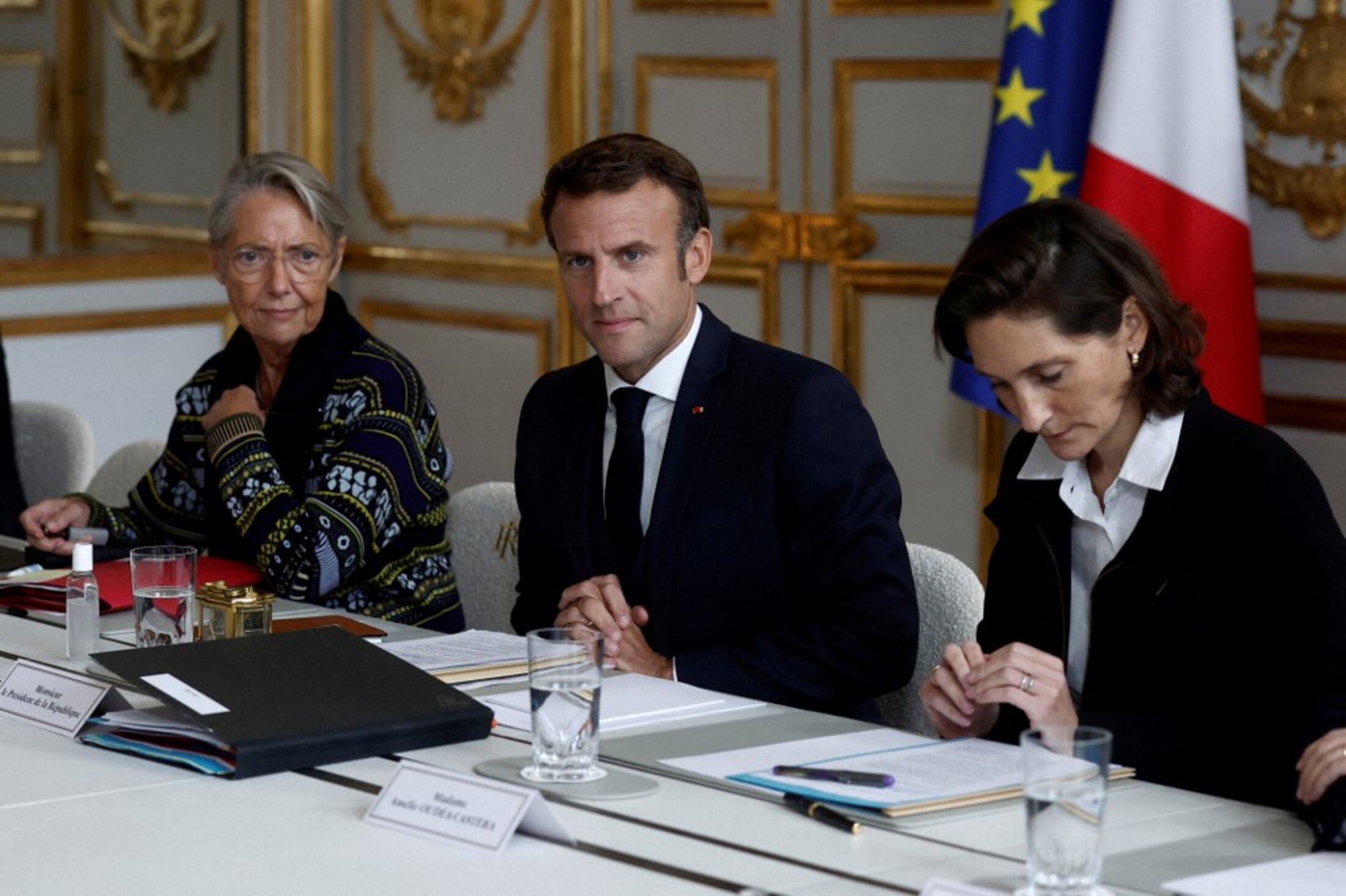
This has led to the re-emergence of claims – rejected in the past– that Macron's Élysée is simply incapable of “feeling” the mood of the country. It was a criticism that was levelled at the time of the 'yellow vests' social crisis. “The president of the Republic has no sensors,” says the former minister already quoted. “Often it's all dumped on him but he's not aware of everything because those around him don't tell him everything. He has a few people who have a feel for opinion polls, but not the country.” It is an important distinction. In the spring Le Monde revealed that the during the president's first term of office the Élysée commissioned several hundred polls in an attempt to gauge public opinion.
Just a few days ago Emmanuel Macron was persuaded that he could introduce a package of reforms this autumn. And the head of state was himself convinced that these issues had to be tackled in quick succession: from unemployment benefits to pensions, via a law on renewable energy and measures on security and migration. In the meantime reality has stepped in. The government wobbles at each vote in the National Assembly, and the opposition parties have no desire to help it, while inflation and a fall in living standards make the situation socially explosive. Last week the start of consultations on pension reform sent cold shivers down the spines of MPs from the ruling majority. Was it, they wondered, really the right moment?
----------------------------------------------------------------------
- The original French version of this article can be found here.
English version and additional reporting by Michael Streeter