


Twenty-eight years after the end of conscription, Emmanuel Macron has announced the launch of a voluntary ten-month national service programme starting next summer. “We need the nation to be mobilised to defend itself … so that it stands ready and is respected,” said the French president in a speech given at Varces in south-east France on November 27th.
By next summer, 3,000 young women and young men, mainly aged 18 and 19, are due to form the first intake of this new military service. The government aims for 10,000 young people to be taken on by the summer of 2030 and some 50,000 by 2035. The volunteers will receive a wage, said to be around eight hundred euros a month, though the head of state did not give the exact amount in his speech.
The announcement at Varces confirms that the Service National Universel (SNU), which was launched during Emmanuel Macron’s first term, is to be wound up, leaving behind it a trail of failure and discontent. The days when the government praised a civic scheme that mixed an introduction to the environment with team-building workshops are now gone. The new scheme will be “purely military”, Emmanuel Macron stressed.

Enlargement : Illustration 1
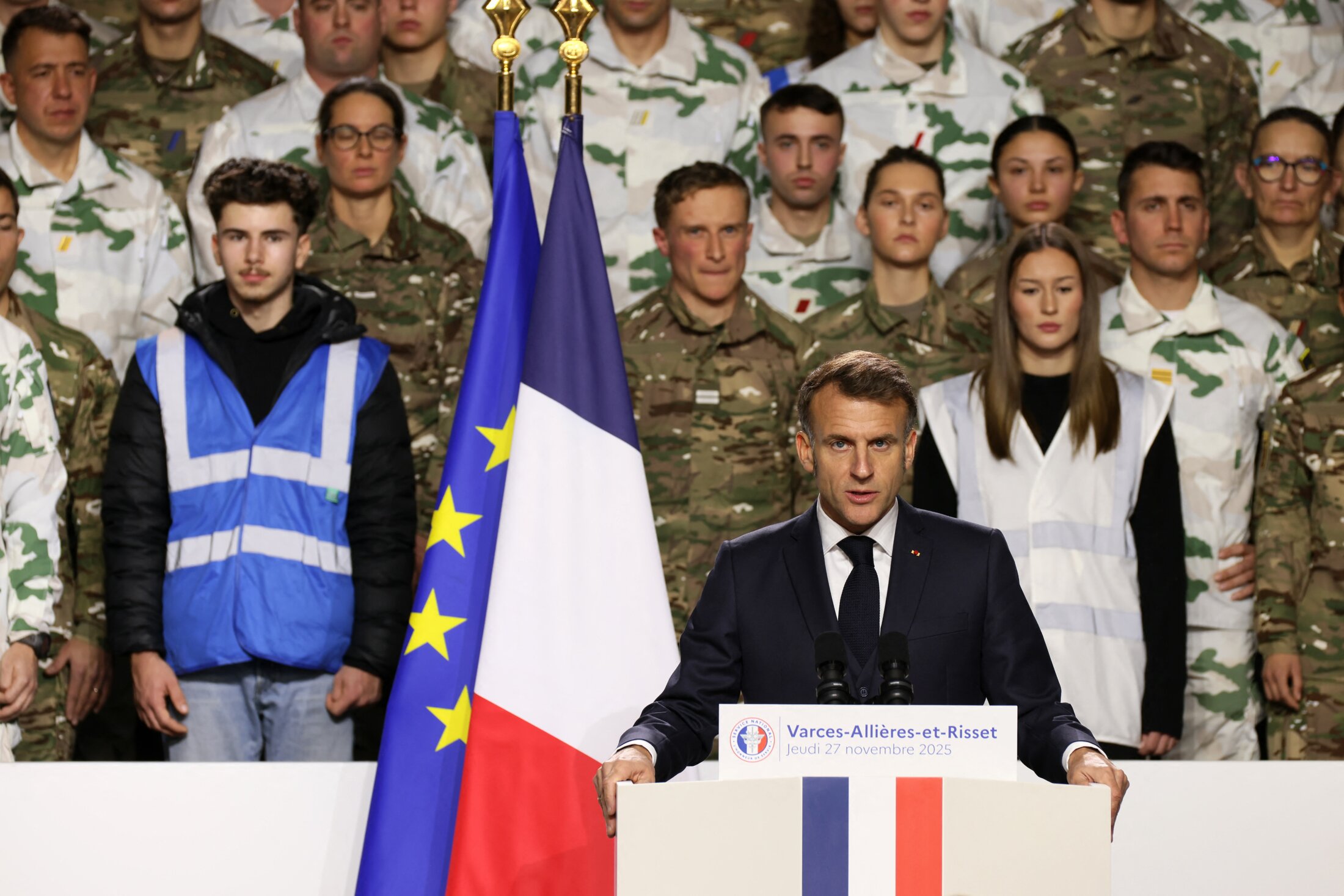
The plan outlined on Thursday is likely to stir a sense of nostalgia among the conscripts of the last century. The presidential references to “one-month initial training” to learn the “basics of military life”, “how to handle weapons”, “marching in step” and the “many songs and rituals that build the fellowship of our armed forces” will remind some of the early training of old-style conscription, which was ended in 1997.
The parallels with the past are intentional; there is a firm belief at the Élysée that the period of peace that began with the end of the Cold War is now over. The president described, in emphatic language, an “uncertain world” where “might outweighs right” and where “war is a fact of everyday life”. He insisted: “The only way to avoid danger is to be ready for it.”
Aiming to make an impact
Will this, at last, be a turning point, the Élysée's long-desired collective wake-up call? Since the start of his second term in 2022, Emmanuel Macron has stepped up the number of bellicose statements about Russia, about the times we live in and what lies ahead. “If we refuse to see the accelerating threat, if we give up on the required effort, then we will be failing in our duty and our calling,” he said in January during his New Year message to the armed forces.
The recent words of the armed forces chief of staff, Fabien Mandon, who controversially told an annual gathering of the country's mayors that France would have to “accept losing its children”, were, on this basis, far from being off message. Before being appointed to his current post at the end of July, the general was the president’s own chief military adviser. He is part of the inner circle, and his brief as the head of the armed forces was indeed to help the country understand the peril it faces.
“Yes, the peace dividend is over,” Catherine Vautrin, the armed forces minister, said a few days later. In the corridors of power, this is one of the themes most often raised, right up to the president’s office. “He has a genuine conviction that society must be prepared for what's coming,” said someone who is in regular communication with the president.
This was why last Thursday’s announcement was designed to have an impact. “It's an important moment,” says Maxime Launay, a researcher at the research institute the Institut de Recherche Stratégique de l'École Militaire (IRSEM), and an expert on the link between the armed forces and the state. “Announcing a military scheme harks back to a form of language that matches the toughening strategic environment. It will probably put the army back into public debate, if only because thousands of people will have a son, a daughter or a cousin taking part in the scheme.”
Yet the move also carries political risk. Indeed, Emmanuel Macron’s tough-minded tone has already led to claims of scaremongering. During a visit to Kyrgyzstan, Vladimir Putin used a press conference to mock as “simply nonsense” European leaders' idea that Russia could attack Europe. “Maybe European leaders are just trying to create an illusion for their populations,” said the Russian President, whose own hunger for more territory is hardly a secret.
Our political system is bound intrinsically to military action. And presidents of the Republic have often adopted that mindset.
Emmanuel Macron, meanwhile, is sticking to his guns: his second term will be military or nothing. All his decisions point that way, from his successful 2022 presidential election campaign, which was shaped largely by Russia’s invasion of Ukraine, to the spending on defence since his re-election, to the naming of his minister of the armed forces – Sébastien Lecornu - as prime minister and his commitment to the defence of Ukraine.
The militarisation of his second term has three advantages for the president. On the diplomatic stage the aim is to regain the strong voice that France currently lacks. Recent events, in Ukraine and in Gaza in particular, and the return of Donald Trump to the White House, have convinced French diplomats that now is the time for force - and for showing it.
So Paris is playing the game, praising its army - the “most effective in Europe” according to the head of state - and is now more willing to highlight its nuclear power status. The shift of the French army towards a “hybrid model”, mixing a professional core, reservists and voluntary service, is cast as a new step on the road to the country making a military statement.
Hoping for consensus
The second advantage for Emmanuel Macron is more political. Lacking a parliamentary majority, it is in his interest to find areas of common interest to ensure that he is still listened to on the domestic front. This is how one must read his new-found zeal for themes linked to democracy and social media, his wish to see through an overhaul of children’s school hours, and also this new idea of voluntary military service.
It is true that opposition parties have voiced sharp criticism since the president's military service speech. But this criticism focuses on the form of the plan, how it will work in practice, the two billion euros it will cost, its late timing, and its overly military tone.
But in fundamental terms, the Élysée believes, voluntary military service is not a divisive issue. Jordan Bardella, president of the far-right Rassemblement National (RN), is one of its keenest backers. And even Jean-Luc Mélenchon, the head of radical-left La France Insoumise (LFI), has for years backed the idea of compulsory national service, though in his case its role would stretch well beyond the military domain.
This hope of finding political common ground is supported by historical precedents, Maxime Launay notes. “For a long time, it was a consensual issue in political debate,” the historian says. “Just about no [political] party proposed ending military service. Pierre Messmer, a key minister under [President Charles] De Gaulle, favoured the model of a professional army but never introduced it. Charles Hernu, [President] François Mitterrand’s first socialist defence minister, was against national service in private but backed it in public. It was a kind of totem.”
The idea that national service should be wound down had to wait until the end of the Cold War. And, again, it came without major political disagreement. “The decision was made by [President] Jacques Chirac and signed off by the leftwing coalition [editor's note, a rightwing politician, Chirac presided over a leftwing government from 1997 to 2002 in a process known as 'cohabitation'],” says Maxime Launay, who wrote a doctorate in 2022 on the link between the Left and the French armed forces.
As the president of a worn-out republic and the head of a political camp that lacks a parliamentary majority, there is a third advantage for Emmanuel Macron in adopting the garb of commander-in-chief: of all his powers, it is the one least open to challenge, the one that lends the greatest legitimacy.
At a time when more and more people, including even his former prime minister, Édouard Philippe, are calling for his resignation or saying that his early departure is inevitable, dramatising the military threat gives the head of state an air of legitimacy that the past two years have stripped from him.
Who is going to call for the president to step down in troubled times when a threat hangs over the country? “It takes us back to the very heart of the Fifth Republic,” says Maxime Launay. “It was shaped by General de Gaulle, who was both a wartime leader and the founder of the [1958] constitution. Our political system is bound, intrinsically, to military action. And presidents of the Republic have often adopted that mindset.”
The use of article 16 of the French Constitution - which allows France's head of state to wield sweeping and exceptional powers “when the independence of the nation” or the “integrity of its territory” face “serious and immediate” threat - is still some way off. But the prospect of a war on European soil is now raised openly more and more, as was the case again in the president's speech last Thursday. “In the event of a major crisis,” national service “would become compulsory”, Emmanuel Macron warned.
-----------------------------------------------------------------------------------
- The original French version of this article can be found here.
English version by Michael Streeter