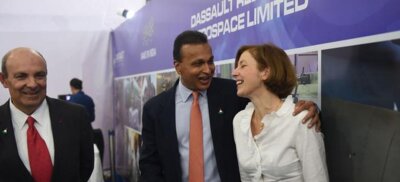
French aerospace and defence group Dassault Aviation has issued a statement insisting it 'freely' chose India's Reliance Group, run by a businessman close to Indian Prime Minister Narendra Modi, as its local industrial partner as part of the sale to New Delhi of 36 Rafale fighter planes, following the revelation by Mediapart of a document in which one of its senior executives is cited as saying the choice of Reliance was 'imperative and obligatory' in securing the contract.
Speaking at a press briefing in Paris on Thurday, Indian defence minister Nirmala Sitharaman reiterated her government's claim that did not impose an Indian company run by a businessman close to Prime Minister Narendra Modi as local industrial partner for Dassault Aviation in the sale to New Delhi of 36 Rafale fighter planes, despite new evidence published by Mediapart suggesting that was the case.
The sale to India by France of 36 Dassault Rafale jet fighters for close to 8 billion euros has become the centre of corruption allegations levelled against Indian Prime Minister Narendra Modi and his close friend, Indian businessman Anil Ambani, chairman of the Reliance Group which was handed the role of local industrial partner of Dassault to build parts for the jets despite no aeronautical expertise. The claim that Ambani was given the joint venture contract as a favour by Modi to save his struggling business is the subject of a complaint lodged this month with India’s Central Bureau of Investigation. Now Mediapart has obtained a Dassault company document in which a senior executive is quoted as saying the group accepted to work with Reliance as an “imperative and obligatory” condition for securing the fighter contract. Karl Laske and Antton Rouget report.
Indian political opposition groups this weekend called on Prime Minister Narendra Modi to resign after a report in Mediapart on Friday in which former French president François Hollande's comments on an 8-billion-euro fighter deal with New Delhi suggested possible favouritism by Modi in the choice of the Indian partner in the joint venture.
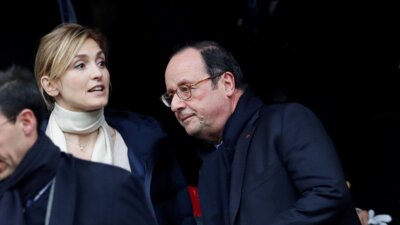
The sale to India by France of 36 Dassault Rafale jet fighters, signed during the presidency of François Hollande, is at the centre of a growing scandal in India where opposition parliamentarians have demanded a detailed investigation of the deal, alleging favouritism, mismanagement of public funds, and the endangering of national security. They are notably suspicious of the circumstances by which India’s Reliance Group was assigned as Dassault’s industrial partner in the jets deal. As Karl Laske and Antton Rouget report here, at the very time the deal was struck, Reliance provided funding for a film produced by Hollande’s personal partner, the actress Julie Gayet.
Serge Dassault, who died on May 28th, 2018, at the age of 93, was a billionaire industrialist in the aviation sector, a former Senator and mayor, and the owner of the conservative daily newspaper Le Figaro. Prevented from having a major role the family business empire until the death of his father, Serge Dassault was driven by ambition and the desire to surpass what Marcel Dassault achieved. But despite his undoubted business successes, Serge Dassault's own legacy was tarnished by corruption affairs and allegations of buying votes, and he was convicted of tax fraud in 2017. Mediapart's Yann Philippin, who has spent many years reporting on the 'Dassault method', reports.
Meeting in New Delhi on Friday, Indian defence minister Nirmala Sitharaman and he French counterpart Florence Parly agreed to increase anti-terrorism cooperation defence ties, including greater industrial and research involvement by India in French weapons sales to the country, notably in an expected second order of Dassault Rafale fighter jets.
Airbus military aircraft division boss Fernando Alonso said he 'really' hopes that France will join development of a German-Spanish project to build a new fighter aircraft, while adding that Britain's withdrawal from the EU made it 'difficult' to envisage its involvement in the programme.
French arms exports in 2016, worth 8.3 billion euros, increased in value by 14% on those in 2015, while imports of weapons saw a five-fold increase year-on-year, according to the French defence ministry's statistical agency, L'Observatoire économique de la défense.