Poste culture. Journaliste à Mediapart depuis sa création, en 2008. Correspondant à Bruxelles sur les affaires européennes (2011-2017), puis reporter, au sein du service international à Paris (2018 - 2025). Co-programme la case « documentaire » chaque samedi sur Mediapart. Toujours en veille sur l’Espagne et l’Argentine.
Ai publié un guide sur l'Argentine (La Découverte, 2011), un essai sur les politiques espagnoles nées du mouvement « indigné » du 15-M (Squatter le pouvoir, Les mairies rebelles d'Espagne, Editions Lux, 2016) et un autre sur l'architecture du quartier européen à Bruxelles (Bruxelles chantiers, Une critique architecturale de l'Europe, Lux, 2018).
Mail : ludovic.lamant[@]mediapart.fr
Declaration of interest
In the interest of transparency towards its readers, Mediapart’s journalists fill out and make public since 2018 a declaration of interests on the model of the one filled out by members of parliament and senior civil servants with the High Authority for Transparency and Public Life (HATVP), a body created in 2014 after Mediapart’s revelations on the Cahuzac affair.
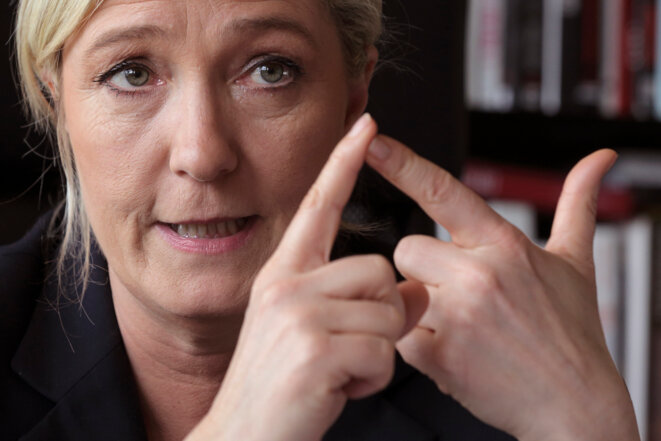
After her party's successes in the recent European elections, the leader of the far-right Front National is striving to form her own multi-national political group at the European Parliament. The official reason is that such a grouping will strengthen the FN president’s political clout in the parliament. But as Ludovic Lamant and Marine Turchi report, there is another reason for setting up the group – and that is to enable the FN to get its hands on several million euros a year in EU funds. Thus this most eurosceptic of French politicians might end up using EU money to help support her attempt to win the French presidency in 2017.
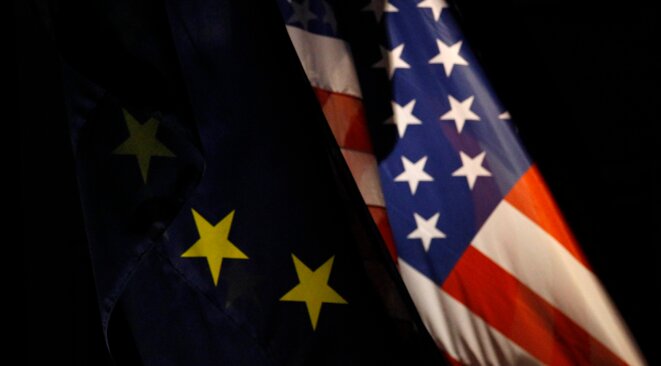
The free trade treaty currently being hammered out between the European Union and the United States is a major issue in this week’s elections of members of the European Parliament, which in France will be held on Sunday. For this year also sees the departure of EU Commission president José Manuel Barroso, and for the first time the new head of this key EU body will be appointed from the political grouping that does best in this week’s continent-wide elections. Here, Mediapart's Brussels correspondent Ludovic Lamant questions all of the parties’ declared candidates for the post of Commission president - Martin Schulz, Guy Verhofstadt, Alexis Tsipras, José Bové and Jean-Claude Juncker – and hears their conflicting views on the transatlantic free trade deal.
In a rare move, a group of young public servants and diplomats based in the European Union's headquarters in Brussels has launched a passionate plea for a more constructive and far-reaching debate about the fate of Europe. Members of the group, called Euro2030, want to remain anonymous to avoid embarrassing the institutions its members work for. But with under two weeks to go before European elections, this new generation of officials at the very heart of the EU has become frustrated both by the tone of the current debate on Europe and by the failures of the EU itself. The group's analysis of Europe's faults and its proposed solutions are at loggerheads with the orthodox view of Brussels institutions. Above all, the young bureaucrats admit that the EU dream is not working – and that European integration “runs the risk” of losing the support of the continent's people. Ludovic Lamant reports.
As the campaigning heats up for the European elections to be held later this month, critics of the European Commission’s handling of discussions over the future landmark European Union-United States free trade treaty have been making their voices heard. Of all the different concerns, the most controversial political issue now emerging is the intended inclusion in the deal of a provision whereby foreign corporations can sue governments before arbitration tribunals for damages in the event that their investments are undermined by future changes in laws, such as those concerning the environment or public health. Mediapart’s Brussels correspondent Ludovic Lamant reports.
During the second part of his government reshuffle this week, President François Hollande did not just change his ministerial team and a key member of his private office – he also reshuffled the Socialist Party, forcing its widely-criticised first secretary Harlem Désir to quit. But to general astonishment Désir was immediately offered the post of junior minister for European Affairs. Political opponents and some allies described this as a bleak moment for French relations with Europe, with one senior figure even calling it an “insult”. Meanwhile the manner in which the president abruptly removed the party's leader has caused consternation among some members. Stéphane Alliès and Ludovic Lamant report.
The former Luxembourg prime minister has just been voted by Europe's mainstream right-wing parties to be their lead candidate ahead of May's European elections. Under new EU rules now in place this means the veteran politician could well become the president of the European Commission later this year. But for many observers Jean-Claude Juncker is indelibly linked to a dated vision of Europe that belongs to the last century. And as Dan Israel and Ludovic Lamant report, he is also closely identified with the financial secrecy of his native country.
During his recent visit to Washington French president François Hollande surprised many observers by calling for a speeding up of the negotiations for a EU-US free trade agreement, the biggest deal of its kind in the world. The president's demands are in sharp contrast with France's earlier caution over the free trade zone, an issue which has provoked concern and opposition across Europe. For some, it also seems a curious stance to adopt just weeks before important European elections at which the proposed deal is set to be a controversial issue. Ludovic Lamant reports.
While the European Union is placing increased resources into blocking clandestine immigration to the continent, its member states, notably those of the south, worst-hit by the financial crisis, are mounting schemes to sell residency rights and even citizenship to wealthy non-EU foreigners in an attempt to attract millions of euros into state coffers. To qualify for most of the schemes it suffices to buy into luxury property, a deal which is notably attracting Russian, Chinese and Middle East investors. The European Commission, meanwhile, says it has no say in the cynical and apparently legal business of selling European citizenship. Ludovic Lamant reports.
The revelation that the United States has been spying on European Union offices in America – and possibly in Brussels too – has sparked outrage across the continent. French president François Hollande has called for an 'immediate' end to such snooping and he and others have suggested the scandal could affect the imminent negotiations over transatlantic trade. There have also been calls from the Right and Left in France for Paris to offer the whistleblower Edward Snowden political asylum. However, as Ludovic Lamant and Stéphane Alliès report, the reaction from EU leaders in Brussels to the affair has so far been much more restrained.
European leaders met this week at a summit intended to decide upon aggressive policies to tackle tax evasion, but the results were far from conclusive, not least because of continuing opposition from Austria and Luxembourg on introducing a yearly automatic exchange of bank account information between member states. Mediapart’s Brussels correspondent Ludovic Lamant reports on the outcome of Wednesday’s talks, and examines whether the European Union is truly capable of acting as the umbrella organisation to halt a tax drain that is estimated to cost its members a combined 1 trillion euros per year.
This Wednesday members of the European Parliament will gather in Strasbourg to vote on the austerity budget that was negotiated by the 27 EU member states last month. According to their public utterances the Euro MPs are set to reject it decisively, triggering a bruising series of negotiations between the powers-that-be in Brussels. But will enough members be won over by domestic pressures to put the no vote in jeopardy? As Ludovic Lamant reports, just one year before the next European elections, this is a crucial test of authority for a group of politicians who often struggle to make their voice heard.
During his election campaign and his first few weeks in office, François Hollande promised to take a different line in Europe, expressing the desire to “reshape” the European Union and promote growth to provide an alternative to German-imposed austerity and structural reforms. But since then the German agenda has re-emerged as the dominant force in the EU, threatening to leave France isolated. Lénaïg Bredoux and Ludovic Lamant wonder what happened to the president’s reformist zeal.
All his blog posts
The Mediapart Club
Join the discussion
Mediapart’s journalists also use their blogs, and participate in their own name to this space of debates, by confiding behind the scenes of investigations or reports, doubts or personal reactions to the news.
La 13e édition du festival multidisciplinaire Hors Pistes, qui s’ouvre ce vendredi à Paris, s’attache aux manières de « dire la nation » à distance du discours national identitaire.
Quentin Ravelli est l’auteur d’un diptyque remarqué sur la crise espagnole : d’un côté, « Bricks », film qui vient de sortir en salle, et de l’autre, un livre, « Les briques rouges », publié aux éditions Amsterdam.
A Bruxelles, « L’assemblée d’avril » organise durant onze jours un « campement artistique et citoyen » en réaction aux crises des démocraties européennes.
Leur conférence de presse est passée inaperçue, tandis que les médias n’avaient d’yeux que pour les cérémonies romaines de la fin de semaine. Mais les conseillers municipaux espagnols, passés par le Parlement européen mi-mars, s’emploient, eux aussi, à défendre une certaine conception, plus sociale, de l’Europe. Ils en appellent à la désobéissance.
Ils sont plus de 500 à dire leur inquiétude. Des réalisateurs, techniciens, programmateurs de festivals et critiques ont adressé une lettre ouverte au gouvernement socialiste d’Antonio Costa, pour l’inciter à annuler une réforme du financement qui menace la diversité du cinéma portugais.