Poste culture. Journaliste à Mediapart depuis sa création, en 2008. Correspondant à Bruxelles sur les affaires européennes (2011-2017), puis reporter, au sein du service international à Paris (2018 - 2025). Co-programme la case « documentaire » chaque samedi sur Mediapart. Toujours en veille sur l’Espagne et l’Argentine.
Ai publié un guide sur l'Argentine (La Découverte, 2011), un essai sur les politiques espagnoles nées du mouvement « indigné » du 15-M (Squatter le pouvoir, Les mairies rebelles d'Espagne, Editions Lux, 2016) et un autre sur l'architecture du quartier européen à Bruxelles (Bruxelles chantiers, Une critique architecturale de l'Europe, Lux, 2018).
Mail : ludovic.lamant[@]mediapart.fr
Declaration of interest
In the interest of transparency towards its readers, Mediapart’s journalists fill out and make public since 2018 a declaration of interests on the model of the one filled out by members of parliament and senior civil servants with the High Authority for Transparency and Public Life (HATVP), a body created in 2014 after Mediapart’s revelations on the Cahuzac affair.
The national social security services of European Union member states are to be opened up to private sector competition according to the terms of a proposed European Commission directive on public procurement. The directive, presented in December 2011 by European Commissioner for Internal Market and Services, Michel Barnier, and due to be submitted to the European Parliament later this year, requires governments to launch a yearly invitation for tenders to manage sectors of their compulsory social security services, most of which until now have been managed according to the principle of social solidarity. Surprisingly, the proposal, contained in an annexe of the 246-page text of the directive, was until this month unnoticed by MEPs, several of whom have now mounted an urgent campaign to have it removed. Mediapart's Brussels correspondent Ludovic Lamant reports.
The tax-avoiding attraction of Belgium for the French rich is nothing new. But since the arrival of France’s socialist president, François Hollande, who has announced a 75% tax on those earning an annual 1 million euros or more, the country’s wealthy have begun pointing north. While speculation continues to surround the motivations of Bernard Arnault, founder and chief executive of French luxury goods group LVMH and France’s richest individual, in applying for Belgian nationality, the controversy has fuelled a lively debate in Belgium itself over the country’s growing status as a semi-tax haven. Mediapart’s Brussels correspondent Ludovic Lamant reports on the rich figures of a tax-avoiding exodus that, continent-wide, is estimated to annually cost European states 150 billion euros.
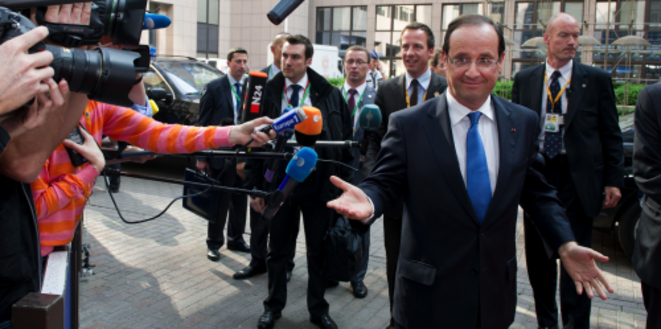
French President François Hollande, whose election campaign was hallmarked by his proposals for tackling the economic crisis by countering austerity measures with growth-led initiatives, has made his support of the European Union’s ‘Compact for Growth and Jobs’ one of the pillars of his policies in Europe. But now the French socialist government is coming under attack for what is perceived by some EU officials as a "contradictory" and "baffling" approach to the European economy. For while outwardly promoting growth, France is joining Germany in limiting an increase in payments to the EU’s 2013 budget to less than half that proposed by the European Commission itself, and which will reduce aid otherwise available to a number of struggling economic sectors. Mediapart's Brussels correspondent Ludovic Lamant reports.
France’s newly-elected president François Hollande has promised he will seek a reform of European austerity policies, beginning with a re-negotiation of the so-called fiscal compact treaty, and the introduction of economic growth initiatives. But his programme faces stern opposition from Germany’s Chancellor Angela Merkel, who has ruled out any change to the fiscal compact. With a busy international agenda ahead, including summits of the G8 and NATO later this month, and crucial parliamentary elections in France in June, Hollande's room for negotiations before an EU summit on June 28th is uncomfortably tight. Meanwhile, the deepening political crisis in Greece continues to threaten an explosion of the eurozone. Lénaïg Bredoux and Ludovic Lamant report on the official and unofficial manouevering as the new French president prepares for his first major test in power.
France and Greece both go to the urns on Sunday for crucial elections that will, whatever the results, have a significant effect on the future of the EU’s approach to the economic crisis. While the final play-off in the French presidential elections on May 6th could produce a turning point in the use of blanket austerity measures to nurse already strangled EU economies back to health, the Greek legislative elections are in effect a referendum on the country’s continued membership of the eurozone. Mediapart’s Brussels correspondent Ludovic Lamant reports on what is likely to be a watershed moment for Europe.
Chilean film director Raúl Ruiz brought a highly individual and sometimes surrealist approach to ostensibly factual subjects, taking them to new dimensions and challenging the viewer’s regard and understanding of events. Now, seven months after his death, the Paris international documentary festival Le Cinéma du Réel is showcasing his work, including some rare footage. Ludovic Lamant reports on what is a must-see event for every fan of the man who was arguably the most original director in contemporary cinema.
Spanish Prime Minister Mariano Rajoy, whose conservative right Popular Party was elected to government in a landslide victory in November, earlier this month named Luis de Guindos, formerly with Lehman Brothers and PricewaterhouseCoopers, as his new economy minister. The appointment, announced last week, was the latest manifestation of a viral pattern now spreading across Europe, whereby technocrats are filling the posts of national governments and private sector "experts" are shaping EU decision making. Ludovic Lamant reports.
The financial crisis that deepens by the day was not only unforeseen by the economic establishment, but has also had little, if any, effect on policies. One of those who has long warned of the dangers now becoming a catastrophic reality is prominent French economist André Orléan (pictured), a distinguished academic and a director of research with the French national scientific research centre, the CNRS. In a book just published in France, and soon to be available in English, he calls for an urgent and radical reappraisal of our approach to economics. Ludovic Lamant reviews a work that is set to cause some lively argument.
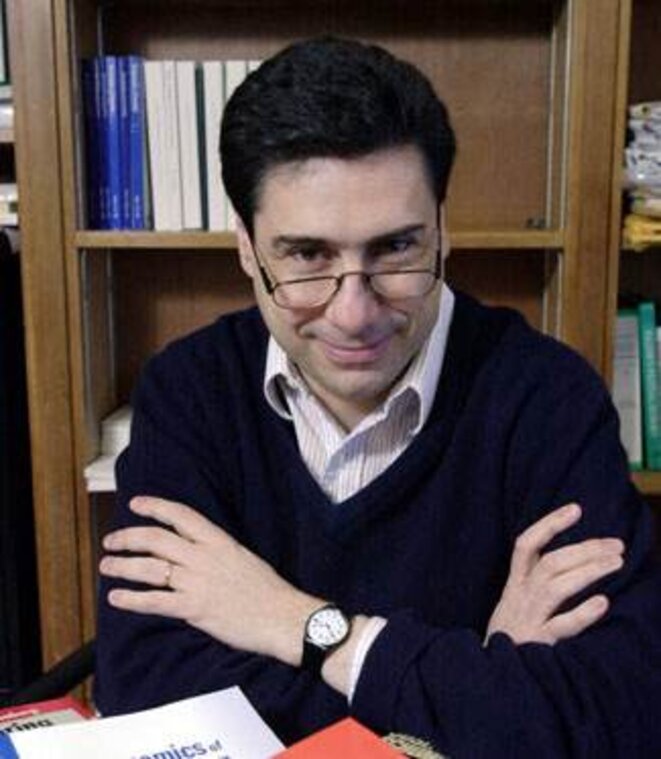
Philippe Aghion is a senior economics advisor to François Hollande, the Socialist Party candidate in the French presidential elections due next spring. This Harvard university professor thinks he knows how to address the economic crisis in Europe, with a new approach to industry and innovation driven by a state-led strategy. The ideas he details in this interview with Ludovic Lamant may become, if Hollande becomes president, the lynchpin of the next French government's economic policies.
A fuse has been lit to ‘deglobalize' the planet, with increasing calls for protectionism, the championing of local production and for an end to the euro. But is a giant step backwards really the way out of the current economic crisis? The leftist economists who think so don't all agree on how to go about it. Ludovic Lamant presents the arguments of four leading schools of thought on deglobalization.
The political crisis in IvoryCoast appeared close to an end Wednesday, as its besieged former president LaurentGbabgo (photo), beaten in elections last November but refusing to hand over power, sheltered in a bunker in his presidential palace as it came under attack by forces supporting president-elect Alassane Ouattara. The sudden en to Gbagbo's four-month stand-off waslargely sealed by the intervention of French and UN attack helicopters thatbegan on Monday. Ludovic Lamant reports on the background to a decisive 48 hours.
Two years ago, as the international banking crisis swept the world, Iceland's economy collapsed through the floor. Thousands of Icelanders regularly took to the streets during the winter of 2008 to drive out their government, disgraced by revelations of corruption. Amid an atmosphere of revolution, and excited talk of remodelling society, the unprecedented mobilisations held high hopes of creating a new democratic platform on the island. So just what has changed since? Ludovic Lamant reports.
All his blog posts
The Mediapart Club
Join the discussion
Mediapart’s journalists also use their blogs, and participate in their own name to this space of debates, by confiding behind the scenes of investigations or reports, doubts or personal reactions to the news.
La 13e édition du festival multidisciplinaire Hors Pistes, qui s’ouvre ce vendredi à Paris, s’attache aux manières de « dire la nation » à distance du discours national identitaire.
Quentin Ravelli est l’auteur d’un diptyque remarqué sur la crise espagnole : d’un côté, « Bricks », film qui vient de sortir en salle, et de l’autre, un livre, « Les briques rouges », publié aux éditions Amsterdam.
A Bruxelles, « L’assemblée d’avril » organise durant onze jours un « campement artistique et citoyen » en réaction aux crises des démocraties européennes.
Leur conférence de presse est passée inaperçue, tandis que les médias n’avaient d’yeux que pour les cérémonies romaines de la fin de semaine. Mais les conseillers municipaux espagnols, passés par le Parlement européen mi-mars, s’emploient, eux aussi, à défendre une certaine conception, plus sociale, de l’Europe. Ils en appellent à la désobéissance.
Ils sont plus de 500 à dire leur inquiétude. Des réalisateurs, techniciens, programmateurs de festivals et critiques ont adressé une lettre ouverte au gouvernement socialiste d’Antonio Costa, pour l’inciter à annuler une réforme du financement qui menace la diversité du cinéma portugais.