Poste culture. Journaliste à Mediapart depuis sa création, en 2008. Correspondant à Bruxelles sur les affaires européennes (2011-2017), puis reporter, au sein du service international à Paris (2018 - 2025). Co-programme la case « documentaire » chaque samedi sur Mediapart. Toujours en veille sur l’Espagne et l’Argentine.
Ai publié un guide sur l'Argentine (La Découverte, 2011), un essai sur les politiques espagnoles nées du mouvement « indigné » du 15-M (Squatter le pouvoir, Les mairies rebelles d'Espagne, Editions Lux, 2016) et un autre sur l'architecture du quartier européen à Bruxelles (Bruxelles chantiers, Une critique architecturale de l'Europe, Lux, 2018).
Mail : ludovic.lamant[@]mediapart.fr
Declaration of interest
In the interest of transparency towards its readers, Mediapart’s journalists fill out and make public since 2018 a declaration of interests on the model of the one filled out by members of parliament and senior civil servants with the High Authority for Transparency and Public Life (HATVP), a body created in 2014 after Mediapart’s revelations on the Cahuzac affair.
The French government was initially enthusiastic about the free trade agreement being negotiated between the European Union and the United States. However in recent months Paris, and in particular overseas trade minister Matthias Fekl, has taken a tougher line on the so-called TAFTA deal. Talks on the agreement resume in New York on Monday April 25th, while the day before President Barack Obama will raise the issue with German chancellor Angela Merkel in Berlin. But as Ludovic Lamant reports, the chances of a deal being struck before the end of Obama's term of office look increasingly remote.
One of the key issues arising from the Paris terror attacks on Friday November 13th is the apparent ease with which the perpetrators and other terrorists got their hands on significant numbers of “decommissioned” military assault weapons. Belgium, where some of those who carried out the Paris attacks lived, is said by many to be the hub of the flourishing illegal firearms trade in Europe. Mediapart's Brussels correspondent Ludovic Lamant interviewed Belgian expert Cédric Poitevin on the issue.
The Spanish government on Friday announced its refusal to grant a request lodged last October by Argentina for the arrests and extraditions of 20 former members of the fascist regime of General Francisco Franco for human rights abuses, including torture. Under Argentine law, the officials, who include two Francoist ministers, can be prosecuted for crimes against humanity even though committed in Spain. Madrid’s rejection of the Argentine request, tabled via Interpol, was a further bitter blow for associations representing the relatives of the victims of Francoist repression who just days earlier had travelled to Brussels to demand that European Union institutions exert pressure on Spain to render justice for the atrocities committed under the 36-year dictatorship. Mediapart Brussels correspondent Ludovic Lamant reports.
The European Parliament has alerted the European anti-fraud office OLAF to its suspicions that the French far-right Front National party has misused the legislature’s funds allocated for the payment of parliamentary assistants. Mediapart has gained access to a letter sent by European Parliament president Martin Schulz to French justice minister Christiane Taubira this week in which he details his concerns over “the scale” of the problem, involving 20 assistants to Front National Members of the European Parliament, most of whom are listed on the anti-EU party’s organisation chart as officials based at its headquarters near Paris. Ludovic Lamant and Marine Turchi report.
A mini-reshuffle has taken place involving President François Hollande's senior advisor on the European Union. First the advisor was shunted to the prime minister's office, then it was confirmed he would remain as the head of state's 'sherpa' in charge of summit meetings in Brussels. As Ludovic Lamant and Mathieu Magnaudeix explain, this rearranging of advisors on the deck of state is symbolic of how, nearly three years after his election, President Hollande has shown himself incapable of presenting a clear, coherent and strong policy on Europe that would enable France to punch its full weight in Brussels. The result, fear some observers, is that France has lost considerable clout in the corridors of European power.
Greece has been summoned by its international creditors to present a package of spending reforms by Monday evening that must be approved before a final decision is taken on whether to give Athens a crucial four-month extension of debt bailout loans. Despite the new Greek government’s earlier concessions towards austerity measures which it initially rejected, the country’s lenders, and above all Germany, appear intent on squeezing more political blood from the radical-left administration. But beyond the struggle to obtain the immediate financial lifeline, Greek Prime Minister Alexis Tsipras is in for a long haul of future negotiations. Key to these is his demand that Germany recognise its massive debt to Greece in reparations of its wartime occupation of the country, and the repayment of a loan the Nazis imposed on Greece. The potential sums of these are staggering, and have been estimated, at the least, as represnting more than 160 billion euros - before interest. The issue is not only a financial one, but also embarrasses Berlin and Brussels by raking over the generous debt-forgiveness deal offered to Germany in 1953 in the name of European reconstruction. Mediapart Brussels correspondent Ludovic Lamant and former Athens correspondent Amélie Poinssot examine the legal arguments, and the evidence, behind the Greek claim.
Sections of the Left in France greeted Syriza's triumph in the Greek elections on Sunday with great enthusiasm, with some hailing it as an “historic moment”. But the success of the Greek party, which unites various left-wing groups, has also highlighted the continuing divisions on the Left in France and its own failure to create a lasting electoral coalition. At the same time the challenges facing the new Syriza government, which is seeking to end austerity and renegotiate its debt burden with the EU and international bodies, underline the problems facing any left-wing administration in Europe. A key question is whether France's own socialist president, François Hollande, will now seize the opportunity to change economic direction and push the EU and Germany to back more growth-oriented policies. First, Mediapart's Stéphane Alliès, in Paris, examines how the French Left will react to the Greek results, then Brussels correspondent Ludovic Lamant wonders whether any truly left-wing policies can be carried out by national governments under current eurozone rules.
Mediapart recently revealed how earlier this year Marine Le Pen's far-right Front National party obtained a loan of 9 million euros from a Russian bank. The man who helped broker the deal was French far-right MEP Jean-Luc Schaffhauser, who has confirmed that he received 140,000 euros for his consultancy work. Questions have now been raised in the European Parliament about whether Schaffhauser has officially declared either the income or his extra-curricular activities, with the parliament’s president Martin Schultz promising to investigate the issue. More broadly, reports Ludovic Lamant, there is growing unease in Brussels and Strasbourg about what are feared to be concerted efforts by Russia to buy influence in a number of European political parties.
In a letter addressed earlier this week to French finance minister Michel Sapin and to which Mediapart has gained access, the European Commission’s vice-president Jyrki Katainen, responsible for economic and monetary affairs, demands to know “why France plans to deviate from the budgetary targets” set by the European Council and “how France could ensure full compliance with its budgetary policy obligations”. President François Hollande has refused to make public the letter, which he described as “of no great significance”, and which Mediapart exclusively publishes in full in this report by our Brussels correspondent Ludovic Lamant.
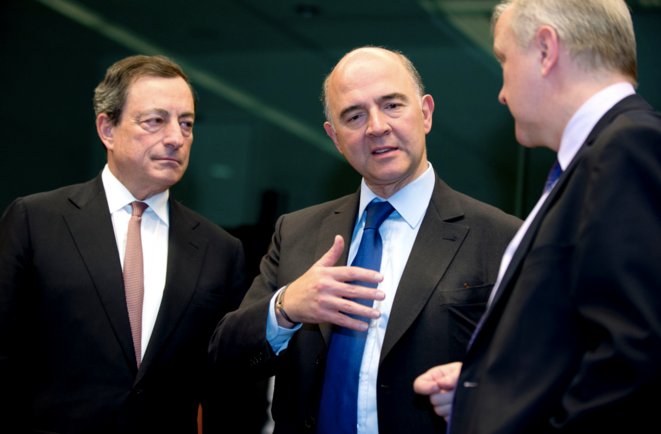
France’s Pierre Moscovici has been named as the new European Union commissioner for economic and monetary affairs in Brussels. At first glance it appears a clear-cut triumph for President François Hollande who has installed his former finance minister in a key economic post at the heart of the EU despite German opposition. It is also a sign that the new European Commission president Claude Juncker wants to display his independence from German chancellor Angela Merkel. But as Ludovic Lamant reports, Juncker has also shaken up the Commission's structure and placed two economic hawks alongside the French commissioner. Some observers believe their main role is to stop the French “social democrat” being too soft on member countries struggling to cut their deficits – and in particular France.
The European Commission’s incoming president, centre-right politician Jean-Claude Juncker, caused surprise this summer when he pledged his support for a continent-wide minimum wage. Juncker, who will take up his post in November, has not yet detailed the potentially complicated practical framework for applying the minimum wage, a move which runs against the tide of the blanket austerity policies until now championed by Brussels. While Juncker faces numerous obstacles to succeed with the scheme, not least from European treaty texts, the idea that raising low incomes would be beneficial to economies appears to be gaining support even from the most unexpected quarters. Mediapart’s Brussels correspondent Ludovic Lamant reports on the arguments for and against, and in just what form a pan-European minimum wage might finally see the light of day.
Future European Commission President Jean-Claude Juncker, due to take up his functions this autumn, already faces an immediate problem as he composes his list of 28 European commissioners. For out of the 23 nominations so far officialised, only four are women. That represents five less than the outgoing commission, whose female contingent have now co-signed an open letter to Juncker demanding he find at least ten women. As Mediapart’s Brussels correspondent Ludavic Lamant reports, there is increasing uproar over the issue, notably among members of the European Parliament to who Juncker must submit his final list of commissioners for approval.
All his blog posts
The Mediapart Club
Join the discussion
Mediapart’s journalists also use their blogs, and participate in their own name to this space of debates, by confiding behind the scenes of investigations or reports, doubts or personal reactions to the news.
La 13e édition du festival multidisciplinaire Hors Pistes, qui s’ouvre ce vendredi à Paris, s’attache aux manières de « dire la nation » à distance du discours national identitaire.
Quentin Ravelli est l’auteur d’un diptyque remarqué sur la crise espagnole : d’un côté, « Bricks », film qui vient de sortir en salle, et de l’autre, un livre, « Les briques rouges », publié aux éditions Amsterdam.
A Bruxelles, « L’assemblée d’avril » organise durant onze jours un « campement artistique et citoyen » en réaction aux crises des démocraties européennes.
Leur conférence de presse est passée inaperçue, tandis que les médias n’avaient d’yeux que pour les cérémonies romaines de la fin de semaine. Mais les conseillers municipaux espagnols, passés par le Parlement européen mi-mars, s’emploient, eux aussi, à défendre une certaine conception, plus sociale, de l’Europe. Ils en appellent à la désobéissance.
Ils sont plus de 500 à dire leur inquiétude. Des réalisateurs, techniciens, programmateurs de festivals et critiques ont adressé une lettre ouverte au gouvernement socialiste d’Antonio Costa, pour l’inciter à annuler une réforme du financement qui menace la diversité du cinéma portugais.