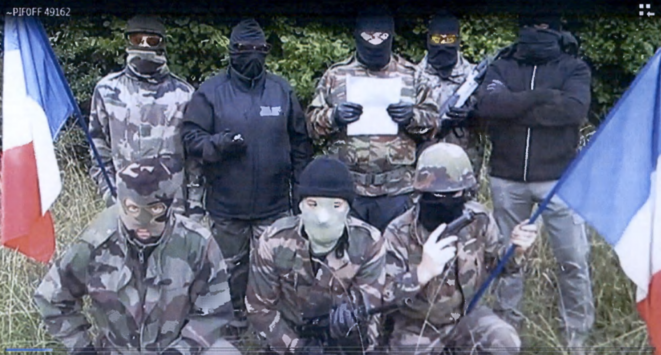
A report by prosecutors in Paris warns about the return of a terrorist threat from the ultra-right, Mediapart can reveal. Based on an analysis of seven separate investigations into allegations of terrorist conspiracies, the report details the groups' professionalism, their ability to arm themselves and the varied profiles of the activists, some of whom are highly-integrated members of society. Matthieu Suc and Marine Turchi report.
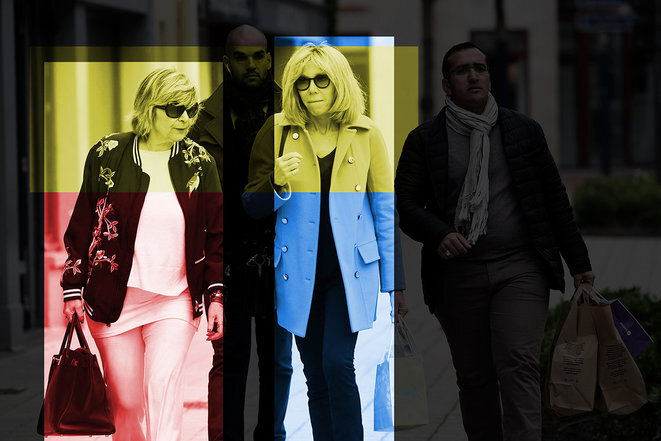
In a tapped phone conversation in July, Brigitte Macron, wife of France’s president, told paparazzi agency boss Michèle Marchand, an influential PR fixer to politicians who is formally placed under investigation for witness tampering and criminal conspiracy in a case related to a probe into suspected Libyan funding of former president Nicolas Sarkozy’s election campaign, that she was to contact her security officer for help “if you get bother”. After she encouraged Marchand to “stay firm” following the latter's release from jail, Brigitte Macron also deplored the “terrible” judicial treatment of Sarkozy. Fabrice Arfi, Karl Laske and Antton Rouget report.
Various factions on the Left are already focussing on the Parliamentary elections in June 2022, in apparent acceptance that they are unlikely to perform well at the presidential election that takes place two months earlier. Opinion polls currently suggest that the battle to be the next French head of state in April 2022 will primarily be between the incumbent president Emmanuel Macron, the far-right and, just possibly, the traditional Right. The subsequent Parliamentary elections, to be held over two rounds on June 12th and June 19th, will meanwhile determine the political influence of the various parties on the Left in the National Assembly. Mathieu Dejean and Pauline Graulle report on the potential horse-trading among the Left ahead of those legislative elections and the impact this may have, too, on the race for the presidency itself.
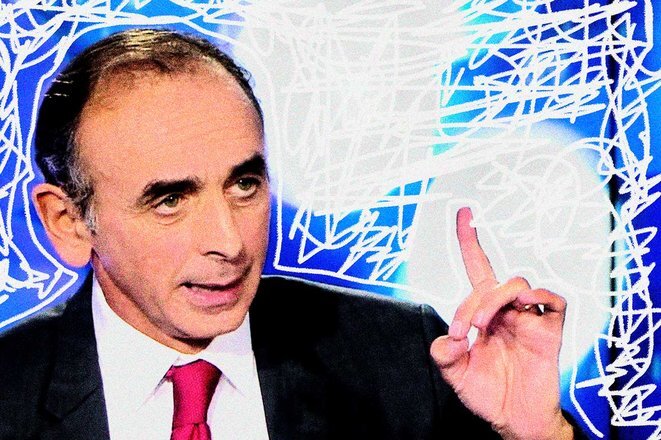
French far-right doyenne Marine Le Pen, who just months ago appeared in the running to reach the final, second-round play-off in next April’s presidential elections, is now facing a serious challenge for her electoral turf from a maverick presidential contender, the polemicist and TV pundit Éric Zemmour. While he has no party structure behind him, he is increasingly backed by the ultra-right and its ideologues, who feel betrayed by Le Pen’s attempts to purge her party’s more outspoken extremists and paper over its racist image. “I don’t care about demonization,” says fervently anti-Islam Zemmour who, despite his Jewish origins, has garnered the support of notorious anti-Semites. Lucie Delaporte reports.
The delayed trial of former French president Nicolas Sarkozy and 13 others over the financing of his failed 2012 presidential election campaign finally got under way on Thursday May 20th in Paris. Sarkozy, the only one of the accused not to appear in court, is accused of the “illegal funding of an election campaign” and faces up to a year in prison and a fine of up to 3,750 euros if found guilty. The prosecution says the ex-president's election campaign spent nearly double the 22.5-million-euro legal spending limit. To hide this illegal overspend a PR and events company is said to have sent fake bills to Sarkozy's UMP party (now called Les Républicains) rather than the election campaign itself. Sarkozy, who was convicted of corruption and influence peddling in a separate case on March 1st, and all the other accused deny the charges. Mediapart's legal affairs correspondent Michel Deléan was in court to hear the divisions that are already emerging between the different defendants.
The late novelist, crime writer and screenwriter Jean Meckert, who sometimes wrote under the name Jean Amila, chronicled society in post-war France in a series of articles for a weekly publication. Many of these have now been collected in a book called 'Chez les anarchistes'. Written between 1946 and 1956, they reveal a downtrodden mood in parts of French society that was far removed from the high hopes that Liberation had brought at the end of World War II. They also show an author who was wearied by events but never resigned to them, and whose humour and energy outshone any disillusion. Sébastien Omont of the online literary review En attendant Nadeau explores Meckert's post-war articles.
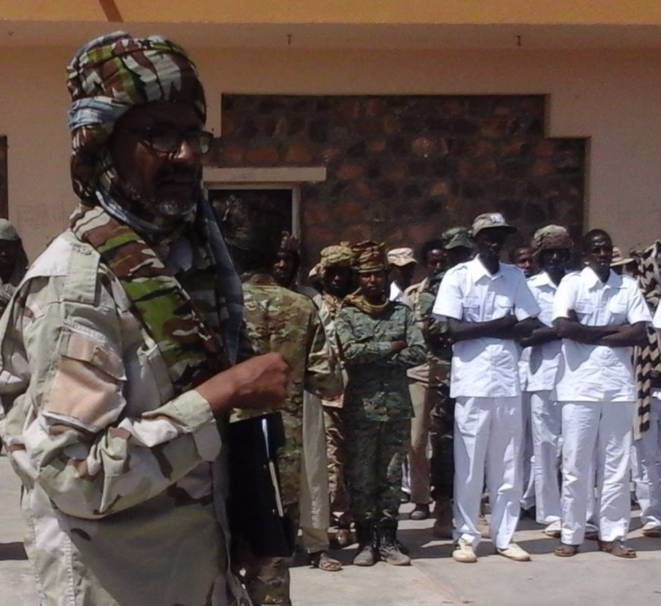
The veteran Chad leader Idriss Déby Itno, a close ally of France for many years, died in April, reportedly after being wounded on the battlefield fighting against an armed rebel group in the country. That group is the Front for Change and Concord in Chad (FACT), led by a man called Mahamat Mahdi Ali. The rebel leader has close links with France; he spent part of his life here and his family still lives in Reims, north east of Paris. He was also a member of the Socialist Party before he says he was “betrayed” by his former comrades when they were in government; he was subject to financial sanctions from the authorities in Paris over what he says are unfounded claims of links to terrorist groups. Some observers see the targeting of Mahamat Mahdi Ali as a favour by the authorities in Paris to the Déby regime, which has been a stalwart supporter of France's anti-terrorism strategy in the region. Rémi Carayol reports.
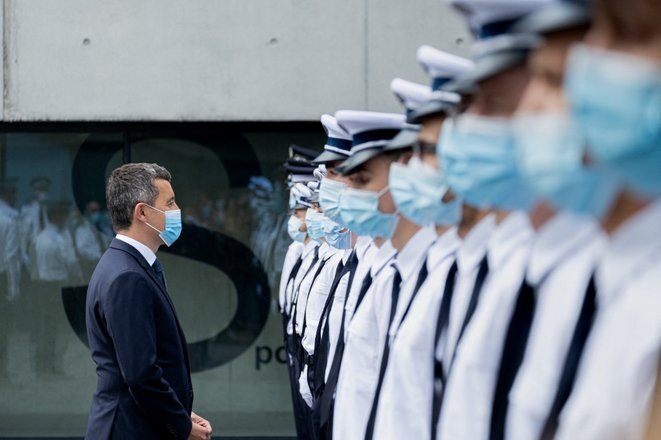
The French Republic should not be subject to the demands of the police. Yet this democratic principle is under challenge from the demonstration held by police officers on Wednesday, May 19th. Organisers of the protest in front of the National Assembly in Paris, which was supported by members of the current government, the far right and the two historic parties of the Left, are demanding minimum sentences for anyone found guilty of attacks on police officers. This undermines one of the key principles of the French Republic, that the police force is there to serve all citizens, and not to seek law changes in its own interest or the interests of the government of the day, argue Mediapart's publishing editor Edwy Plenel and political correspondent Ellen Salvi in this op-ed article.
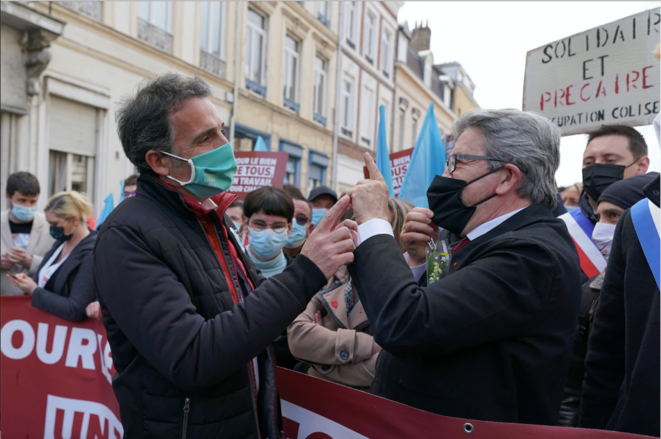
In just less than 12 months, France goes to the polls in presidential elections. On the Left, two distinct blocs are emerging, with separate policies and strategies, no common candidate and the prospect of a political crash. But could growing forecasts of a strong performance, and even victory, by the far-right yet force a union of the Left? Pauline Graulle reports.
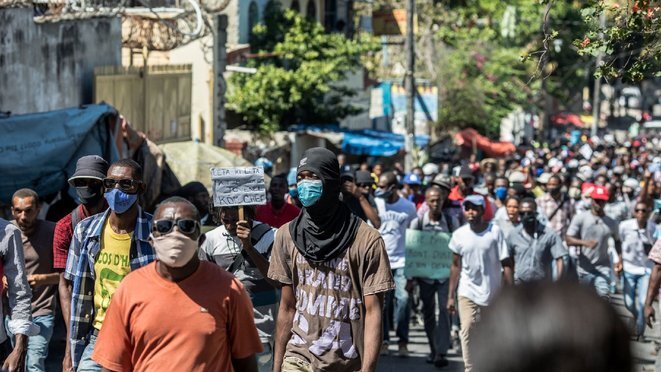
In Port-au-Prince, the capital of Haiti, a succession of massacres since 2018 by criminal gangs of inhabitants in several neighbourhoods is denounced by rights organisations as a strategy by the country’s deeply unpopular president, Jovenel Moïse, to terrorise the population into submission. François Bonnet reports on the horrific events, and interviews one of Haiti’s leading young writers, Jean D’Amérique, whose recently published novel, Soleil à coudre, centres on one such neighbourhood.