


“The Queen.” That is the writer Nicolas Mathieu's affectionate nickname for French author Annie Ernaux who has just been awarded the Nobel prize for literature. She is something of a mother figure or perhaps grandmother figure – she was born in 1940 – for a whole generation of artists who have emerged in recent years. The writer Édouard Louis, the singer Jeanne Cherhal and the director Audrey Diwan – who last year adapted Ernaux's novel 'L’Événement' for the cinema – all acknowledge the importance of her literary legacy to their own work. This is literature which, written in a deliberately modest form, hits the reader with real impact. It is a form of writing that marshals intimate details in order to unleash deep emotions and the hard-hitting force of political anger.
Ever since her first novel, 'Les Armoires Vides' ('Cleaned Out') in 1974, Annie Ernaux has used her own life as material for her books. In 'La Place' ('A Man's Place') - which won the Prix Renaudot literary award in 1984 – she evoked her childhood; in 'La Honte' ('Shame') in 1997 she looked back at how she abandoned her class – her parents ran a modest café-cum-grocery store at Yvetot in Normandy, while their daughter became a teacher who entered the world of the bourgeoisie and its social codes. Ernaux told the story of her youth and her sexual initiation - in the form of rape - in 'Mémoire de fille' ('A Girl's Story') in 2016, and how she had a secret abortion in 'L’Événement' ('Happening') in 2000. As a wife and mother she reflected on her life as a woman confronted by male domination in 'La Femme Gélée' ('A Frozen Woman') in 1981, while some years later, in 1992, she recounted her experience of all-consuming passion in 'Passion Simple' ('Simple Passion').
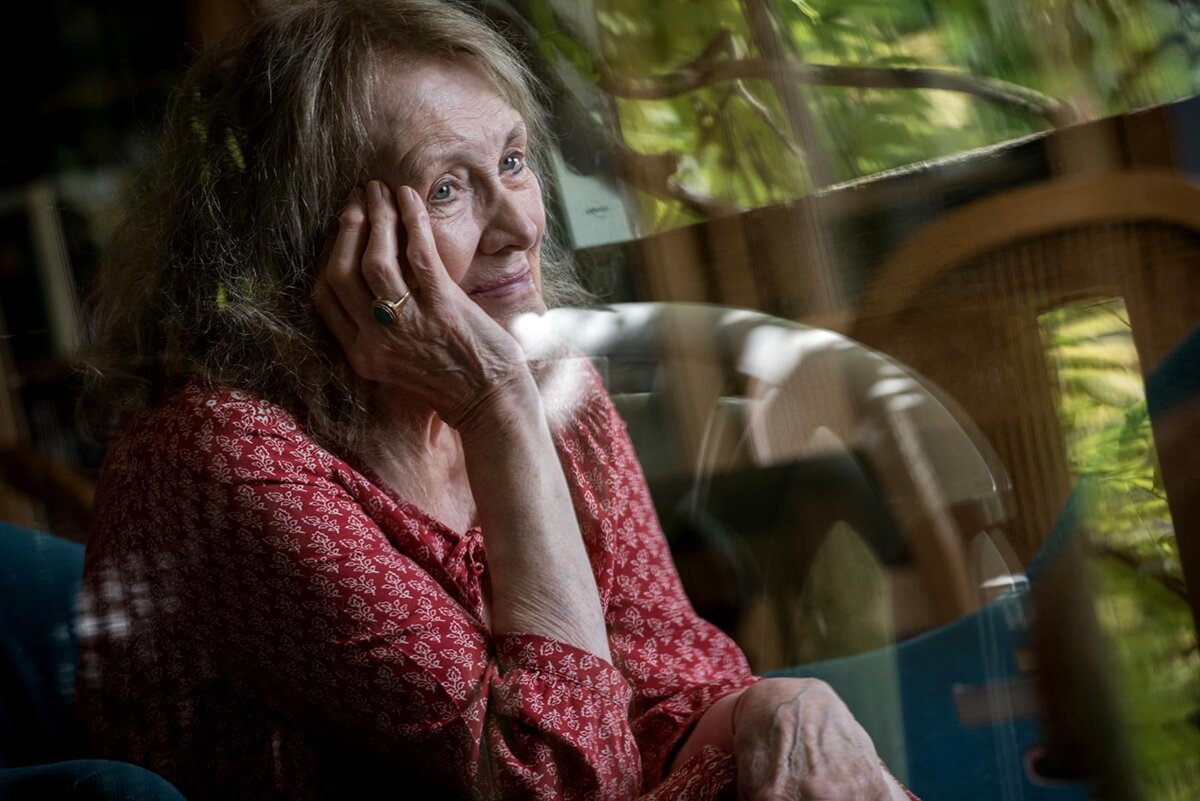
Enlargement : Illustration 1
So she created a space for a form of literature that dealt with what wasn't there, with experiences that were not spoken about, with opinions that were not considered worthy; it is life from the viewpoint of a woman, of going to the supermarket, of being able to love both the poet Paul Verlaine and the comedy actor André Bourvil.
As early as her first book, 'Les Armoires Vides', she has the young female literature student who is studying traditional French authors say: “Working on an author from the syllabus perhaps, Victor Hugo or [poet Charles] Péguy. How nauseating. There's nothing in them for me, about my situation, not a single passage that describes how I feel now, to help me get through difficult moments. There are certainly lots of prayers for all occasions, births, marriages, death throes, one should be able to find something for everything, for a young woman of twenty who went to a backstreet abortionist, who comes through it, about what she's thinking as she walks, as she throws herself on her bed. I'd read and reread it. Books are silent about all that. A lovely description of a probe [editor's note, a probe fitted to induce the abortion], the transfiguration of a probe...”
Major writing in a minor mode
Her patiently constructed work, which can pick up on the same episode from one book to another, tells the story of a life which is also an impersonal story. She does this in 'Les Années' ('The Years'), published in 2008, by weaving together an evocation of photographs of herself with the memory of objects and of words that belong to the collective memory.
If Annie Ernaux uses a form of writing that she herself describes as “unadorned”, it's because she comes from a world where “you never mistook one word for another”. She wrote in 'La Place': “An unadorned style comes naturally to me, it's the same style as I used in the past when writing to my parents to tell them essential news.”
This writing, which may appear minor in nature, has long been acknowledged as major in literary terms: Annie Ernaux's works have been translated in many countries, some of her books are on the school syllabus, and many articles have been written about her. In the spring of this year a lengthy collection of articles devoted to the author were published as part of the well-known Cahiers de l'Herne series. For the last two years British bookmakers have made her one of the favourites to win the Nobel prize. And now 'The Queen' has indeed done just that and won global recognition.
This is cause for celebration. The Nobel prize for literature has been bestowed on just sixteen women since its creation in 1901 and one imagines that the committee, which was hit by an awful #MeToo scandal in 2018, now wants to make a serious contribution to building a global female legacy in literature.
It is also worth noting that for the third time in fifteen years this Nobel prize has gone to a French language writer (after Jean-Marie Gustave Le Clézio in 2008 and Patrick Modiano in 2014) from which one can conclude that French literature is doing well (awards also act as thermometers). Since the announcement on Thursday it appears that bookshops, which have been suffering badly recently, have been celebrating an award which promises an uplift in interest in books.
Finally, one can only be happy to hear Annie Ernaux, who has always made clear her allegiance to the far-left, declare during a press conference at her publishers Gallimard on Thursday that this prize places a “responsibility” on her. She promised to “continue the fight against injustice” in all its forms.
A preoccupation with movement
But in acclaiming Annie Ernaux's work in this way, the Nobel prize has also shaken a particular conception of literation. Clearly this decision will not cause the kind of scandal provoked when the prize was awarded to the singer Bob Dylan in 2016. On the contrary, it seems to follow in the line of past awards for what can be termed documentary literature or investigative literature, for example the prizes given to Patrick Modiano in 2014 and the Belarusian journalist Svetlana Alexievich in 2015.
But the explosive nature of Annie Ernaux's writings has to be acknowledged. In one interview the author declared: “What I also want to destroy is literature, otherwise I wouldn't write!” In 'Une Femme' ('A Woman's Story') published in 1988, the writer describes her mother's life and explains: “My project is by its nature a literary one, as it's about seeking a truth about my mother than can only be attained by words. (That's to say, photos, my memories or family accounts can't give me this truth.) But in a certain way I want to remain below literature.”
The Nobel prize is thus consecrating – like a monument – a body of work which shows a constant preoccupation with movement. These are the works of a writer who never finds her niche: because of her social origins, because of her life as a woman in a patriarchal world. And this year, too, is no different; her latest book, 'Le Jeune Homme' ('The Young Man'), is seen from the viewpoint of an ageing woman who looks back over the relationship she had with a man thirty years her junior.
One might think that all bodies of work that win the Nobel prize run the risk of becoming turned into a form of living monument. But that is not the case: there are some works which already have a statuesque, ceremonial, heroic feel, something which is very well adapted to novelistic pride.
In contrast, everything about Annie Ernaux's books falls short of or even runs contrary to such pretensions. With precision she undermines the entire literary paraphernalia and rejects the novel as a form. “A life [depicted] in a novelistic narrative is a fake,” she wrote in 'L'Atelier Noir' ('The Dark Studio') in 2011. Furthermore, she had her book 'La Femme gelée' ('A Frozen Woman') reclassified under the category 'true accounts' when it was later published in paperback.
More broadly, she declines to categorise her books under any genre: they are not fiction, but nor are they autobiography or self-fiction either. These books fluctuate between a first person “I” that she wants to be impersonal (the first person has “something narrow and stifling about it” she has said), the third person “she” and sometimes even “one” or “we”. In a collection of interviews called 'L’écriture comme un couteau' ('Writing as sharp as a knife') published in 2003 she said: “It's less about saying 'me' or 'finding oneself' than about getting lost in a larger reality, a culture, social status, pain, etc.”
But she also rejects tidy chronological narratives: investigative writing allows her to turn her back on well-ordered accounts that use facts in a linear logic with the author peering down on them from on high. In 'Passion Simple' she warns the reader: “I'm not narrating a relationship, I'm not telling a story (half of which escapes me) with a precise chronology.”
In the end, she avoids the easy option of beautiful prose. “It seems to me that I'm always seeking to write in that worldly language of then and not using words and syntax that I didn't have at that time, that I would not have had then. I will never know the magic of metaphors, the jubilation of style,” she wrote in 'La Honte'.
Extreme literature
But this rejection does not mean she is laying herself bare, like some form of exercise in humility, as women have long been encouraged to do. On the contrary, it represents a triumph. It is a costly triumph, won on the back of shame; social shame, the shame of being a woman who may have suffered but who knows the glory of truth. The implication is that she was marked by this, in other words she was sensitive to “what the world impressed on her and her contemporaries”, as she wrote in 'Les Années'. But that she was never cowed.
Annie Ernaux is a writer who strives to be herself. In 'L'Occupation' ('The Possession') in 2002 she wrote: “The dignity or lack of dignity of my behaviour, of my desires, is not a question that I asked myself at that time, any more than I ask it now when writing about it here. I have come to believe that this absence is the price paid to be more certain of getting to the truth.”
It is a form of extreme literature. In 'L’Événement', which looks back on her abortion, Annie Ernaux writes that the young woman that she then was wanted to go “right to the end, whatever happened”. But it is also part of her pride as a writer that she goes “where others would never envisage going”. She compares this to the pride felt by solo sailors, people on drugs and thieves.
Annie Ernaux emphasises this principle in her latest book, 'Le Jeune Homme': “If I don't write them, things have not reached their conclusion, they have only been experienced.” With this Nobel prize, Annie Ernaux now has some new endings to write; and one is eager to read what comes next.
--------------------------------------------------------------------------
- The original French version of this article can be read here.
English version by Michael Streeter